
Ke’Bryan Hayes Needs a Bat Path Fix
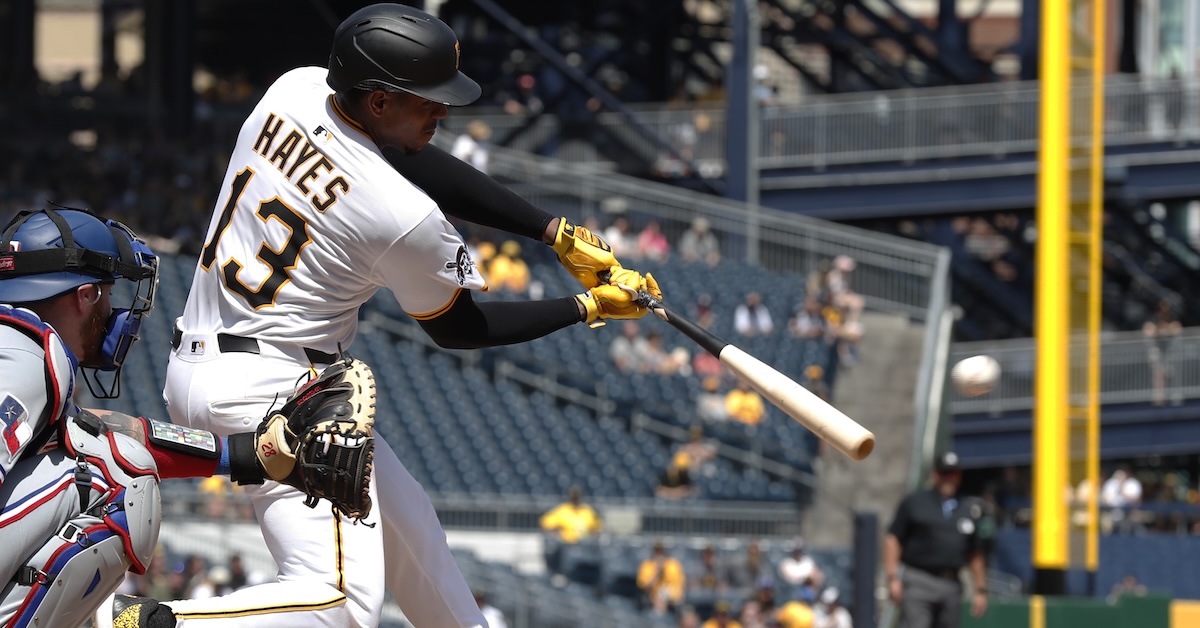
Since 2021, Ke’Bryan Hayes is the leader in OAA among all infielders. As one of the best defenders in the sport, his floor is very high. Even with his career 87 wRC+, he has still been worth about 3 WAR per 162 games. If he could be a consistently average offensive player, he’d be one of the most valuable players at his position. This is a story we all know. With his name swirling in trade rumors, you have to imagine other teams are thinking about the possibility more so now than in the past. His issues stem from his suboptimal swing path, and if he’s traded, that will be what his new hitting coach tries to fix.
In the last calendar year (459 plate appearances), Hayes has a 60 wRC+. That is bad! But despite those struggles, it’s not like he is completely lacking offensive ability. His bat speed is only a little below average. His strikeout and whiff rates are better than league average over the past three seasons. He hits the ball hard more often than not, and he chases at about an average rate. Those are all things you could work with if you’re trying to manufacture a league average hitter. But if you’re doing all this and your path is rarely working in an ideal direction, you’ll always have limitations on what you do when you actually make contact.
Some of the key batted ball metrics that summarize Hayes as a hitter are his second-percentile pulled fly ball rate, his 11th-percentile groundball rate, and sixth-percentile Sweet-Spot%. My initial reaction when looking at each of these metrics is that Hayes must be getting handcuffed and making contact way too deep in the zone (or deep relative to his center of mass). If you can’t keep the ball off the ground, this is a logical estimation. But interestingly enough, he’s actually 34th out of 219 qualified hitters this year when it comes to point of contact versus center of mass. Before explaining exactly how that oddity can happen, we have to check out Baseball Savant’s bat path highlighter. It’s easiest to understand by seeing for yourself:
Notice anything specific? Pay attention to the overlay of his bat once the downswing gets going. It takes an incredibly long time for him to get his bat sloping on an upward plane that matches the angle of the pitch. If you’re constantly working through a negative attack angle, then it’s going to take you more time and space to get to a positive one. In other words, the only ideal contact point he has to get any lift is way out in front of the plate. If he had a positive slope earlier on, he’d have more room for error. The next clip shows the same phase as above but with an arrow that guides you through the process of his attack angle.
Same thing here: That arrow is pointing downward for most of the swing. The best hitters in the league either match the plane early (think a contact hitter with a flatter swing) or work from a positive angle very early on (think a guy with light tower power). A swing that takes as long as Hayes’ does to match planes is going to generate a ton of groundballs.
OK, now that I’ve framed his swing, I want to show you a similar hitter with an identical average attack angle (five degrees) on the season whom I think is a reasonable comparison to Hayes, albeit with better performance: Alec Bohm. Like Hayes, Bohm’s bat speed is slightly below average, and he has the same attack angle; the difference is Bohm has managed a 102 wRC+ over the course of his career. Why is that? Well, let’s look at the same phase of his swing with the arrow highlighting the progression of his attack angle:
He gets to a neutral angle earlier in his swing. Most of that is related to how his hands make their entry into the hitting zone. His hands start behind his center of mass and then work through the plane of the ball. Don’t get me wrong, he doesn’t have the greatest bat path – that’s exactly why I’m referencing him – but unlike Hayes, Bohm doesn’t have a hitch that disrupts the plane his hands and barrel are moving on. I know it might be a little difficult to see that, so I’ve put two screenshots below of the moment where each player gets to a zero-degree attack angle:
Bohm
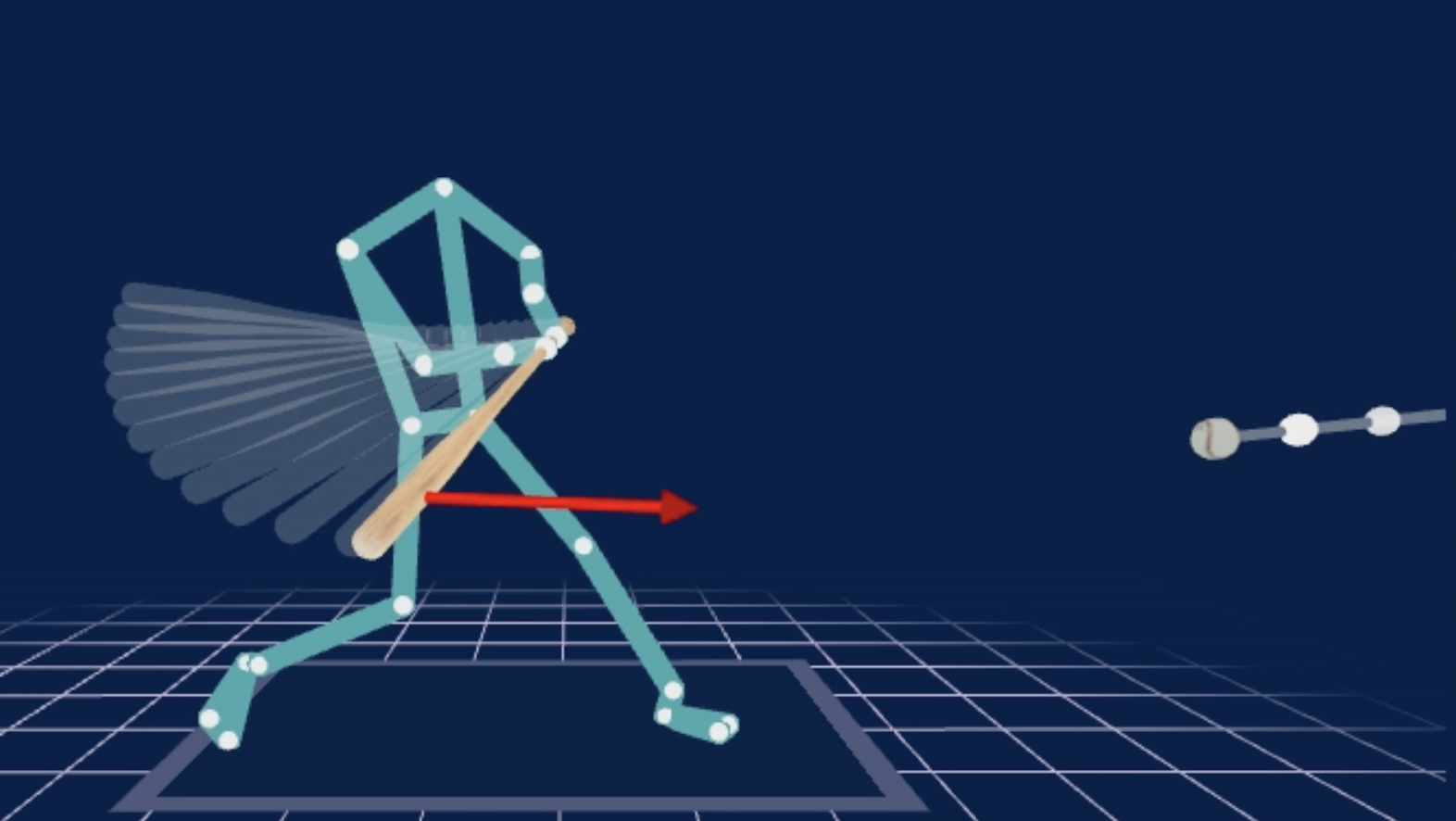
Hayes
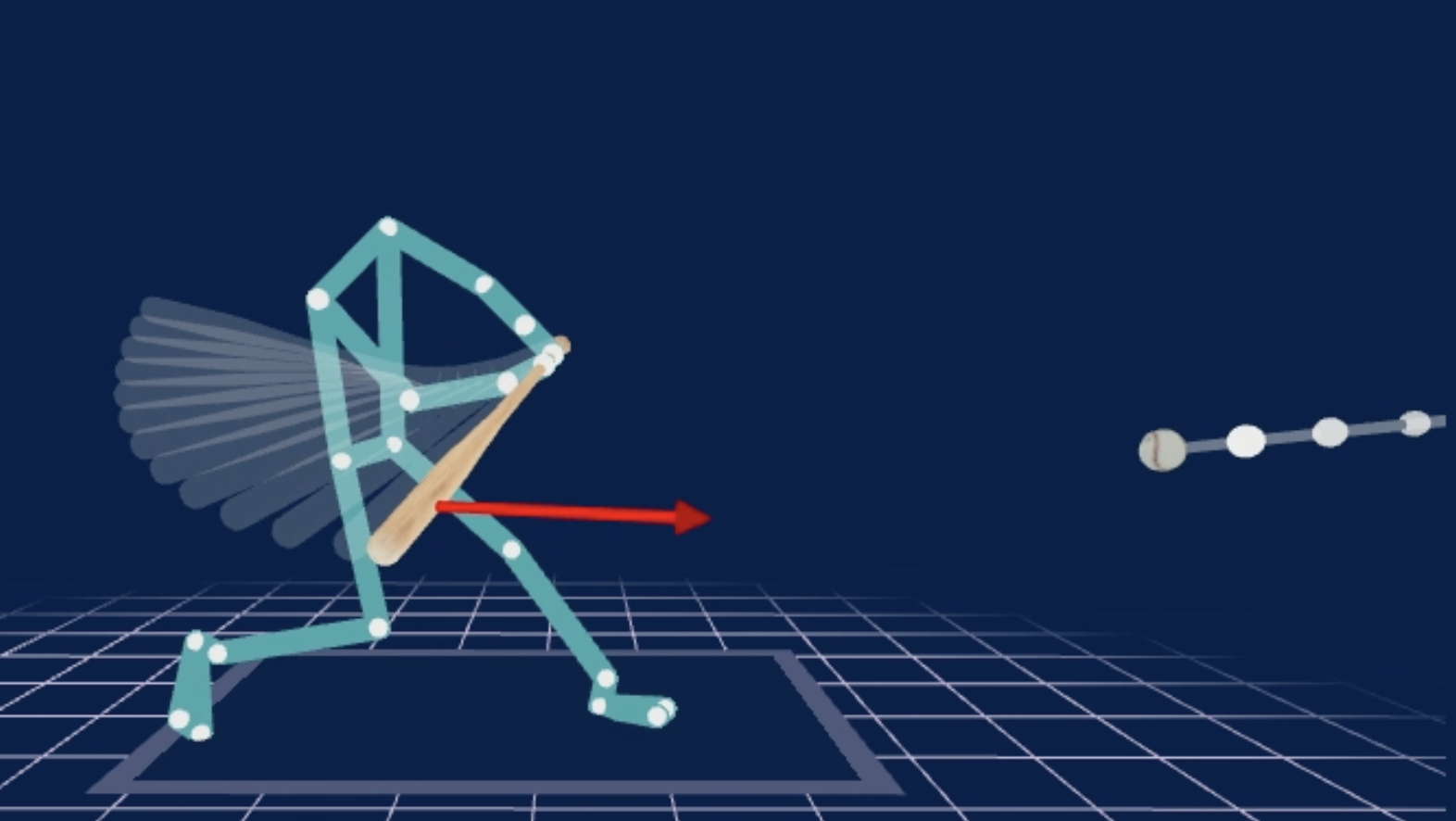
The small dots over each joint are incredibly helpful here. Bohm is getting to a neutral plane closer to his back hip, while Hayes’ bat is completely ahead of his center of mass, meaning he gets on plane later in his swing. That narrow difference between them is enough to give Bohm more room for error to create launch at different depths in the strike zone. And as I said, it’s not like Bohm has one of the best paths in the game. He’s a league average hitter with a contact and gap-to-gap profile. If Hayes was to model his ideal game, it’d look something like Bohm’s.
Now that the diagnosis is in place, it’s time to decide on where Hayes should target adjusting within his swing. Let’s continue to focus on Hayes’ first move with his hands:
His knob is on a diagonal line downward for almost the entirety of this phase of the swing. Typically, when a hitter has their initial entry into the slot from where they want to fire, the knob of their barrel either straightens out or starts working upward. Hayes’ works down. That is what old-school folks have always referred to as a pushy swing. His hands are pushing forward too early relative to when he rotates. It’s very difficult for him to get his barrel under the ball with any variability.
Adjusting out of this can go in a few directions. One simple option is to start with his hands lower relative to where they are now so that he can’t push down when he starts swinging. Though if he feels comfortable in the higher slot, he could also remove the verticality of his barrel during his stance and bat comb, because right now, he isn’t able to flip the angle of his barrel fast enough to get on plane in time. Here’s a quick GIF of him in his setup and row to show you what I mean:
There’s a lot of a movement going on, and that’s how his barrel gets on plane. This is more of a philosophical concept, but when a hitter has a flatter swing (lower tilt, lower attack angle, etc), I have trouble understanding why they wouldn’t also start flatter during their stance or their row. By starting vertically and trying to flatten out, you’re throwing your body’s rotation off the natural path it wants to move on. There’s a reason why not a lot of hitters can swing like Ronald Acuña Jr. It’s just difficult to repeat. When in doubt, you might as well simplify things as much as possible.
If the Pirates decide to trade Hayes, the team that acquires him should suggest at least one of the changes I prescribed above to fix his bat path, and he should fully embrace it. There is a lot of room for growth here, he just needs to put himself in a better position for success.
Esteban is a contributing writer at FanGraphs. One of his main hobbies is taking dry hacks every time he sees a bat.
This was excellent.
You have not talked about his real problem, he has a bad back. He can’t get his hands and bat into the proper position because of it.
Funny how the bad back doesn’t prevent him being a plus fielder or plus on the bases.
Which part of the two tasks you mentioned rely on high-stress, explosive rotation around his spine?
Throwing
3B isn’t exactly fly RF when it comes to the throwing motion’s stress on your back,
Throwing from 3b generally doesn’t place anywhere near the torque on your spine that hitting does. A ton of the work done in throwing from that position is generated by the forearm and the wrist explosion generating carry. Watch Machado and Arenado for good examples. It’s why you can see catchers and 3b actually make laser throws from their knees.
I’m amazed at the downvotes on this comment.
As a Pirates fan, this makes me sad. It’s like there is something in the water that prevents any sort of meaningful hitter improvements in their entire system. A small part of me hopes someone in their organization reads this article (perhaps Hayes himself?) and it leads to a meaningful swing change before another organization MUCH more adept at developing hitters buys him for pennies on the dollar and completely transforms him.
If you go back and read the Athletic article about Ke Hayes getting help from his old minor league coach Jon Nunnally who the team then fired you’ll see mention of Head of Methodology – Coaching and Player Development Bart Hanegraaff who has absolutely zero prior experience coaching in MLB. He’s still in that role and the hitting is still bottom of the league.
the coaches don’t have the money to spend the time.
I’m just glad they aren’t still trying to convert every single pitcher (Cole, Glasnow to name a few) into sinkerballer, contact-oriented types (at least I don’t think they’re doing that anymore). The brief ‘success’ that former pitching coach Ray Searage had with this approach wasted the youths of Cole, Glasnow, Musgrove, etc. Thankfully he can’t sink his outdated paws into Skenes!
When Searage was asked why Cole was running roughshod over the AL almost immediately post trade, he said it was “because Cole didn’t have to be The Guy in that rotation.” When I read that, I was firmly out on that management team. The NH Pirates knew how to get something out of a decent pitcher who was struggling and make him productive. When given immensely talented arms like Glasnow and Cole, they were out of their element.
Skenes and hayes for clark, rainer, mcgonigle
This was a great article. Thanks
cool article!
Stating the obvious. hopefully he is traded to a team that can fix him.
I mean people have been writing this about him since he debuted in the majors. This is a more detailed version of that but some people can’t change their swing. This was why the so called “swing change revolution” couldn’t be a one size fits all. Muscle memory is weird, a lot of these guys when they changed one thing everything else changed too and they couldn’t swing at all.
I think it’s worth a swap of bad contracts but with his ongoing injury issues and how hard it is to get someone to change their swing I certainly wouldn’t be excited about taking him on. If they’d be willing to swap him for Masataka Yoshida, for example. Which I am pretty sure the Pirates wouldn’t want to do.
I agree. If he could have changed his swing I would think that he would have done it by now.
I am a Pirates fan as well and always liked Hayes. We just keep waiting for him to increase his launch angle and it hasn’t happened. Maybe he needs a change of scenery or a different voice to unlock the potential.
I don’t think any team should think they can fix his swing. Or stay healthy. If he does one or both of those things it would be really exciting, but if I had to assign a probability to either one happening I would say somewhere in the 15% range (each).
& even more importantly, what is he worth? 1.8bWAR in his last 700+ PA’s (2024-25).
I’m a Tiger fan & I keep hearing these trade rumors of him to Detroit & I can’t figure out A) Why they would do that when McKinstry is a borderline AS 3B & they have guys coming in a year or 2 & B) What is a fair trade for Hayes?
Yes, he has a long term contract that is very low in cost..However, if he keeps running a 60wRC+, he’s borderline unplayable if you’re trying to win & now you have a guy for 5 years that possibly just can’t hit.
I think he has something like $80M left on his contract and if he really does have a chronic back issue I would guess it is $70M underwater. You can’t take a guy on like that and expect for him to give you anything.
Even without the back injury his contract is still probably $50M underwater. I don’t know that anyone would pay more than $30M for an 85 wRC+ slam dunk gold glover at third. Teams still want something closer to league average offense at third even if his defense is super valuable on paper.
His contract isn’t that high. It’s:
$7M for 2026 & 2027
$8M for 2028 & 2029
$12M team option for 2030 with a $6M buyout.
Basically, 4 yrs for $36M or 5 yrs for $42M
Still not sure if there is any surplus value there or not.
Guess if you got him for some low-level prospects (40-40+ types), you could take a swing at it..but, there’s a decent you’re going to end up eating $20-30M.
Yeah, Hayes is not that expensive (same guarantee for four years as Yoshida has for two) and provides some value if you believe in defensive numbers. But his bat is hard to carry.
One thing is that he did get his bat to average in 2023, and had increased his launch angle that year (his launch angle is also up this year but not as much). Looking at his ’23 swing path metrics* I don’t see much radically different from this year–except that his bat speed is 1.3 mph slower. Tilt 29 vs. 27, attack angle 6 vs. 5, attack direction 2 pull vs. 2 opp. But if he’s having to swing slower to maintain the same path, and the path isn’t even that great, that’s a problem.
*According to Savant this only covers the second half of ’23, but he hit much better in that half than the first.
I must have read the wrong line on Roster Resource. In that case I would be willing to consider taking something like a third of that contract and send back some autographed baseballs in return.
Based on the swing, I think Hayes is far too concerned with generating power from his hands. Basically, he’s a handsy hitter, which is a more old-school way of thinking about hitting. He’d probably benefit from a hitting coach who can convince him that the hands are simply the end point of a swing, and that generating swing speed through your lower half and rotation will lead to better results.
He’s been a frustrating hitter his whole career, so I don’t chalk it all up to the back, but this specific piece of advice seems terrible for a guy who’s missed months at a time for a bad back.
This is a great article. One thing that I would be interested in seeing (understanding the swing data is new, so it may not be available) is what has changed over time. I think every year, there has been talk of Ke’Bryan changing his swing. He added a kick, then changed it to a toe-tap. He raised his hands. He lowered his hands.
Do we see evidence of those changes? Did any of those changes change the swing plane? Were there any other consequences of those changes (less contact? More torque, which exacerbated his back issues)? In other words, has anything already been tried, and if so, why didn’t it work?
i know it wont happen, but i want the angels to trade for him. a defensive anchor there would work wonders and cement the IF and maybe we can show him to hit home runs (and strikeout a lot)
Does anyone care about this online rando’s success in slow pitch softball? Probably not. BUT. I made the exact same adjustment (lowered my hands during my load) and basically all my hard contact is now elevated and much higher quality than the grounders and knee height liners I was hitting. If I, generally an idiot and non athlete, can identify and address this issue in my own game then one hopes that a major league team could approximate the same.
This online rando that hits a great many grounders and knee height liners in his slow pitch softball league is quite interested in hearing how you fixed that issue
Where are your hands during your load? Mine were high and I realized it was causing me to swing down on the ball, which is an even worse habit in slow pitch than real baseball considering the arc of the ball. I stopped holding my hands at shoulder level and started holding them at rib level while I wait for the pitch.
Also I started incorporating a reasonably high leg kick to keep my timing synced together, previously I was striding way too early causing my hips to fly open
Generally lowering your hands has the result you mentioned. Hayes absolutely should lower his hands.
It’s how I fixed my swing in Babe Ruth, only to have it ruined again by my HS coach.
Now that I’m playing beer league, my load is below my shoulders with my hands cocked…and I spray line drives.
Even if this isn’t actually a fix for Hayes, and I am generally of the opinion that a swing change would have happened if it would work, this is one of the most process informative articles I’ve read on this site. Truly fantastic work.
Doesn’t help that when the Pirates do get a guy to change his swing, the results… vary (see: Suwinski, Jack – there’s someone else I’d like to see in a different org)
There was a time in the second half of 2023 where it seemed like Hayes had finally figured out hitting. Have you taken a look at his bat path/swing mechanics from that specific time period to see if there are any differences?
See formerly matt w’s comment above: fairly similar, but with more bat speed. Whether the lost speed is from bad back or bad habits, it would be enough to get the bat to the right place on time and, obviously, improve EV.
Fantastic article and graphics.
This is a great article, but I have to say the Bohm v Hayes swing comparison is very very subtle to my untrained eye.
I agree, but the author did a good job of explaining what we were seeing, including the matching stills.
I assume anybody could develop an eye for this if you watched enough of them. I just smile and nod.
A year ago, even a few months ago, I would have been happy if my Nats traded for Hayes and tried to fix him. But, now we have a very similar guy in Brady House. All glove and a few singles. Hayes is a better defender, but not much. House is a slightly better hitter, but not much.