
Marlins Continue to Improve With Dickerson Addition
The Marlins have spent this offseason quietly adding a number of high-upside veterans on the cheap. They’ve traded for Jonathan Villar after Baltimore unceremoniously dumped him, claimed Jesús Aguilar on waivers, and added Francisco Cervelli on a one-year contract worth just $2 million. They continued to upgrade their roster just after Christmas, signing Corey Dickerson to a two-year deal worth $17.5 million.
The left-handed outfielder fills a big need on the Marlins roster. In 2019, Miami utilized the uninspiring trio of Harold Ramirez, Curtis Granderson, and Austin Dean for the lion’s share of the innings in left field. They collectively cost the Marlins 1.7 wins, with just Ramirez rating above replacement level. For a rebuilding club, this isn’t necessarily concerning or surprising. In Dean and Ramirez, the Marlins were simply looking to see if either minor league veteran could make it in the big leagues, and Granderson was a classic clubhouse veteran playing out the last days of a long career.
But with the Marlins looking to break free from their endless rebuilding phase, adding Dickerson is a savvy move. He immediately upgrades their outfield and provides the club with a much-needed left-handed bat in the lineup. Since his debut in 2013 for the Rockies, he’s posted a 117 wRC+ and 11.5 WAR. After a good start to his career in Colorado, a strikeout problem and getting traded away from the Rays forced him to make some changes to his approach in 2018. In Pittsburgh, he started choking up regularly in an effort to make much more contact. The adjustments worked and he cut his strikeout rate by almost 10 points.
However, an unfortunate side effect of this contact-oriented adjustment was a significant drop in power; he posted a career-low .175 ISO in 2018. Even though his strikeout problem was seemingly fixed, he needed to find some middle ground to leverage both his power and strong bat-to-ball skills. Despite a season marked by a couple of significant injuries, he found that middle ground in 2019. His pushed his ISO up to .262, a career high, and even though his strikeout rate jumped up to 20%, it was still below where it was previously. The key was selectively finding moments to choke up when a high-contact approach was beneficial instead of using it in almost every situation like he did in 2018. That allowed him to use his full swing when the count or situation was in his favor.
In this at-bat from early 2019, Dickerson isn’t choked up in a hitter’s count and he’s able to crush a 95-mph fastball on the inside corner for a home run.
But when he was behind in the count, Dickerson would often switch back to choking up on the bat to help him make contact more often. In this June at-bat, he uses this high-contact approach to catch up to a high fastball, a pitch that he had struggled with back in 2017 before making his adjustments.
A strained shoulder suffered during the first week of the season and a fractured foot in September held him to just 279 plate appearances last season. If he’s able to carry over the adjustments he made last year, he should have no problem outperforming his rather pessimistic Steamer projection of a 102 wRC+.
Defensively, he hasn’t been nearly as consistent. He won a Gold Glove for his work in left field in 2018, and the advanced defensive metrics backed up the award committee’s decision. He saved 16 runs per DRS, 8.6 runs per UZR, and was 10 outs above average according to Statcast. But that sterling defense in one season seems like an outlier based on his previous career norms.
| Year | DRS | UZR | OAA | Reaction | Burst | Route |
|---|---|---|---|---|---|---|
| 2016 | 2 | 2.0 | -5 | 1.5 | 0.2 | -0.4 |
| 2017 | -1 | 2.5 | -2 | 1.7 | 1.5 | -0.2 |
| 2018 | 16 | 8.6 | 10 | 1.2 | 0.8 | 0.2 |
| 2019 | -6 | -4.7 | 0 | 0.5 | -0.8 | 0.5 |
Dickerson has always had good reaction times, and his initial burst was great in 2017 and 2018. His sprint speed hasn’t changed significantly over the last four years, but he just wasn’t able to get up to that speed as quickly in 2019. It’s also possible that his positioning helped him be so successful in 2018. Here are a couple of heat maps from Baseball Savant showing a sample of initial fielding positions for the Pirates in 2018 and 2019.
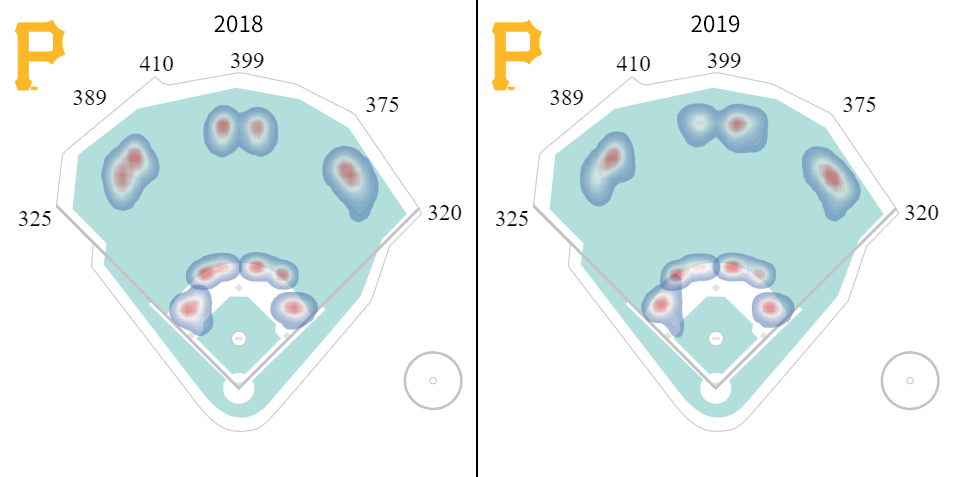
It looks like the Pirates were far more aggressive in adjusting Dickerson’s position in left field in 2018 based on the spray tendencies of the batter. Since Dickerson was injured so early in the season, it’s possible the club was less aggressive in moving their left fielders around in 2019 because they didn’t want to overwhelm rookie Bryan Reynolds when he was called up to cover for Dickerson. The Marlins are also fairly aggressive when it comes to moving their fielders around. They employed a shift of some sort over a third of the time last year, the fifth-most in the majors. With that in mind, Dickerson could see a boost in defensive efficiency as long as he’s able to maintain his underlying skills.
With a consistently solid bat and above-average, if inconsistent, defensive skills, it’s remarkable that the Marlins were able to add Dickerson on such an affordable contract. If we compare him to some of the other free agent outfielders available on the market, his career numbers don’t really fall short.
| Player | Age | PA | K% | BB% | ISO | wRC+ | UZR/150 |
|---|---|---|---|---|---|---|---|
| Corey Dickerson | 30 | 2914 | 21.3% | 5.8% | 0.218 | 117 | 0.5 |
| Marcell Ozuna | 29 | 3861 | 21.1% | 7.5% | 0.183 | 112 | 4.7 |
| Nicholas Castellanos | 27 | 3646 | 23.0% | 6.4% | 0.194 | 112 | -11.6 |
| Yasiel Puig | 29 | 3376 | 20.2% | 8.8% | 0.198 | 124 | 2.6 |
All four of these outfielders debuted in 2013 — Castellanos had a tiny 18-PA cup of coffee — which makes comparing their career totals rather convenient. Despite being the oldest in this group, Dickerson’s career numbers are on par or better than the three other big name free agent outfielders. Ozuna and Castellanos are rumored to be looking for four-year deals worth far more than what Dickerson commanded. His recent injuries are a potential concern and he’s on the wrong side of 30, but he looks like a downright steal for Miami.
Jake Mailhot is a contributor to FanGraphs. A long-suffering Mariners fan, he also writes about them for Lookout Landing. Follow him on BlueSky @jakemailhot.
Miami has indeed made a few nice moves this offseason.
And speaking of the Marlins, I don’t think that CEO and soon-to-be Hall Of Famer Derek Jeter has received enough attention for the attendance boost in Miami from 2018 to 2019. Specifically, the fish improved the head count from 811,104 all the way to 811,302. At that rate of growth they’ll top three million fans in just over eleven thousand more years.
Your handle is excellent and your point is also excellent.
I’m still kinda floored by the lack of trade response in Villar. The guy is a switch-hitter who can play everywhere, has power, speed, not overly expensive. I think the Fish have done better than most teams this year and now they might have a sneaky good team that could maybe push .500 or more.
I think .500 is a stretch. Maybe push .450
An Outside chance at .500 is not unfathomable. The young pitching should improve overall, The question is really how much, and the hitting should be much better.
As strong as the division is and as weak as the Marlins are in a lot of areas they’re not getting to .500 this yea imo. They had a 352 winning percentage last year and lost 105 games. I think they’ve made solid moves but they’re likely to lose 90+ games.
The depth charts currently project at 21.1 fWAR, which would be 69.8 wins. I’m feeling generous today, call it 70.
Figuring 1 standard deviation at 7 wins, then I get .500 or better at a 7% chance.
I suppose if you are on board with the depth charts, that .500+ meets what most people would call an “outside chance”.
I get:
60+ wins 93%
65+ wins 78%
70+ wins 52%
75+ wins 26%
80+ wins 8.7%
85+ wins 2.0%
90+ wins 0.3%
95+ wins 0.02%
I’ll say 93-94 loses instead of 105 like last year they’ve had a good offseason but they’ve got a very steep climb
The Marlins are probably the third-worst team in baseball, behind the Orioles and Tigers and ahead of the Mariners and Royals. Stating that they have a shot to get to .500 is really more of a statement about how anything can happen. This is a bad team, and Corey Dickerson and Jonathan Villar serve to make the team less awful rather than “average.”
Seems odd to call Ramirez and Dean minor league veterans, when they were 24 and 25 last season. I don’t think they were just testing out milb players, as both those guys made their respective clubs top prospect lists as recently a one to two years ago. I am pretty sure they were trying to see what they could do at the major league level. While neither was good, they aren’t exactly throwaways yet either.
I wonder if the Phillies will ever give the Pirates the PTBNL for Dickerson …
Crash Davis is looking for work
Still loving the Marlins offseason.
There is a reason the man’s nickname is Big Swingin’ Dickerson. Hopefully this is the year he doesn’t hurt his back, shoulder or oblique swinging as hard as he can every pitch. Fun player to follow and nobody gets hotter. Or colder.