
MLB Teams with the Most Dead Money in 2019
Sunk costs are difficult for all of us. We might keep a gym membership longer than we should hoping to get some value out of it despite not going for months. We might finish a meal that was terrible from the start because we cooked it or paid for it. We finish movies and books we know we will not enjoy. Once some of our money or time has been spent, there is a pull to keep spending or wasting that time and potential enjoyment because we’ve already started. Sometimes, baseball teams are just like us. Once a big contract is handed out, teams feel compelled to continue to provide playing time past the point of utility or give a roster spot to a player whose play doesn’t merit it. That’s not always the case, though. Sometimes teams move on, and when they do, they end up with dead money on their payroll.
This is my fourth year tracking dead money on payrolls and while the amount fluctuated greatly from 2016 to 2017, going from under $150 million to $300 million, last year it was back around $200 million, and it remains the same this season. As to what counts as dead money, this is what I said in last year’s post:
Dead money is generally any money a team is paying out to a player who no longer appears on their 40-man roster. There are three types of dead money:
-
Money paid to players who have been released. Those players are free to sign with other teams, but the team releasing the player still owes the money remaining on the contract.
-
Money paid to other teams as compensation for players who have been traded. Generally, we see teams cover a portion of a contract to receive a better return in trade.
-
Money paid to players who are still in the organization, but who have been removed from the 40-man roster. Any team could have claimed these players if they were willing to take on the contract, and the player probably could have elected fee agency, but then he would forfeit his right to the guaranteed money.
While Jacoby Ellsbury’s salary sits on the Yankees payroll with no expected contribution, that money is only mostly dead. As far as which team has the most money this season, that honor, or dishonor, goes to the Los Angeles Dodgers. These numbers were compiled from Cot’s Contracts.
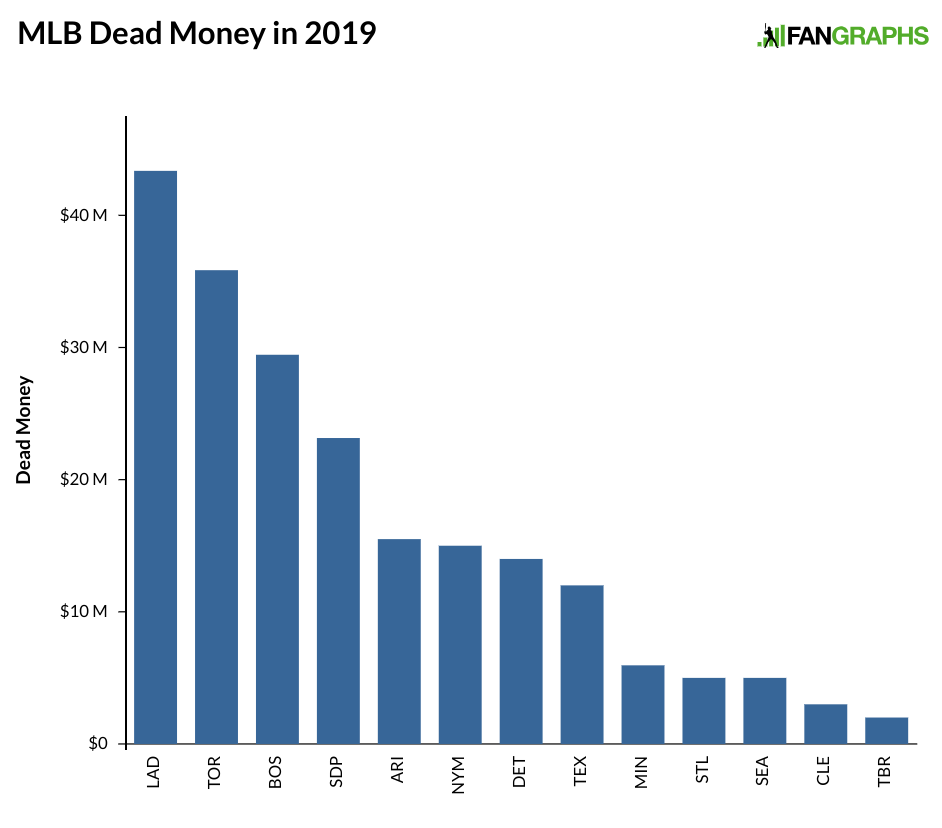
The Dodgers have been first or second on this list every year I’ve done this exercise, spending close to $140 million since 2016 on players not on their roster. This year’s big expenditure comes in the form of Homer Bailey, who the team acquired from the Reds in order to move Matt Kemp’s contract as well as acquire a few prospects in the deal that sent Yasiel Puig and Alex Wood to Cincinnati. The Blue Jays come in just behind the Dodgers as the team that decided to cut bait with the oft-injured Troy Tulowitzki as well as trade Russell Martin to the Dodgers. The moves by the Dodgers and Blue Jays illustrate contrasting styles when it comes to dead money on the roster. Los Angeles acquired Homer Bailey to drop him in a move designed to save tax space as they exchanged Kemp’s bad contract. For the Blue Jays, who are not expected to compete for the division this season, giving playing time and roster spots to aging veterans doesn’t help the club’s future as those resources can be better utilized by providing meaningful experience to younger players. Nearly one-third of Toronto’s payroll won’t even be on the team and the club’s on-field roster is set to make under $80 million this season.
Breaking the money down, here are the players who have been released by their teams.
| Player | Old Team | Current Team | Money Owed in 2019 |
|---|---|---|---|
| Homer Bailey | Dodgers | Royals | $23 M |
| Troy Tulowitzki | Blue Jays | Yankees | $19.45 M |
| Pablo Sandoval | Red Sox | Giants | $18.45 M |
| David Wright | Mets | None | $15 M |
| Prince Fielder | Rangers | None | $9 M |
| Phil Hughes | Padres | None | $7.25 M |
| Hector Olivera | Padres | None | $7.5 M |
| Austin Jackson | Rangers | None | $3 M |
| Dian Toscano | Dodgers | None | $200,000 |
In Prince Fielder’s case, the Tigers are paying some of his salary and a discount for insurance proceeds has been taken. It would be useful to do the same with David Wright, though those numbers are a bit more murky. We know that Wright restructured his contract with some deferrals so that he will make $9 million this year. It’s possible that insurance proceeds, estimated at $12 million by Ken Davidoff over the next two seasons might mean the Mets aren’t actually paying any money to Wright this season. The Padres essentially bought a draft pick by taking on some of Phil Hughes’ salary last year, while also taking on Olivera, who they immediately released, allowed them to get out from under Matt Kemp’s money.
As for trades, here are the players for whom teams are paying some or all of their salaries this season. There are a few repeat names from the list above.
| Player | Old Team | New Team | Money Sent for 2019 |
|---|---|---|---|
| Russell Martin | Blue Jays | Dodgers | $16.4 M |
| Matt Kemp | Dodgers | Padres and Reds | $10.5 M |
| Justin Verlander | Tigers | Astros | $8 M |
| Prince Fielder | Tigers | Rangers | $6 M |
| Phil Hughes | Twins | Padres | $5.95 M |
| Robinson Cano | Mariners | Mets | $5 M |
| Mike Leake | Cardinals | Mariners | $5 M |
| Jedd Gyorko | Padres | Cardinals | $5 M |
| Hector Olivera | Dodgers | Braves | $4.66 M |
| Edwin Encarnacion | Indians | Mariners | $3 M |
| Evan Longoria | Rays | Giants | $2 M |
| Clayton Richard | Padres | Blue Jays | $1.5 M |
Most of these deals are pretty straightforward, with the old team offsetting some salary to get a deal done or receive a better prospect return. The Edwin Encarnacion situation is a bit complicated. Cleveland and Seattle swapped Carlos Santana and Encarnacion with Seattle actually sending a couple million dollars to Cleveland for this season and $4 million next year. That was not the entirety of the deal; Tampa Bay sent $5 million to Seattle as part of the deal with Cleveland that sent Jake Bauers to the Indians for Yandy Diaz and Cole Sulser. It’s fair to think of that $5 million as shipped through Cleveland, which is how Encarnacion ends up with $3 million from Cleveland this season.
There are just a few more players with payroll qualifying for dead money.
| Player | Team | Money Owed in 2019 |
|---|---|---|
| Yasmany Tomas | Diamondbacks | $15.5 M |
| Rusney Castillo | Red Sox | $11 M |
| Yaisel Sierra | Dodgers | $5 M |
| Kazuhisa Makita | Padres | $1.9 M |
We have multiple, big contracts for Cuban players who haven’t quite worked out. Tomas’ deal couldn’t even be made under the current rules, while Castillo suffers, in part, because adding him back on the roster would result in more competitive balance tax payments. Tomas didn’t make enough contact despite swinging a lot. Castillo has played well in the minors though still wouldn’t be a starter for Boston even if they did bring him up to the majors. Sierra is still in the Dodgers’ system and could be a reliever at some point.
Having a bunch of money on the payroll devoted to players who won’t contribute to the MLB team isn’t a great situation to consider; most of the decisions made above were done to help teams reach some goal, now or in the future. Teams have finite roster space and using that space on players who can contribute is better than using it on a player just because they have an expensive contract. Sometimes teams save money in the present, but have a bigger cost later on. While teams have gotten more frugal about long-term deals, we haven’t yet seen the amount of dead money on MLB rosters decrease significantly.
Craig Edwards can be found on twitter @craigjedwards.
GREAT to see the Braves are not on the list. Financial Flexibility!! Who needs quality free agents, when you can have Financial Flexibility!!
Remember, the Braves were going to be able to shop in any aisle this off-season, provided that aisle was only stocking Nick Markakis.
Yes, the Nick Markakis signing was clearly their biggest of the offseason in all aspects. I hear they signed a third baseman, but the scrub wasn’t even an All-Star last year!
Donaldson was an exciting signing for them, but it’s still a fact that the Braves’ payroll has not increased. I got massively downvoted a year ago in comments about the Kemp trade for pointing out that taking on contracts in 2018 would not cause them to spend more money in 2019, it just shifted the money they would have spent in 2019 into 2018.
As a Braves fan since 1985, I have to say I am so damned tired of Braves fans belly-aching the lack of spending this off season. Do i want the Braves to contend and to win? Of course I do; every game. Do I want them to recklessly spend the capital, both in prospects in cash, they have acquired? Heck no.
I do not want to be tied to 10 or 13 year contract that takes a player to their late 30’s. So bravo on not taking that road.
I also did not want to invest in a questionable free agent outfielder, and for all the crying about it, as near as I can tell, none of the free agent outfielders available came without major questions about declining performance and/or health.
Also, many of the players people are upset over not signing, especially Keuchel require taking a ding in the draft. That is a poor value proposition again. That is giving up your future for the present when you can have both.
So that leaves a trade. None of us know what the actual cost was for some of the trades we missed out on. And, yes, I would love, love, love to see Mitch Hanniger in my outfield, but it is not like you just call up and say “give me Mitch, here’s some magic beans.” Dave Stewart is not in charge up there in Mariner land. If I were the Mariners, my price would be obscene.
Point being, not a single game has yet been played this year. Our team, like every other, is an “on paper” team. Let’s see what we are on-field, then expend our capital strategically where the holes are, or where the injuries (inevitably) set us back. Trading to trade, singing FA’s to sign FA’s, these are poor plays.
Maybe I am completely wrong here, but the flip side is maybe all my fellow belly-aching Braves fans are. None of us know a damned thing at this stage about how this season plays out. So let’s watch some ballgames, and see what unfolds…
Your rant missed the point. The Kemp trade was sold as a way to increase payroll in 2019 and many fans, including ones on this website who should have known better, bought that argument. So it isn’t just that the payroll didn’t increase, it’s that fans were misled. Meanwhile revenue from the team has increased dramatically, yet the payroll has remained largely flat since 2014. I think the Braves were wise not to give $330 million to Bryce Harper and I hope that they don’t give $50+ million to Craig Kimbrel, but the fact that payroll has remained flat for multiple years despite revenue increasing so much is a perfectly legitimate thing to complain about.
The Kemp trade was sold as a way to add Brandon McCarthy and Charlie Culberson without giving anything up of value (including payroll space). This looked a lot better when Brandon McCarthy was coming off of 2.4 wins in 92 innings and Matt Kemp was so bad in the field he was borderline non-rosterable (weirdly, Charlie Culberson wasn’t awful, proving that the cosmos do have a sense of humor), although even prospectively it looked like the Dodgers were getting a slightly better deal.
sadtrombone:
Go back and look because what you’re saying is wrong. The Kemp trade was sold as a way to clear money off the 2019 payroll. McCarthy and Culberson were just throw-ins.
Philo:
Michael Brantley signed for $32 million over two years. J.A. Happ signed for $34 million over two years. Charlie Morton signed for $30 million over two years. Joakim Soria signed for $15 million over two years. Cody Allen signed a one year deal for $8.5 million. There were multiple opportunities for the Braves to strengthen the 2019 roster significantly without making questionable long-term financial commitments. Yet again, this is not about just one off-season either. Atlanta’s payroll has remained largely flat for the last five years despite revenue increasing by more than 50% during that span due to the new stadium, which cost tax-payers 392 million dollars.
It looks like we were both wrong, and right. The main goal was, according to AA, to open up a spot for Acuna (who, of course, started the year in the minors…hmmmm)
But then, in two separate interviews, he talks about “financial flexibility” and how much he likes Charlie Culberson.
All that said, I don’t think the financial flexibility talk is “wrong” so much as it is likely an unfortunate reflection of the way Atlanta’s ownership group budgets. I don’t know why he would have said that otherwise.
I don’t think I missed the point at all. Spending and spending intelligently are not the same thing. Again, maybe I am wrong, and if so, I eat these words, but I have not seen anything that makes me feel like I missed out on someone special where I would not have minded losing the opportunity cost. If I were getting a Mitch Hanniger caliber player, sure, spend away, but ill-spent FA money, and short-sited trades are no way to build a long-term contender. I want the Braves of 15 straight Pennants (with hopefully more than 1 WS win of course) not a team that has a 3-year run and a steady decline.
Someone below mentioned we won’t be able spend the money on FA in season, but that is entirely incorrect. There WILL be players available, who will cost money, and also the possibility that there will be poor contracts that can be absorbed to gain some younger talent as well. Either option will probably be short-term cost and more financially and prospect favorable than playing in the FA market.
I guess the counter point is if you aren’t willing to spend prospect capital, and money in areas to push your team over the top you’ll never win a world series. That strategy may help the Braves to make it to the playoffs most years, but t’s going to be a struggle to compete with the elite teams at that point.
I am jealous of Braves for all cost-controlled talent they have. They have a first baseman in his prime. Game’s one of the best young stars. Lot of talent on the mound. Pretty good CF and 2B. What exactly is the point of holding out for more picks in 2019 draft or keeping all that money free? They won’t be able to sign any free agents during the season. They will only be able to trade and guess what, that will take away from your enviable system. Adding Donaldson on a 1 year deal was a smart move but I think they could have added at least couple of relievers.
As a Braves fan myself, I mostly agree with you…
While I’m a supporter of AA and for the most part have agreed with his strategy so far, there were a few decisions that didn’t quite make sense.
But as you said, the games haven’t started yet, so there’s really no point in getting to excited at the moment.
AA is obviously very adamant about allowing this organization to grow over time organically. He is banking on his top-5 prospect group to provide value for years to come, in addition to a young and solid core that’s currently in the Majors at the moment. And I agree with all of that as a whole.
But a couple of things I’m not understanding:
▪ why let Suzuki walk? Why not resign both Suzki and Flowers. The duo has provided some of the best value at their respective position over the past two seasons. The McCann signing is nice. We love McCann, but there’s just not enough at that position now; especially now that Flowers has forgotten how to hit righties (though hopefully a platoon between Flowers and Mac will commence in 2019).
▪ Kimbrel: just sign him! Yes the price is steep. Yes he costs a Draft pick. But the Braves are coming off of a season where they led the world in walks, and it was no more costly than from their bullpen. No Kimbrel isn’t what he was back in his “Welcome to the Jungle” days… but he will provide depth in the pen and push down guys like Sam Freeman or Luke Jackson; while allowing Snit to have a Minter/Kimbrel 8th and 9th inning tag team. A Kimbrel signing instantly makes the ‘pen waayyy better.
There’s a few others, but too much typing. However, all in all, I like what the Braves have done for the most part this Winter.
Sweet a 1 year deal! The team still has a smaller payroll than the previous year and is coming off a division title. The owners wanted to pocket the extra money and thats that.
Even as a Mets fan who hates the Braves, I feel bad for the fans who are dealing with this nonsense. They’re coming off a 90 win, division title winning season. They have a brand new, taxpayer funded park and a roster littered with high end cost controlled talent. And rather than go for it, they sat on their hands. It’s a disgrace.
Welcome to Pirate Fandom.
Thanks, that is good stuff right there! A Mets fan feeling bad for Braves fans and calling the Braves organization a disgrace. Golden!
Nah it’s not that bad…
Yeah, I’m really not that sad either.
Hey now, Bob Nutting values financial flexibility so much that he probably makes Pirates accountants do yoga.
Check out Mark Bradley’s defense of the “do-nothing” Braves at the Journal Constitution for another perspective. I think he has it right.
Meals can be terrible?
I wonder if Rusney Castillo would still rather have the money or the major league experience. Probably the money, but what a life.
I’m sure Rusney would prefer the money. But it does feel like he deserves another shot as a 4th OF somewhere that he’s never going to get because of his contract.
Most fourth outfielders who spend a decade in the majors will still never reach Castillo’s contract total. Such a shame on both ends.
The current CBA changed the luxury tax calculation so a team doesn’t save on luxury tax with the Castillo / Allen Craig maneuver anymore. Under the current CBA, the contracts of players outrighted to the minors still count for luxury tax calculations.
Existing players in that situation were grandfathered in with the prior treatment of their salaries not being included in the total that’s calculated for luxury tax, so Castillo’s salary doesn’t count for luxury tax purposes.
Is Castillo the only one the old provision still applies to? Wonder if the commissioner could step in and make some kind of exemption/compromise that would work for both the team and the player.
It also looks like this provision also applies to Yaisel Sierra, who was outrighted by the Dodgers in July 2016. (The current CBA was signed after that season.)
It is such a weird kafkaesque situation, and the inverse of the traditional “sunk cost” scenario Craig describes in the post. Normally a team pays a guy too much so they play him more than he might deserve. Castillo won’t get to play in the majors BECAUSE he’s getting paid too much. Surely there are a dozen teams who would pay him a minimum salary (or more!) as a 4th OF. Truly bizarre.
Kei Igawa says hi. Dude just loved playing baseball; chose to play in the minors for four years rather than be released.
Bobby Bonilla doesn’t count?
No deferred money included. That would be an even more interesting list – would love to see just how many retired players are still being paid. I bet it’s a lot. Bruce Sutter is still getting paychecks 30 years after he retired
Saw an article recently on the entire Bobby Bonilla deal that brought up an angle I had not previously considered. Which it remembered the article so I could properly link and credit. But the crux of the article was the fact the the Mets ownership was deeply involved int he Bernie Madoff scandal. So, at the time that they negotiated Bonilla’s deferment at an 8% interest return, they thought they were getting free money since they could easily get a 10% to 12% return on investments through Madoff. After that whole house of cards came tumbling down, the Mets realized just how big a mistake they had made in agreeing to the 8% rate on the deferments.
That would be a good story if it had anything to do with reality, but unfortunately it’s BS. Bonilla’s deal is perfectly standard and it would have paid for itself even at a normal 5%-7% rate of return that all of us have access to if we have a few grand to invest, and aren’t billionaires with crazy 12% interest hookups.
Worse, **even if this line of reasoning were true**, Bonilla’s deal was taken in 2000. Madoff got arrested in 2008. So even if they were beholden to 12% returns to make this deal work, **they got 8 years of those returns** before Madoff got sent up the river, **and** they got 3 more years to make normal returns on that $5.9M deferral before the payments started in 2011. **And**, they only pay $1.2M out per year, in increasingly devalued dollars, so, they are still earning interest on the remaining portion of those funds.
This is another example of the horrible press that covers the Mets looking under rocks for “lolMets” and Madoff connections. What really happened is Bonilla was acquired for Mel Rojas in a swap of “headache” players, and then at the end of the year they wanted to move his salary to clear space to acquire guys like Mike Hampton (who helped them to a pennant), so they shuttled his $5.9M out to 2032 and adjusted for inflation to help him agree to go away. It’s a perfectly reasonable deal for both sides and doesn’t rely on Madoff returns to work in the slightest.
The Mets are still repaying ill gotten gains from the Madoff scandal. I think this is the last year.
That’s a nice post, or it would be if it were factually correct. Bonilla got significantly more money on the deferred salary, so much so that he consulted someone before accepting to make sure it was legit. While the reasoning behind the Mets’ decision to do that is hard to discern since those responsible aren’t talking, they clearly mentioned something to Bonilla about Madoff because Bonilla called his agent in panic, worried that he might stop getting the money, when Madoff was arrested. Finally, the Mets did not get eight years of those returns. They smelled something iffy a few years before and pulled out. That is why the trustee has forced them to give up some of the gains they made from investing with Madoff (as the gains were stolen money from others). So, yeah, it is lolMets. Not sure why they haven’t trademarked it yet. I mean, hell, they are all excited about an offseason that involved their new GM mostly acquiring aging former clients.
Wherever the Madoff thing shakes out, the “lolmets” mockery of the Bonilla story has always been overblown by people with a weak grasp of the time value of money. Deferring the money might have been a losing gamble, but it isn’t disastrous.
That would be a great FG article. Someone needs to get on it. No hurry though. The Mets will still be paying Bonilla after the Phillies stop paying Harper.
Yeah, but the Mets are paying Bonilla $1.2M per year out of a fund they invested in 2000 that is paying for itself. Harper is going to be paid 20 times that to, y’know, **actually play baseball** in 2031 when he is an old man.
How much of that money went to a fund “managed” by Madoff?
The last three years of the deal were a sop to the Phillies. The key for Harper was the total amount. He obviously would have taken $330 million for 10 years.
The Nationals will soon have 8 figure sums locked up annually in deferred money.
Basically every big contract the Nats have entered into in the past five years has significant deferred money involved. They will pay Scherzer something like $105m from 2022-2028 after his contract expires. Zimmerman will get $10m after he retires. Strasburg will get $70m from 2024-2030. That’s an enormous ($185m) amount of money that will be essentially dead to the team, and that doesn’t factor in that they were willing to add another $100m in deferred money to Harper, though likely in the 2030s.
It would only seem appropriate to include money like this in a calculation of “dead money”, as it’s only a technical distinction that doesn’t include it.
Was thinking of the Nats when I posted that – they have become the kings of deferred money. But they aren’t the 1st team to do that. I’m a DBacks fan and I know they deferred a lot money from the period around the WS title in 2001. Just searched now and one article said that the current owner (Ken Kendrick) inherited $250M in deferred salaries when he bought the team in 2004, though I think they have worked through all of that by now. Grienke had $65M deferred
LIke I said, would be interesting to see all the deferred money floating around out there. . . .
But it’s an important technical distinction. Deferred money is just cash that ownership is spending at a later date. It does not, generally, impact the running of the team in any significant way. Actual Dead Money does.
In the case of a team like the Nats I do not doubt that the Lerner family is adept enough at growing their fortune such that they earn more on the deferred sum than it costs them in future interest. They aren’t doing it because they can’t afford the contract. They’re doing it because it makes the contract cost them less in the end.
It’s possible, I suppose, that a (relatively) impoverished owner might defer salary as a means of maintaining today’s cash flow. That would seem to be a VERY BAD THING though, and I can’t imagine MLB would let it happen. Anyone who tried it would likely get the Frank McCourt treatment
“Dead Money” counts as real salary for luxury tax purposes. Deferred payments on prior salary do not. Deferring payments has no effect on a contract’s AAV, it’s just money paid at a later date (with interest). Max Scherzer will receive $15M for each of 7 years after his current contract ends in WAS, but none of it counts for tax purposes.
Get Jacoby Ellsbury to Miracle Max.
So where do the folks like Bruce Sutter or Bobby Bonilla figure in to this?
The only merciful thing about the Dodgers and their dead money is that by releasing Homer Bailey, next year they will have finally cleaned their payroll of waste-of-space players like Kemp and Gonzalez instead of just kicking the can down the road.
Well, except for Pollock, who I expect to be the next contract hot-potato starting in the 2020-2021 offseason.
But Pollock is on about $12 million a year (there are some bonuses he could get – but only if he’s doing well, like getting MVP) – so much less than Kemp, etc
How about Bruce Sutter. Braves. $1.12M each year, to 2021. Then $9.1M in 2022!
https://www.ledger-enquirer.com/sports/mlb/atlanta-braves/article213840114.html
Where do deferred payments (e.g. Bobby Bonilla) fit into this scheme?
Do deferred payouts count into these numbers? A la Bobby Bonilla for the Mets?
It appears Dian Toscano has been released: “April 3, 2017 – Rancho Cucamonga Quakes released RF Dian Toscano.”
https://www.mlb.com/player/dian-toscano-661281?stats=career-r-hitting-minors&year=2016
Ellsbury, Pujols, Fowler and Davis out there sinking costs in their own special way <3
While all of them were pretty awful last year, it’s fair to note that Fowler is projected for nearly a full win above replacement in about 350 PAs. That might be optimistic, but he was an above-average regular as recently as 2017. There’s more than a small chance he deserves a roster spot.
Pujols, on the other hand, is toast.
His whole situation with the club seems pretty toxic and he’ll probably never be an average player for STL at this point. If they can somehow trade him away, he’d maybe have a bounce back.
I like that between Leake and Gyorko the Cardinals are effectively at zero. Might be interesting to recalculate the numbers with that in mind.
Pujols should get his own category. “Players who are still on the roster but should probably be on a different list in this article.”
He would shoot the Angels from off-the-list to about first place by himself.
So what’s the net on Cleveland?
Are they actually paying anything out of pocket or keeping $2M of the Rays money?
“Sunk costs” is a bit of a misnomer for MLB GMs. A GM who ‘fesses’ up to having wasted 10s and 10s of millions of the owner’s $$$ on a now-useless signing becomes a former GM. Often his only hope of saving his job is ordering the manager to keep playing the guy and hope the player does turn things around enough.
And if the manager himself was also gung-ho about signing the guy, he’ll be happy to oblige. New GMs love bringing in their own guy as manager as soon as they have the chance.
Sunk Costs = bad contracts doled out by the previous front office administration
Me, clicking on article: “Gotta be the Mets.”
Me, seeing Mets have 6th most dead money: “Much better than I expected.”
And I’m not even sure it’s “Wright”.
Hector Olivera, Phil Hughes, and Prince Fielder … Kings of Dead Money.
Do Bonilla’s payments still count?
Not to be a downer, but should Yordano Ventura be on this list? I thought the Royals were obligated to pay out the remainder of his contact. I think this is the last year, but they may be in litigation with his estate.
There was a condition in Ventura’s contract that voids it in case of a DUI. Toxicology report were never released to public but I assume if it were clean, we would have heard about it. His whole story is kinda sad.
https://www.kansascity.com/sports/mlb/kansas-city-royals/article225961990.html
Is that a standard clause? If not… ugh.
Last thing I read said it is still in litigation but that was several months ago.
Dodgers hall of $$$$hame.. Carlos Perez, Jason Schmidt, Andruw Jones 😩
deleted
Aren’t the Mariners still paying off part of Cano’s deal also? Maybe I misunderstood when the trade was finalized since the terms seemed confusing to me at the time.
Well that second table explains Kemp’s fielding numbers.
I almost feel bad for Rusney Castillo. He’s hit well enough in the past two years that he would probably make a bad team if not for that contract. Of course he also still became extremely wealthy while getting to play baseball for a living, even if it’s only at the AAA level.
Maybe I’m not understanding this correctly, but can anyone verify the Austin Jackson money? The Tigers only had him up through arbitration and traded him in his last year. I’m not sure how the Tigers would owe him money.
Why do I see Jacoby Ellsbury as the old man in the “Bring out your dead” scene from the Holy Grail?
Wuuuuuurrrrtttt!!! I totally forgot the Tigers are paying the Astro’s to have arguably the best pitcher in the AL!!!
At the time, my understanding was that the Tigers threw money in so that they could get another decent prospect back – they did reasonably well in that deal. Daz Cameron looks like he will become a legit starting outfielder, Franklin Perez has a good chance at a mid-to-back-end rotation spot, and Jake Rogers has a great glove and solid pop as a catcher – might end up as a backup in the bigs. That’s a decent haul for three years and $84M of Verlander – and the classy move of sending him to his home state to chase a title. I think both teams and all of the players involved are happy with how that deal turned out. Verlander had an amazing run in Detroit, and appreciates the city, and it’s reciprocated…it’s great when it works out that way.
I think the Giants must be setting some kind of a record for ratio of live money to dead money. It’s incredible that a team which spends so much money on salaries refuses to eat any of it. There’s just complete denial.
Whither Kyler Murray?
I’d be interested to see which of these dead money contracts expire after 2019. I’d imagine several of them. It seems like the Sox have been paying Castillo for years. Might end up being one of the worst contracts of all time, along with Tomas and Olivera.
The initial picture looks bad for the Jays as they have so much invested in the two veteran players now on different teams, but it is a good news story from the big picture perspective. Something not mentioned in this article possibly since it is looking at the 2019 season only.
The Jays can afford to sacrifice that salary this year. Not because they don’t expect to compete for the division – granted that will be a very long shot this season – but because they have so much young and cheap talent on the roster. Even veteran players like Smoak and Giles are on very reasonable contracts and Morales is only slightly overpaid. I still maintain the Jays will surprise people this season and be more competitive than most predict, likely not enough to fight for the division but they could be in the fight for a wildcard.
That would be nice but whatever the outcome the real advantage comes next season, as after this season the Jays will enjoy an excellent amount of financial flexibility. The contracts of Martin, Morales and Smoak all come off the books, as do Shoemaker and Richard. I suspect this is also Pillar’s last season with the Jays (if he isn’t traded during it) as the team has a bunch of young OFs that are ready to step in.
The young position players will have another year of MLB exposure and Guerrero Jr will have his first season under his belt. Bichette and Biggio may be ready for MLB, and likely at least some of the young starters and relievers the team has accumulated as well. This will give the team something like $60+ million to spend in free agency going into 2020, possibly as much as $80 million if they are confident in the team’s competitiveness after the 2019 season. They will be players for whatever talent is available, be it in free agency or in trades where they take on an established player.
I would like to see Matt Kemp’s w-2. He’s got what? 4 teams (braves, dodgers, padres, reds) somehow paying him. How does that work, tax-wise?
I would bet he is being audited by pissed off politicians in at least three states.
I’m pretty sure that Kemp is only paid by his current team and that the teams just send money to each other based on what they’ve agreed when trading him. Kemp’s contract is still being assigned between teams just like any other traded player. Cash is simply part of the consideration between teams in the overall trade packages.
It’s possible that players such as Sandoval and Tulowitzki, OTOH, are receiving separate paychecks from two teams because they were released and then signed to minimum salary contracts by their new teams.
yea but that’s not as much fun to think about.
Craig, You have a lot of incorrect information in this article regarding the Tigers. They have $14M in dead money: $8M to Houston for Verlander, and $6M to Texas for Fielder. Insurance covered half of what the Rangers owed Fielder annually ($18M); the Tigers got no relief from their obligation. And Austin Jackson (who has played for 5 teams since his days in Detroit) is being paid $3M by the Rangers, not the Tigers. Not to be a jerk, but again, you need more/better editors.
Craig, you have Hector Olivera in the second table with the Dodgers owing him money, but according to this article ( https://www.usatoday.com/story/sports/mlb/2016/08/10/olivera-placed-on-unconditional-release-waivers-by-padres/88540624/ ) the Dodgers are off the hook.
“Olivera’s contract with the Dodgers included a $28 million signing bonus, which they remained responsible for. The final $8.5 million installment is due on Dec. 31 [2016].”
and
“His deal includes salaries of $6 million in 2017, $6.5 million in 2018, $7.5 million in 2019 and $8.5 million in 2020, money San Diego is responsible for.”
So what does the $4.66M you have coming from the Dodgers to pay Olivera cover?
I prorated the signing bonus over the life of the contract like Cots does.
They do that even for bonuses where the payment schedule is known? That feels…inaccurate.
So the Tigers are technically paying some money for Verlander to dominate on the Astros? 😀
The Runsey Castillo situation is just weird. I understand the monetary calculations, both from the team and player sides…no need for Red Sox to bring him up, and he’d forfeit a lot of money if he asked for his release, but it’s still strange to see someone with his slash-lines over the last two years stuck in the minors. He’s got to be better than a lot of 4th outfielders.
Marlins owe $35M to Chen and Prado. Yeesh.
As shown in games of strategy like Texas Hold Em Poker, the ability to cut and run based on a running assessment of risk is critical to long term success. As Craig points out, it is not our natural inclination to ditch things with sunk costs, so not all teams will take those measures.
But it may explain why two of the most successful teams in baseball, the Dodgers and the Red Sox, appear on this list. If this holds true, then perhaps the other two teams in the top 4, the Blue Jays and Padres, have management teams that will set them up well for future success.
Rusney reminds me of Josh Harrison, but with better contact skills. Maybe they should move Rusney to 2nd or a utility role?