
MLB’s Latest Proposal Caters to Its Richest Teams
Much of the focus regarding baseball’s potential return has centered on whether the players and owners can come to a financial agreement both parties feel works for them. The two groups may negotiate as cohesive units, but they are comprised of distinct individuals and entities that often have diverging interests. The league’s proposal appears to have been an attempt to drive a wedge between the highest earners in the sport and those making closer to MLB’s league minimum. And while Rob Manfred needs to find a solution that players will agree to, before he can even make such an offer, his proposal has to fly with his 30 bosses, the MLB owners. Those owners don’t always have the same goals or ideas about how the business of baseball should be run – the league’s latest proposal reflects those differences, as big-market teams received the biggest benefit.
A few weeks ago, Ken Rosenthal and Evan Drellich reported in The Athletic that baseball’s traditional revenue sharing was at risk in 2020. Local television money is big for teams in this era, and the gap between the top 10 teams in television revenue and the bottom 10 is, on average, $67 million even before accounting for network ownership. Attendance and stadium-related revenue tends to further exacerbate that gap. Revenue sharing, where each team pools together 48% of local revenue and divide it equally, shrinks the gap some, but still provides the big-market, high-revenue teams a significant advantage. With most stadium-related revenue potentially gone, the divide gets a bit skinnier. From the Drellich and Rosenthal piece:
“The discrepancy between the Rays and the Red Sox this year is not that dramatic,” the executive said. “It’s still money. It’s tens of millions of dollars. But it’s not hundreds of millions of dollars. And if you’re going to share that, it’s not going to move the needle enough this year.”
MLB’s presentation to the players regarding team losses had some fairly significant holes, but it did show the traditional big moneymakers like the Yankees and Dodgers suffering the biggest losses. Lost stadium revenue drives some of that, but high payrolls contribute as well. Those high payrolls are normally easily justified by massive revenues, but if team revenues were the same, the higher payroll clubs would be more likely to lose money. MLB’s latest proposal attempted to do those clubs a huge favor.
To provide some sense of the typical payroll gap between teams, the graph below shows only salaries of $1 million or more projected in the original 2020 season:
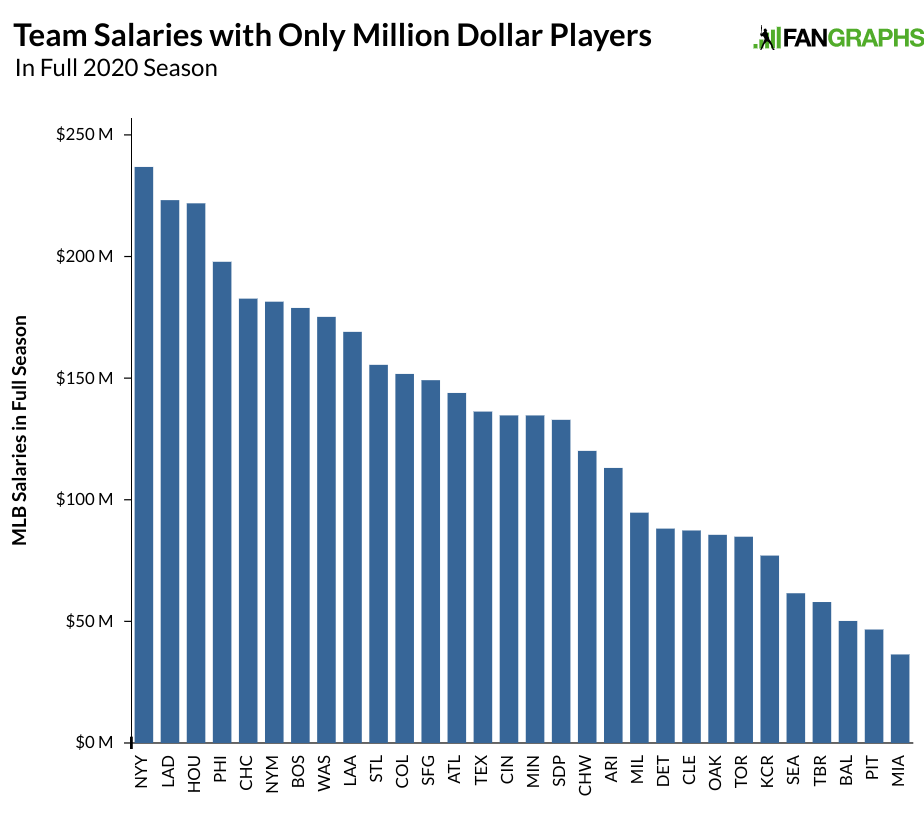
We see a huge spread between the top and bottom teams, which is fairly typical over the last few years. Here’s what the same graph looks like with pro-rated salaries over an 82-game season:
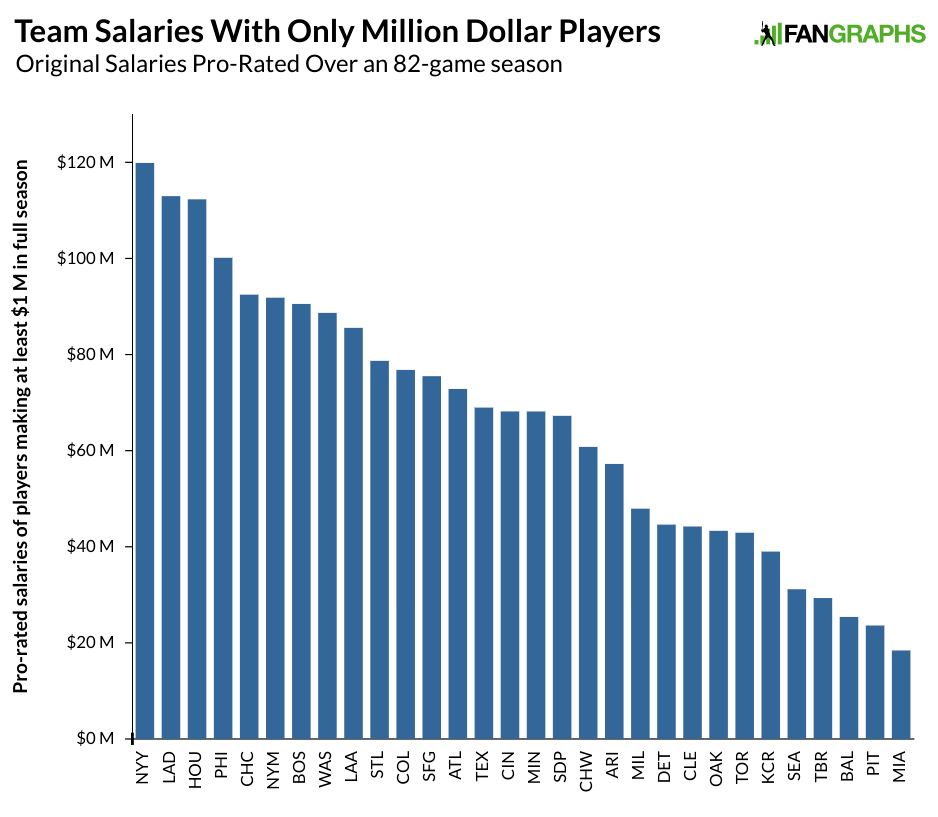
The second graph is basically the first one divided in half. These aren’t full payrolls because we’d need to add in all the minimum-salaried players, but the differences you see are pretty close to the total numbers. MLB’s latest proposal hits the highest-salaried players the hardest, and the teams that pay the higher-salaried players tend to have the larger payrolls. Here’s what would happen to team payrolls under MLB’s latest offer, including only players originally scheduled to make $1 million or more in a full season. The $200 million for playoffs is included in the figures below:
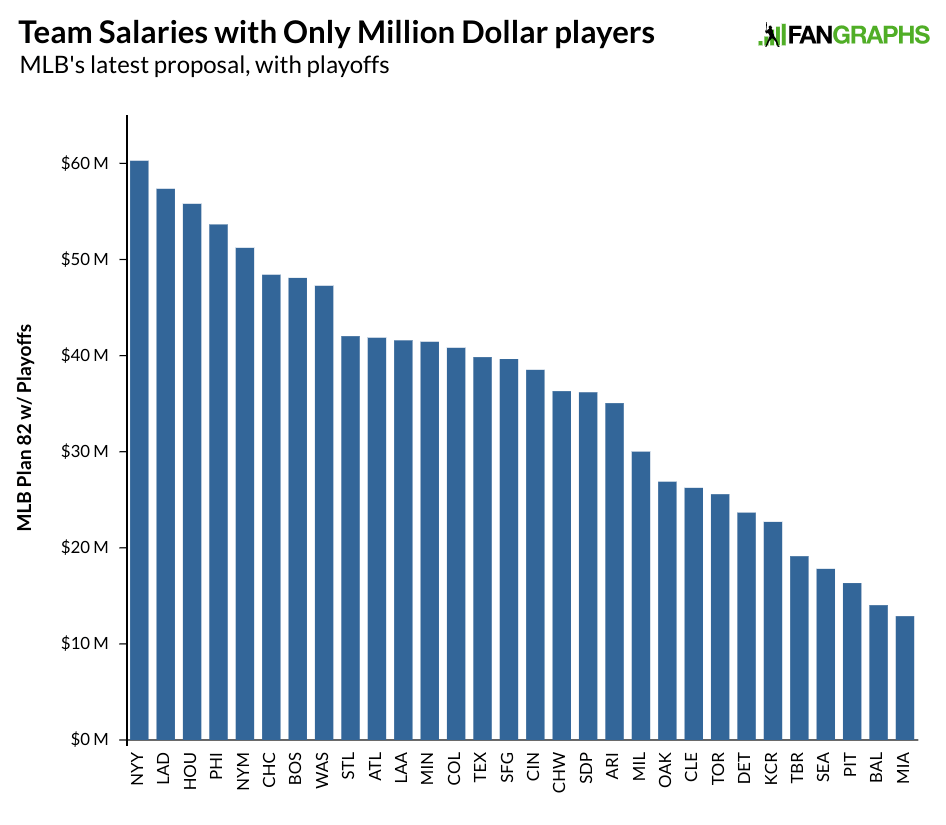
We see these salaries bundled more in the middle. MLB’s proposal dropped these players’ salaries by 45% compared to a pro-rated 82-game season, but the standard deviation of these salaries dropped by 53%. The graph below shows the changes in each team’s payroll from the March agreement with pro-rated salaries to MLB’s latest proposal:
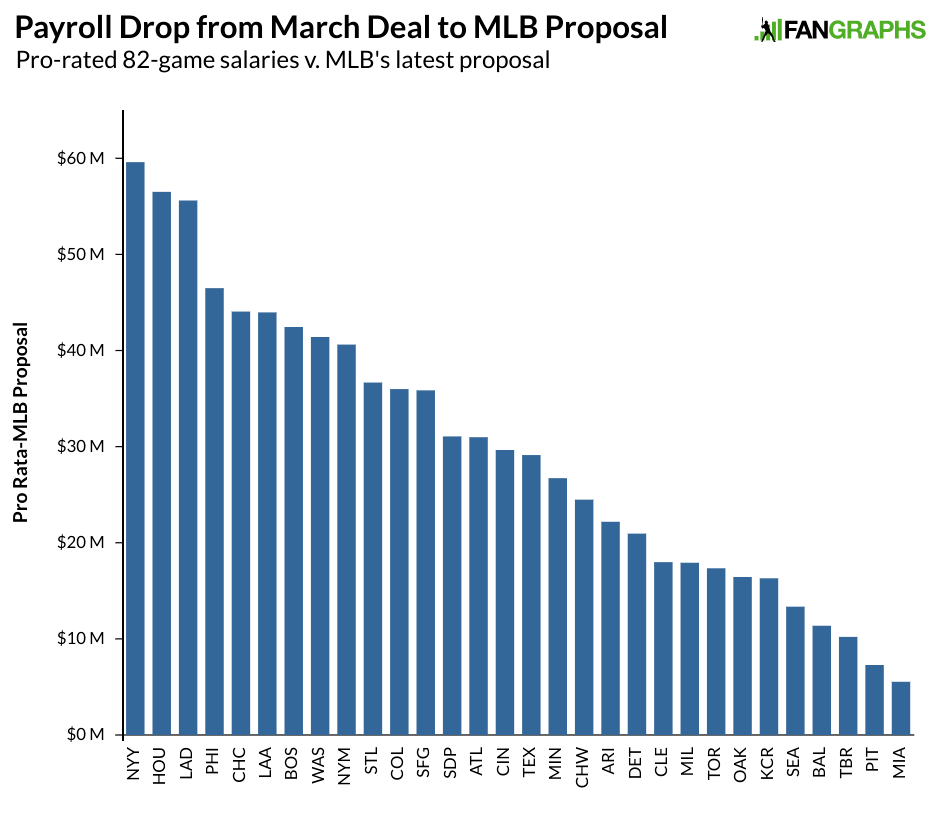
Those teams on the left have the most to gain under MLB’s latest proposal, while those teams on the far right barely see any change to payroll at all. It’s not hard to identify the types of teams in each group. We have the Yankees, Astros, Dodgers, Phillies Cubs, Angels, and Red Sox leading the way with salary cuts while the Marlins, Pirates, Rays, Royals, and A’s are all near the bottom in terms of change. To illustrate the change a little more, here’s a scatter plot showing the change above with Forbes valuations:
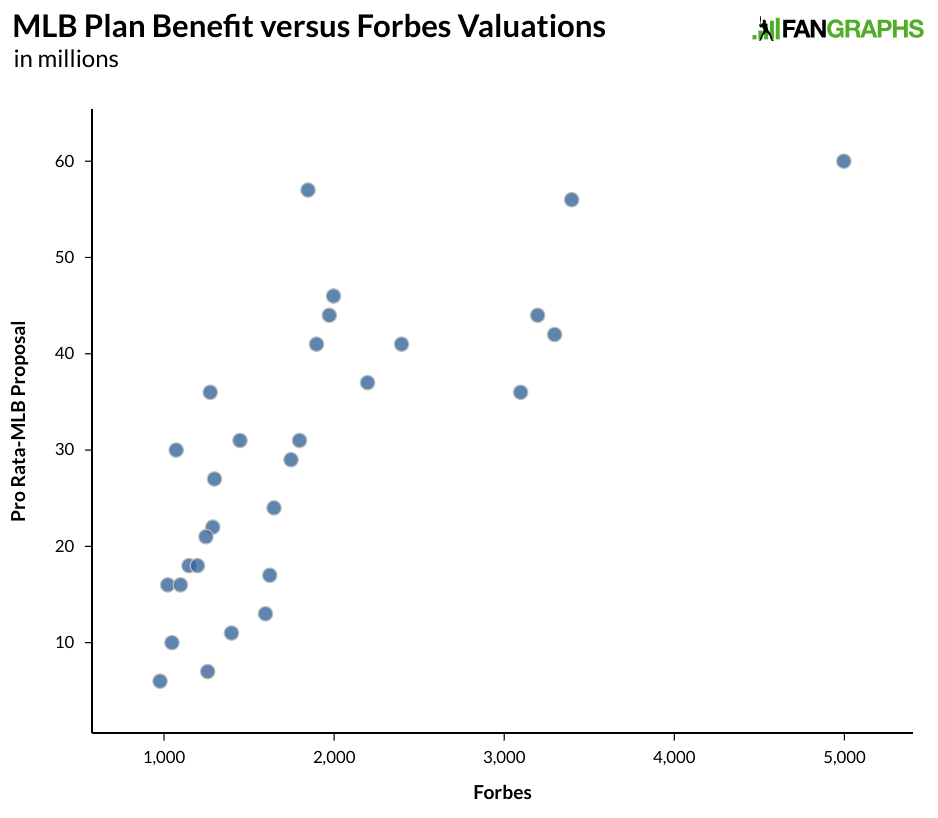
There’s a pretty strong relationship here (the R-squared =.57) and a lot of that is because rich teams spend more. In MLB’s latest proposal, those same rich team receive the biggest benefits. It’s the owners’ of trying to share the lost revenue, except instead of doing it amongst themselves, they are hoping that the players will do it for them. It’s a way that prevents some potentially difficult conversations between Rob Manfred and the owners. If the union response is any indication, the owners are going to need to have some of those difficult conversations in the coming days if they want to have a 2020 baseball season.
Craig Edwards can be found on twitter @craigjedwards.
Nice work, Craig. I just broke down the potential Tigers’ payroll using a prorated 82 game schedule as well as the owners’ proposed (non starter) plan. Without Prince Fielder’s final $6M payment, they come in under $50M on a prorated deal and just $21.4M under the owners’ plan.
https://www.blessyouboys.com/2020/5/28/21273605/mlb-salary-proposal-pay-cuts-mlbpa-shortened-season
There is no way that the team would lose money by playing games on an 82 game schedule with prorated salaries. In fact, MLB overall would make more money by playing the games than not. Their claims to the contrary are simply not true.
Player salaries total under $4 billion, and would be under $2 billion if prorated for 82 games. We don’t know the contract details with the networks in the event of a partial season or no season, but they would have more than enough revenue from national and local media sources even with no attendance or other stadium related revenue, and half of those media revenues.
Scott Boras may be right that the owners want to pawn off losses due to loan payments for their real estate deals, but they’re not losing money by playing baseball, and they won’t open the books to show otherwise.
Took a quick look at your site where you site an AP article where MLB claims that the Detroit Tigers will lose $84M (negative EBITDA) and this is the lowest loss amongst all MLB teams (Yankees most at $312M since they funded their own stadium) based only on pro-rating salaries. Where do you get from this that the Tigers will not lose money by not having the players taking any additional hit from no audience? MLB’s -$84M estimate seems high since the Tigers’ payroll (Miggy & Jordan Zimmerman, yuck!) is low and their expected stadium receipts were low too, though maybe they were expecting a big loss had 2020 proceeded normally, since teams often lose money when they’re bad. In other words, what revenues (local TV + revenue sharing) are you expecting for the Tigers?
Craig’s article is interesting but he seems to want to dis-incentivize teams from carrying high payrolls. “These teams are getting all the relief and it’s not fair!”, seems to be his argument. I thought Craig and most Fangraphs’ readers wanted all teams to have high payrolls (cuz that’s how you win!, apparently) and now Craig wants to penalize these high rollers during a nationwide emergency.
I don’t think a divide-and-conquer-the-owners strategy is going to work since it seems to be NYY, LAD, BOS that are most in favor of Manfred’s proposal. Alienate them and there ain’t going to be a season.
Good points. You’re always open minded and engaging. It seems the rich man, poor man narrative fits for both players and owners. But we knew this going into the next CBA. The players salary disparity is easier to fix than the owner disparity. I say this because fans are what baseball is about. Both owners and players are nothing without their customers. Unlike the NBA and NFL local revenues fund the MLB game. This means rich team fan bases disproportionately fund the game. I wish MLB had big national television contracts, but they don’t…
The craziest thing about that list is that so many of the teams that would see the biggest drop in payroll are the ones that have the largest media deals. It’s not just that it’s the richest teams, it’s the ones with the best revenues in the exact situation we’re facing.
This implies that after losing the gate and associated revenues, the teams that are most opposed to starting the season are the ones that will have, by far, the most revenues in an empty-stadium-season. This would further imply that the teams that will lose the most money are the ones that will have, by far, the most revenues in an empty-stadium-season. And then it is possible that the franchises who will suffer the worst fates are the franchises that will make the most money during the shutdown.
I find this nearly impossible to believe. One of the things I just stated must be wrong. It’s not the media deals part. It’s possible that the league is just doing this on behalf of the richest teams despite prodding by the poorer or middle teams, but that seems unlikely. The last two, I think, are up for interpretation or further analysis.
Sadtrombone, I love ya stay well! Those teams you reference also have the highest cost structure. Salaries, debt service, and higher cost of being in those areas. Essentially “shelter in place” costs everyone money but it’s more expensive for some than others. It comes down to regional television contract versus cost of business.
Great analysis.
I hope the Players Association is as clever as Craig in identifying the fault lines, and makes a counter-proposal that pits the owners against each other in the same way the owner proposal did to the players.
So…. we don’t have baseball in 2020? Essentially the players did. They proposed playing 100 games which exacerbated the problem the owners presented. I side with neither, I’m just an old baseball fan trying to preserve the game with his kids. However, the owners, players, and yes fans make it hard. Look at the goodwill Tiger, Phil, Tom and Peyton generated last weekend. While baseball wallows in politics, labor nonsense and a lack of leadership by owners. The game could be inspiring the nation in a time of fear, anger, uncertainty and national doubt. I suspect my kinds will placate my interest in baseball and move on to “better sports” when I’m gone. Sadly, I don’t know if I blame them.
I keep looking for something to explain how the owners came up with this proposal. Why did they come up with something that disproportionately benefits these teams? These teams are not the ones with the largest team debt, although the Cubs, Dodgers, Mets, Nationals, and Astros do all have more than $250M in debt. They are not the teams with the worst media deals, although the Mets and Cards and (especially) Rockies don’t have great media deals and would benefit a lot from this.
And there are teams that were likely in trouble before this proposal that are going to get absolutely hosed here: The Marlins, Brewers, Pirates, Royals, A’s, and Rays have some of the worst TV deals and they’re among those who get the least relief. And the Royals and Marlins are in a ton of debt (which I don’t think entitles them to anything, but those are probably two exceptionally desperate teams).
I’m guessing National TV money gets distributed equally. If so, divide what you think that would be for the league by 30 teams, and then look at the third table.
It does, but local TV revenue doesn’t. Somehow this proposal is based around the idea that the teams with the highest payrolls are going to lose the most money, which seems to be the league’s overall talking point–but this seems impossible. The only way this makes any sense is if the owners have made a deal behind closed doors to share all or most of the TV revenue equally, regardless of the source.
Say National TV money is $1B or $33M per team and you are the Marlins with your largest expense, players, projected to be $15M for a proposed deal. Do you care more about that the payrolls for the Yankees are slashed more than yours or do you care more about getting a deal agreed to by the union?
I think I figured out the answer. Every team is sharing 50% of their revenue from all sources with MLB this year, then distributed equally across teams.
I still don’t think the numbers add up, but if you’re sharing that much local TV revenue with each other it’s going to change the story a lot.
That definitely adds to it. Any money divided equally among teams helps the low payroll teams even if they get lower payroll reductions.
Alright, I just found an article that said that every team is sharing 50% of their revenue from all sources with MLB this year. So that might explain why they think the teams spending more will lose more.
Almost all of the owner-player labor conflicts over the past few decades in every sport (perhaps except the NFL) are really more a conflict between high-revenue team owners and lower-revenue team owners.
As another commenter said- MLB’s “proposal” is aimed at the players taking a hit in order to resolve this owner vs. owner conflict.
I don’t know if that was me you’re referring to but or even if I wrote it here but I 100% agree with it.
I’m missing something. How does a proposal that disproportionately benefits the richest teams replace revenue sharing or diffuse conflict between owners?
(I’m not disagreeing, I seriously think there’s something I’m overlooking)
National TV money gets distributed evenly. Teams with cheap payrolls/low local revenues have a huge benefit to want a deal get done even if it favors rich teams more in absolute dollars.
If I wanted players to take home more money, not only now but for future seasons. I would be for measures that dont punish rich teams for giving more money to the players.
The teams with the high payrolls also have the most fans in the stands and therefore have the most to lose from playing without fans. So the owners came up with a payroll proposal to help balance that out.
“It’s the owners’ of trying to share the lost revenue, except instead of doing it amongst themselves, they are hoping that the players will do it for them. ”
You mean like nearly every other business in the world, where if revenue gets suddenly chopped in half, employees make a lower wage?
But revenue likely won’t be chopped in half because TV networks are desperate enough for any sports programming that they will not be likely to try to claw back any of their payments
This proposal means that the highest-spending teams (i.e., the teams that carry the rest of the league) should proportionally take less of a hit than cheapskates and tankers.
I fail to see the outrage.
And of course it’s generally true that teams with larger RSN deals and payrolls also stand to lose more from missing gate revenue and concessions.