Nationals Move on From Mike Rizzo and Dave Martinez
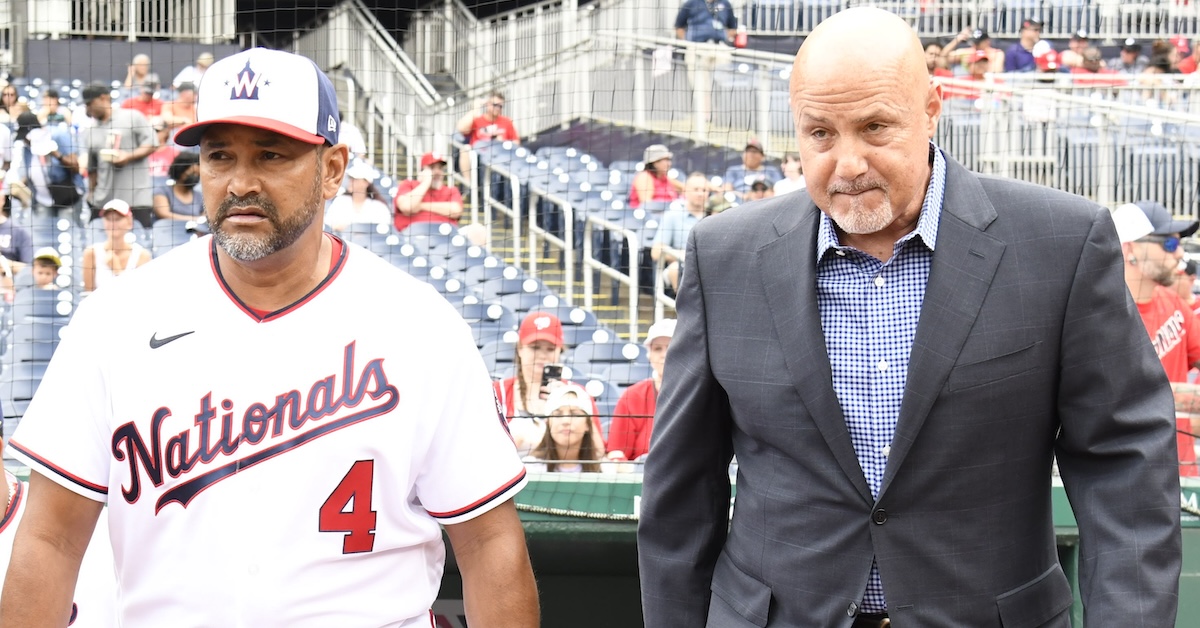
Last night, exactly one week before they’re slated to make the first overall pick in the 2025 draft, the Nationals fired president of baseball operations Mike Rizzo and manager Dave Martinez. After ESPN’s Jeff Passan broke the news, the team announced assistant general manager Mike DeBartolo will serve as interim GM. Bench coach Miguel Cairo was named interim manager this afternoon.
Rumors that Rizzo and Martinez might finally be on the hot seat had made the rounds over the past several weeks, but the timing is less than ideal. According to Ken Rosenthal of The Athletic, the last time a team fired its GM before the trade deadline was when the Twins got rid of Terry Ryan on July 18, 2016. USA Today’s Bob Nightengale provided an explanation, reporting that both Rizzo and Martinez had contract options for 2026, with mid-July deadlines for those decisions. Even for a franchise that just fired its POBO and manager, it’s a bad look to let money dictate the timing of the decision when so much is at stake.
The son of a scout and a 28th-round draft pick in 1982, Rizzo spent three years in the minors and 12 as a scout. He became the Diamondbacks’ scouting director in 1998 and moved to Washington as an assistant GM in 2006, the team’s first hire after the Lerner family bought the franchise. Rizzo was named interim GM in March 2009, after Jim Bowden resigned in the midst of a bonus-skimming scandal. The team removed the interim tag in August, and Rizzo went on to become the game’s third-longest tenured GM. The Nationals finished in last place in both 2009 and 2010, giving them five last-place finishes over their first six years in D.C.
Those lean years gave the Nationals the first overall pick in both 2009 and 2010, drafts that featured slam dunk top choices in Stephen Strasburg and Bryce Harper. Rizzo handed out his first major free agent deal before the 2011 season, signing outfielder Jayson Werth for seven years and $126 million. At the time, the contract was viewed as a wild overpay, but it was intended as a statement. The Nationals were ready to compete, and they wanted to announce that intention to potential free agents.
They crawled to one game below .500 in 2011, then ran the best record in baseball the following year. It was their first postseason appearance since they relocated to Washington before the 2005 season and just their second in franchise history; the first came in 1981, when the Expos took advantage of the strike-interrupted campaign to reach the playoffs despite not finishing with the best overall record in the NL East. From 2012 to 2019, the Nationals won 730 games, second only to the Dodgers, and Rizzo became known for taking big risks. Under his leadership, the Nats signed Max Scherzer for big money and swung a three-team trade to get Trea Turner (as a player to be named later). In 2018, they called up a 19-year-old Juan Soto after just 340 minor league plate appearances and let Harper walk to a division rival when he became a free agent after that season. They grabbed high-upside prospects who only fell to them in the draft because of concerns about injuries, makeup, or signability that scared off other teams.
For all their regular-season success, the Nationals couldn’t get over the hump or find a long-term manager for the bulk of the 2010s. Jim Riggleman took over for Manny Acta in 2009, but in a move that had some echoes last night, Riggleman resigned abruptly in June 2011. On a one-year contract for the third straight year, he finally got the team over .500 and demanded to know whether his contract option for 2012 would be picked up. Said Rizzo at the time, “I felt that the time wasn’t right for me to pick up the option, and certainly today’s conversation put to me in the way it was put to me, you certainly can’t make that decision in a knee-jerk reaction. It’s too big of a decision.”
Riggleman quit. Davey Johnson filled in, but wasn’t expected to be a long-term solution. Matt Williams lasted two seasons, never quite clicking with the club. The Nationals agreed to hire Bud Black as manager, but that fell apart after they lowballed him with a one-year offer. Dusty Baker led the team to back-to-back division titles in 2016 and 2017, with Game 5 defeats in the NLDS each year, but Rizzo let him go as well, bringing in Martinez.
Martinez spent 16 years in the majors with nine franchises (including the Expos), then served as bench coach for the Rays and the Cubs. The Nationals missed the playoffs in 2018, just barely finishing above .500. When Martinez finally led the team to the championship 2019, it was no longer as a juggernaut. The Nationals sneaked into the postseason with a Wild Card berth and went the distance in both the NLDS and World Series. Martinez pressed Patrick Corbin into relief duty between starts to cover for a bullpen bereft of reliable lefties.
They were top-heavy, too. While Rizzo was building the Nationals into a championship-caliber team, the rest of the league was catching up to him. Washington lagged behind as analytics came to supplement or supplant traditional scouting and player development. As a result, the organization became a cautionary tale. “In recent times,” Jarrett Seidler wrote in the 2023 Baseball Prospectus Annual, “the Nationals have systematically overvalued hitters who look good by traditional scouting methods — sweet-looking swings, nice shows of power in batting practice, old-school notions of physical projectability — while ignoring glaring flaws exposed by analytics — poor in-zone contact rates, low exit velocities, high chase rates.” They overvalued fastball velocity and undervalued fastball shape. They’re still one of the only teams in the game without a Trajekt Arc pitching machine.
That’s not to say Rizzo didn’t recognize his own shortcomings. Twice in the past few years, the Nationals have publicly announced they were going to change how they did things and get on board with the analytical revolution. The second proclamation occurred before the 2024 season, and it came with sweeping changes in the scouting and player development departments. Rizzo really did try to catch up. It just hasn’t seemed to work.
The Nationals have picked the wrong players and they’ve failed to develop them, leaving the cupboard bare. The table below shows the team’s first-round picks during Rizzo’s tenure, along with the WAR they put up for the franchise. It will take time to see what the team gets from more recent picks, but the drop-off after Anthony Rendon in 2011 is staggering. From 2012 on, the team’s first-round picks have put up a combined -1.1 WAR with Washington.
| Year | Pick | WAR With Nationals |
|---|---|---|
| 2009 | Stephen Strasburg | 36.6 |
| 2009 | Drew Storen | 4.5 |
| 2010 | Bryce Harper | 28.7 |
| 2011 | Anthony Rendon | 30.0 |
| 2011 | Alex Meyer | 0.0 |
| 2011 | Brian Goodwin | 0.7 |
| 2012 | Lucas Giolito | -0.6 |
| 2014 | Erick Fedde | 1.4 |
| 2016 | Carter Kieboom | -2.0 |
| 2016 | Dane Dunning | – |
| 2017 | Seth Romero | -0.1 |
| 2018 | Mason Denaburg | – |
| 2019 | Jackson Rutledge | -0.4 |
| 2020 | Cade Cavalli | 0.1 |
| 2021 | Brady House | 0.0 |
| 2022 | Elijah Green | – |
| 2023 | Dylan Crews | 0.5 |
| 2024 | Seaver King | – |
Things fell apart following the 2019 season. Corbin turned into a pumpkin, while thoracic outlet syndrome effectively ended Strasburg’s career just after he signed a seven-year deal. Exciting young players like Victor Robles, Michael A. Taylor, Carter Kieboom, and Tanner Rainey stopped looking so exciting, and the farm system didn’t hold any young players who could fill in. So the Nationals decided to embrace the rebuild ahead of the 2021 trade deadline, when they sent away Scherzer and Turner for prospects; a year later, they swapped Soto for more prospects. The team has only spent money in order to net more prospects, signing veterans on one-year deals and hoping to flip them at the deadline. In 2022, Mark Lerner announced the family would look to sell the team, then changed his mind. Over the past six seasons – in other words, since the day after the 2019 World Series – only the Rockies have a worse record than the Nationals.
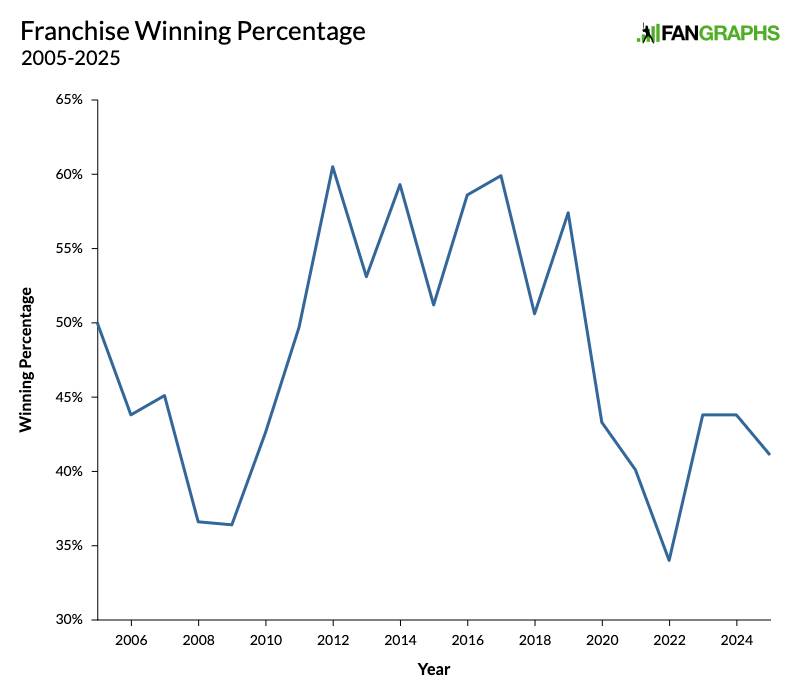
That brings us back to the original question. Why move on from Rizzo and Martinez right now? Any time over the past few years would have been easily justifiable. As I wrote in the 2024 BP Annual, the Nationals became the only team since the Philadelphia Athletics under Connie Mack to record four straight last-place seasons without firing either their manager or their GM. Not only that, but they gave both Martinez and Rizzo contract extensions before the 2024 season, for which they were rewarded with a refreshing fourth-place finish. You could argue that no team has ever been so patient.
It can’t really be because the team has been a disappointment this year. Before the season, we had the Nationals with a projected winning percentage of .444. They’re currently at .411. At most, you can say they’re underperforming their expectations by three losses.
Washington clearly held similar expectations. In February, Mark Lerner revealed the Nationals wouldn’t be spending money on players because Rizzo didn’t think they were ready to compete. “When Mike calls me in and says, ‘We really need to think about it,’ for next winter, we’ll talk about it,” he said. “Right now, he doesn’t think – and I agree with him: There’s no point in getting a superstar and paying him hundreds of millions of dollars to win two or three more games. You’ve got to wait until – like Jayson [Werth]. Jayson was right on the cusp of [the team] being really good, and it took us to the next level.”
This was, in its way, a vote of confidence for Rizzo. Lerner has clearly changed his mind in the last five months. It’s possible that he figured he’d give Rizzo and Martinez one last shot to figure things out in the first half. But even if that were the case, this doesn’t seem like the right moment. This season has already had a pretty clear rock bottom. It came from June 7 through 18, when the team went through an 11-game losing streak, with six of those losses coming at the hands of the lowly Marlins and Rockies. That’s also when Martinez made headlines for comments that defended his coaching staff a bit too vigorously, leaving the impression that he was blaming the players instead. It’s hard to imagine any logical rationale for changing things now rather than two weeks ago.
The timing is also awkward for the franchise as a whole. The team has been rebuilding for years now, and the new, young core has arrived in the form of James Wood, MacKenzie Gore, CJ Abrams, Luis García Jr., and Dylan Crews. Unfortunately, the new, young core is neither young enough nor good enough to build around. The Nationals are once again in last place in the division. They don’t have any pitching, and they’re below replacement level at first base, catcher, and right field. García and Gore are in their first year of arbitration and are only under contract for two more years. Abrams will enter arbitration next year. That leaves just Wood and Crews under contract past 2028. Whoever takes over this franchise will have to navigate some difficult decisions. They may well start by initiating yet another rebuild.
They may also be taking over a job that is messier than we realize. In the Washington Post, Barry Svrluga painted a picture of an organization without a decision-making process: “Ted Lerner died in February 2023. Even before that, his son, Mark, had served as the club’s point person. But the reality is that decisions were made by a group – Ted Lerner’s sons-in-law, Edward Cohen and Robert Tanenbaum, as well as his daughters, Debra Cohen and Marla Tanenbaum. A third generation – Ted’s grandkids – is sometimes involved. There’s a herding-cats element to it all, and it can make it hard to find consensus, with an individual decision as well as an overall direction.” Rizzo reinforced that notion with a text message to Svrluga last night: “The sun will come up tomorrow,” he wrote. “That’s the job. I had a great run. Navigated that ownership group for almost 20 years.”
Rizzo and Martinez will have complicated legacies in Washington. It’s hard to put too much blame on Martinez. He inherited a good team that underperformed a bit in his first season, then steered what might have been a less-talented roster to a World Series title, an achievement that required some deft tactical maneuvers. In recent years, he’s led a team that no manager could’ve turned into a winner. The Nationals have been sloppy in terms of baserunning and defense, but until his comments a few weeks ago, he’d also avoided any major missteps. Before he arrived, Washington’s managers averaged less than two years apiece. Since the franchise moved to Washington, he has the most games managed, the most wins, and the only championship. But he also has the second-lowest winning percentage.
Rizzo inherited one of the worst teams in baseball, built it into one of the best, won a championship, then oversaw its return to the very bottom. Regardless of how things ended, it’s not hard to argue that he deserves a statue outside Nationals Park. His attempted rebuild was too little too late, but it’s there. We can see it. He’s the guy who signed Juan Soto as an amateur in 2015 and the guy who traded Soto for James Wood in 2022.
As for the Nationals, it’s probably time for a new regime. The big league club isn’t ready to compete, and as Eric Longenhagen wrote earlier today, the farm system is still below average. Virginia native Thad Levine, who parted ways with the Twins in October, has already been mentioned as a possibility to lead the front office. But in the meantime, somebody’s going to have to decide whom to draft first on Sunday.
Davy Andrews is a Brooklyn-based musician and a writer at FanGraphs. He can be found on Bluesky @davyandrewsdavy.bsky.social.
When Martinez made his defensive speech about how you can’t blame the coaches, my mind immediately turned to the Nats’ underperformance – how their bats lag behind the league in things like GB%, launch angle, etc. Sean Doolittle & Co. appear to have made some positive changes to the org’s pitching philosophy, but the hitting philosophy is still sabotaging young hitters who should be better. (Except Wood. My theory is he doesn’t listen to ’em.)
The Rizzo era was marked by extremely savvy targeting of players in drafts and trades (and FA if the Lerners weren’t involved – apparently they overruled him on Wieters), followed by poor development of those players later on. But man, when you look at Rizzo’s trade record, there’s a lot of gold. Most people’s favorite Rizzo trade is the Trea Turner heist, and the Soto deal is now becoming a trendy pick. But my fave was Jonathan Albaladejo for Tyler Clippard. They essentially got a durable, distinctive, fun setup arm for free.
Wood hits as many ground balls as anyone. They’re just hit so dang hard that a decent number of them punch through for hits in spite of it.
I also remember Abrams getting into it with Martinez last year about being coached to not pull the ball.
I did not realize this – oof: “Over the past six seasons – in other words, since the day after the 2019 World Series – only the Rockies have a worse record than the Nationals.”
I think the analysis is a little too dismissive of the 2019 Nationals as a team – after the abysmal start, they played way over .600 ball and beat two juggernauts, the loaded Dodgers and the cheatin’ Astros, to win the title. Hitting-wise, they were a great team. Pitching-wise, not so much beyond the Big 3, but it was enough.
It also likely saved baseball from a huge black eye and fan loss by ensuring the Astros didn’t steal the championship in the year before COVID basically made us all insane.
Rizzo’s drafting has been putrid and the team never really got its footing after COVID destroyed any chance to leverage the World Series win into $$ from fans and talent from free agents wanting to come to DC.
Martinez’s teams are never prepared. They start the season slowly, they are putrid on defense, make silly baserunning mistakes over and over and over again, and are, with a few exceptions, way too aggressive at the plate. The young players, except for Wood, are getting worse, not better. The lack of effort displayed this weekend vs. Boston was unacceptable.
Ruiz and Garcia, Jr. are horrible situational hitters and league worst fielders. Neither belongs anywhere near a winning team except, maybe, Garcia, Jr. in a L/R DH platoon.
The timing of the move was poor. The decision to fire both was correct and long overdue.
The drafting has been real bad. I get that Rizzo likes high-risk high-reward guys but they just. keep. missing.
Even then, they were a Trent Grisham error away from being knocked out in the Wild Card game.
They still would have tied it with Stevenson pinch running with 2 outs.
I’d forgotten about the Bud Black debacle
They have not developed well, but I don’t think it is completely fair to judge a GM’s drafting solely based on how much they did on the field for the drafting club. Sure, ideally everybody you draft plays at least 7 years for you and plays well. But those guys are assets and sometimes their best use is to acquire other players when that makes sense.
Just as an example, the Nats got -0.6 WAR from Giolito and Dunning, but got 10.2 WAR and a World Championship from Adam Eaton, who might have never been on the team if not for those guys. Both of them have had at least serviceable careers, so Rizzo deserves some credit for identifying and developing their talent, as well as turning it into something they needed more at the time.
Agreed. The deal that shipped out Giolitto and Dunning (and don’t forget Robbie Ray!) brought back important pieces of the championship team. The same goes for the trade where Rizzo bought the back end of a bullpen from OAK for Jesus Luzardo. There’s no shame in trading prospect WAR for missing-pieces WAR.
Rizzo is a good, bordering on great, trader.
But the drafting has still been atrocious. And the development worse.
The third guy in the Eaton trade was Reynaldo Lopez (who likewise has had a serviceable career for teams other than the Nationals), Ray was part of the Doug Fister trade.
Weirdly in retrospect, as good as the Fister trade looked for the Nationals at the time, I’m not sure if they’d do it again if they knew Fister’s career was going to implode after giving them only one good year and Ray was eventually going to become a solidly good and occasionally great pitcher.
Scouts should draft better
While Eaton did win a WS with the Nats and contributed a few key hits. This is just blatantly false that he got the Nats 10.2 WAR. He was worth a grand total of 4.0 WAR across 4 full seasons with the Nationals.
You do have to wonder, though, if there was another way to acquire a 1.0 WAR corner outfielder than by giving away Giolito, Dunning and Reynaldo Lopez…
This analysis of Eaton is a bit too dismissive. A lot of his time in DC was marred by injuries. He was having a great 2018 season, but got hurt early and missed most of it. COVID year was, what, 60 games. He was great in 2019 and delivered several clutch plays – his catch at the wall in NLDS, Game 5, miss that, Dodgers likely win the series. His HR in World Series Game 6 and key 2-RBI hit in game 7. He was worth every player and every penny. An underrated and unappreciated hero of the 2019 season.
Keep in mind that Eaton absolutely wrecked his knee at the very start of his tenure with the Nats and his defense never recovered – a big blow for someone who derived so much of his value from being an excellent corner outfield defender.
Perhaps if he had remained healthy he’d have been the ~4 war/yr player he was in Chicago. Maybe he would have been a 1 war guy anyways. We’ll never know.
Those deals after 2016 amounted to one last feast on the seed-corn. IIRC the Doolittle/Madsen deal was not only for Luzardo but also Blake Treinen, who they gave up on after his first try at closing. Then they turned around and traded 3 guys who are still contributing for Eaton. Those are 5 MLB players for short term fixes. I love Doo, they don’t win in 2019 without his early year and post-season performance, but Treinen pretty quickly was his equal.
I had completely forgotten how this team lowballs guys with year to year deals! They are going to have to change that if they want to get a top-flight GM and manager. A lot of the best guys have families that they don’t want to move to a brand new place only for their contract to not be renewed.
Maybe Joe Maddon or Joe Girardi or Buck Showalter is desperate enough to get back into the game to take that deal, but the real challenge is going to be finding a GM who is willing to rebuild the org from the bottom up. James Click or Eve Rosenbaum or Brandon Gomes might not be willing to leave their current jobs anyway but they certainly aren’t going anywhere without at least a 3-year deal.
The uncertain ownership situation – and the Lerner family’s micromanaging manner – are also disincentives to any top flight GM wanting to sign a contract with the Nationals.
One thing I think this article does well is show that most GMs have an expiration date because they can’t keep up. Guys like Dombrowski and Cashman are the exception rather than the rule because they’re constantly pushing themselves to do new things, most guys are like John Mozeliak who are awesome when they are hired, have a ton of success, and then get seriously behind and they don’t even know it until it’s too late.
(Another example: Jeff Brdich wasn’t a worse GM than Dan O’Dowd in absolute terms and probably was better, but O’Dowd became GM in 1999 and Brdich became GM in 2014. It’s a lot tougher to compete with Andrew Friedman and AJ Preller than it is to compete with Dan Evans and Kevin Towers.)
It seems pretty clear that Rizzo also found out that he was behind much too late for it to make a difference, but the cracks were there from the beginning unlike someone like Mozeliak. It’s totally ridiculous that they fired him because they didn’t want to pick up his option, and typically GMs need a good 5 years before we have any sense whether a rebuild was successful. But this team finished last in the division for five consecutive years and is last in the division again and the prospects list is not suggesting that this is going to change anytime soon.
Cashman and the others have never maintained that they’re the smartest guys in the room. They hire those smarter guys to work for them and get out of the way.
Dombrowski has an advantage because he’s constantly hopping around to new organizations and learning from them, while also bringing a fresh perspective into the mix (along with some people he’s wanted to work with for a while). Cashman doesn’t have that.
I think you could make a very strong argument that neither the Phillies nor the Yankees have a Top 5 front office, maybe not even Top 10. But the mere fact that Dombrowski and Cashman have managed to remain relevant for this long is amazing. Cashman has been running the same team since…1999? Dombrowski has been running front offices since something like 1989.
There is nobody left in the game who is even close to them in terms of how long they’ve been successfully running a front office.
Sandy Alderson, Billy Beane, Brian Sabean, John Schuerholz, and John Hart are the only executives who started around the same time as them that have anything close to their track record over a really long period of time, and they’re all gone (with it looking like the game had passed them by when they went, some by a little and some by a lot).
Maybe you could make an argument that Gillick and Jocketty were a contemporaries of Dombrowski, but not Cashman, and in any case Gillick has been retired since 2008 and Jocketty was not good with the Reds.
Andrew Friedman started somewhere between 5 and 10 years after Cashman. Theo Epstein started a little after Cashman, and he’s gone. Mike Shapiro hasn’t really done as much of the GM-type stuff since Antonetti was promoted, and in any case his time with the Blue Jays has been really uninspiring. Jon Daniels started after Cashman and things fell apart several years before he was fired, like when Preller left.
Effective GMs seem like they have about a decade before they need to go into general baseball operations, and the best have about 15. Guys like Dombrowski, Cashman, and Beane are enormous outliers, with Friedman already being an outlier and likely joining them as an enormous outlier soon.
I wouldn’t put Preller anywhere near up there with a top exec like Friedman.
Absolutely not but compared to Kevin Towers he looks like a genius.
Agreed. Preller is amazing at scouting, building a bullpen, and finding cheap MLB guys that then become productive (Profar, Wacha, Lugo, Sheets). But when it comes to managing the mlb roster money he’s terrible.
Considering his marching orders were to win it all for a dying man no matter the cost, I don’t really know how to judge him on that front.
Eric said in the prospect write up that that the team is amazing at finding amateur talent and not so good at developing it. I think that is fair, and it’s been covered up by them trading away prospects at a pretty high clip.
I’m not sure that Mozeliak doesn’t actually deserve credit for being good longer than you’re flagging. It’s definitely time for him to step down, but I’d argue that even through 2022 he was still doing really well.
The doldrums of the late 2010s can be blamed on getting ~ nothing from not one but two top 5 prospects. Maybe Taveras busts anyway, but losing him clearly had a huge impact on the organization. Getting one all star closer season from Alex Reyes but nothing else was a huge deal too, and not being able to handle the losses of both of those seems pretty fair, especially with an ownership group that seems very committed to always being relevant, at least.
Mozeliak’s trade for Goldschmidt looked okay at the time and pretty solid in retrospect. The Arenado trade, time will tell, but at a minimum, you can’t be mad about the guys he traded to the Rockies.
So I guess it seems to me like Mozeliak got hit with brutal luck and tough constraints, had a bad run with Ozuna/Liberatore trades, then took a step back and figured out a new way to succeed.
I wouldn’t be surprised at all if he ended up cycling back into another org and had a strong run with them. I do think he’s fairly adaptable, so I’d not be shocked to see him adapt in a big way again.
Which makes sense! These are incredibly smart, capable, devoted people. Totally reasonable to need a break after 18 years doing the same job, then to come back and light it up again because you’re refreshed and you figured some new stuff out
Also keep in mind what a great job Mozeliak has done since that terrible 2023 season.
The Goldschmidt trade and accompanying contract extension was excellent, not just merely solid, and even with Arenado’s offense dropping to merely average over the past couple of years, that trade has also been a significant win for Mozeliak and the Cardinals.
Plus, the Liberatore trade is finally bearing fruit and may actually eventually go down as a win for the Cardinals.
John Mozeliak hasn’t fallen behind. He just had one terrible year in 2023, has done a great job rebounding from it over the last two years, and is simply retiring rather than being fired.
Rather, it was the Cardinals’ player development system that fell behind and was recently restructured.
I think Rizzo is a good GM for a win now, largish payroll team ( like Dombrowski and Cashman.) He’s not Friedman who can put together winning teams on shoestring budgets. The Nats have the highest debt to income ratio in the league. They are going to have to operate as a small market team for another year or two as the MASN deal ends.
All of this is true, but one cannot dismiss how little the Lerner Offspring Conglomerate has spent in the last few years. They are routinely regarded as cheap (as noted above in how they approached managers). They haven’t signed an FA for more than $15m in 5 years. Hell, even Bob “Spend” Nutting has done more to lock up their talent. (Keibert was extended). Strasburg eats up 1/3rd of their payroll to this day.
Yeah, they were antiquated in some ways… but you can’t build new systems on limited spending. Look at the piece on Trajekt.
The problem with this franchise has been the cabal of nepobabies who can’t make up their minds about selling the last 3 years. Ted bought it for $450m. DC built the stadium, which I believe will be paid off in 2027 many years early.
Ted is Dead. SELL THE TEAM.
Also, Davey needed to go. That’s on Rizzo. Rizzo had to go because he couldn’t fire Davey. End of story.
Example #136 of “The dad that made the $$/built the business is a good owner while the nepo baby offspring is cheap & only knows how to cash checks”.
See John Fisher in Oakland for further evidence.
Pohlads, Illitch (until now), Jeanie Buss to an extent…. Off the top of my head (I’ll ignore the President)
Hal is the odd exception. He does spend, but he doesn’t go crazy like Dad did. Steinbrenner wealth is the team itself.
Hal’s matched the longest pennant drought in Yankees (not Highlanders) history because he’s a nepo-baby idiot who spends out of obligation rather than intentionality.
The Yankees are currently spending $26m on Aaron Hicks and DJ LeMahieu, solely to facilitate 2021’s dip under the luxury tax threshold.
The same considerations drove their decision to drastically cut payroll after making it to Game 7 of the ALCS…and to pursue Stanton rather than better, younger, more durable options in Machado and Harper.
He’s simply not willing to make the necessary investments to build a high-powered, financially sustainable winner…because he treats the Yankees as a piggy bank that his daddy left him after the first, second, and third options didn’t work out, rather than a business.
& even Illitch..We’ll see.
Yes, the Tigers are winning & the hiring of Harris was a great move & he’s clearly been given the resources to run a great operation.. which is the best way to spend $$. Spend $15-20M a year extra on scouting, tech, great analytics & development staff & it pays for itself five-fold. Much better than signing FA’s.
Question is will they sign Skubal, Greene, etc to extensions or let them walk?
Of course, the key is to do both – invest heavily in hiring and developing FO personnel AND aggressively court special FAs.
That’s the difference between the Lucchino Red Sox and the Kennedy ones.
Ted’s dead, baby. Ted’s dead.
I think Rizzo needed to go. He drafts!
It always felt to me like the Nationals won their championship at the very end of their competitive window, as if it were just shutting. I remember texting a friend about the Nats’ opening day lineup in 2020 and saying they just didn’t look very good (and looking at that lineup, it wasn’t).
I think you’d have been right anyway, but they also didn’t get the advantage of the World Series winning boost the following year. They weren’t very good in 2020 and then by the time 2021 rolled around and fans were allowed back, the juice from that championship had totally faded. I think failing to lock up Soto and/or Turner earlier in their careers also contributed to the need or at least perceived need to tear things down.
I thought they’d start falling off, but I thought they had enough talent through 2021 to make a Wild Card or two so long as they had the big three starters, even if they saw some decline. I still think they make the postseason in ’21 (they had a good lineup,) if they get even very average years from Strasburg and Corbin. The contention window just closed a year or two before I expected.
Doesn’t it seem like they could have quietly told Rizzo they weren’t picking up his option, and let him serve out the year, rather than making it into a spectacle? They could have dared him to quit, and he might have, but that’s not a good look for him.
There’s never a time when a major professional sports franchise can axe top management and not have it be a spectacle. Like any other relationship, the best time to end it is the moment that you decided it’s over.
Sure, they told Lucchino that he was handing over the reigns at the end of the year!
…so he hired Dombrowski over Cherington’s head a few weeks later.
I have been thinking about this since it happened and I still can’t figure out how the timing on Rizzo makes any sense at all. It just seems to reflect terribly on the ownership group and indicate that it’s totally rudderless. Martinez, sure — they probably should have fired him sooner. But dumping the GM/PBO/whatever immediately before the draft and the trade deadline just seems ridiculous. It’s not like there’s time to put together a new strategic direction.
The party line THERE is that all of the drafting apparatus that was in place under Rizzo is still there, and that Mike DeBartolo is well equipped to make the picks.
I wouldn’t overthink this. Lerners had to decide on their extension deals by July 15 and if they wanted changes, they’d be stuck with dead money contracts. It was now or never to save a few million dollars. This is how they operate. Rizzo may have been a casualty of his reluctance to fire Davey now. I think it’s that simple.
There’s been an increasing volume of bad press too about the Nationals and how bad their stewardship has been.
I think they will be sold after the season or early 2026 to reap whatever new tax benefits help the oligarchs.
Fair, though I think part of it is that they wanted to fire Martinez and Rizzo got in the way of that. The ownerships many hands in the decision-making pot approach also slows decisions down (they were probably deliberating about this a month ago.) Though that’s how they worked even when Ted was around.
This teams weaknesses have been the same for years. Lack of bullpen depth, team defense, terrible drafting, and weakness after the stars. Even 2019 these were still relative issues.
Fingers crossed that Cherington is next!
Look we are not going to get any of the best GMs, so we should gamble. I think we should bring back NG the former Marlins GM that was let go for no particular reason. I’ll bet she would be much better now, and she could draft and evaluate pitching!
They should sell and let someone who is passionate about the team run it.
Ted is Dead. Sell the team, Mark (and your 4-6 siblings, in-laws, grandkids, etc.)
well sure, but I would not count on it!
From what is available, they have the highest debt in the league, a bad TV deal, and low attendance. Bad debt to income ratio is a big part of the problem here that I’m unsure if new ownership can fix (particularly if a sale is further debt financed.) I think a new FO/GM has something to work with at the major league level if they can scrap together a bullpen and a good platoon or two on a lower end budget. I think ownership has proven in the past they will bump spending if the team is near .500, how much of a bump you get, who knows, but the end of the MASN deal next year is huge. At the end of the day the Nats were back in the middle of the pack in FA spending last offseason even if the total payroll is low. Those deals have accumulated negative WAR ( a big part of why I think Rizzo got let go.) All told I think ownerships stinginess around FA deals makes sense given that you’re coming off two 71 win seasons and have a bad D/I ratio, so short term spending just gets you to maybe 80 wins and more debt.