Riley Greene Is Luis Arraez’s Wario

Ken Blaze-Imagn Images

On last Monday’s episode of the Rates and Barrels podcast, Derek VanRiper raised a curious contradiction. “[Riley Greene is] first percentile in squared-up percentage, but 97th percentile in barrel rate, which — I’m sure there’s an explanation, I don’t know what it is just yet.” In response, Eno Sarris asked, “How can he barrel it without squaring it up?” It was a great question. In colloquial use, a squared-up ball is synonymous with a barreled ball. So what’s going on here, exactly?

The first thing to know: A squared-up ball is not necessarily a well-hit ball, as Davy Andrews highlighted when these stats were first made public last June. To understand why, one must first become acquainted with the Statcast definition of squared up. The MLB glossary entry for squared-up rate defines it thusly: “A swing’s squared-up rate tells us how much of the highest possible exit velocity available (based on the physics related to the swing speed and pitch speed) a batter was able to obtain – it is, at its simplest, how much exit velocity did you get as a share of how much exit velocity was possible based on your swing speed and the speed of the pitch.” If a hitter generates 80% of their possible exit velocity on a given swing and the ball is put in play, the batted ball is considered squared up.

We might quibble over the simplicity of that definition. In any case, as Davy showed, squared-up balls can be hit at super low speeds — if all it means is that a hitter channelled 80% of the potential exit velocity, then 80% of a half-swing is not very much exit velocity.

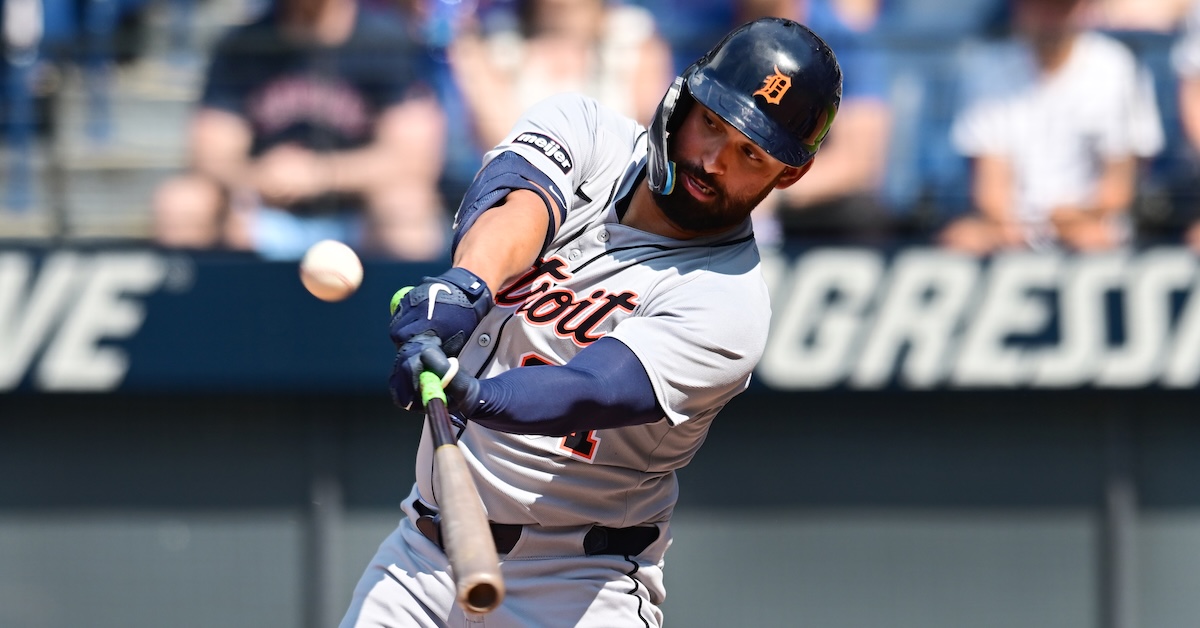
It’s also possible to do damage without making frequent flush contact; Greene shows us how. As Ben Clemens wrote just a couple of weeks ago, Greene is posting yet another excellent offensive campaign despite one of the higher strikeout rates among qualified hitters. He’s doing it unconventionally, swinging a ton in early counts to maximize damage. He’s also unconventional in another sense: He barrels the ball a ton while hardly ever squaring it up.

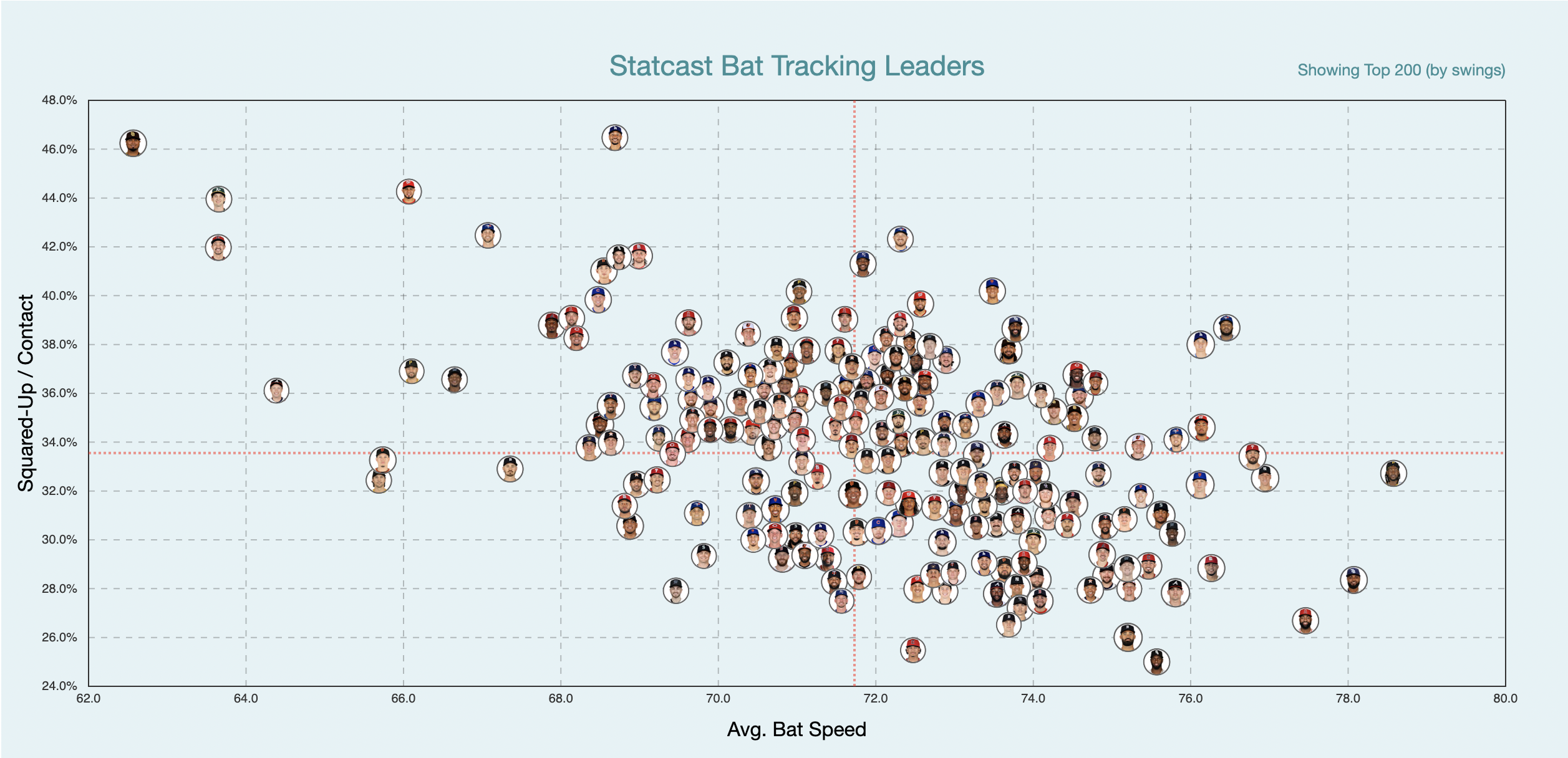
Part of the explanation for how this works is tied to the nature of swinging hard. When the bat speed statistics first dropped, it immediately became clear that there is a strong negative relationship between bat speed and the ability to square the ball up, at least by the Statcast definition. Click over to the bat tracking leaderboard, and the first thing you’ll see is this image, which shows the negative correlation between these two variables:
You Aren't a FanGraphs Member
It looks like you aren't yet a FanGraphs Member (or aren't logged in). We aren't mad, just disappointed.
We get it. You want to read this article. But before we let you get back to it, we'd like to point out a few of the good reasons why you should become a Member.
1. Ad Free viewing! We won't bug you with this ad, or any other.
2. Unlimited articles! Non-Members only get to read 10 free articles a month. Members never get cut off.
3. Dark mode and Classic mode!
4. Custom player page dashboards! Choose the player cards you want, in the order you want them.
5. One-click data exports! Export our projections and leaderboards for your personal projects.
6. Remove the photos on the home page! (Honestly, this doesn't sound so great to us, but some people wanted it, and we like to give our Members what they want.)
7. Even more Steamer projections! We have handedness, percentile, and context neutral projections available for Members only.
8. Get FanGraphs Walk-Off, a customized year end review! Find out exactly how you used FanGraphs this year, and how that compares to other Members. Don't be a victim of FOMO.
9. A weekly mailbag column, exclusively for Members.
10. Help support FanGraphs and our entire staff! Our Members provide us with critical resources to improve the site and deliver new features!
We hope you'll consider a Membership today, for yourself or as a gift! And we realize this has been an awfully long sales pitch, so we've also removed all the other ads in this article. We didn't want to overdo it.

That’s no surprise. By the Statcast definition of a squared-up ball, slow swingers will always come out on top, because swinging slower allows for greater barrel accuracy. But it’s not all bad news for hard swingers. They also tend to produce the most valuable type of batted ball: a barrel.

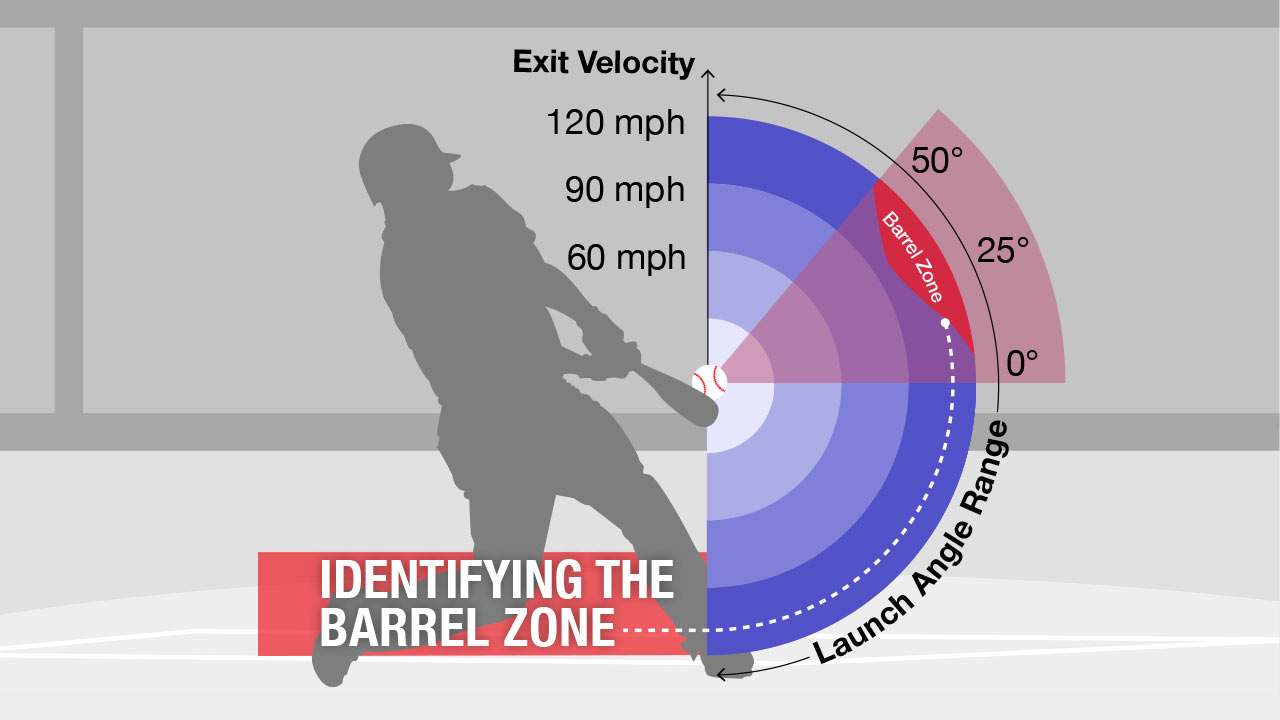
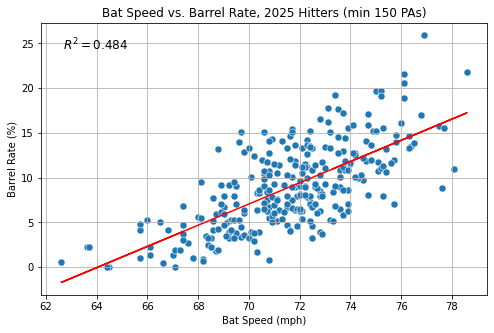
Naturally, bat speed is correlated — positively — with barrel rate. A barrel, by the Statcast definition, is any type of batted ball where the expected batting average is at least .500 and the expected slugging percentage is at least 1.500. Barrels tend to be clustered in a pretty narrow exit velocity/launch angle range, somewhere north of 100 mph in terms of exit velocity and between 15 and 40 degrees or so of launch angle:
As the scatterplot below shows, the relationship between bat speed and barrel rate is extremely tight:
Greene’s average bat speed — 75.2 mph — is in the 91st percentile, so on some level, a high barrel rate and a low squared-up rate is to be expected. Even so, the spread between these two metrics is striking. His barrel rate is higher than his squared-up rate! Only one other hitter has a lower squared-up-minus-barrel rate — Aaron Judge. And that gives a hint into how, exactly, Greene is pulling this off.

Judge racks up an obscene number of barrels. Already, he’s mashed 60 this year, good for a 25.9% barrel rate. Like Greene, his squared-up rate is low — not as low, but comfortably a standard deviation below the mean. But also like Greene, Judge is amazing at converting his squared-up balls into barrels.

Nobody comes particularly close to Judge in this metric. Nearly 40% of his squared-up balls are converted into barrels, by far the highest rate in the league. (The league average is 13.6%.) As you might have guessed, Greene also excels here, ranking fifth among all hitters with at least 150 plate appearances:

Squared-Up Barrels
Name % of Squared-Up Balls That Are Barrels
Aaron Judge 39.7%
Oneil Cruz 32.1%
Kyle Stowers 31.9%
Shohei Ohtani 30.7%
Riley Greene 30.5%
Cal Raleigh 29.1%
Seiya Suzuki 29.1%
James Wood 28.9%
Nick Kurtz 28.8%
Pete Alonso 28.7%
SOURCE: Baseball Savant
Minimum 150 plate appearances.

So that’s the first part of this equation. Greene might not square the ball up that often, but when he does, it’s frequently crushed. The other part of the equation? Greene hits a ton of foul balls.

Greene’s 315 foul balls rank fifth among all hitters. When Greene makes contact with the ball, it goes foul 56% of the time. That mark ranks 11th out of all hitters with at least 150 plate appearances; besides Cal Raleigh, nobody else in Greene’s squared-up-to-barrel cohort fouls off nearly as many balls:

Foul Ball Rates
Name Fouls Per Contact
Bo Naylor 59.0%
Anthony Santander 58.2%
Sean Murphy 57.6%
Kody Clemens 57.2%
Cedric Mullins 57.1%
Josh Lowe 56.8%
Jasson Domínguez 56.4%
Spencer Horwitz 56.0%
Cal Raleigh 56.0%
Jake Cronenworth 55.8%
Riley Greene 55.5%
Matt Thaiss 55.4%
Tyler Stephenson 55.4%
Brandon Marsh 55.3%
Max Muncy 55.3%
SOURCE: Baseball Savant
Minimum 150 plate appearances. Foul balls divided by pitches that end with contact.

All of those foul balls — in addition to his seventh percentile whiff rate — contribute to the squared-up percentage denominator, sinking Greene’s squared-up rate to the very bottom of qualified hitters. Importantly, foul balls are not part of the barrel rate denominator. The barrel rate that shows up on the Savant player page popsicles is a measure of barrels per batted ball event. A bunch of foul balls do nothing to affect a hitter’s barrel rate, but they’ll go a long way toward tanking a squared-up rate.

It isn’t necessarily intuitive to think that a hitter could be so good at barreling the ball and so bad at squaring it up. But breaking it down in this fashion, I think it starts to clarify this ostensible conundrum. Barrels are hard to come by. Even Judge, the barrel GOAT, hits one just over a quarter of the time he puts a ball in play. To be a barrel king like Judge or Greene, you don’t need to crush that many baseballs, at least on an absolute basis. But you better make sure that when the ball is in play, it gets smushed.

More than anything, I think these two data points paint a compelling picture of the modern hitter. Greene, perhaps more than any other hitter, goes for broke, almost like the anti-Luis Arraez. His swing tilt is the steepest in the sport. He mishits a bunch of pitches. He whiffs a ton. But when he connects, he does damage. And even though those damage events are relatively infrequent, they’re valuable enough to make him one of the better hitters in baseball.


Michael Rosen is a transportation researcher and the author of pitchplots.substack.com. He can be found on Twitter at @bymichaelrosen.

43 Comments
Oldest
Newest Most Voted
PC1970Member since 2024
1 year ago

“Wario great!”

sadtromboneMember since 2020
1 year ago

A few weeks ago I noticed his Statcast numbers are super weird. Out of 158 qualified batters, he is:

(I’m going to order all of these from “best” to “worst”)

8th in Barrel %
26th in EV90
54th in Hard Hit %
84th in Launch Angle
86th in Average EV

I would be very interested to see the distribution of EVs for his batted balls, but I’m guessing that whatever is happening is that he isn’t hitting the ball over 95 MPH all that often compared to his peers (95 MPH is the cutoff for the hard hit rate) but he’s hitting the ball over 100 MPH a lot.

A barrel % has a minimum of 98, and while a barrel at 98 requires a launch angle between 26 and 30 degrees. But for every extra MPH I think the window goes up 1.5 degrees (on the high end) and down a little over 1 degree (at the low end) up to some ridiculous number like 117 MPH.

That means a 100 MPH ball can be a barrel anywhere between 24 and 33 degrees, which is still quite a bit higher than his actual launch angle. But a 102 MPH ball can be between 22 and 36, so now we’re getting closer to his very average launch angle rate. A 104 MPH ball would be between 20 and 38.

My hypothesis is that he’s hitting an enormous number of balls that are between about 102 and 106 MPH. His hard hit rate is something like 45%, so if he is hitting the ball between 102 and 106 MPH 40% of the time and between 20 and 38 degrees something like 20% of the time, that could lead someone to have a huge barrel rate despite not really standing out in anything else except EV90.

In reality, he’s probably not hitting the ball 40% of the time between 102 and 106 MPH and 5% of the time between 95 and 102, he’s probably combining an ideal launch angle with his 100 MPH hits a lot more often than by chance, but I would still hypothesize that the only other players who hit the ball more than 102 MPH are guys who hit the ball way harder than him (Cruz, Judge, Ohtani, Wood, Vlad Jr) and way more than you would expect given his rate of 95 to 102 MPH.

AnonMember since 2025
1 year ago
Reply to  sadtrombone

Can’t figure percentages, but a quick Savant search shows there are 526 players who have at least one batted ball between 102 and 106 mph. Greene is tied for 41st with 33. Kyle Tucker is 1st with 54.

Add in the launch angle component and there are 425 guys who have at least one batted ball between 102 and 106 mph and 20 and 38* LA. Greene is 15th with 14. Tucker is again 1st with 27, 7 more than Rooker in 2nd with 20. (An interesting list – a lot of names you’d expect but McCutchen, Rafaela and Benintendi are all top 15. . .)

As for the 102+ leaderboard, 546 guys have at least one batted ball at 102+ mph. Greene ranks 30th with 69. Yandy is 1st with 108, 9 more than Vladito in 2nd with 99. (BTW, that means there are 20 guys with no batted balls between 102 and 106 but at least one above 106. . .)

sadtromboneMember since 2020
1 year ago
Reply to  Anon

That’s amazing, do you have a link for that? I couldn’t find it on the Statcast page.

This is indicating to me that his MPH range is probably higher than that, like 104 to 108 or something; his EV90 is 108.1 so I assumed it would be meaningfully lower than that, but maybe not.

I’d love to look at it and figure out what his batted ball distribution looks like.

AnonMember since 2025
1 year ago
Reply to  sadtrombone

It’s just using the Search feature on their website. It’s not super intuitive and there are limitations on what stats you can search and how so there is a little bit of a learning curve to figure it out.

I wish there was a way to save searches. . .

Last edited 1 year ago by Anon
Cool Lester SmoothMember since 2020
1 year ago
Reply to  Anon

I have Fielding Run Value by Pitcher bookmarked!

…along with a plug and play Excel sheet to add FRV/10 to their RA9-WAR totals.

DIPS in 2025, baby!

sadtromboneMember since 2020
1 year ago
Reply to  sadtrombone

Update, it’s this, but without the foul balls.

sadtromboneMember since 2020
1 year ago
Reply to  sadtrombone

Thanks to Anon’s tip of using the Statcast search function I was able to download all of Riley Greene’s batted balls from 2025. I gave a link to it in another comment, although I removed the foul balls.

I cut them into 3 MPH and yeah, something weird is going on. I’m going to try to upload a histogram of it, but if it doesn’t work, the link below should take you to it. Take a look at the bucket between 102 and 105. I’ve stuck an arrow pointing to it in case you’re not sure which one it is.

https://imgur.com/a/7q3LvRj

Riley Greene has 12.61% of his batted balls in this bucket alone. The bucket just before that was 5.22%; the bucket just after is 6.96%. That’s weird.

Overall, about 26% of his batted balls are between 102 and 111. That is a lot. And the launch angle on those 60 batted balls is quite a bit higher than his overall launch angle (19.75). Of those 60, nearly half of them are in the right range for a barrel (29).

Is any of this unusual for a hitter? My guess is that having about half of your balls hit between 102 and 111 being in the right range for barrels is not that unusual, since the launch angle range for a barrel expands as EV goes up. I do think that having a quarter of your batted balls between 102 and 111 is unusual unless you’re an EV monster like Aaron Judge, and Aaron Judge does in fact have 64 of those this year in about the same number of batted balls. But Aaron Judge has about three times as many batted balls over 111 as Riley Greene does (26 vs 8).

I wouldn’t be able to say for sure on this unless I saw a bunch of other hitters, but to me this is weird.

Last edited 1 year ago by sadtrombone
Cool Lester SmoothMember since 2020
1 year ago

I will say that another possible driver of the misalignment is that Squared Up rate seemingly excludes a key factor of Potential EV:

The mass of the lever being used.

Judge’s bat is 2.5 oz heavier than Luis Arraez’s, after all.

A Salty ScientistMember since 2024
1 year ago

I feel like there needs to be a bat weight normalization factor to help interpret some of the more granular things like bat speed. I’m guessing that some guys with average-ish bat speed swing heavier bats, leading to more power than would otherwise be expected. I could probably guess such things by comparing bat speed to actual EVs…

socialist
1 year ago

Lots of tiger haters have disappeared. Tigers will have the best lineup in mlb in 2026 to 2030.

Jewish PacheMember since 2020
1 year ago
Reply to  socialist

Braves will have the best lineup in MLB 2024 to 2028

— my inner monologue, circa 2023

socialist
1 year ago
Reply to  Jewish Pache

Briceno/dingler
Torkelson
Mcgonigle
Keith
Anderson/lee/Pacheco
Greene/carpenter/Meadows/clark

God

Last edited 1 year ago by socialist
CosmoMember since 2024
1 year ago
Reply to  socialist

slow down turbo… most of those guys are 50 grade or lower, not exactly a lineup full of superstars

Jason BMember since 2017
1 year ago
Reply to  socialist

You have God batting way down in 7th?! Get that fella into the cleanup spot or something

Sleepy
1 year ago
Reply to  socialist

They’re gonna need it against 2027-30 Yankee ace Tarik Skubal.

drewsylvaniaMember since 2019
1 year ago
Reply to  socialist

Does FG have people agitbotting for them?

Jay WatsonMember since 2024
1 year ago

One question this raises: what players are the best at combining high squared up AND high barrel rates? For example, if you took the standard deviation above the mean for both stats and then added the z-scores together, what players would top the list? Or if you totaled their percentile scores for the two stats?

And are those players necessarily great hitters?

Cool Lester SmoothMember since 2020
1 year ago
Reply to  Jay Watson

Juan Soto’s at 94th percentile Square-Up% and 96th for Barrel%.

He’s pretty good.

Big Daddy V
1 year ago

And next on the list with 90 squared-up rate and 81 barrel rate is… Benintendi. So your results may vary.

AnonMember since 2025
1 year ago
Reply to  Jay Watson

Not sure of a way to put both columns in a Savant Search since squared up rate is not in the search function yet – my guess is it’s new enough that it hasn’t made it’s way onto the search page. I also don’t know of a way to create a custom report on Savant’s pages.

One rough way to find a list of guys who are probably good on both is to sort by squared rate and then look at the guys who have a fast swing speed since both columns are on the same leaderboard. Of course, you need to get those squared up balls in the air for it to be a barrel. Maikel Garcia is 96th percentile for squared up but only 28th for barrels since he doesn’t hit it in the air often enough. Alejandro Kirk is a little better but still doesn’t hit it on the correct trajectory often enough to be more than average at barrels.

KyleMember since 2024
1 year ago

“swinging slower allows for greater barrel accuracy”

But also, slow swingers without barrel accuracy will not start in the majors for long. I’m not sure if that’s correlation based on selection or actual causality.

AnonMember since 2025
1 year ago
Reply to  Kyle

Was going to post the same thing and actually, there is a lower limit no matter the bat speed. Joey Gallo was a legit major leaguer at 30% Ks but out of the majors at 40%. . .

A Salty ScientistMember since 2024
1 year ago
Reply to  Kyle

Probably, but the tightness of the correlation suggests that slower bats equal more bat control, all else equal. If you look at the correlation between run value and bat speed, it is much weaker, which I think is selection bias in the same way that there’s little correlation between PPG in the NBA and height.

Tim LivingstonMember since 2020
1 year ago

So barrel rate includes all contact? Even foul balls? No adjustment for balls put into play?

danwithoppMember since 2018
1 year ago
Reply to  Tim Livingston

Barrel rate only includes balls in play. Squared up rate includes all swings. Riley Greene whiffs and fouls on a lot of swings, which drags down his squared up rate, but doesn’t affect his barrel rate, hence the massive gap in his performance on those two metrics.

GoodEnoughForMeMember since 2024
1 year ago

But then who is Luigi to Arraez (presumably Mario) and who is Waluigi?

sandwiches4everMember since 2019
1 year ago

Luigi is obviously Stephen Kwan.

A Salty ScientistMember since 2024
1 year ago

Beat me to it. For Waluigi, I would vote for Oneil Cruz.

Last edited 1 year ago by A Salty Scientist
sadtromboneMember since 2020
1 year ago

IMO Stephen Kwan and Riley Greene are much more direct comparisons, playing the same position and all.

Unfortunately there is not really anyone who looks like the opposite of Arraez who plays first base. Guys like Jo Adell and Junior Caminero are cut from the same cloth as Greene is, but they don’t play the same position at all. Maybe Willson Contreras.

Jason BMember since 2017
1 year ago

Who is Bowser for Riley Greene and Arraez?

From the standpoint of “a formidable foe”, for Riley Greene I would say definitely Simeon Woods-Richardson (0-for-12, 5 Ks) and for Arraez I would say either Aaron Civale (4-for-23, .428 OPS against) or Tristan McKenzie (3-for-22, .458 OPS against) in a larger sample, or Chris Sale (2-for-13, .385 OPS against) or Tarik Skubal (1-for-12, .250 OPS against) with worse performance over smaller samples.

From the standpoint of “a foe but Mario always triumphs in the end”, for Riley Greene I would go with Spencer Arrighetti (2-for-2 with 2 HR) or Tanner Houck if you want a larger sample size (1.633 OPS against in 10 PAs). Arraez has absolutely owned Kevin Gausman (9-for-12, 1.833 OPS against).

branflakesMember since 2024
1 year ago

When are the new power rankings coming out? Thought they are out each monday

bada87bingMember since 2020
1 year ago

I’m wondering if the combination of Riley’s fast swing speed and extreme tilt on the bat path plays into this. Given a squared up ball, we can expect a high barrel rate, since his swing is so steep.

bluestragglerMember since 2016
1 year ago

How does a profile like this age? He’s only 24 so he’s got a few years of mashing ahead but when the bat speed drops after 30, it seems like the bottom could drop out.

CosmoMember since 2024
1 year ago
Reply to  bluestraggler

I’m guessing the Tigers will be ok with 6 more years of near superstar performance.

bluestragglerMember since 2016
1 year ago
Reply to  Cosmo

If they have him for 6, indeed they will. But only 3 more for sure. I’ve been wondering why they haven’t tried to lock him up. For all we know they’ve been trying, but maybe they’re also figuring out the profile.

Cool Lester SmoothMember since 2020
1 year ago
Reply to  bluestraggler

Aaron Judge has been doing okay since turning 30.

Jason BMember since 2017
1 year ago

Riley Greene sure ain’t no Aaron Judge…

CosmoMember since 2024
1 year ago
Reply to  Jason B

Greene is better through his age 24 season than Judge was… look it up.

drewsylvaniaMember since 2019
1 year ago

This article solved my brain’s issue with squared-up vs barrel, and the stats are amazing. I loved this article.

Other tidbits I looked up while reading:

Judge has a .913 BA on liners. Absurd. But he also has a .366 BA on grounders. Which is more absurd?

(Green is .750 on liners, .323 BA on grounders)

darrylhumpsgophersMember since 2025
1 year ago

So SquaredUp% is kinda useless on its own?