
Occam’s Razor and Jackson Holliday’s Demotion
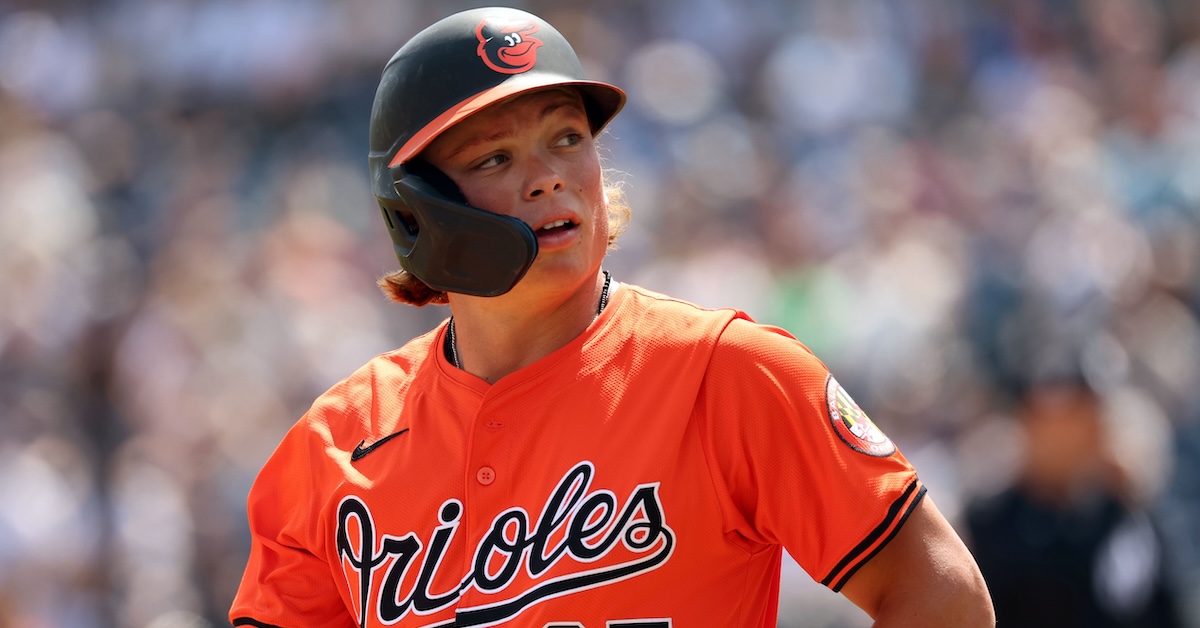
Baseball is back! Well, I guess it never really left, what with winter leagues and spring training and all. But major league games that count are back, and I’ve been parked on my couch watching as much as I can all week. Naturally, then, it’s time to talk about a guy who hasn’t debuted in the majors yet.
The Orioles are one of the best teams in the American League, and before the season, it seemed like they were going to debut one of the top prospects in the game for a third straight year. Jackson Holliday tore up the minors in 2023, and though he only got a shot of espresso at Triple-A, he was the team’s presumptive starter at second base.
At first glance, nothing Holliday did in Sarasota this spring changed that likely path. He hit .311/.364/.600 in 48 plate appearances while largely playing second base. Then the Orioles did something no one saw coming: they sent him down to the minors.
For years, sending a good prospect down for a few weeks at the start of the season – to “work on their defense” or “learn to hit lefties better” or some other fig leaf – was an economic decision. Players who earned less than a full year’s service time – 172 days out of the roughly 187-day season – reached free agency a year later, with that near-year giving them Super 2 status: an early dip into arbitration, more or less.
The most recent Collective Bargaining Agreement specifically addressed this practice by creating something known as the Prospect Promotion Incentive plan, or PPI. It’s a carrot-and-stick approach. Should a prospect win Rookie of the Year after a) accruing a full year of service time and b) appearing on preseason Top 100 prospect lists (two out of three of MLB Pipeline, ESPN, and Baseball America), that player’s team gets a draft pick just after the first round in the next draft. There are a few other ways to get that pick – winning or placing highly in MVP or Cy Young voting prior to the player qualifying for arbitration – but basically, touted rookies who spend the full year with the major league club and win awards share the wealth with their team.
The stick side of things is that players who finish in first or second place in Rookie of the Year voting accrue a full year of service time, regardless of how many days they spent on a team’s 26-man roster. Adley Rutschman, for example, didn’t get called up until May 21 of 2022, mostly due to injury. That worked out to 134 days of service time. But he finished second in Rookie of the Year voting, and you can see that he’s listed as having two full years of major league experience on his player page.
Teams have responded to this new model by starting their best prospects in the majors. If things click right away, hey, draft pick city! If they don’t, the odds are high that the team will send them down at some point. After all, they aren’t clicking. Jordan Walker debuted on Opening Day last year, but he wasn’t quite ready for prime time, and ended up accruing only 149 days of service time.
This feels like a comfortable decision for most clubs. The Orioles did it with Henderson last year, for example, and got a draft pick out of it. His case was complicated by the fact that he’d already debuted in 2022, so he was likely picking up a year of time either way, but the point is that the PPI changed team incentives, bringing them into closer alignment with prospects’ desire to make the majors earlier (and thus hit free agency earlier down the road).
That’s the background. The Orioles don’t seem to be doing that with Holliday. So what are they doing? Normally, I’d apply Occam’s Razor: the simplest solution is the correct one. But the thing is, neither of the options here are simple, or even logical:
- Baltimore’s front office is manipulating Holliday’s service time and also making a bad financial decision
- Baltimore’s front office doesn’t think Holliday is ready
You probably think there are other options. Maybe this is just some new, heretofore-unseen service time manipulation plan. Maybe there’s actually a secret way that the O’s can have their cake and eat it too. Maybe. I don’t think so, though. I can’t figure out what they’re doing, in fact. Let’s walk through why not.
First, could the Orioles be planning on threading the needle, holding Holliday back long enough that he doesn’t finish in the top two for Rookie of the Year voting while still contributing to the team? Perhaps, but that seems essentially impossible to control. The three betting favorites for AL Rookie of the Year are Wyatt Langford, Evan Carter, and Holliday. That matches our projections. The rest of the group of rookies – Colt Keith, Colton Cowser, Ceddanne Rafaela, Junior Caminero, and a host of others – are a step behind, both in the markets and according to the Depth Charts.
How many games would Holliday need to miss to drop his odds of finishing in the top two substantially? I wrote a simple computer program to assess the problem. I gave each of the top three players a 2.5 WAR/600 projection, as well as two other contenders a 1.8 WAR/600 projection. I asked the computer to simulate 1,000,000 seasons with randomness injected into each of those projections, so that we didn’t get an exact tie every time. Specifically, I bumped each projection using a normal curve with a standard deviation of 1.5 WAR per 600 PA.
If each of the top three players have 600 plate appearances given these inputs, Holliday would win the award 25% of the time and finish in second an additional 18% of the time. The same is true for Langford and Carter. The last two contenders – I called them Keith and Raffaela, but you can pick whoever you’d like, it’s just a simulation – each win 13% of the time and finish second 23% of the time.
That’s with everyone playing a full-ish schedule. Now, let’s start docking Holliday some playing time. At 550 plate appearances, he’s down to a 20% chance of a win and a 20% chance of a second-place finish. At 500, he’s down to 15% odds of winning and 22% odds of getting second. At 450 plate appearances, he’s only 11% likely to win the award, but now 25% likely to get second place. Here are those odds in a grid:
| PA | First% | First/Second% |
|---|---|---|
| 600 | 25% | 43% |
| 550 | 20% | 40% |
| 500 | 15% | 37% |
| 450 | 11% | 36% |
The issue here is that if Holliday is as good as our projections think, holding him down longer doesn’t accomplish what you might expect. It makes him less likely to win the award, sure, but he’s still fairly likely to finish in the top two if he has a good season. If he has a bad season (as determined by my variance term), he’s unlikely to finish in the top two regardless. Playing time does more to affect his chances of winning Rookie of the Year than his chances of finishing in the top two.
We can convert these percentages into dollars if we make a few assumptions. Off the cuff, I approximate that the Orioles would gain something like $20 million in value through lower salaries and increased team control if Holliday hits Super 2 this year instead of getting a full year’s service time, using these rough values for arbitration pay. A draft pick just after the first round is worth roughly $10 million. So let’s re-cast that chart in terms of dollars:
| PA | First% | First/Second% | S2 “Savings” | Draft Pick Bonus EV | EV of PPI Bonus Time | Total Value |
|---|---|---|---|---|---|---|
| 600 | 25% | 43% | 0 | $2.5M | 0 | $2.5M |
| 550 | 20% | 40% | $20M | 0 | $-8M | $12M |
| 500 | 15% | 37% | $20M | 0 | $-7.4M | $12.6M |
| 450 | 11% | 36% | $20M | 0 | $-7.2M | $12.8M |
It might look like holding Holliday down is the clear best answer, but there’s an offsetting cost: less playing time for Holliday in the 2024 season. That matters a lot! There’s also a missing benefit in that first line. If Holliday struggled out of the gate, the O’s would probably send him down anyway; they’re in a tight divisional race, after all, so they can’t afford to keep giving a struggling prospect important at-bats. They might end up giving him less than a full season’s playing time not in some plan to manipulate his time, but merely because he isn’t ready. Having him up only to send him down if he looks overmatched would mean burning an option, but if the Orioles are sweating how many options Holliday has a few years from now, other things will have gone very wrong in his development; the option will be the least of their worries.
I threw some very rough values on these outcomes based on my rough understanding of the marginal value of wins, plus a simulation of how frequently Holliday will realize an outcome poor enough to get sent down. To be clear, these are guesses. I don’t have an infallible calculator or anything. I think they’re pretty good guesses, based on win leverage and value over replacement and the aforementioned simulation, but I want to be clear that they’re only approximate. The O’s might have completely different values for some of these things I’m estimating. That’s just how it goes sometimes. Anyway, my guesses:
| PA | First% | First/Second% | S2 “Savings” | Draft Pick Bonus EV | EV of PPI Bonus Time | Lost 2024 WAR | EV of Later Demotion | Sum |
|---|---|---|---|---|---|---|---|---|
| 600 | 25% | 43% | 0 | $2.5M | 0 | 0 | $6.5 M | $9.3M |
| 550 | 20% | 40% | $20M | 0 | $-8M | $-2.5M | 0 | $9.5M |
| 500 | 15% | 37% | $20M | 0 | $-7.4M | $-5M | 0 | $7.6M |
| 450 | 11% | 36% | $20M | 0 | $-7.2M | $-7.5M | 0 | $5.3M |
Reducing the extra expected wins the O’s would get from a few weeks of Holliday to a monetary amount feels ridiculous, I know. Honestly, it kind of is ridiculous. We don’t know how close the Orioles will be to the playoff cut line at the end of the year. They could make it by 10 games, or miss the playoffs even if Holliday were up the whole time. Turning that binary into a single number is strange. You could ignore that column if you wanted, but it’s my attempt to capture the decline in playoff probability from not putting your best team on the field. In fact, maybe you could ramp that number up; missing the playoffs by a few games would be pretty devastating if there were an easy way to add a win here or there.
You’ll notice that the expected values of these options are extremely close. They’re so close, in fact, that tiny changes in my estimates of the cost or benefit of each effect could change the optimal outcome. They’re pretty close to equivalent options, in other words. And if they’re equivalent options, then the Orioles should always pick the one that doesn’t mess with their top prospect’s service time in a transparent way.
Why? There are a ton of reasons, but the most obvious one is that dealing with prospects isn’t a single-shot game. Holliday is going to be on the Orioles next year, and for quite a few years after that. Messing with his compensation in a ham-handed way isn’t free; he’ll remember it in his future dealings with the team. What’s more, this doesn’t occur in a vacuum. Everyone else on the Orioles will see what the team does with their top prospect. If you’re a fellow high performer, seeing the O’s play service games with your compatriot might make you think twice about signing a contract extension.
That’s a much bigger deal than the tiny savings you might or might not achieve by gaming Holliday’s service time to get him into Super 2 status rather than accruing a whole year’s worth of time. Contract extensions are often mutually beneficial for team and player. They give the team meaningful economic savings while providing the player financial certainty. Both sides win on that deal – but you can’t make the deal without trust, and that can get harder to come by in a hurry if you have a high-profile case of manipulating the rules of service time to limit player compensation.
Maybe this sounds like a minor effect to you, but given that the benefits of keeping Holliday down an extra few weeks are tiny to begin with, even the chance of affecting a single extension negotiation makes keeping Holliday down a bad expected value play in my book. The O’s have a lot of guys they’d love to extend in the coming years; signing any one of those players to a team-friendly deal would give them vastly more financial savings than anything they do with Holliday this year.
To put it a little more forcefully: I believe that keeping Holliday down through the Super 2 deadline would be not just a bad faith decision but a bad economic one. The savings just aren’t high enough to offset the potential future costs. The Orioles obviously will never tell us publicly if they agree with my assessment, but I feel pretty good about my math here. The new CBA didn’t completely change the calculus of service time manipulation, but it certainly tilted the scales towards calling players up as soon as they’re ready, and the O’s are in the perfect place for that tilt to matter. They’re locked in a tight race for the playoffs, their top prospect is better than the other options they have at his position, and they also have a ton of players they’re hoping to sign to extensions sooner rather than later.
The other option in this case isn’t particularly likely either, but it’s at least possible that the O’s simply don’t think Holliday is ready to play in the major leagues every day. The case here is plate discipline. Sure, he hit well in spring training, but he struck out 30% of the time with swing-and-miss numbers that suggest it wasn’t a complete fluke. He’s 20 years old and has batted only 255 times above A-ball. The presence of Henderson on the big league roster has also necessitated a move off shortstop, where Holliday had seen the bulk of his minor league defensive innings, to second base (975.1 innings at short vs. 215.1 at second entering this year). I think that Holliday is probably ready, but I’m not certain about that opinion. I’m more certain that demoting him for service time reasons is a bad call; the numbers simply don’t lie.
I’m not here to tell you which of the two scenarios is true. I don’t think either option makes that much sense. The math is no good on the service time manipulation front, and Holliday also looks ready to me. It’s clearly a very small sample, but he’s tearing up Triple-A to start the year and doesn’t seem to have a strikeout problem. Meanwhile, Tony Kemp is on the major league roster but the O’s don’t seem interested in using him. Ramón Urías looks like a weak link in the starting lineup, to boot.
Whatever Baltimore is doing, it’s strange in my eyes. If they’re trying to squeeze out a few extra dollars, it’s too much risk for too little return even if you think there are no ethical implications. If they think their super-prospect isn’t ready, I think they’re being too sure in their own assessment. Whether he needs more time or not is, in the end, unknowable. We and the team can only make estimates. Even if they think there’s only a 20% chance that he’s ready, the relative costs and benefits of finding out at the major league level suggest to me that he should be up already. We’ll never know exactly what the Orioles front office is thinking, but I’m perplexed by their decision here. The simplest explanation is often correct – but in this case, there’s no simple explanation at all.
Ben is a writer at FanGraphs. He can be found on Bluesky @benclemens.
Pirates fans will need to bookmark this article, thanks Ben.
The math for teams like the Pirates and Nationals are going to be a bit worse, given the lower probability of their incremental wins having real value.
Great analysis. It might be interesting to do a follow-up piece that considers this within the broader context of the Orioles’ logjam of promising young players. They have underutilized talent on their Majors roster already, not to mention other good to elite prospects banging on the door in AAA. Presumably the Orioles are thinking about how to optimize the entire mix of young talent. Does promoting Holliday make it harder to market/trade some of the guys already in the majors? They have a good problem on their hands, no doubt, but it feels more complicated than just optimizing for Holliday as you’ve (brilliantly) laid it out here.
The Orioles are probably fine at the moment but they could be in a weird “too much of a good thing” situation in a year from now. I think it is quite likely that Mayo, Kjerstad, and Holliday are going to work out, which gives them solid replacements for Urías, Hays, and Santander. It only gets weird if Beavers, Norby, Fabian, and others pan out as well.
True, but even then, it’s not like they’re replacing…replacement level guys. Hays or Santander still have value, so you’d need to trade them if this shuffle happens before they hit free agency.
I hope that the O’s extend Santander simply because I like his personality, but the reality is that Hays, Santander, and Urias don’t have much trade value.
The reason prospects cost so much is that the best benefit to cost ratio in baseball comes from pre-arbritation seasons. In free agency, you’re paying $5+ million per win above replacement, so even if these guys “disappoint” and only produce 1-1.5 WAR, that represents a massive savings for a small market team since they’re making less than a million per season.
Santander is about to be a free agent and seems like a reasonable DH candidate. Hays I think is a year behind. I think the real question is Cowser, who seems like he could be good but Eric is skeptical. If Mayo, Kjerstad, and Cowser all pan out it will be tough. Playing these guys at first base seems like a waste.
So this whole thing has a lot of layers. Elias and/or Hyde clearly value vet clubhouse presence, hence Frazier, hence Kemp (and Odor before, lest we forget).
I think Santander stays after this year primarily on account of the lack of vet leadership otherwise from the Spanish speaking side. This is an org that just began integrating the idea of having a presence in the DR so, even with their forward thinking of org building, they’re still Rockies level (general Rockies level) behind there.
They use the entirety of their 40 to squeeze juice and sometimes they hit (Cano, O’Hearn, Webb?) but if dudes don’t become dudes (Stowers, Cowser, Kjerstad) or if there’s a pumpkin relapse for OHearn, there’s a place on this team for Tony Taters next year. I’d honestly be shocked to not see him back, I think his value goes way beyond his numbers and I imagine he’s at worst their vet guy next year before tgey figure out what to do with Hays (going) and Mullins (staying). Mateo? Urias? F, man, no idea there.
I am buying the D and lefties argument but I think that’s probably more tertiary to Os mgmt.
Exactly. Trade any/all of Santander/Hays/Mountcastle for the best pitching it can buy and then let all the kids play. In an offseason that saw Candelairo, Gurriel, and Soler all get $42-45M each these guys have trade value.
Baltimore needs to take advantage of their 1 year of Burnes. They don’t seem to be taking advantage of all organizational talent at the moment.
Thank you Ben for diving deep into a confusing decision by the O’s.
I wonder how much of Henderson’s early seasons struggles last year inform the move to give Holliday time in AAA? Do they think Jackson, as a person, would perform better if he’s coming in with some positive momentum? Theo Epstein did mention that in his Boston days as something the org believed helped young players perform better right away (but then, years later, he did the whole Kris Bryant thing so who knows).
I also wonder if the FO believes there’s zero chance of an extension before FA so why not squeeze an extra year out of a player they’d lose by his 26th birthday otherwise.
The extension angle is most compelling to me. Jackson Holliday will almost certainly not sign an extension, not just because he’s running with Boras, but because unlike many young extension-signers, Holliday has a father who made ~$160MM playing baseball, so there’s no rush to secure the money. Will the service time manipulation poison the well for the others? Adley Rutschman and Grayson Rodriguez?
He got a pretty nice bonus too, but yes: His family doesn’t need any money. He probably doesn’t even need money.
He would be an obvious candidate for a Chourio style extension if it wasn’t for the fact that he already has a good financial cushion.
I have higher hopes for Gunnar Henderson, their other middle infield Boras client. There is something irksome about drafting and developing high quality high school position players and then not doing anything to capture their “extra” pre-30 years. But yeah, after 2023, a Gunanr extension would look more like BWJ than Chourio.
I like Gunnar but Witt is in an entirely different class right now. I had him as my AL MVP pick before the season started and nothing in 2024 has changed my mind about that. If I had to pick only one person, I would pick him as the best shortstop in baseball right now. And while Judge is better when he is healthy, as long as Judge is battling injuries I think I’d go with Witt next.
I was really low on Witt for a long time, I thought the comparisons to guys like Correa was kind of silly. But I think there’s a decent chance he is going to be better than Correa.
“The stick side of things is that players who finish in first or second place in Rookie of the Year voting accrue a full year of service time, regardless of how many days they spent on a team’s 26-man roster.”
If you’ve got a bunch of good players who might conceivably be ROY you should promote all of them at once. That way you maximize the odds you get the draft pick for having a player win the award, and ensure that some of your rookies mathematically can’t place first or second. The slow dribble means you might have a ROY contender several years running!
Interesting way to play it. In 2024, the incentives are different for the Nationals than the Os because 2-4 wins just aren’t as valuable for the Nats, but there was some noise about James Wood making the team out of spring training. They also have Dylan Crews, who looked less ready but is still a top 10-15 prospect by most raters. They are playing Jacob Young now that Victor Robles is down, and they are playing veterans on 1 year contracts in left with the hope of a deadline prospect deal, but the question pops up about their debuts. It probably makes the most sense to hold off until 2d half of August to avoid exhausting RotY status in 2025 and then have both start 2025 on the active roster, along with possibly Brady House if he has a good year. That’s in contrast to trying for the RotY bonus 3 years running spreading out their top prospect debuts over 2024-2026.
I’m really hoping that the calculus is just that the Orioles looked at the start of the schedule and saw that there are a lot of lefty starters projected to face them in the first 3 series. My understanding is that the PPI can still be awarded if the player isn’t on the opening day roster, so long as they accrue 172 days of service, which can be done with a call up around April 10.
Maybe they didn’t feel comfortable throwing him out against a bunch of lefties off the rip but still wanted him to get everyday PAs and decided to send him to AAA for 2 weeks and then call him up once they get passed the early stretch but 172 days is still possible.
They’d never say all of this publicly, and its very well possible (I’d say likely) that this isn’t the case and they’re just making several bad decisions, as Ben outlines.
Either way, it’s all just very confusing.
This is what the GM said when they announced they were sending him down.
This is what I’m hoping for – we’ll know shortly.
To me, this is the simplest answer. The Orioles face 5 lefties in the first 9 games, then start a stretch with just 2 lefties in the next 12 starting with the Red Sox on Tuesday. By having Jackson skip that unusual stretch in the schedule after going 2-14 with 9Ks vs LHP in ST, gives him the best chance to succeed early in his big league career.
As Ben points out, the benefits of keeping him down if he’s ready aren’t there. This front office with a new owner doesn’t seem likely to be making a blunder like that. But time will tell.
turns out this was the case
Yep. Good analysis. Thought of this comment as soon as a friend sent me the news
Is anyone else disappointed with Holliday’s AAA performance so far this season? I know it’s only been 5 games, but you can see where the Orioles are coming from re. Promotion when he’s only hitting .400
Probably needs to work on his defense, too.
The only way this is complicated is if you think he’s ready and can’t understand why the Orioles would think that. If you accept that’s what the Orioles think then it’s a lot clearer.
Eric had said that while his defense projects well it is in iffy shape right now, so if he’s not going to come out and hit super well then he might not be in good enough shape to play every day. In that case he might as well stay down there to play every day. And furthermore, if they really don’t think he is ready then the PPI situation is moot.
This whole thing seems like such a mountain out of a molehill. It’s completely plausible that the Orioles are legitimately concerned about his defense, and not in a ‘Kris Bryant needs more seasoning’ way, but actually legitimately concerned.
The risk of him starting the season with an enormous amount of hype and flailing as not ready for primetime is high. If he comes up a bit later when they can pick and choose the timing it’s a lot easier to deal with it if he struggles.
Isn’t that the Occam’s razor answer? Instead of that one of the smartest FOs ever is making an obvious blunder?
You’d have to think the “they’ll remember this in future negotiations” plotline is a non-issue– you don’t mention it, but there was never going to be a *good vibe* discount for the Orioles come free agency, not with Scott Boras representing Holliday and Gunnar.
After the off-season he’s just had, is Boras a bit vulnerable? I wonder if the Yankees, for example, offered him a $400 million extension for Soto, would Boras actually go for that, so he could go to his clients: “look, I can still get you all the money”.
Boras would almost certainly turn it down… but after allegedly turn down the Snell offer from the Yankees (might just have been media speculation), and the Chapman extension from the Blue Jay’s (again, could just have been speculation), he wouldn’t be human if he’d have a few nagging doubts.
Boras/Soto already turned down a $440M contract offer when he was more than two seasons away from free agency. They’re not going to accept less than that on the cusp of entering the market having barely turned 26.
If he really wants to stay in NY, then sure, he would take it. An extra $50M or whatever isn’t worth the risk, especially if he’s happy there. But if there are a dozen different places he could see himself playing, then it’s iffy.
“I’ll remember this!!” has been threatened many times, but almost always ends up overblown. We’re talking about 6-7 years from now, at which point so many other overwhelming factors will have arisen.
Kris Bryant may have been the one dude for whom “I’ll remember this!!” may have applied since his being held down was so transparent and bloody, but he heavily declined, then was traded, then was offered an absurd contract by Colorado.
Ben, I agree with you that the calculus of sending him down makes little sense for all the reasons you enumerated. Elias is a savvy guy who understands the nuances you point out so I can only conclude that the Orioles don’t think he is ready. And I agree. I watched him play a number of games in Spring Training, and he was overmatched at times, especially against lefties. His two home runs were hit with the wind blowing out, and even his triple was a ball lost in the sun. So I am inclined to take Elias at his word–he has always seemed a pretty straight shooter to me, making no pretense about the rebuild or the horrible state of the Orioles’ organization when he took over. That he is benefiting from Henderson being promoted last year (and they were certainly going to being the year with Rutschman until he got hurt) tells me that they see the calculus as you do. We are talking here about a young man who just turned 20 and has very few at bats in the minors, and ridiculously few about High A. I am suspending my abiding cynicism about management in this case. In fact, in watching Spring Training, to me the better question was “why is Mayo going back?” (Though with 3 errors in the first two games I think I have my answer.) One thing is for sure, unless the O’s get something from Urias and Kemp offensively soon, we are going to see movement. And I might include Hays in that as well. Elias is in win now mode, not in eke out another year of Holliday mode.
Holliday isn’t ready. He led the team in strikeouts during spring training, and he was absolutely hopeless against left-handers. Meanwhile, he is very much a work in progress defensively at second base.
Mike Elias isn’t worried about what happens seven years from now, as it’s unlikely than a GM would still be in the same job after that much time. He is making decisions based on what is best for the team this season, and what is best for the player over the next three seasons. Right now, Holliday needs to be in an environment where he can play every day and work on his flaws, so that he can become the best version of himself in 2025, 2026, and beyond.
I saw Holliday play on Tuesday, and he was max effort swinging on almost every pitch, missing most of them in the zone, resulting in three more strikeouts. I get why people would assume that this is service time manipulation, especially when looking at the surface numbers, but I genuinely do not believe that is why Elias sent him down.
1) Agree that a little extra time at 2B, and facing tougher LH pitching can only help Holliday.
2) Tony Kemp aside–and calling up Holliday to be the 26th man makes no sense–the Orioles value everyone and the roster, and calling up any of the young studs means giving away someone–to me that is the Occam’s Razor factor.
3) All that being said, he will be up by May 1–unless they call up Mayo first, given the need for RH hitting.
4) In Elias we trust!
Look, I agree Holliday should be up. I thought he should be up last year. I thought it was stupid when this website threw up their hands in the trade value column last year and arbitrarily decided they were only going to rank one minor leaguer, and if they were going to do that the one minor leaguer they decided to pick is the guy who is likely to strike out 35% of the time in the majors.
But he’s 20 years old and the Orioles are not lacking for infielders at the moment. I recall the Jarred Kelenic discussion. He had an actual motive to point to! And it was irrelevant, because Jarred Kelenic was not good and not ready.
You used Jordan Walker as an example in the column. Jordan Walker is a pretty bad outcome!
Occam’s Razor is actually: Organizations are going to be risk averse because risk is scary. If Jackson Holliday starts the year on the Orioles and goes 1 for 20, they’re going to get blamed for rushing him and if he never turns it around, for ruining him. If Jackson Holliday starts the year hitting .400 in AAA, gets called up in a couple weeks and wins ROY, there’s a little teeth gnashing about it for two weeks and then everyone forgets about it. If Jackson Holliday is just kind of whatever in AAA, everyone shuts up about him and it sorts itself out.
Occam’s razor would suggest that we should just take Elias at his word and that JH needs a little more time at 2b. I also think there’s a psychological component — it’s possible he didn’t want the opening of the season for a team that won 101 games last year to be dominated by news and questions about JH. IOW, let the vets have their moment.
The main reason given for Holliday to start the season in Tidewater is that he looked completely lost at the plate against major-league left-handed pitching: https://www.thebaltimorebanner.com/sports/orioles-mlb/jackson-holliday-sent-down-orioles-why-LMGUHSNA3FDAVE3SQHPAUZC3DE/. Holliday has confirmed this: https://www.thebaltimorebanner.com/sports/orioles-mlb/jackson-holliday-orioles-triple-a-norfolk-DXPE7CTYYZGR7BZTDUGJOBY7XM/. His struggles with lefties were the source of the strikeout issue mentioned in this article as Holliday struck out in 9 of 14 plate appearances against lefties during this year’s spring training.
As Ben points out, the O’s other options at either 2B and 3B (depending on which Westburg is playing) are not particularly credible. I expect, therefore, we’ll see Holliday on the O’s roster sooner rather than later. Hopefully soon enough to minimize any adverse impact on future contract negotiations (with Scott Boras or with other players’ agents).
This. It’s weird that this article doesn’t directly mention this which was a series of defensible explanation from the O’s. And the Orioles face a ton of left handed pitching to start the season. Why would a playoff-competing team, put their top prospect who can’t hit lefties on the roster simply to sit on the bench, when they can basically continue his spring training so he becomes comfortable both defensively and not simply be platooned? We want to see the best propsects perform at the big leagues, but we need them to improve and don’t want them to become frustrated and burn out like so many other top prospects.
Why would a writer write an piece detailing the boring truth when a conspiracy catches more eyeballs and attention…especially if said conspiracy is about teams (read: greedy owners) screwing over poor players?
It’s blatant service time manipulation. They’re running out 2/3 of Ramon Urias, Tony Kemp, and Jordan Westburg on a daily basis. I mean they manipulated Adley’s service time and got burned by the new RoY rules. I don’t see how anyone can see it as anything else. The Rangers pushed their highly touted prospect in Langford on their OD roster, but the Orioles chose to keep theirs down and probably get an extra year of control 6 years from now lol.
Wyatt Langford is two years older, and didn’t hit .143 with a 60% K rate against LHPs this spring.
Spring training stats in a tiny sample size? Lol alright man.
Also age is inconsequential. One was drafted out of college and one out of high school.
They didn’t manipulate Adley’s time. He got hurt, and the rules for PPI would have required that they add him to the roster just to add him to the major league IL, which given that he was going to be out for months would have been a stupid decision, even though it would have worked out in the end.
I would argue that if they had put him on the roster arbitrarily when he got hurt, THAT would be the manipulation of the rules.
No he should’ve been up the year prior in 2021. He destroyed the minors in 2021 and needed an MLB challenge yet they held him down. They manipulated his time there with the intent to hold him down in 2022 until the deadline passes. But lucky for them, he got hurt and didn’t have to call him up.
I get that Orioles fans are downvoting me, but this is 100% service time manipulation (again).
Your homerism is showing so much that you don’t even realize *when* his service time was manipulated.
The Jackass guys have gotten old. I remember when they would suffer real physical pain instead of pranks that merely netted lots of downvotes.
It looks like the Os are about to mess up the service time manipulation if that was the reason.
This is a good analysis. I agree with the analysis that the EV of holding him down a few weeks is ~$10MM.
I personally think $10MM is a lot of money to a team like the Baltimore Orioles and that bird in the hand is worth a lot more than the potential “costs” of looking like a service time manipulator. There’s enough cover here with Hollidays age and limited AAA experience and position change that I think they can “get away with it”.
Teams routinely run the risk of pissing off players in arbitration hearings over a lot less money than $10MM.
The question about whether Holliday should be in Baltimore instead of Norfolk is only part of a huge problem that confronts Elias. It is both a problem and an opportunity that the Orioles GM faces and how he sorts it out will determine the future of a lot of the teams throughout baseball. The vast amount of potential talent that is residing on the Tides roster will eventually end up distributed amongst other teams? Last night the team put up a 26 spot on the Charlotte Knights and all of the young mashers are carrying OPS over 1,000. It has been suggested that he wait to see how these prospects play before making a decision but that can’t go on forever. I make no claim about having any idea who is going to be great and who is going to be Monte Harrison. When the time comes that Elias is forced to move does he trade Hays or Kierstad, Santander or Mayo. Mullins has value and a package of Mountcastle, Meteo and O’Hearn along with a lottery ticket could get something back. Will average major leaguers get a better return than unproven, but touted, prospects? If all the kids at Norfolk continue to perform very well will the fan base raise enough of an uproar to force Elias’s hand. The Orioles could use more pitching but I would be terrified to trade any of these prospects in light of the fact that it appears more and more arms are falling off. Giolito, Alcantara, Cole and today, Eury Perez just to name a few. Will the new ownership give Elias more room to maneuver? Lots of questions and some tough decisions await.
I agree with most people here that Occam’s razor is that the Orioles do not think Holliday is ready. There have been plenty of top prospects that were “rushed” to the majors in hindsight with Vladdy Jr. being a recent example.
Also, one of the reasons why the math does not make sense is that you are assigning $7.5M to 150 PAs of a 20 year old Holliday. I have a hard time believing that is close to a hypothetical market price.
I think, and hear me out, that the people who are paid lots of dollars to make decisions specifically about baltimore’s organization probably know more than we do and thus are better able to make an informed decision about the subject.
Yes, absolutely. However, it’s still fun as a fan of baseball to discuss our reasons why we would or wouldn’t do a thing if we were running a team. Also, Jeff Sullivan and Dave Cameron are both currently working for major league front offices because their analysis was widely respected in the writing/blogging side of the sport for years. You may have heard of them.
In an ideal world, the O’s front office reads this article, promotes Holliday, and issues you a check for saving them a significant sum.
O’s F.O.: No, but we’ll send a fruit basket.
Excellent article. Thank you.
You can’t just directly convert value into money like that. The Orioles may be so desperate for a 7th year of control over Holliday that they only plan to keep him down for 2 weeks and just hope he doesn’t finish in the Top 2 for Rookie of the Year.
While it doesn’t make sense from an expected value analysis, it does make sense if you consider that the potential reward could be so valuable to them that it’s worth the risk of it backfiring on them just to have a decent chance at keeping Holliday for an extra year and at less than full market value.
Orrr the Orioles just have a lot of players ahead of Holliday that (right now at least) can perform at a similar level and need some exposure to boost their trade value so the Orioles can, say, trade for another pitcher.
Holliday is good (now) and is likely to be very good (later). For a number of teams, Holliday would be an improvement right now on someone. If Jackson Holliday played for 25+ other clubs this would be a no-brainer, but this article doesn’t touch on opportunity cost. The Orioles are stacked on the position player front, so Holliday won’t be displacing a replacement player, but someone rather good.
So starting the season with Holliday up means that you are starting his service clock now (not ideal), and displacing a decent sized opportunity cost. This opportunity cost is some combination of the value you lose from PAs that don’t go to Santander/Mountcastle/Ortiz etc and whatever value their trade auditions might accrue.
Giving Santander/Mountcastle/whoever 2 months to shine, trading them and then getting an extra year out of Holliday is better than bringing up Holliday now, for a marginal net gain, losing the year of service time, and punting on whatever the guy who Holliday displaces would give you.
Occam’s razor here is that Holliday is either not one of the Orioles best position players right now or insufficiently better than whoever he would displace to be worth every other cost that his promotion would entail…
Holliday would be replacing Urias in the starting line up, and lead to one of Kemp and Mateo getting demoted and the other to receive even less playing time. All three players are essentially replacement level players, and not rather good.
The cost of promoting him out of spring training versus midseason or September is almost entirely negated by the fact that he’s immediately a strong ROTY candidate. If he wins that award, the Orioles get another 1st round draft pick. That’s very valuable for an organization that’s so far been excellent at drafting and developing quality players. There’s hardly any excuse for the Orioles to keep Jackson down other than his “lack of professional baseball experience,” which is nearly utter BS to me because his dad is Matt Freaking Holliday, and has probably been in and around major league clubhouses since he was an infant.
Occam’s Razor without a solution? Very disappointing. There’s a lot of solid reasoning here, but no conclusion. I wish I hadn’t wasted at ten minute read here (mostly spent trying to comprehend the logic, which was solid, but I like to dig it.)
I have no better idea of why Jax Holliday is in AAA than I did yesterday.
Did you use the exact code as posted in github? I’m not 100% sure if I’m reading it correctly but it looks like the code as posted will give all ROY candidates a stdev of 2 WAR, not 1.5.
Yeah, also noticed that. I am pretty sure the top2 %s are also marginally off, because the way second-highest is computed returns the second-to-last value in the array.
Hopefully this comes back to hurt them and they miss the playoffs by two wins.
First of all, what a weird and uncalled for thing to say, even if you’re a fan of one of their hated rivals. Second, they won over 100 games without him last year, have Burnes frontlining the rotation, and have such a deep system that they’ll be able to throw their weight around at the deadline. The chances of the Orioles missing the playoffs are so low that it might as well be zero.
Agreed. What a low thing for them to do.
The 2007 Brewers held Ryan Braun in the minors and he got only 492 PA in the majors. He hit for a 154 OPS+. Baseball Reference has him at 5 Batting WAR.
Unfortunately he attempted to play 3B in order to keep Geoff Jenkins in the lineup. Braun racked up a cool negative 3 Defensive WAR.
The Brewers finished 2 games out of the playoffs. They learned 2 valuable lessons. 1) Play your best players. 2) Do not let Geoff Jenkins dictate where they play.
Maybe the Orioles shouldn’t let Ramon Arias dictate whether or not Jackson Holliday plays.
one anecdote is not data
True. It’s datum.
Yeah. Orioles fans are trying to convince themselves that *checks notes* Ramon Urias and Tony Kemp are the reason Holiday is in AAA. Loser franchise.
Any chance they think Holliday is unlikely to win Rookie of the year this year, but could next year?
Thanks for this article, Ben! This exact concept has been the subject of a few conversations I have had, so great to see someone put numbers to it.
I am unsure on the math on probability “EV of later demotion”, though. If I understanding correctly, this assumes the opening day callup scenario has a 30% probability of sending back down mid season to gain the extra year back. There are two issues here:
1) 30% odds of demotion combined with ~70% odds of being top 2 ROY means that Holliday either is good enough to be top 2 or he is sent down. There has to be probability that he is a fine player but not good enough for ROY, like Volpe last year. Citing Walker is fine, but Walker was below replacement level in his first stint. If we assume 70% ROY is correct, demotion has to be a far lower outcome -probably less than 10%
2) If Holliday is Walker-level bad, that impacts his expected value in super 2. I don’t think $20M is a fair assumption for those super two savings. That gets far more complicated of math because it needs to factor in out-year dev curves, but half that in savings seems more reasonable from the cuff.
10% chance of actualizing $10M in savings brings us to a number of $1M in EV of later demotion, making a later callup much more economically viable.
All this gets to, I think the math supporting later callup has a bit wider gap than is presented here. The points remain on why OD callup might still be the best choice, but I think it’s unfair to say it makes no sense from an economic perspective.
The O’s could have saved face by calling Holliday up in time for him to get 172+ days on the major league roster, but all most of them care about is saving money.
Good thing for the O’s then that they called Holliday up in time to get the required days on the major league roster.