The Current Simplicity of Pitching to Puig

There’s always a risk that comes with pre-writing. I’m writing this Wednesday afternoon, about Yasiel Puig, even though Puig hasn’t yet begun his game Wednesday night. I can’t know what’s going to happen. Puig might have the game of his life! Or he might hijack a blimp. Life’s a mystery. But what I know is that I’m writing about the Puig who’s batting .235. The Puig with a 78 wRC+ that would very easily stand as a career low. Maybe Puig snaps out of this in between writing and publishing, but what’s happened has most definitely happened, so now, a discussion of that.

You might’ve noticed by now that I take a lot of interest in the way that good hitters get pitched. Puig’s been pitched in a certain way, and it’s remarkably uncomplicated. A couple weeks ago, Dave Roberts said Puig’s been hurt on fastballs in and soft stuff away. Pretty much. And that’s also kind of a traditional blueprint, but it’s been aces against Puig to this point. We have the overall numbers, and we have the idea from the manager. Let’s now get into some deeper evidence.

Read the rest of this entry »


Max Scherzer Made History

Max Scherzer just threw a complete game in a victory over the Detroit Tigers. That’s not the important part. The important part is that the outs went like this:

  1. Foul out
  2. Strikeout
  3. Strikeout
  4. Strikeout
  5. Strikeout
  6. Strikeout
  7. Strikeout
  8. Strikeout
  9. Strikeout
  10. Strikeout
  11. Ground out
  12. Foul out
  13. Strikeout
  14. Strikeout
  15. Fly out
  16. Ground out
  17. Strikeout
  18. Strikeout
  19. Fly out
  20. Strikeout
  21. Strikeout
  22. Strikeout
  23. Strikeout
  24. Strikeout
  25. Strikeout
  26. Strikeout
  27. Fielder’s choice

Sorry, I just had to see them all laid out like that.

Read the rest of this entry »


How the Mariners Became AL West Favorites

This isn’t my own subjective interpretation. When you throw around a word like “favorites,” that opens the door to opinion-based writing, but I have numbers on my side. Sweet, sweet, precious numbers. Look at the following table. You have our preseason projected win totals, and our current projected win totals, which take into account everything that’s happened.

Projected Wins, 2016 AL West
Team Wins, Before Wins, Now
Angels 81 74
Astros 88 82
Athletics 79 77
Mariners 82 86
Rangers 79 81

We liked the Astros a lot. Still do, but they’ve done themselves considerable harm. After the Astros, there was a group of four teams, all vying for second or last. The Mariners have emerged through the early going, and now they’re well out in front. Sure, that’s just us, but if it makes you feel any more trusting, PECOTA agrees. Projections still like the Astros, but the Astros are way behind the Mariners, just because of the games in the books. So the Mariners find themselves in a great divisional position. Getting to the point faster: This.

playoff-odds-al-westA lot has gone into that picture. Let’s talk.

Read the rest of this entry »


Marlon Byrd on His Career Arc and Mechanics

Marlon Byrd has been around. Drafted by the Phillies out of Georgia Tech in 1999, the 38-year-old outfielder is in his 15th big-league season. The Indians, who inked him to a contract in March, are his 10th team.

Byrd has never been a star, but he’s had a solid career. His slash line over 6,066 plate appearances is .275/.329/.429 and he’s recorded 504 extra-base hits, including 156 home runs.

Eno Sarris wrote about Byrd a year ago this month, largely through the lens of former teammate Justin Turner. Last week, I caught up to Bryd to get his own perspective on the notable adjustment he made in 2013, and the overall arc of his career.

———

Byrd on playing at age 38: “What’s different is that I have more confidence and a higher baseball IQ. It’s knowing instead of trying to figure out. It’s the same process as far as the way I go about my work. I’m just better at it now, because I have more experience.

Read the rest of this entry »


Let’s Watch a Pitcher Break the Rules and (Sorta) Get Caught

A a writer, you typically have an agenda when you approach a major-league hitter in the clubhouse. Literally. Even me! I try to keep it open-ended — and avoid the old “can you talk about how important player X is so that I can finish up my piece on him”-type questions — but I still have a (loose!) narrative sketched around some key stats when I step to a player. It’s called research.

Sometimes, the player has an agenda, too. Maybe that’s wording it too strongly. Sometimes, the player doesn’t want to answer your questions and has something else on his mind. That’s better.

That describes what happened when I talked to Josh Donaldson last night before a game against the Giants. He was obviously thinking about the night before, and when I brought up an old conversation about his two-strike approach, and the deception between Zack Greinke and Paul Konerko, he started talking about pitchers not following the rule book.

I let him run with it.

Read the rest of this entry »


Angels Trading for Jhoulys Chacin

The Angels season has been wrecked by injuries, most notably the season-ending injury to Garrett Richards, leaving them with a big hole in their rotation. And with no pitching depth in the minors, the team has been scrambling to fill the hole. Today, apparently, they found an outside option.

Jhoulys Chacin has strung together five encouraging starts from an xFIP perspective, cutting his walks and upping his strikeouts while still getting his regular share of ground balls. His ERA is ugly, but that’s mostly due to a high BABIP and low strand rate, things that haven’t been a problem for Chacin throughout his career; his career 3.82 ERA is 23 points better than his 4.05 FIP/xFIP. So there’s no real reason to think Chacin’s got a new found contact problem, and if any of his strike zone improvement is real, he could be a decent back-end starter again.

Of course, Chacin isn’t going to save the Angels season, which was probably over even before Andrelton Simmons also was lost for the next few months. He will make their rotation less terrible, but he’s not going to make it good, so hopefully they didn’t give up too terribly much for a rotation stopgap in a lost season. But if they didn’t give up much, then it wouldn’t be clear why the Braves — who also have a terrible rotation — would give Chacin away. So we’ll see what this ends up being. Chacin probably isn’t anything special, but he’s at least interesting enough to acquire and see what he turns into. Of course, those are reasons the Braves could have kept him too.

We’ll see what this turns out to be once the final details are announced.


Weak Free-Agent Class Gets Weaker Sans Strasburg

Next year’s free-agent class is going to be weak. It was going to be weak before Stephen Strasburg opted out of it. It was going to be weak before Adrian Beltre opted out of it. It might have been strong if Madison Bumgarner, Freddie Freeman, Buster Posey, Chris Sale, and Giancarlo Stanton hadn’t opted out of the class much earlier, but we’ve known for a while now that this year’s free-agent class was not going to be strong. Without Strasburg, the pitching class will be one of the weakest we have seen in recent history.

The position-player side of this year’ free-agent class won’t be strong, but between Jose Bautista, Edwin Encarnacion, Carlos Gomez, and Josh Reddick — along with Yoenis Cespedes and a resurgent Dexter Fowler opting in to next year’s class — there will be handful of above-average players available for teams looking to add an extra bat. On the pitching side, that will not be the case.

After Cespedes signed his three-year contract with the New York Mets, I took a look at the free-agent class Cespedes was entering. With Strasburg gone, Cespedes is likely the top free agent and the only one projected for more than four wins this season. The pitching side looked even worse, as I wrote in January:

Next year is a good year if you want to get a closer on the free-agent market, but if you want an a pitcher approaching an ace level, it is Stephen Strasburg or bust. James Shields would need to opt out of his contract. The same holds true for Scott Kazmir, who got $48 million in the current market. Brett Anderson accepted the qualifying offer this year. The top of next year’s class looks a lot more like the middle of this year’s, and the middle next year looks a lot like the lower-tier options from this offseason.

Aroldis Chapman and Kenley Jansen will be free agents, but when it comes to starters, there’s not much to go around. Last year’s class was topped by Zack Greinke and David Price, but Johnny Cueto and Jordan Zimmerman weren’t terrible fallback options. Zimmerman put up three wins above replacement last season and he received the fourth-largest contract of the past offseason. Unless a pitcher dramatically exceeds his current projections there won’t be any pitchers who put up even a three-win season this year. The only pitcher currently projected to produce more than 2.1 WAR this season is a 36-year-old pitcher who recorded no major-league starts for a period of six years between August 2009 and September 2015.

Read the rest of this entry »


Josh Donaldson Has Gone Full Edwin Encarnacion

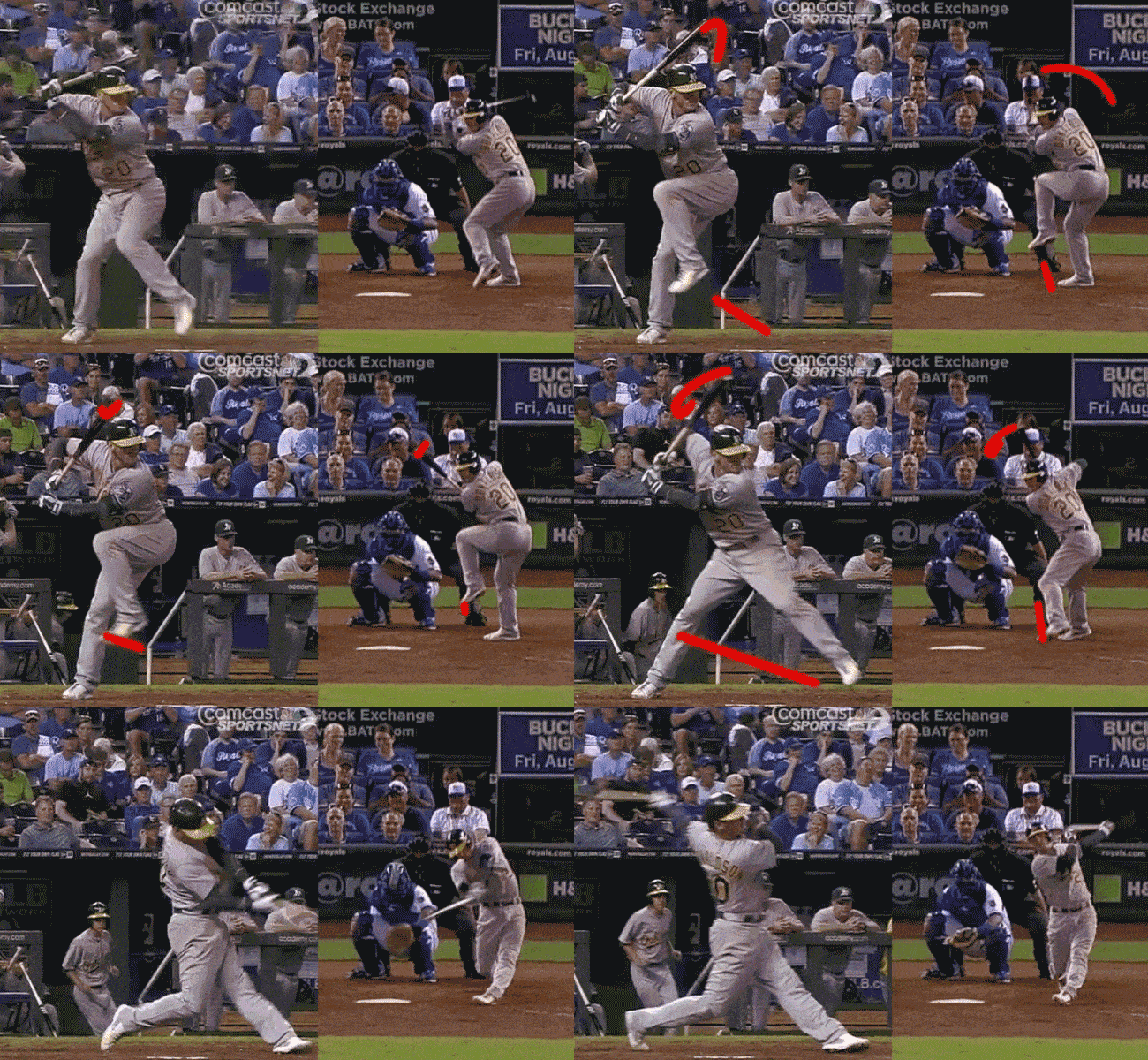
Nothing about Josh Donaldson being great is surprising anymore. There was the late-career breakout in 2012, and then confirmation that the breakout was real in 2013-14. And then, of course, he won the Most Valuable Player award in 2015. We love stories about unexpected rises to prominence more than anything else, and that’s true within baseball and outside of it. Once a player reaches the elite and stays there, the story of the rise fades away, and consistent excellence has a strange way of becoming almost routine — whether it deserves it or not. (Note: it does not.) The really fun part comes, however, when great players do things to try and make themselves more great, pushing themselves past the already absurdly high plateau. From what we’ve seen so far this season, Donaldson appears to be embarking on that hallowed and honorable mission.

First, a little background to what we’re talking about. Donaldson based his breakout on better patience, all-fields power, and a few aggressive mechanical changes. Those mechanical changes were based on the leg kick and bat tipping of Jose Bautista, so it was a nice coincidence when the two were united on the Blue Jays last season. Here’s a couple GIFs that visually explain some of those changes, from a 2014 interview with Jerry Brewer:

2013 swing — smaller leg kick, controlled bat tipping:

091313_Controlled

2014 swing — bigger leg kick, aggressive bat tipping:

081214_Aggressive

The latter swing is more of the hitter we know today — the guy who consistently murderizes baseballs — and we can see the quite obvious visual similarities to Bautista’s swing. It’s also the swing that, along with his great defense, vaulted him into the top of the WAR leaderboards over the past few years. Since he joined the Jays, however, Donaldson’s batted-ball tendencies have trended more toward his other power-laden teammate, Edwin Encarnacion. There’s certainly potentially something to gain from him moving more toward Encarnacion’s approach, as it has mimicked the sort of trajectory a number of players follow during single-season power surges. Here, allow us to consider how.

Read the rest of this entry »


We’ve Probably Been Underestimating KBO Hitters

Last year, Jung-ho Kang became the first hitter to make the transition from the Korean Baseball Organization to Major League Baseball. To say it was a success would be a remarkable understatement, as Kang put up a 130 wRC+ on his way to a four win season and a third place finish in the NL Rookie of the Year balloting. Considering that Kang will cost the Pirates a grand total of $20 million, posting fee included, over the five years for which his contract runs, his signing was probably the best transaction any team made in 2015. The Pirates bet on a quality KBO hitter paid off in a massive way.

Thanks to Kang’s success, the door opened for more KBO hitters to follow, and this year, Byung-ho Park and Dae-ho Lee have joined Kang in the big leagues. But it’s not like Kang’s success led to instant riches for the pair; Park got a four year, $12 million deal from the Twins with an option that could push it to 5/$18M, and Lee got a minor league deal that would pay him up to $4 million if he made it to the big league roster and hit all his incentives. Teams were more open to KBO hitters — and in Lee’s case, a KBO hitter who had already made the transition to the more difficult NPB league in Japan — but the contracts suggest plenty of skepticism about the expected production levels from both hitters.

It’s obviously too early to be making any kind of declarations, but here’s what Park and Lee have done in their first six weeks of action.

Byung-Ho Park and Dae-Ho Lee
Name PA BB% K% ISO BABIP AVG OBP SLG wOBA wRC+
Byung-ho Park 102 8% 30% 0.300 0.283 0.244 0.324 0.544 0.368 138
Dae-Ho Lee 50 6% 16% 0.326 0.242 0.283 0.340 0.609 0.397 164

Park has 22 hits; 12 of them have gone for extra bases. Lee has 13 hits, and five of them have gone for extra bases, but they’ve all been home runs. Between them, they’ve launched 12 home runs in 152 plate appearances; Nolan Arenado currently leads the big leagues with 12 home runs in 145 plate appearances.

Now, they won’t keep hitting bombs at this rate. Lee’s HR/FB rate is a hilarious 46%, and Park is at 28%; the highest sustained HR/FB rate any hitter has put up during the last decade is Giancarlo Stanton’s 26%. Chris Davis, who is generally considered to have 80 power, has had 24% of his fly balls leave the yard during his career. Adam Dunn was at 22%. Chris Carter is at 21%. Bryce Harper and Mike Trout are at 20%. This is the reasonable range for top-of-the-shelf power hitters, and both Park and Lee are surpassing those levels, making it almost impossible to keep hitting for as much power as they have.

But power is also something that is very hard to fake, and the fact that both guys are showing off this kind of power suggests that they’re better equipped to handle MLB pitching than was advertised. While Lee has certainly benefited from being platooned — 60% of his at-bats have come against lefties — and Park’s contact rate might limit his upside even with real power, these guys both look like average-at-worst MLB hitters, and Park is probably a good bit better than that.

Combined with what Kang did in his first year in the big leagues, it seems likely that MLB teams have been overly skeptical of KBO hitters. And the three teams who were willing to make small bets on their ability to hit MLB pitching may get rewarded in a big way.



Dave Cameron FanGraphs Chat – 5/11/16

12:02
Dave Cameron: Alright, let’s do this.

12:02
Ben: Cubs vs Red Sox World Series.

12:02
Dave Cameron: Certainly possible. Probably even the most likely option at this point.

12:03
Dave Cameron: But most likely WS match-up is still like a 100-1 shot or something.

12:03
Drew: Having trouble finding the Trade Value series. What am I doing wrong? Also, when do we get new ones?

Read the rest of this entry »