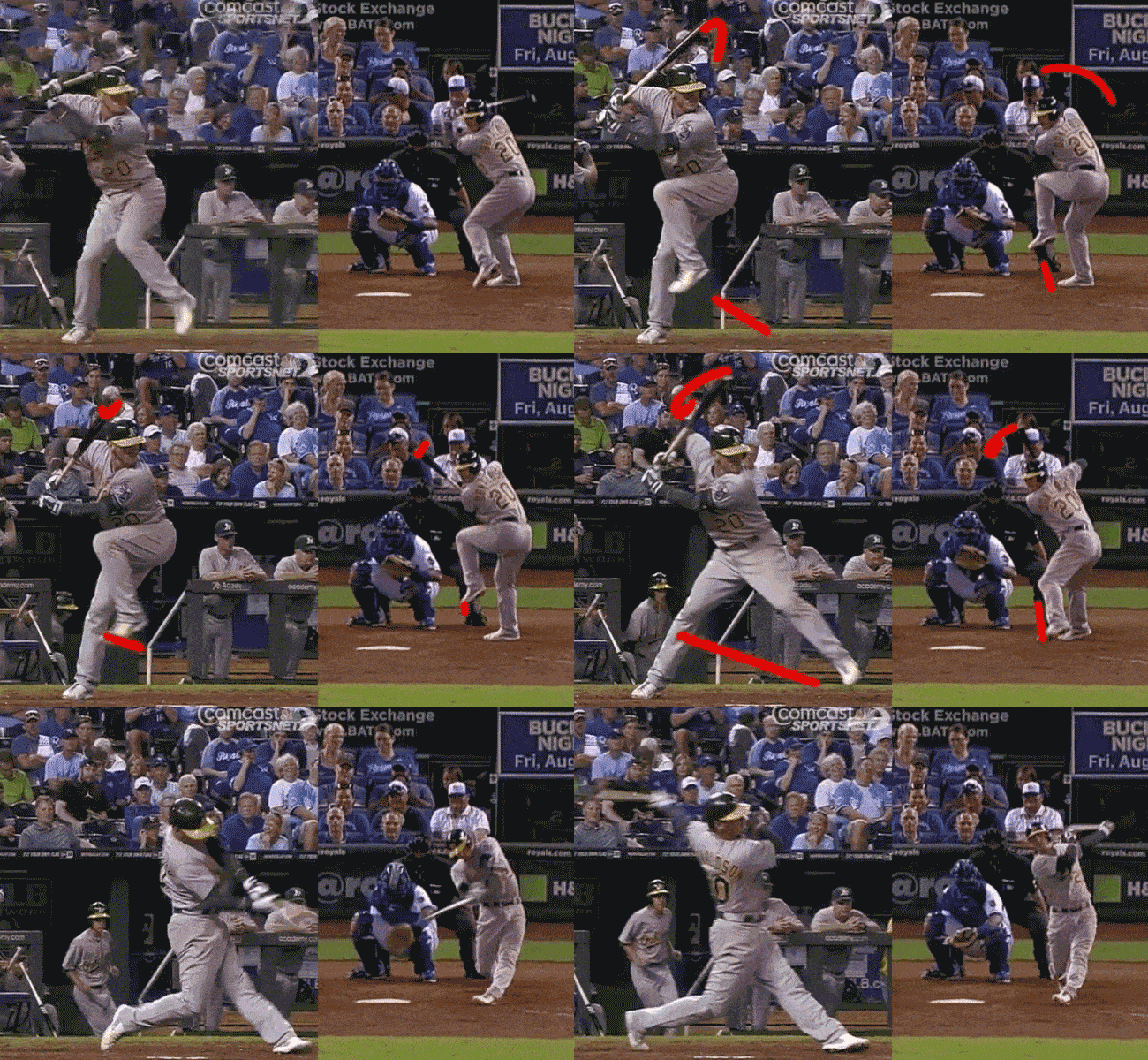
Nolan Arenado Looks Like He’s Up to Something

We’ve gotten to see many sides of Nolan Arenado over the past two years. The maker of ridiculous defensive plays. The hitter of a multitude of home runs. The effusive trotter of the base paths. With regard to his plate discipline, however, Arenado hasn’t changed much since he got to the majors. To call him a “free swinger” doesn’t really do him justice: between 2014 and -15, Arenado ranked 10th in overall swing percentage (53.5%) and eighth in swing percentage at pitches outside of the strike zone (38.7%). As a result, he hasn’t walked much since he was called up in 2014 — at just over half the league average the past two years — which, hey, is something you might do too if you had the talent and skill to hit 40-plus home runs in the major leagues. In 2015, he saw the 17th-fewest pitches per plate appearance out of qualified hitters. Arenado hasn’t really waited around, is the point. He’s been aggressive in and out of the zone, and the trade-off has been fewer free passes. The reward was ten first-pitch home runs last season.

Swinging as much as Arenado has in the past two years tends to require other skills to offset/complement that tendency, like above-average contact rates, great power, or speed on the base paths. An illustration: of the ten leaders in overall swing percentage from 2015, five had below-average contact rates:

Read the rest of this entry »


How Defensive Metrics Might’ve Saved Jake Arrieta’s No-Hitter

It’s possible that more has been made of defensive positioning over the last five years than the prior hundred before it. Infield shifts are something we actually track now, and if the early season is any indication, the usage of those infield shifts is on the rise for a fifth consecutive season. Players and managers discuss them openly, television broadcasts take note — some going so far as to display the position of every fielder on the screen — and we see the benefits (and occasional drawbacks) of the shift on a daily basis.

But nearly all the attention we’ve paid to defensive positioning has gone to the infield. There’re more holes in the infield, less margin for error when the shift doesn’t work, and baseball is slow enough to adapt to any sort of change that it should come as no surprise we had to take this one step at a time. But now, slowly but surely, teams have begun shifting more in the outfield, and before long, the outfield shift, just like the infield shift, will become accepted as standard practice, rather than something that demands attention when it happens.

But shifts aren’t confined to lateral movement, the way we most often see. Players are free to move in and out, too, and thanks to new Statcast data, this is the kind of thing we’re starting to see measured and quantified.

Enter Dexter Fowler. Fowler was the center fielder behind Jake Arrieta for Arrieta’s no-hitter last night. Fowler’s been arguably the best player in baseball this year, owing to positive marks in the batter’s box, on the bases, and in the field. Fowler’s long been an above-average hitter, and he’s long been a plus base-runner, but the defensive marks haven’t been so kind. You could make the case the defensive marks are the thing that’s prevented Fowler’s reputation from exceeding “nice little player” to “borderline star.” An above-average hitter who runs the bases well with a reputation as a plus center fielder is a borderline star. But Fowler hasn’t had the reputation as a plus center fielder, because the tools we use to evaluate defense in this day and age have considered Fowler one of the worst defensive outfielders in baseball since he entered the league.

Since 2009, Fowler’s first full season, 28 players have registered at least 3,000 innings in center field — the kind of sample we prefer to have before working with defensive metrics. To contextualize Fowler’s place among his defensive peers, I took that pool of 28, weighted Defensive Runs Saved and Ultimate Zone Rating equally, and prorated the figures to roughly a year’s worth of playing time. The worst three regular center fielders over the last seven years, by the numbers, are as follows:

  1. Matt Kemp, -11 runs saved per 1,000 innings
  2. Dexter Fowler, -9
  3. Angel Pagan, -4

Fowler stands 6-foot-5, 195, has good speed, and overall looks like an elite athlete, so his consistently league-worst defensive metrics have always been puzzling, the kind of guy the eye-test crowd uses as an example against the metrics by pointing at him and going, “Just look at him!” Which, I can’t blame them. Fowler looks like he should be fine defensively. It’s always puzzled me, too.

Which is why I was immediately captivated by this tweet from Mike Petriello last month:

Read the rest of this entry »


Jose Altuve: Power Hitter

He’s listed at a generous 5-foot-6, and he’s never hit more than 15 homers, so when you look up and see that Jose Altuve has hit five home runs already this year, you really just want to shrug and sing a song of sample size. But if you’ve been watching for longer, you’ll have noticed that this has been a long time coming, and that under the hood we find reasons to believe that this young man is just growing into his power stroke.

Read the rest of this entry »


Effectively Wild Episode 868: Jake Arrieta is Reaganing

Ben and Sam banter about this spring’s Tommy John toll, tanking, Barry Bonds, closer erosion, and a replay wrinkle, then discuss the dominance of Cubs starter Jake Arrieta.


Jake Arrieta: King of Weak Contact

Ever since Voros McCracken revealed his DIPS theory, stating that pitchers had little control over the outcomes of batted balls, people have been looking for exceptions to the rules. The first ones identified were knuckleballers, who consistently and relisably post some of the lowest BABIPs of any pitchers during their careers. From there, it was found that flyball pitchers, especially ones who generate a lot of pop-ups, can also run relatively low BABIPs over long periods of time. And then there are guys like Bronson Arroyo, who don’t easily fit into a bucket of pitcher-types, but managed to suppress outs on balls in play for over a few thousand innings, showing that he had some ability to induce weak contact.

Often times, the guys who fit the mold of a FIP-beater are guys who wouldn’t be in the big leagues if they hadn’t figured out how to exploit this advantage. The list of guys that we have to write the “FIP is wrong about them” disclaimer currently includes the likes of Chris Young, Marco Estrada, Jered Weaver, Tyler Clippard, and Darren O’Day. You’ll notice that these guys all throw in the 80s, and in Weaver and Young’s case, the low-80s. The guys who don’t conform to the normal range of BABIP variance use their ability to generate weak contact to offset their lack of stuff. They can’t dominate the strike zone — O’Day is the exception to that point — so they get batters out by allowing the kinds of contact that their fielders can get to. I’m sure they’d rather just strike everyone out, but since they can’t do that, they’ve learned to succeed in another way.

But while Weaver and Estrada are still chugging along, soaking up innings and keeping their teams in the ballgame, there’s a new king of weak contact in Major League Baseball. And to make life unfair, he also happens to throw 95.

Read the rest of this entry »


Jeff Sullivan FanGraphs Chat — 4/22/16

9:08
Jeff Sullivan: Hello friends

9:08
Jeff Sullivan: We should baseball chat

9:08
Bork: Hello friend!

9:08
Jeff Sullivan: Hello friend

9:09
Tony G.: Is injury-risk the only thing stopping Drew Smyly from joining the conversation of top-tier arms in the league?

9:09
Jeff Sullivan: He seems to have the habit of giving up a few too many homers, on account of all the high fastballs, but a more durable Smyly would be an incredible Smyly

Read the rest of this entry »


Upper-Deck Fan Safety Questioned in New MLB Lawsuit

Major League Baseball stadiums have been the site of a series of unfortunate accidents in recent years in which fans seated in the upper deck have toppled over the safety railing and fallen dozens of feet onto the concourse below. The most infamous of these incidents occurred in 2011, when Texas Rangers fan Shannon Stone fell to his death while reaching over the upper-deck guardrail to try to catch a ball tossed into the stands by Josh Hamilton.

Although not as highly publicized, Atlanta’s Turner Field has rather shockingly been the site of three such fatal falls in just the last eight years alone. Most recently, in August 2015, Gregory Murrey fell over a guardrail to his death after losing his balance when standing up from his second row, upper-deck seat.

In a new lawsuit filed on Tuesday, Murrey’s family seeks to hold the Braves legally accountable for his death, arguing that the team failed to take the basic precautions necessary to protect fans from injury in the upper deck. In particular, the suit contends that had the safety railing at Turner Field been installed at a more appropriate height, Murrey’s unnecessary death could have been avoided.

Interestingly, in addition to suing the Braves, the lawsuit also names MLB itself as a defendant in the case, claiming that the league has consistently failed to require its teams to install sufficient safety railing in the upper deck. As a result, Tuesday’s lawsuit may bring renewed awareness to a fan-safety issue that, at least in recent years, has taken a backseat to injuries resulting from foul balls or broken bats flying into the stands.

Read the rest of this entry »


The Fringe Five: Baseball’s Most Compelling Fringe Prospects

The Fringe Five is a weekly regular-season exercise, introduced a few years ago by the present author, wherein that same author utilizes regressed stats, scouting reports, and also his own fallible intuition to identify and/or continue monitoring the most compelling fringe prospects in all of baseball.

Central to the exercise, of course, is a definition of the word fringe, a term which possesses different connotations for different sorts of readers. For the purposes of the column this year, a fringe prospect (and therefore one eligible for inclusion in the Five) is any rookie-eligible player at High-A or above who (a) received a future value grade of 45 or less from lead prospect analyst Dan Farnsworth during the course of his organizational lists and who (b) was omitted from the preseason prospect lists produced by Baseball America, Baseball Prospectus, and John Sickels, and also who (c) is currently absent from a major-league roster. Players appearing on an updated prospect list or, otherwise, selected in the first round of the current season’s amateur draft will also be excluded from eligibility.

Read the rest of this entry »


Randal Grichuk’s Doing Something Very Unusual

I write a lot about player adjustments. I write so often about player adjustments I start to get a little self-conscious about it. I just do it because I love doing it, and because sometimes I forget what else there is to cover. I love it when a pitcher tries to add a new pitch. I love it when he adjusts an old pitch, or when he starts using the same pitches in different ways. It interests me when a hitter starts putting more or fewer balls in play on the ground. Or, there are the cases where hitters pull the ball more, or spray the ball more. There are so many types of adjustments. There’s one in particular we very seldom see. One we also dream about players making. Randal Grichuk, for his part, is giving it a go.

Grichuk has had a familiar hitting profile: big power, but limited by wavering control of the strike zone. He’s been the hitter equivalent of a talented pitcher with overwhelming stuff but inconsistent command. Those pitchers can still be valuable, but more often than not, they never figure out how to throw strike after strike. And, even more often than not, aggressive hitters tend to stay aggressive. It’s easy to observe when a guy is swinging too much, but it’s not an easy thing to improve.

In his last 10 games, Grichuk has drawn nine walks. He’s struck out six times. To put it another way, Grichuk has drawn a quarter of his career walks in the most recent 7% of plate appearances. Obviously, it’s too soon to say anything for certain, but it’s incredible we’re even here in the first place.

Read the rest of this entry »


My Best Guess at Chris Archer

Chris Archer isn’t where he wants to be. He’s made four starts this season — in two of them, he’s allowed three runs, and in the other two of them, he’s allowed six runs. One of the especially bad starts came Wednesday, and now Archer stands with baseball’s fifth-worst ERA, and baseball’s sixth-worst FIP. Archer so far has been mostly dismissive of his struggles, but given how he also ended last year on a pretty flat note, fans are paying close attention. By no means would concern be unwarranted.

One certainly shouldn’t be too concerned. This is something we can say without even going too deep. While Archer has some ugly numbers, he also has a top-20 xFIP, owing to his high rate of strikeouts. The stuff is still there, for the most part. And while there have been too many hits, Archer hasn’t shown any decline in contact rate. It’s still not easy to get the bat on the ball, and as long as Archer is getting whiffs, he stands a good chance of getting straightened out.

You just can’t say this has all been nothing. Archer himself would tell you he hasn’t executed. Not with sufficient consistency. He hasn’t located the ball like he’d like to, and that’s made him vulnerable. When the location goes, you can blame something physical, or you can blame something mechanical. I trust that Archer is healthy, so I’m thinking about mechanics. And I do have a guess at what’s been wrong. To repeat: this is a guess! I am not Chris Archer, and we’ve never even emailed. If we’ve ever been in the same room, I sure as shoot didn’t notice. What follows is just one thing I have noticed. Put however much stock in this as you want.

Read the rest of this entry »