Evaluating the 2016 Prospects: Los Angeles Dodgers

Other clubs: Angels, Astros, Braves, Brewers, Cubs, Diamondbacks, Indians, Marlins, Mets, OriolesRedsRed Sox, Rockies, Royals, Tigers, Twins, White Sox.

You might not know it by listening to talk radio or television discussions about the club, but it’s an awesome time to be a Dodgers fan right now. They continue to use their financial might to bring in a plethora of international and domestic amateur prospects, then proceed to pawn off their international bonus slots for even more prospects. While they’ve gotten a lot of criticism for letting Zack Greinke go and not dishing out any of the bigger contracts this offseason, the reinforcements they have available in their minor-league system are at least a part of the reason why. Not only do they boast one of the deepest major-league rosters, they have ready-made replacements within a couple levels of their parent club, particularly on the pitching side. On top of that, they keep making shrewd mid-level trades and taking some of my favorite upside talents in the amateur draft. At every turn, their process has been consistent and on point.

You could make a case that they’re light on impact offensive prospects outside of the guys who’ll be starting the year in Los Angeles and first baseman Cody Bellinger, but they have enough depth in the next tier down. Outfielders Johan Mieses, Jacob Scavuzzo and Alex Verdugo are close in the outfield, while Willie Calhoun and hopefully a return to form by Micah Johnson give them options in the infield should multiple position players falter this year. Julio Urias and Jose De Leon are two of the top pitching prospects in all of baseball, and could handle a promotion in the near future if pressed into duty.

Austin Barnes and Trayce Thompson are in the 50+ FV group here, despite how Barnes is only the club’s second or third option at catcher, and Thompson’s reputation in recent years as a questionable bat who might not make it in the big leagues. Thompson is quicker to explain: I really like the changes he made to his swing and approach. No one ever denied the tools and overall athletic ability, and barring a step back for some reason, he’s positioned to develop into a legitimate starting option in the outfield.

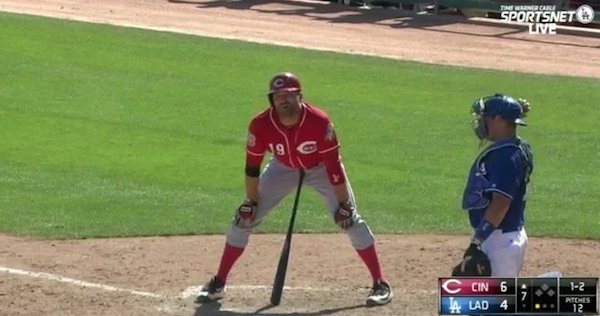
Barnes is much farther out there compared to perception, I’m well aware. He’s not a big power guy, and he doesn’t have big arm strength, both tools that historically are typical of catching prospects. His atypical profile is probably why he didn’t get more of an opportunity in the Marlins organization. Perhaps it’s telling, however, that one of the smartest front offices in baseball targeted him. As a professional, all he’s done is hit, flirt with an on-base percentage over .400, steal some bases and be one of the best pitch framers in the minor leagues — for years now. He makes enough contact and has a good swing, so there’s no reason I can find that he won’t continue to do it against big-league pitching. I don’t see any reason to discount his receiving behind the plate. Watch a Dodgers spring-training game and you’ll quickly notice what makes him so special back there.

Read the rest of this entry »


A New Way to Study Pitching Injury

BauerDL
Indians’ starter Trevor Bauer prepares to collect data at Driveline Baseball.

Kyle Boddy spent years getting it wrong. “There were years of inconclusive results that led to more questions,” Boddy told me about his past work at his Driveline Baseball facility in Kent, Washington.

He had the best intentions. After years of day jobs, and coaching youth baseball with some competitive weightlifting sprinkled in, he started writing at The Hardball Times and studying injuries with Josh Kalk, now a member of the Tampa Bay Rays’ front office. They had some success using neural networks on PITCHf/x data in order to spot injuries earlier than usual.

In the end, though, the Seattle-based mechanics analyst wanted to take a look at pitcher development under the same data-based lens that he and Kalk had used to spot existing injury.

So he built a biomechanics lab, complete with high-speed cameras and objects of known size. (That object, known as the Cube, is a square box built of tubing that helps calibrate the cameras so that the video created is all comparable.) It was a lot of work with an uncertain reward. “We got a lot of great kinetic data,” said Boddy of that time. “Then we realized that there was a huge amount of noise.”

Helping Boddy with the realization was Dr. Murray Maitland in the Department of Rehabilitation Medicine at the University of Washington. When approached with analysis based on limb movement and pitchers’ physical tendencies and the link to injury, Dr. Maitland smiled and dropped what might have been a bombshell to Boddy that day. “Just because the joint or limb moves in this direction doesn’t mean the underlying muscle is doing that,” said Maitland in Boddy’s recollection. “The movement could be due to inertia, it could be due to whatever. You can’t infer muscle activity.”

Read the rest of this entry »


Another Year of the Jered Weaver Experiment

At this point it’s safe to call it a spring tradition: Eyebrows get raised in response to Jered Weaver’s underwhelming velocity, and Weaver tells the media he doesn’t care. There’s nothing wrong with Weaver’s reaction, because he is more of a command pitcher, and he knows he’ll be fine if he locates. I’m sure he’s beyond tired of this repeating conversation. But from the outside, it’s significant that Weaver’s fastball continues to surprise, because it just keeps getting slower, more quickly than it probably ought to. The public is velocity-obsessed, yeah. That doesn’t mean this doesn’t warrant attention:

weaver-league-fastball

The league-average fastball has gotten harder over time. You know that. But while we expect velocity to decline for pitchers as they age, Weaver’s curve has gotten weird. He lost more than a mile between 2011 and 2012. He lost more than a mile again between 2012 and 2013. And then last year, he lost three miles. He lost even more after returning from a DL stint. This isn’t the kind of thing people just shrug off. This is kind of a big deal, whether Weaver wants to admit it or not.

Now there’s another season coming. Weaver is a healthy member of the Angels rotation. The league will probably continue to throw harder, and based on recent historical trends, we might expect its average at about 91.9 mph. As for Weaver? Weaver isn’t going to average that.

Read the rest of this entry »


Effectively Wild Episode 836: 2016 Season Preview Series: St. Louis Cardinals

Ben and Sam preview the Cardinals’ season with Dayn Perry of CBS Sports, and Jeff talks to The Cardinals Way author Howard Megdal (at 22:29).


The Latest Chapter In Adrian Beltre’s Incredible Book

In my earlier blogging days, many of my arguments were a little less, shall we say, nuanced. I was a man with opinions and a man with a platform, and I would frequently use my platform to express my opinion that players shouldn’t try to play through injury. The way I figured, while the players’ hearts were in the right place, someone needed to step in, because playing through pain is bad for performance, and playing through pain is bad for health. I identified it as a problem for the team and for the player, and it was something that always drove me nuts.

Speaking of nuts, in 2009 I watched Adrian Beltre remain in an extra-inning game and eventually score the winning run, even though he’d suffered a damaged testicle that he later estimated became the size of a grapefruit.

As the years have passed, my opinion has somewhat matured. Though I still don’t think players should push themselves too hard, since they’d be doing themselves a disservice, I do understand that you can’t always play at 100%. There are injuries you could make worse and there are injuries you might just have to deal with, and as clubhouse dynamics go, teammates respond to players they perceive to be warriors. This is when we get back to Beltre, who might be the ultimate baseball-playing warrior of his generation. He just last season won another battle against his own pain receptors.

Read the rest of this entry »


Calculating the WAR Threshold for Qualifying Offers – Part 2

Editor’s note: This post contains considerable math. If you’re the sort interested merely in conclusions, scroll to the bottom.

Introduction
In my previous article, I developed a model for calculating the WAR threshold for qualifying offers, the threshold above which it makes sense for teams to hand out a qualifying offer to a player. In order to keep the math to a reasonable level, I limited myself to linear and exponential functions to model the probabilities that a player accepts the offer, declines the offer, and signs with another team. In this article, I extend the model to use a more rigorous class of functions called sigmoids. This should yield a better model, while still keeping the math to a reasonable level.

Analysis
Sigmoids are a class of functions that have “S” shapes, and which asymptotically approach two y-values as x approaches negative infinity and positive infinity. The most well known sigmoid is S(X) = 1 / (1 + exp(-X)) :

2016-fangraphs-QualOffer2-Sigmoid

This function satisfies the fundamental requirements of the P(rejects) function, that P(rejects) approaches 0 for low values of X, and approaches 1 for high values of X. We can generalize this function to S(X) = 1 / (1 + exp(-(a+bX))). Note that the previously graphed function is the special case of this generalization where a=0 and b=1.  In an intuitive sense, “b” controls the sharpness of transition between 0 and 1, and the value of X where S(X) = 0.5 is X = -a/b.

Read the rest of this entry »


Cleveland’s Rotation and the Holy Grail of Strikeouts

In absolute terms, we know that strikeouts are at an all-time high. We see it in box scores, talking heads consistently discuss and lament the phenomenon on broadcasts, and in truth, it’s been going on for years. We’re left to wonder and analyze where the ceiling is for this trend, and exactly where the line between passable and unacceptable strikeout totals for batters begins and ends. For pitchers — whose velocity is a main factor in the increased strikeout numbers — going to work must be that much more enjoyable. And, in 2015, it was most enjoyable in terms of strikeouts for the rotations of the Chicago Cubs and Cleveland Indians.

If we look at strikeout rates for individual team seasons over the course of baseball history, no one struck out batters at a higher clip than the rotations of the 2015 Indians (24.2%) and 2015 Cubs (23.9%). That isn’t really surprising given the strikeout trend of recent years, but in mid-June of last season, the Indians’ rotation was actually on pace for the third-highest league-adjusted strikeout rate since 1950. At that point in time, they were striking out a historic rate of batters in a historic strikeout period, which is the sort of thing that tends to lend itself to positive team results. It didn’t, but most of that wasn’t the rotation’s fault (hello, team defense!), and the ridiculous strikeout pace didn’t quite continue into the second half of the season.

In the end, they finished as the 41st-best league-adjusted strikeout rotation, which really isn’t too bad: they ended up striking out almost 27% more batters than the league average starting rotation in 2015. Here’s the 2015 Indians compared to the best 15 league-adjusted strikeout rotations since 1950 by K%+ (percentage points above average compared to a given year’s league average strikeout rate):

Highest_K+%_Rotations

In case you’re wondering, the 2015 Cubs finished 105th-best, with a K%+ rate of 120. Also not bad, but it’s illustrative of just how many strikeouts a team has to amass to make a run at breaking the record. And so I wondered: what strikeout rate would it take in 2016 to break the league-adjusted rate? And do the Cubs or Indians (or another rotation) have any realistic shot at breaking it?

Read the rest of this entry »


KATOH Projects: New York Mets Prospects

Previous editions: Baltimore / Boston / Chicago AL / Chicago NL / Cincinnati  / Cleveland / Colorado / Detroit / Houston / Kansas City / Los Angeles (AL) / Miami / Minnesota / Milwaukee.

Yeaterday, lead prospect analyst Dan Farnsworth published his excellently in-depth prospect list for the New York Mets. In this companion piece, I look at that same New York farm system through the lens of my recently refined KATOH projection system. The Mets have the 23rd-best farm system in baseball according to KATOH.

Read the rest of this entry »


Last Year’s WAR with True-Talent Defense

I’ll begin by saying I’m not sure what value all of what’s to follow actually has. I know that’s about the least-compelling way to begin a blog post, but I just want that to be very clear. TangoTiger’s recent Building a Better WAR Metric series on the site jumpstarted an idea I’d been kicking around in my head for a while. It’s an idea that mostly exists because I’ve seen people on the internet say they’d want to see something like it, and, at the very least, it could serve as a talking point for another constructive discussion about WAR, and any constructive discussion about WAR is a good thing, because we all admit it’s far from perfect and constructive discussions usher progress.

People don’t really have beef with the offensive side of WAR, I don’t think. As far as sabermetric stats go, wRC+, and therefore wRAA, are about as infallible as they come. Tough to argue with the outcomes of history. I don’t see too many quibbles with the base-running numbers, partially because I think most people think they do a good job, but also because they don’t move the needle much either way, and there’s bigger fish to fry. Some people aren’t fans of the positional adjustments — both the assigned weights, and the entire concept of including them. I’m in the camp that firmly believes in the idea of the positional adjustment, but, like anything, the formula for the weights could always be looked at to see if it could be improved in any way, and Jeff Zimmerman’s work on this topic last offseason was a great place to start.

But the bigger beef, beyond the positional adjustments, is of course defense. Anyone will admit this is the weak link of WAR. It’s probably the weakest link of sabermetrics, as a whole, in 2016. And mostly, what it boils down to is, we know that defensive metrics don’t stabilize until the sample spans roughly three years, or 3,000-ish innings. Meaning, the single-season data is subject to noise, and if we wanted to draw any conclusions from it, we’d have to regress it. Despite that, single-season WAR is powered by noisy, unregressed, single-season defensive metrics. That’s the crux of the beef with WAR.

So, some folks have suggested that the defensive component of WAR ought to be regressed in some way, in an effort to strip out some of the noise that comes with single-year defensive data, or to better capture a defender’s true performance. I think there are a number of flaws in this general line of thinking, but there are a number of flaws with the way it’s being done now, too, so let’s humor one another.

Both ZiPS and Steamer use multiple years of data, giving more weight to the most recent seasons. Multiple years of data to weed out noise? Check. Both also incorporate some form of “scouting” information: Steamer regresses toward the results of the Fans Scouting Report, ZiPS searches for keywords in actual, physical scouting reports and uses those as a means for regression. Eye test? Check. Blend all that together and factor in some aging curves, and you’ve got yourself as good an idea of any player’s true-talent defensive ability as you’re going to find. Sort the Fld column here and I think you’ll agree that these numbers pass the eye test with flying colors.

So let’s imagine a world where, last year, every player performed exactly to their true-talent defensive ability. Everyone hit the same, everyone ran the same, everyone had the same amount of playing time, but defensively, we knew exactly what everyone’s true-talent ability was worth, and no one varied from it.

Read the rest of this entry »


Dave Cameron FanGraphs Chat – 3/9/16

11:56
Dave Cameron: Bonus time today; we’re going to start a few minutes early.

11:56
Ira: How will a Jay Bruce addition for the whitesox shake up the projections in the AL Central?

11:57
Dave Cameron: Well they didn’t trade for Jay Bruce, so it won’t. But now that they’ve signed Austin Jackson, Bruce serves no purpose for them.

11:57
Dave Cameron: The Jackson and Rollins signings could end up being pretty important, though. Those two probably add something like three wins to the White Sox ledger over what the team had.

11:57
Dave Cameron: They still need one more starting pitcher, I think, but the White Sox have a chance to be good this year.

11:57
Desmond : Is it fair to say the Giants and dodgers lineup and pitching is more or less dead even but when factoring in injuries dodgers are much more able to sustain why giants risk being crippled by a injury to the wrong guy ?

Read the rest of this entry »