FanGraphs Baseball

Job Posting: TruMedia Networks Principal / Senior / QA Software Engineer

Position: TruMedia Networks Principal / Senior / QA Software Engineer

Location: Boston (remote possible)

Description:
TruMedia is looking for Principal, Senior and QA Software Engineers to help build tier one sports analytics and scouting solutions. The ideal candidates will be passionate sports fans, have a strong interest in data science and have the ability to work on the full software stack with a focus on web development and user interface design. Interfaces will be needed for web based solutions as well as mobile platforms.

Why TruMedia?

  • TruMedia is a fast growing sports analytics firm with a focus on changing the way we all look at sports.
  • TruMedia’s clients include world class brands like ESPN and TruMedia works directly with both MLB teams and NFL teams.
  • TruMedia is making it’s own path and we love to have fun as we innovate.
  • Everyone’s opinion matters and we look forward to working with people that are excited to share their insights.
  • Flexible work environment.

Qualifications:

  • 2+ years experience developing web applications in a software engineering team.
  • Working with engineers, designers, third parties, and stakeholders.
  • JavaScript
  • HTML/CSS
  • JQuery
  • Windows and Linux
  • MySQL

Additional Usefull Skills:

  • Analytics
  • Statistics
  • Business Intelligence
  • AWS
  • D3
  • Node.JS
  • Express
  • Angular, Backbone, or other MVC frameworks
  • HTML5
  • MongoDB
  • IOS/Android Apps (including video playback)
  • Video Players
  • Experience working with a remote team

Compensation:
These positions are compensated. Full-time is preferred.

To Apply:
Please email TruMedia.


Marcus Stroman’s Strange Breaking Balls

Here’s a weird thing about Marcus Stroman’s slider: it has more drop than his curveball. We still call it his slider because it goes four miles per hour faster than his curve, but the curve has slowly tilted sideways. Or, to say it better, Stroman’s other pitches have tilted downwards and the curve has stayed about the same.

Check out Stroman’s release points. For every pitch other than the curve and the sinker, Stroman is an inch or two more over the top this year.

Brooksbaseball-Chart-38

In related news, all of Stroman’s pitches — other than the curve — are dropping more this year.

Marcus Stroman Vertical Movement by Year
Year Fourseam Sinker Change Slider Curve Cutter
2013 9.1 0.0 6.4 -0.7 -3.9 4.3
2014 9.2 3.3 3.9 -1.4 -2.3 4.9
2015 8.6 1.8 3.6 -2.0 -1.1 4.0
SOURCE: BrooksBaseball.net
Movement = PFx_z, or vertical ‘drop’ in inches

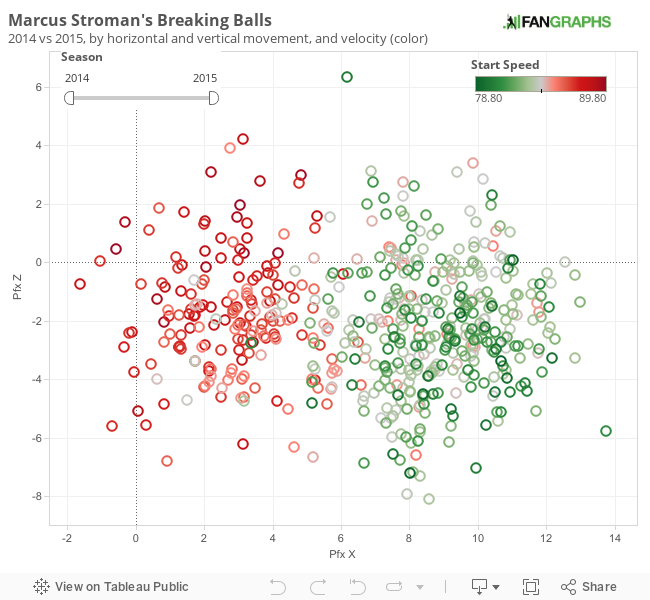
Could this just be mucking with classification systems? Maybe. The two pitches are only three mph apart. Let’s look at the movement on both of his breaking balls in one place and see if they’ve moved from last year to this year, then. Use the filter to change years.

Yup. The slider drops more than the curve, and the curve is more horizontal this year. He’s also using the slider more this year, and the curve less. But the whiff and ground-ball rates on the curve are better than they are for the slider.

Going more over the top has increased the ground-ball rate on all but his slider, and that may be why he’s pitching today. Not going over the top as much on the curve has made that pitch more of a frisbee than a round-house curveball.

Maybe he’s still getting his feet under him, and things will change again in the future. But for now, Marcus Stroman may be the only pitcher in baseball that has a slider that drops more than his curveball. PITCHf/x classifies his pitches a little differently, but we can forgive that system. He’s got a strange mix.


Clayton Kershaw Silences Mets, Narratives

The stories were silly to begin with. That the best pitcher in the world was somehow hardwired to falter when the calendar flipped from September to October. That the same hitters who floundered against Clayton Kershaw throughout the regular season would feast come playoff time.

The seven dominant innings Kershaw hurled against the Mets on Tuesday shouldn’t go a long way in changing anyone’s opinion of what Kershaw can do under the bright lights, only because the 50 innings prior shouldn’t have, either.

I probably haven’t told you anything you didn’t already know. Clayton Kershaw is incredible. At times, in the postseason, he’s appeared as something less than incredible, but lately, he’s looked more like himself. Even in his Game 1 loss to New York, which oddly seemed to fuel the anti-Kershaw postseason narrative, he was great, making what amounted to one real mistake to his apparent-kryptonite, Daniel Murphy.

Though the outcome of Game 1 was the opposite of what Kershaw desired, he pitched well, and so on the surface, it didn’t appear that much needed to change. Of course, that’s just the surface, and Kershaw goes well beyond the surface. Kershaw and catcher A.J. Ellis, that is.

Ellis contributed an enlightening article to the Player’s Tribune last month, concerning the act of catching Kershaw and Zack Greinke and the way each prepares for their starts. Pulling from that article:

“Before each of Clayton’s starts, he and I, with pitching coach Rick Honeycutt, sit down together two hours before the game. Clayton dictates that entire meeting, running through the starting lineup in detail. ‘Here’s what I want to do … ‘ Hitter after hitter.

Usually he’s spot-on with his approach and it matches with my scouting and game plan. Occasionally, I’ll throw in my two cents, but I’d better make damn sure my two cents fits with what he wants to do, because otherwise he’ll snap at me. ‘I’m not doing that. That makes no sense.'”

Read the rest of this entry »


Dave Cameron FanGraphs Chat – 10/14/15

11:43
Dave Cameron: Happy American League Elimination Day. Two pretty exciting games on tap for this afternoon that we can discuss, or we can cover the Cubs vs Mets/Dodgers upcoming NLCS, or talk about Chase Utley some more, or we can all make fun of Kiley on his last day working at FG.

11:56
Dave Cameron: Alright, we’ll start a couple of minutes early today.

11:56
Comment From dom
thoughts on DeGrom warming up last night?

11:57
Dave Cameron: I wouldn’t really call what he did warming up. There’s a difference between just throwing off a mound and getting ready to come into a game. Having him just play catch probably isn’t a big deal, and it doesn’t look like he ever really threw like he was preparing to pitch.

11:57
Comment From Kris
Could the Blue Jays go Stroman through 5, Price 6 & 7, Sanchez 8, Osuna 9? Only thing that could seemingly rationalize pitching Price in relief in game 4

11:58
Dave Cameron: I don’t think they use him today. I bet the hope is Stroman for 6 or 7, then Loup against a tough LHB, then the RH relievers to close it out.

Read the rest of this entry »


Contract Crowdsourcing 2015-16: Day 3 of 15

Free agency begins five days after the end of the World Series. As in other recent offseasons, FanGraphs is once again facilitating this offseason a contract-crowdsourcing project, the idea being to harness the wisdom of the crowds to the end of better understanding the giant and large 2015-16 free-agent market.

Below are links to ballots for five of this year’s free agents, including four notable second basemen and then David Freese.

Other Players: Alex Avila / Chris Davis / Stephen Drew / Chris Iannetta / Kelly Johnson / Justin Morneau / Mike Napoli / Dioner Navarro / Geovany Soto / Matt Wieters.

***

Howie Kendrick (Profile)
Some relevant information regarding Kendrick:

  • Has averaged 561 PA and 3.1 WAR over last three seasons.
  • Has averaged 3.4 WAR per 600 PA* over last three seasons.
  • Recorded a 2.1 WAR in 495 PA in 2015.
  • Is projected to record 2.3 WAR per 600 PA**.
  • Is entering his age-32 season.
  • Made $9.5M in 2015, as part of deal signed in January 2012.

*That is, a roughly average number of plate appearances for a starting player.
**Prorated version of final updated 2015 Steamer projections available here.

Click here to estimate years and dollars for Kendrick.

Read the rest of this entry »


More Than a Curveball: Making Collin McHugh

“When the Mets drafted me, I had a sinker and a decent curveball,” the Astros’ Collin McHugh told me earlier this year. If you wanted to be reductive, he’s still almost all fastball and curveball — those pitches make up 96% of his repertoire this year, after all — but being reductive robs all the nuance out of how McHugh has become who he is today. The Astros’ Game Five starter has learned a lot about his craft as he’s bounced his way around the league, and it will all be on display on a national stage with Houston’s season on the line.

After joining the New York system, McHugh learned that he had to ditch his slider at first. “I had a slider and curveball in college, and the two started to get too close together,” he said of arriving in Kingsport. “I did away with the slider in pro ball. My curveball is my out pitch, and I need to make sure it is where I want it to be.”

McHughCurveball
The second-biggest curveball in the game.

Only Jose Quintana and Yordano Ventura got more raw whiffs from their curveball this year than McHugh. Even if you turn it into a rate stat, McHugh does well, with a top-15 whiff rate on the pitch among starters who threw the pitch 300 times. With eight inches of cut and eight inches of drop, only Rick Porcello’s curve matches McHugh’s for movement in both directions among qualified starters. It’s big, and it’s beautiful.

Of course, a curve and a fastball are more than a buck short of 200 innings in the major leagues, so he knew he had to find something to add back in. “Once I’m good with that,” McHugh remembered thinking, “I’ll start working on something else.” So he started taking his fastball, offsetting it a bit, and “throwing it hard as I could.” The result: a cut fastball.

The cutter gave him a second weapon, a hard breaking ball that got almost as many whiffs as a slider. The pitch drops a whopping eleven inches less than his curve, and goes 14 ticks faster, effectively making batters cover in and out horizontally as well as up and down vertically when it came to his secondary pitches.

McHughCutter
The cutter that gave McHugh the second out pitch he needed.

Especially lefties, even if the curve was already a weapon. “Anything that breaks plane as much as a slower breaking ball does, that makes hitter from that side of the plate has to respect up and down instead of just in to out, it makes it tougher on them,” McHugh said of using the curve against lefties. Big curves like his traditionally have reverse platoon splits, meaning they are more effective against opposite-handed batters than you’d expect.

The cutter is also effective against lefties, even if proving this in the numbers has been difficult due to the nebulous nature of the cutter. “Is it a breaking ball or a fastball?” agreed McHugh as he laughed.

But McHugh started with a true cut fastball as he approached the big league team in New York. “When I first started throwing it, it was specifically a cutter, it was always a cutter, that’s what I wanted it to be,” McHugh remembered. “To lefties, make it a little flat, and find that spot right at the belt.”

While the curve makes the lefty respect up and down, the cutter keeps them from getting extension and showing their power in another dimension: in and out. “It’s just something to keep guys from getting extension on you, which, as a righty to a lefty hitter, it’s always been our issue, lefty extension, whether it’s extension down here or away there. That’s where power comes from.”

LeftyonRightyISOheat
Lefties show power low and in and out over the plate against righties.

Still. Armed with a cutter, a curve, and a sinker, McHugh debuted with the Mets in 2012 and… did poorly. A 7.59 ERA in just over 20 innings that also featured five home runs must have turned the team on his future, as they traded him to Colorado for Eric Young, who had been designated for assignment.

Colorado was a terrible place for a pitcher with a sinker and a curve. “When I got to Colorado, when I first trying to pitch there, I couldn’t get my ball to sink,” sighed McHugh. “That was a challenge.” A challenge that’s been well documented, but a challenge nonetheless.

But pitching there allowed something to crystallize in McHugh that he’d been thinking about when it came to his fastball. His sinker was getting crushed, whether it was at home or away, New York or Colorado. Something was wrong.

He started throwing the four-seam more, and not only because the sinker wasn’t sinking. “Make it look as fast as possible,” he said of his newer fastball philosophy. “Work it up-down. A fastball down, the perceived velocity is slower than a fastball up. A fastball moving, the perceived velocity is slower than a straight fastball. When I’m trying to throw sinkers down, my 89-91 mph looked — especially to a lefty — like 85-87 mph.”

Watching a mediocre sinker, thrown away, lefties got all kinds of a look at the pitch. They could extend on it, and it just looked crushable. So in came the four-seam, and when Houston claimed the pitcher off of waivers from Colorado, they agreed. Astros pitching coach Brent Strom “basically told me, I think you should use your four-seamer more,” laughed McHugh.

McHughFourSeam
The right fastball for McHugh.

Houston wasn’t happy with just throwing it more, though. They wanted the pitcher to elevate it and work on showing more “ride” or “rise” — the riding fastball drops less than you’d expect, given gravity. More fastball spin leads to more rise, and his new team was fluent in this sort of stuff. “They talk about spin rate, in the organization, but not in the way of getting more,” said McHugh. “They talk about how it helps or affects what you do. Like, Vincent Velasquez throws a high-spin-rate fastball, how does that affect what he does?”

The task put in front of McHugh was more simple. Elevate the four-seam. The rise will come. While Curt Schilling said you want to slap the seams for rise, and Sean Doolittle talked about his hands and release points, and Phil Hughes talked about keeping a stiff wrist, McHugh felt that gaining that vertical movement on the fastball was a matter of intention:

The way I started out being able to do it was thinking about long toss. You’re playing long toss with the catcher from 60 feet the same way as if you were out playing long toss at 180 feet. You’re trying to throw the ball through them, you’re not trying to throw the ball down the mound. Get that extension. You can throw the ball 180 feet when you get down into it, as long as you get that backspin. The mound makes you want to get on top of the ball. Some people do an eye level thing. I want to do everything the same but long-toss through the umpire’s mask.

McHugh added over three inches of rise, and a better weapon against same-handed batters. “It’s an out pitch against righties,” admitted McHugh. “Especially to power righties, you want to deny extension, so you throw the four-seamer which acts like a left-handed cutter.” Against righties, McHugh’s rising four-seam gets 56% more whiffs than your average four-seamer. That whiff rate would also put him between Matt Harvey and Clayton Kershaw on the four-seam leaderboard, which is somewhat amazing considering he barely cracks 90 mph on average with it.

McHughRise

If the Mets taught him to focus on the curveball, Colorado told him to ditch the sinker, and Houston coached or coaxed rise out of his four-seamer, it was some combination of the three that helped him refine his cutter. “The more I’ve gotten the feel for it, the more I’ve been able to do both with it,” McHugh said. “To righties, I can make it more of a slider with some depth now.”

McHugh does this by manipulating the cutter’s release and the grip slightly. For the true, flatter cutter, he’ll “really try to get on top of the ball.” For the deeper slider, he’ll pick up the index finger a little bit, and “hook” the fingers a bit more around the seams.

McHughSlider
McHugh moves his fingers slightly and changes focus to get more slider movement from his cutter grip.

When asked if these small alterations affected his ability to command the pitch, McHugh shrugged, even as he admitted that it’s been a little tougher to get depth on his slider to righties this year than last year. “It’s just a matter of focus,” the Astro said. “You focus on what you want the pitch to do.”

That’s a bit of a mantra for him. Focus is what helped him continue to develop in the face of bad results and an uncertain future in baseball. Focus helped him incorporate the best advice from each organization he was with. Focus on improving his pitches helped him learn more about how pitches are perceived and how he could best make use of his skillset.

And it was focus that helped him turn two pitches into four — with a rising fastball, a slider, a cutter, and a curveball, he’s much harder to face these days than he was back with the Mets in 2012. “If they can figure out what pitch you are going to throw in what count, they can figure you out,” he thought. “But if you have four pitches you can throw in any count, they aren’t going to figure you out.”


The Advantage of Matching Up Marcus Stroman

The Blue Jays paid a lot to get David Price, even though they knew he was about to become a free agent. The Jays rightly figured the starting rotation could use a big upgrade if the team was going to go on to make some playoff noise. Of course, at that point, they didn’t yet know what to expect from Marcus Stroman. They might not have expected anything.

The American League Cy Young is going to go to Price or another guy. Price stands a perfectly fine chance, and you’d assume that when a team trades for that sort of pitcher, the same team will use him in as many important starts as possible. Sure enough, Price started Game 1 of the ALDS, but as you know by now, the ball in Game 5 is being handed to Marcus Stroman. Price just threw a lot of pitches in relief in Game 4, even though the Jays were already heavily favored. It’s surprising, and it’s complicated. It doesn’t seem like throwing Price so much out of the bullpen was a good managerial call. Yet we can at least say this much: it’s not all that clear the Jays are worse off. Stroman might even come with a certain advantage.

Read the rest of this entry »


Effectively Wild Episode 743: The Cubs Clinch and Kershaw Recovers

Ben and Sam review the Cubs-Cardinals series and Mets-Dodgers Game Four, then return to the David Price puzzle.


Entirely Superfluous Footage of Kyle Schwarber’s Home Run

There’s no reason, really, for FanGraphs.com to publish the footage one finds here of the improbably majestic home run authored earlier tonight by Kyle Schwarber during his club’s postseason victory over St. Louis — no reason, that is, because all relevant sports-media outlets have already examined the home run and its attendant majesty. And yet, what one finds here is that same footage, reproduced once again for the public and unaccompanied by anything in the way of particularly insightful analysis.

“Pourquoi?” a Frenchman might ask in French. And “Pourquoi pas?” a second Frenchman might reply. Because the French are contrary by nature, is probably why. But also because, yes, there’s little incentive not to have done it.


NLDS Game 4: Cubs Advance Amid Euphoria

The overriding theme of this year’s NLDS is age and the passage of time. That calendar dynamic is two-fold, and it pertains solely to the team advancing to the NLCS. The Chicago Cubs are a talented kiddie corps. The Chicago Cubs haven’t won the World Series since 1908.

If baseball’s lovable losers (or, to some, not-so-lovable losers) extend their goat-exorcizing quest even further, overkill is inevitable. You’re excused if you think we’ve reached that point already. Far more electronic ink has been spilled on the Cubs than on the team that finished with the best record in either league. St. Louis is good again. St. Louis is back in the postseason. Ho-hum.

It’s not fair, really. But it is understandable. Fresh faces that teem with talent is a good storyline, and truth be told, 107 years is a long time.

Jason Hammel started for the home team, and predictably it wasn’t pretty. The journeyman right-hander had a 5.37 ERA over his last 13 outings, and according to catcher Miguel Montero, “in the second half, he kind of started elevating his fastball a little bit more; obviously you don’t want him to do that.”

The wind – as it was last night when eight balls left the yard – was blowing out. Read the rest of this entry »