Defensive replacements might be the most overlooked of managerial decisions. We can (and do) spend hours debating the merits of lineup construction, pitching changes, and pinch-hitters, but rarely are defensive replacements a part of those conversations. Every Phillies fan has an opinion as to whether or not Rob Thomson should have pulled Zack Wheeler in the World Series. Padres faithful were left scratching their heads when Bob Melvin didn’t bring Josh Hader in to face Bryce Harper in the deciding game of the NLCS. The phrase “Taylor Walls, Pinch-Hitter” still echoes in many a Rays fan’s head.
But how many of the 24 defensive replacements do you remember from this year’s postseason?
I’m not trying to be obtuse here. I’m well aware of why defensive replacements don’t get much attention; they’re far less likely to make a difference than almost any other managerial decision. Defensive replacements only come in for an inning or two when their team is already in the lead. There’s no guarantee they get to a make a single out, let alone a difficult play that could have significant ramifications for the outcome of the game. Yet that being so, when and how to deploy defensive replacements is still an interesting bit of strategy, and eventually, over a substantial number of games, some defensive replacements are going to make a meaningful difference. Read the rest of this entry »
Title: Product Manager Department: Baseball Research & Development Reports to: Director, Baseball Research & Development Status: Regular Full-Time
Position Overview:
As the first full-time Research and Development (R&D) Product Manager you work within our R&D and larger Research and Information (R&I) groups to develop products that serve as differentiators in evaluating, acquiring, and developing baseball players. You are responsible for creating and maintaining a roadmap for our Software Engineering (SWE) team and tracking the use and value of products that have been built and deployed.
You will work closely with end-users across Baseball Operations, Scouting, Player Development and the Major League Coaching Staff to identify impactful tools to build, based on your knowledge of R&D research and the technology landscape.
Responsibilities:
Project Execution
Work with the SWE Team and the Manager, SWE to develop detailed requirements and project plans for each upcoming feature / epic
Collaborate with stakeholders and engineers to test the finished product and ensure that the potential impact is realized
Vision and Roadmap
Work closely with Baseball Operation stakeholders and the SWE team to develop a roadmap of features and capabilities that will provide maximum impact to the Phillies
Manage and communicate any changes to the roadmap, periodically updating and reviewing the plan. Maintain a best-estimate schedule at all times
Stay engaged with stakeholder needs and new and ongoing research from the Quantitative Analysis team to proactively raise ideas for new features and capabilities
Product Evaluation
Develop key metrics and measures that will be used to evaluate the success of our products and features
Advocate for usage of our products and features, collect feedback, and continuously re-evaluate their design and implementation
Required Qualifications:
1-3+ years prior experience in product management
Excellent written and verbal communication skills; able to run efficient meetings, create compelling presentations, and have productive conversations with people from a variety of backgrounds
Ability to identify and prioritize user stories and turn them into actionable technical requirements
Insatiable curiosity to learn more about the intersection of baseball, technology, and data science and constantly ask ‘why’
Proven willingness to both teach others and learn new techniques
Proven leadership and self-direction
Preferred Qualifications:
BS or higher degree in Computer Science, similar technical field of study or equivalent practical experience
Software development experience in one or more general purpose programming languages (including but not limited to: Python, Javascript/Typescript, Go, Rust, Swift, Objective C, C/C++, or Java
Experience working in baseball or other sports
Spanish fluency would be a plus
Interested applicants should submit both their resume and an answer to the following question:
In 500 words or less, please tell us why you are interested in Product Management role in a Baseball Research & Development department.
Title: Lead Quantitative Analyst Department: Baseball Research & Development Reports to: Director, Baseball Research & Development Status: Regular Full-Time Location: Philadelphia, PA; also open to Remote
Position Overview:
As a Lead Quantitative Analyst (QA), you help shape the Phillies Baseball Operations strategies by processing, analyzing, and interpreting large and complex data, while providing guidance and feedback to other quantitative analysts as they do the same. You do more than just crunch the numbers; you carefully plan the design of your own studies by asking and answering the right questions, while also working collaboratively with other analysts and software engineers to lead larger projects.
Using analytical rigor, you work with your team as you mine through data and see opportunities for the Phillies to improve. After communicating the results of your studies and experiments to the GM and executive staff, you collaborate with front office executives, scouts, coaches, and trainers to incorporate your findings into Phillies practices. Identifying the challenge is only half the job; you also work to figure out and implement the solution.
Responsibilities:
Conduct and oversee statistical research projects and manage the integration of their outputs into our proprietary tools and applications (e.g., performance projections, player valuations, draft assessments, injury analyses, etc.)
Ensure projects conform to best practices for implementing, maintaining, and improving predictive models throughout their life cycles
Communicate with front office executives, scouts, coaches, and medical staff to design and interpret statistical studies
Assist and mentor other members of the QA team with their projects by providing guidance and feedback on your areas of expertise within baseball, statistics, data visualization, and programming
Manage other analysts and their projects to ensure that QA work meets technical standards and aligns with the needs of stakeholders
Continually enhance your and your colleagues knowledge of baseball and data science through reading, research, and discussion with your teammates and the rest of the front office
Provide input in architecting the storage of baseball data
Required Qualifications:
3-5+ years of relevant work experience and some familiarity with baseball, sabermetrics, or sports analytics in general, or an ability to show meaningful completed projects in this space
Deep understanding of statistics, including supervised and unsupervised learning, regularization, model assessment and selection, model inference and averaging, ensemble methods, time series modeling, forecasting, etc.
Proficiency with scripting languages such as Python, statistical software (R, S-Plus, SAS, or similar), and databases (SQL)
Demonstrated experience designing, constructing, implementing, and leading technical research projects for use by non-technical stakeholders
Proven willingness to both teach others and learn new techniques
Willingness to work as part of a team on complex projects
Proven leadership and self-direction
Preferred Qualifications:
Possess or are pursuing a BS, MS or PhD in Statistics or related (e.g., mathematics, physics, or ops research) or equivalent practical experience
Familiarity with best practices in machine learning operations (Git, Docker, MLFlow or the equivalent)
Experience managing or overseeing the work of other data scientists or analysts
Experience with a probabilistic programming language (Stan, PyMC, etc.)
Interested applicants should submit both their resume and an answer to the following question:
The R&D department has been asked to provide a recommendation to promote or not promote a position player/hitting prospect from AA to AAA. What information would you consider in formulating your recommendation? (250 word limit)
Tip: There’s no defined right or wrong answer. Responses are used to get some insight into how you approach problem solving and baseball in general.
Title: Quantitative Analyst Department: Baseball Research & Development Reports to: Director, Baseball Research & Development Status: Regular Full-Time Location: Philadelphia, PA; also open to Remote
Position Overview:
As a Quantitative Analyst (QA), you help shape The Phillies Baseball Operations strategies by processing, analyzing, and interpreting large and complex data. You do more than just crunch the numbers; you carefully plan the design of your own studies by asking and answering the right questions, while also working collaboratively with other analysts and software engineers on larger projects.
Using analytical rigor, you work with your team as you mine through data and see opportunities for The Phillies to improve. After communicating the results of your studies and experiments to the GM and executive staff, you collaborate with front office executives, scouts, coaches, and trainers to incorporate your findings into Phillies practices. Identifying the challenge is only half the job; you also work to figure out and implement the solution.
Responsibilities:
Conduct statistical research projects and manage the integration of their outputs into our proprietary tools and applications (e.g., performance projections, player valuations, draft assessments, injury analyses, e)
Communicate with front office executives, scouts, coaches, and medical staff to design and interpret statistical studies
Assist the rest of the QA team with their projects by providing guidance and feedback on your areas of expertise within baseball, statistics, data visualization, and programming
Continually enhance your knowledge of baseball and data science through reading, research, and discussion with your teammates and the rest of the front office
Provide input in architecting the storage of baseball data
Required Qualifications:
0-3+ years of relevant work experience
Deep understanding of statistics, including supervised and unsupervised learning, regularization, model assessment and selection, model inference and averaging, ensemble methods,
Ability to demonstrate some baseball knowledge and how quantitative analytics can provide value to a baseball organization
Meaningful work experience with statistical software (R, S-Plus, SAS, or similar), databases, and scripting languages such as Python
Proven willingness to both teach others and learn new techniques
Willingness to work as part of a team on complex projects
Proven leadership and self-direction
Preferred Qualifications:
Possess or are pursuing a BS, MS or PhD in Statistics or related (e.g., mathematics, physics, or ops research) or equivalent practical experience
Experience drawing conclusions from data, communicating those conclusions to decision makers, and recommending actions
Interested applicants should submit both their resume and an answer to the following question:
The R&D department has been asked to provide a recommendation to promote or not promote a pitching prospect from AA to AAA. What information would you consider in formulating your recommendation? (250 word limit)
Tip: There’s no defined right or wrong answer. Responses are used to get some insight into how you approach problem solving and baseball in general.
Description:
The Los Angeles Angels are seeking an Analyst with a focus on pitching to join our Baseball Operations department. This position will support the Baseball Operations group’s efforts to analyze and provide pitching data, statistics and other pitching-related information. The ideal candidate combines a strong background of technical skills with an understanding of baseball research concepts and modern pitching technologies, information and strategies.
Responsibilities:
Develop tools and visualizations for disseminating statistical concepts.
Conduct research projects and player analysis for the Baseball Operations group.
Help build database and reporting infrastructure to support advance scouting and coaching staff needs.
Opportunities for other ad-hoc contributions to the pitching development process.
Qualifications:
Strong foundation in the application of statistical concepts to baseball data and the translation of data into actionable baseball recommendations.
Understanding of modern pitching philosophies, technologies and applications.
Preferred: Demonstrable experience creating effective data visualizations.
Preferred: Some web development experience.
Ability to work flexible hours including evenings, weekends and holidays
Physical Demands:
Ability to frequently sit for extended periods of time
Ability to occasionally work in inclement weather (when in stadium)
Ability to traverse from office to stadium frequently
Ability to occasionally lift up to 20 lbs.
The above statements are intended to describe the general nature and level of work being performed by individuals assigned to this position. They are not intended to be an exhaustive list of all duties, responsibilities, and skills required of personnel so classified.
Please note that any job offer is contingent upon your providing verification that you have been fully vaccinated (at least 14 days have passed since receiving final dose of vaccine) against COVID-19. Job offers will be withdrawn (regardless of whether you have already signed) if this condition is not satisfied. Unless and until this step has been completed, you should not resign your current employment, otherwise alter your employment status, or alter any personal circumstances in reliance on a conditional offer. Angels Baseball is committed to providing equal opportunity, and does not discriminate on the basis of any characteristic protected by law. If there is a medical or religious reason you believe you cannot comply with this requirement, please discuss with Human Resources if/when you are offered a position.
The Angels believe that diversity contributes to a more enriched collective perspective and a better decision-making process. All qualified applicants will receive consideration for employment without regard to race, color, religion, gender, gender identity or expression, sexual orientation, national origin, genetics, disability, age, or veteran status, or any other characteristic protected by law.
Description:
The Los Angeles Angels are seeking a Baseball Administration and Operations Assistant to support the departments in their day to day tasks. The ideal candidate will have outstanding organization skills with a strong attention to detail along with an understanding of baseball data, technologies and information.
Responsibilities:
Assist with Budget reviews throughout year and in yearly budget preparation process
Assist with visa, expense report and vendor processes
Coordinate various Internal and MLB lists, surveys and reporting
Assist with on-boarding new baseball operations employee processes
Assist with advance scouting including depth charts, daily and period reviews
Support baseball operations, scouting and player development on ad hoc projects as needed
Qualifications:
Knowledge of Microsoft Office software, including Word, Excel and Outlook.
Ability to communicate clearly and solve practical problems.
Self-starter who is able to work individually and also be a team player
Demonstrate attention to detail in all work, including writing, editing and presentation.
Understanding of baseball data, research and technologies
Proficiency in or clear ability to learn SQL and some coding (R or Python).
Preferred: Demonstrable experience creating effective data visualizations.
Preferred: Spanish language fluency
Ability to work flexible hours including evenings, weekends and holidays
Physical Demands:
Ability to frequently sit for extended periods of time
Ability to occasionally work in inclement weather (when in stadium)
Ability to traverse from office to stadium frequently
Ability to occasionally lift up to 20 lbs.
The above statements are intended to describe the general nature and level of work being performed by individuals assigned to this position. They are not intended to be an exhaustive list of all duties, responsibilities, and skills required of personnel so classified.
Please note that any job offer is contingent upon your providing verification that you have been fully vaccinated (at least 14 days have passed since receiving final dose of vaccine) against COVID-19. Job offers will be withdrawn (regardless of whether you have already signed) if this condition is not satisfied. Unless and until this step has been completed, you should not resign your current employment, otherwise alter your employment status, or alter any personal circumstances in reliance on a conditional offer. Angels Baseball is committed to providing equal opportunity, and does not discriminate on the basis of any characteristic protected by law. If there is a medical or religious reason you believe you cannot comply with this requirement, please discuss with Human Resources if/when you are offered a position.
The Angels believe that diversity contributes to a more enriched collective perspective and a better decision-making process. All qualified applicants will receive consideration for employment without regard to race, color, religion, gender, gender identity or expression, sexual orientation, national origin, genetics, disability, age, or veteran status, or any other characteristic protected by law.
Ben Lindbergh and Meg Rowley share their impressions of HBO’s new feature-length documentary about Willie Mays, Say Hey, Willie Mays!, and reflect on Mays’s career, then (29:23) talk to director Nelson George about the making of the movie, what didn’t make the movie, his interactions with Mays and other legends, and much more, followed (1:04:59) by a postscript and a Past Blast from 1927.
Reports To: Manager, Player Development Video & Technology Department: Player Development
Position Overview:
The Player Development Video and Information Trainee will provide a service to an Atlanta Braves affiliate through charting live baseball games and providing video and information to Braves coaches, coordinators, and front office personnel. This role manages all aspects of the assigned affiliate’s video, technology, and advance scouting operation and aims to provide an experience that prepares the ideal candidate for a future role in the baseball industry.
Responsibilities:
Capture and chart video for each game of the full minor league schedule of an assigned affiliate (home games and team travel to road games, postseason included)
Manage a network of cameras set up to collect high-quality video from multiple angles
Attach, edit, and upload video following each game daily
Assist in the deployment and utilization of all Braves technology equipment at assigned affiliate
Support the coaching staff/players with ad-hoc video/technology requests as assigned
Participate in the affiliate’s advance scouting process and produce associated materials for the coaching staff
Attend Braves’ Spring Training camp in Venice, FL to undergo training of all video, technology, and advance applications
Participate in periodic calls with the Baseball Operations group in Atlanta
Other duties as assigned
Required Qualifications:
Prior baseball coaching/playing experience (High School, College, or Professional preferred)
Knowledge of baseball rules, scoring, and statistics
Exceptional verbal communication skills and computer skills
Proactive, organized, and detail-oriented person who can prioritize their workload and follow-through with minimal supervision
Ability to work independently and as part of a team
Willing to relocate to a Braves minor league affiliate from Mid-March through Mid-September
The ability to safely lift and transport equipment weighing 25 lbs. or more
The ability to climb ladders and successfully place equipment from variable positions and heights
Flexible schedule: able to work nights, weekends, and holidays
Bachelor’s degree
Able to successfully complete a background check
The Atlanta Braves are an Equal Opportunity Employer.
Ben Lindbergh, Meg Rowley, and FanGraphs writer Ben Clemens banter about Game 6 of the World Series, the Series and the playoffs as a whole, Phillies manager Rob Thomson’s decision to pull Zack Wheeler in favor of José Alvarado, Yordan Alvarez’s titanic dinger, the Astros’ bullpen performance, and Kyle Schwarber’s bunt attempt, before discussing the Astros’ legacy, the 2022 team vs. the 2017 team, and the “dynasty” debate. Then (45:29) they cover Edwin Díaz’s extension with the Mets, what the Phillies have to teach teams about spending, and Other Ben’s ranking of the best free agents (1:01:15), touching on the strengths of the class, their expectations for the pace of the offseason, the contracts Aaron Judge and Jacob deGrom could get, the premium shortstops available, the best and worst values on the market, and more, plus a Past Blast (1:30:33) from 1926.
One of this winter’s top free agents crossed himself off the list over the weekend, as Edwin Díaz signed a five-year, $102 million contract to remain the Mets’ closer. Díaz was absolutely dominant this season, striking out nearly two batters an inning, resulting in a FIP under 1.00, and avoiding any of the walk or home run flurries that occasionally have marred his résumé. While I’m not particularly a fan of the save stat or the conclusions drawn as a result, him only blowing three saves in 2022 accurately reflects his dominance; he only allowed multiple runs in a single appearance all year, and all three of his blown saves occurred with one-run leads. The deal comes with a $12 million signing bonus, a team option at $20 million for a sixth season, a no-trade provision, and an opt-out after 2025.
Star closer Edwin Díaz and the New York Mets are in agreement on a five-year, $102 million contract, pending physical, sources familiar with the deal tell ESPN. There’s an opt-out and a full no-trade clause, plus a sixth-year option. The best closer in baseball stays in New York.
Generally speaking, when a pitcher has a microscopic ERA, there’s some measure of luck involved; nobody’s long-term baseline expectation is an ERA of 1.31. So it naturally amuses me that Díaz arguably underperformed his peripherals this season. How often does a pitcher with an ERA that excellent actually have a FIP nearly half a run lower? Not very.
Going back to the start of 1901, there have been only 35 player-seasons in which a pitcher had an ERA under 2.00 and had a FIP lower than their ERA (out of 796 possible player-seasons). Only Gagne and Kimbrel had lower ERAs in seasons during which they failed to match their FIP; the average FIP for a pitcher with an ERA between 1.01 and 1.51 is 2.30. Read the rest of this entry »
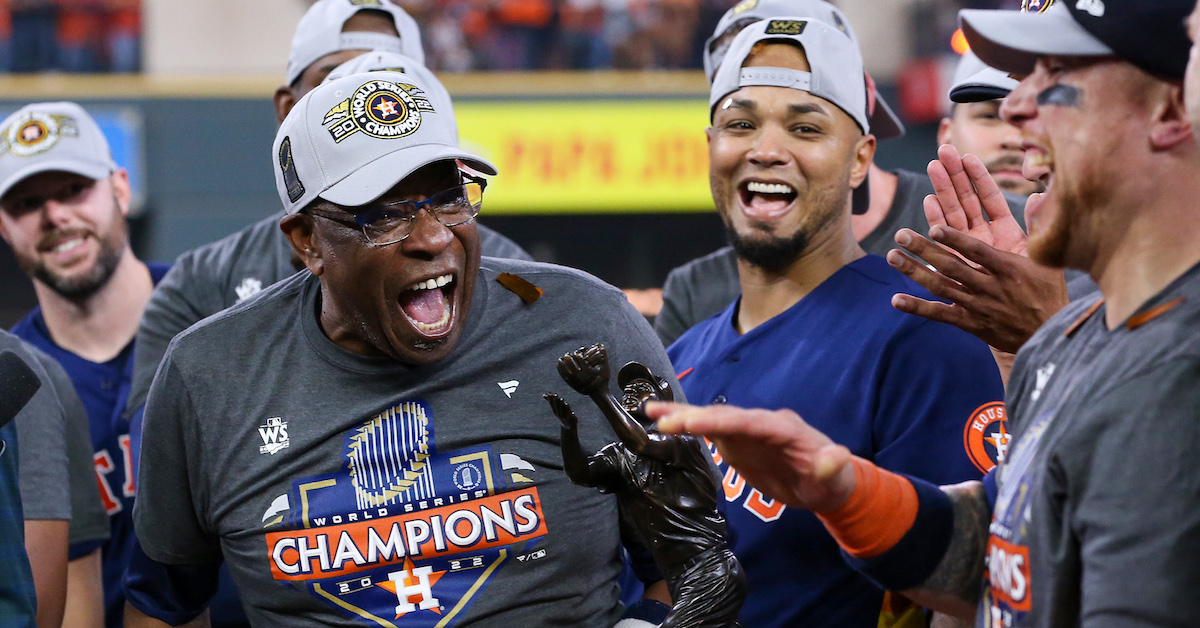
Dusty Baker is on the outside no longer. On Saturday night, the manager with the highest win total of any skipper never to pilot a World Series winner shed that distinction, as the Astros secured their championship by beating the Phillies, 4–1, in Game 6 at Minute Maid Park. After managing for 25 seasons — 12 of them with at least 90 wins — and reaching the World Series two other times (2002 and ’21), the 73-year-old Baker finally won one:
Not that he hadn’t already tasted champagne as the All-Star left fielder of the 1981 Dodgers. That makes him one of seven men to win championships as a player and manager during the division play era (1969 onward), and one of 22 overall, not counting player-managers.
Saturday’s victory made Baker the oldest manager to win a World Series, but he viewed the significance of his accomplishment differently. “I don’t think about being the oldest,” he told reporters after the victory. “I don’t think about my age. But I do think about being the third Black manager with Dave Roberts and my good friend Cito Gaston, who was responsible really for me as a kid when I first signed with the Braves.”
In a game that’s all too lacking in diversity at the leadership levels, Baker has remained mindful of his status. Prior to Game 6, he said, “I do know that there’s certain pressure from a lot of people that are pulling for me, especially people of color. And that part I do feel. I hear it every day… and so I feel that I’ve been chosen for this.”
As the manager who took over the Astros amid the fallout from their illegal electronic sign stealing, Baker was an inspired if counterintuitive choice. A commanding presence in the clubhouse and with the media, he helped deflect attention away from an owner who shirked responsibility and a squad whose star players seemed to go through the motions in apologizing for their roles in the scandal before swiftly pivoting to an us-against-everyone rallying cry. Though hardly averse to the use of sabermetrics in decision-making, Baker also brought a warmth and humanity to an organization whose commitment to analytics under general manager Jeff Luhnow and manager A.J. Hinch had often been described as dehumanizing even before the trash can banging scheme came to light.
Only five players remain from the 2017 squad whose World Series victory over the Dodgers was subsequently tainted by the revelations of their sign stealing: Jose Altuve, Alex Bregman, Yuli Gurriel, Lance McCullers Jr., and Justin Verlander. The combination of their minimal contrition and Major League Baseball’s decision not to discipline them (particularly the hitters) for their participation has made them villains in the eyes of many fans, booed everywhere but Houston. Baker indicated his belief that such treatment galvanized the team:
“The boos and the jeers that we got all over the country, it bothered these guys, but it also motivated them at the same time. And it wasn’t an us against the world thing. It was more of a come together even closer type thing.”
Perhaps, but anger toward the 2017 group — and anyone else in an Astros uniform — for what McCullers frankly termed “the whole cheating scandal” still runs deep. On social media, seemingly minor matters that arose during this World Series, such as Aledmys Díaz leaning into a pitch, Martín Maldonadousing a grandfathered Albert Pujols bat, and Framber Valdezremoving his glove on the mound and rubbing his hands together were taken as evidence that they were still cheating, somehow. On the one hand, the paranoia is quite silly, particularly as the Phillies didn’t seem to get too worked up about such matters. On the other hand, this is the price that the Astros and MLB must continue to pay for what transpired… and what didn’t. For many fans, Baker’s victory is the most, if not the only, palatable way to accept the Astros’ championship.
In winning the World Series, Baker has almost certainly secured himself a spot in the Hall of Fame. His resumé might have been enough without a championship, as he ranks fourth in playoff appearances (12, a product of the Wild Card era but also a reminder of his routine success), ninth in victories (2,093), 10th in games managed (3,884), and 15th in games above .500 (303). Wilbert Robinson (1902, ’14–31) and Al Lopez (1951–69), each of whom won two pennants but lost twice in the Fall Classic, are already enshrined, as is every manager with at least 2,000 wins save for Baker and the recently un-retired Bruce Bochy, who has a spot awaiting him given his three World Series wins:
Dusty Baker’s Managerial Record
Team
Years
W
L
W-L%
90+
Div
WC
Pennant
WS
Giants
1993-2002 (10)
840
715
.540
5
2
1
1
0
Cubs
2003-2006 (4)
322
326
.497
0
1
0
0
0
Reds
2008-2013 (6)
509
463
.524
3
2
1
0
0
Nationals
2016-2017 (2)
192
132
.593
2
2
0
0
0
Astros
2020-2022 (3)
230
1154
.599
2
2
1
2
1
Total
25 years
2093
1790
.539
12
9
3
3
1
SOURCE: Baseball-Reference
From a childhood in Riverside and Sacramento through a 19-year career as a major league outfielder with the Braves, Dodgers, Giants, and A’s, and then a quarter-century as a manager, Baker’s road to Cooperstown has been a long one. As the only manager ever to guide five franchises to division titles (the Giants, Cubs, Reds, Nationals, and Astros), he already had an achievement that set him apart from his peers, albeit one that he didn’t quite feel was cause for celebration. “I don’t really think nothing, other than why was I on so many different teams,” he told reporters as the playoffs began last year. “I’m serious. I feel fortunate to have gotten that many jobs, but I feel unfortunate that I shouldn’t have lost jobs when I was winning.”
Indeed, as I’ve noted before, at three of his previous four stops, Baker departed after seasons with at least 90 wins and postseason berths. In 2002, he won 95 games in guiding the Giants to their first World Series since 1989; it was the fourth time in six years his team had topped 90 wins, and third with a playoff berth. Yet the Giants didn’t offer him a contract after the 2002 World Series due to his strained relationship with managing partner Peter Magowan, and Baker landed with the Cubs. He nearly took them back to the World Series in his first season, only to be derailed by the Steve Bartman play and the Cubs’ sudden unraveling; by his fourth season in Chicago (2006), the team was 66–96 and in need of a new direction. The Cubs let his contract expire, the only time he left a losing team.
In 2008, Baker took over the Reds; after back-to-back, sub-.500 finishes, his team won 91 games and the NL Central in 2010, its first postseason berth since 1995. Following another sub-.500 season, he won 97 games and another NL Central title in 2012, but after 90 wins and a Wild Card berth in ’13, he was fired nonetheless. It took him two years to land another managerial job, and despite leading the Nationals to back-to-back NL East titles and seasons of 95 and 97 wins, the team let his contract lapse.
In 2019, Baker got as far as a second interview for the Phillies opening that went to Joe Girardi, whose team didn’t make the playoffs in either of the next two seasons. Girardi was fired after a 22–29 start in early June, but Rob Thomson guided them on an unlikely run that took them all the way to Game 6.
One team’s second choice is another team’s skipper, so it’s fortunate for the Astros that the then-70-year-old Baker was available when owner Jim Crane needed to make a quick but credible hiring to replace Hinch just a couple of weeks before pitchers and catchers reported for the 2020 season.
As we all know, the world shut down and the season was delayed by nearly four months. With Verlander lost to a forearm strain (he would eventually need Tommy John surgery), and Altuve, Bregman and Gurriel considerably less productive than before (ahem), the Astros went just 29–31 under Baker during the pandemic-shortened season. Even so, they finished second in a weak AL West and made the expanded playoffs as the sixth seed. There they caught fire, sweeping the Twins in the Wild Card Series, beating the A’s in a four-game Division Series, and taking the Rays to seven games in the ALCS before falling. Houston won 95 games last year, then knocked off the White Sox and Red Sox before losing to the Braves in a six-game World Series. This year, the Astros won an AL-high 106 games, then swept both the Mariners and Yankees to reach the World Series again.
Despite falling behind by losing Games 1 and 3, the Astros came back to subdued the Phillies by winning three straight; the first two of those came at Citizens Bank Park, where Philadelphia had gone 6–0 during the postseason to that point. Beginning with a combined no-hitter started by Cristian Javier, the Astros held the Phillies to three runs and nine hits over their final three games, a .101/.223/.180 showing.
In losing the aforementioned games, Baker drew criticism for sticking too long with the struggling Verlander and McCullers; the pair combined to allow 12 runs in 9.1 innings, and a quicker hook might have given the Astros a better shot at winning. Yet the Astros allowed just six runs (five earned) in the 44.2 innings thrown by their other pitchers in the World Series, and the team as a whole posted a 2.29 ERA over the course of the postseason. Baker rarely called a wrong number when it came to his bullpen, which pitched to an 0.83 ERA in 54.1 innings for the postseason. The Astros went 11–2 during their march to the championship, including 5–1 in one-run games. Baker may not have run the team flawlessly, but it’s hard to find much fault with his performance.
This was a very different team from the won that one in 2017, as well as a reminder that the criticisms that were so easy to levy at Baker a decade or two ago no longer apply. Young pitchers thriving on his watch and handled with care? The 28-year-old Valdez (1.44 ERA in 25 innings) and 25-year-old Javier (0.71 ERA in 12.2 innings) were the team’s two best starters in October and November, and maxed out at 104 and 97 pitches, respectively; they helped compensate for Verlander and McCullers both posting ERAs above 5.00. Young position players getting playing time? Hello, Jeremy Peña, the first rookie position player to win World Series MVP honors, and at 25 years and 45 days old, the youngest position player to do so. Yordan Alvarez and Kyle Tucker are less than a year older than Peña, and both are already grizzled veterans, with three postseasons of regular play under their belts. Sacrifice bunts? Nine all season, four by the light-hitting Maldonado, and just two in the postseason, one of which — the bunt by Peña in ALCS Game 3 — was part of a daring sequence where only an insurance run was at stake.
I suspect the baseball world outside Houston will remain salty when it comes to the Astros so long as Altuve and Bregman wear the blue and orange, and perhaps so long as Crane owns the team, given his longstanding reputation for avoidingaccountability. Crane hardly seems like a delight to work for, and it has not escaped notice that neither Baker, who entered the season on a one-year contract, nor general manager James Click, who is in the final year of a three-year deal, have contracts for 2023. Neither is a lock to return, though it’s believed that Baker will receive an extension offer, and that he wants to continue his career. “I’ve always said if I win one, I want to win two,” he said. Even if the rest of the baseball world may prefer another team wear the crown, it’s very hard to wish anything but the best for Dusty.





 Sponsor Us on Patreon
 Subscribe to Stathead
 Facebook Group
 Twitter Account
 EW Subreddit
 Effectively Wild Wiki
 iTunes Feed
 Get Our Merch!