
Randy Vásquez Is Ready Now
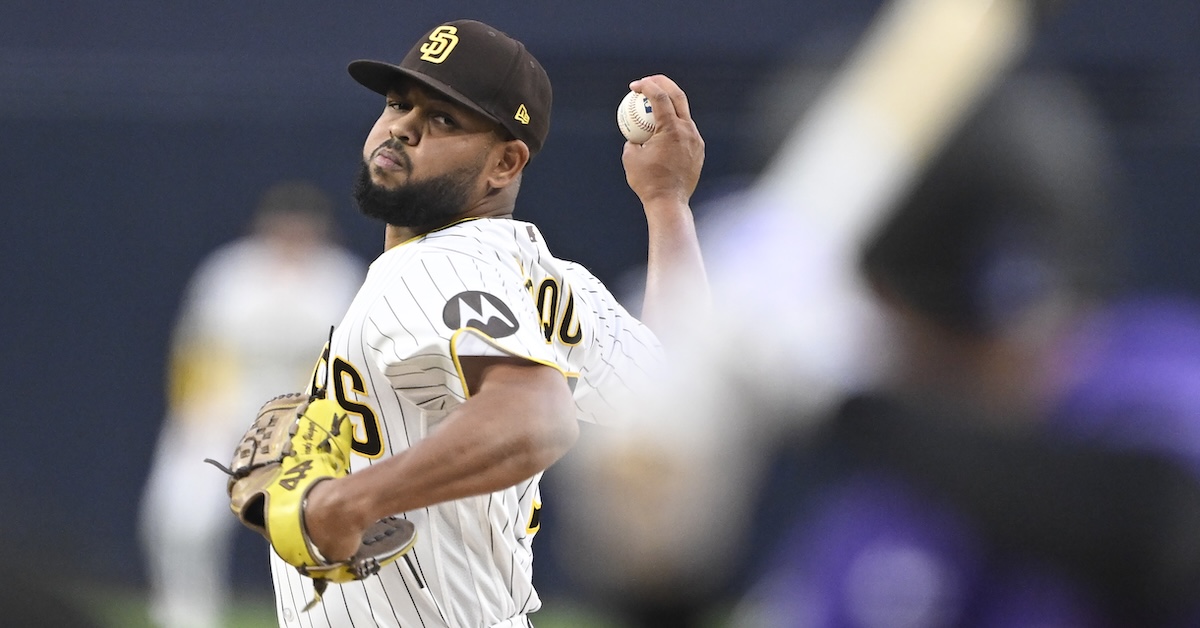
Randy Vásquez has struck out 19 batters in his first three starts of 2026. He didn’t record his 19th strikeout in 2025 until May 14, in the third inning of his ninth start.
Vásquez has simply dominated in the earliest days of the new season. He opened the year with six shutout innings against the Tigers, striking out eight. He picked up a mere three strikeouts in his second start against the Red Sox, but his stuff was just as good, generating whiffs on 32.6% of swings. And then he picked up eight more strikeouts on Thursday against the Rockies. He now has a 1.02 ERA, a 2.57 FIP, a 27.5% strikeout rate and a 5.8% walk rate, pitching like a top 20 starter in the majors to begin 2026.
Weird, right?
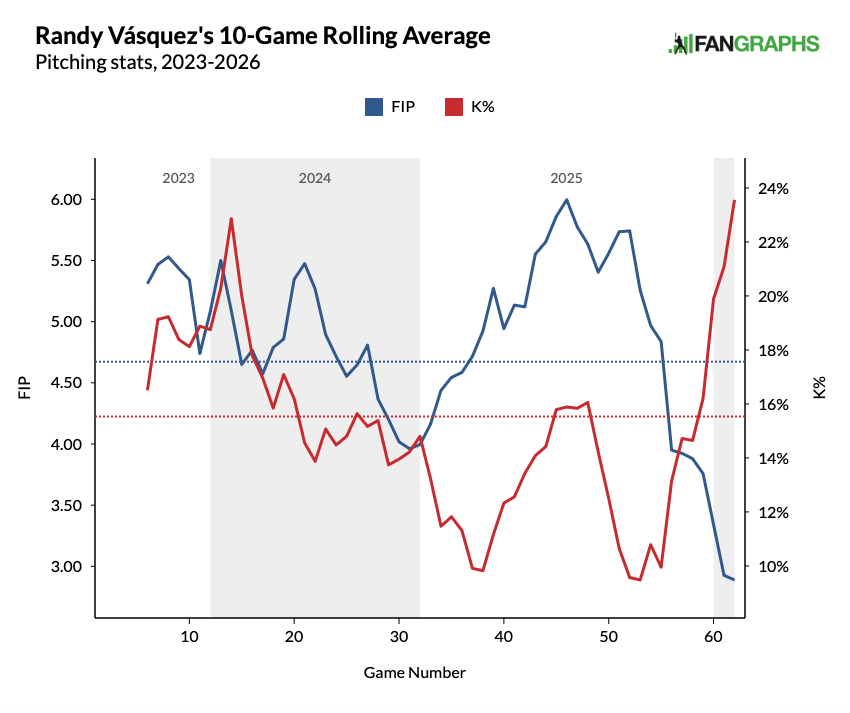
It’s not that Vásquez was terrible before this year. He posted a 3.70 ERA and 4.96 FIP across 26 starts in 2025, and his performance was similar in the two seasons prior. That’s a pitcher who can stick in the backend of most rotations and serve as useful depth. But it wasn’t clear what Vásquez did well, or how he might take the next step to becoming a true mainstay in the majors. He walked more batters than average. He didn’t really limit hard contact. And his 14.8% strikeout rate was the lowest among any starting pitcher with at least 200 innings from 2023 through 2025. He was just kind of there.
And now he’s here:
I don’t want to get too worked up over three starts. This is a dangerous time of year for analysis. Any big league-quality pitcher can look good over a handful of outings, and Vásquez has notably faced two lineups ranked in the bottom 10 of the league by wRC+ (the Red Sox are at 92 wRC+, the Rockies a 78). Chandler Simpson is hitting .411, and the Nationals have a top-five offense. Not much is knowable yet.
But what’s different about Vásquez is that this new success isn’t quite so new. Again, he struggled to be more than passable for most of 2025, and was demoted in early August after failing to get through five innings in four straight starts. He was briefly recalled after Michael King went on the IL, only to be optioned again. When he returned on September 6, however, he looked like a brand new pitcher — a lot like the pitcher we’re seeing in 2026. His velocity was up, he was throwing more strikes, and, crucially, he was finally starting to miss bats. In four starts after returning to the majors, Vásquez posted a 3.09 FIP, a 21.7% strikeout rate, and a 3.6% walk rate.
What changed?
In broad strokes, not a whole lot. I tried running through the standard gauntlet of diagnostics, looking for new patterns in movement and spin and angles. I couldn’t find many large, wholesale changes to his repertoire or delivery. Vásquez is still a contemporary, seven-pitch pitcher. He throws three kinds of fastballs, relying on those for about two-thirds of his pitches, while also sprinkling in a changeup, curveball, sweeper, and slider, depending on the handedness of the batter.
One subtle change is the shape of his cutter, as spied by Michael Rosen in spring training. Michael noted that Vásquez is getting more break on the pitch both up and down. It now moves a lot like his little-used slider, just four ticks faster. That extra depth has allowed Vásquez to “cut” his cutter across the face of the zone and land it for a strike on the black. PitchingBot loves this change, upgrading his cutter’s command rating from a 47 on the 20-80 scale in 2025 to 60 so far in 2026.
But the biggest change for Vásquez might actually be reducing his reliance on that cutter. Last year, it was his primary pitch, throwing it 24.9% of the time. This year, it’s dropped to second at 20.9%. This is actually true of for several of his pitches. Vásquez in 2026 is not only throwing fewer cutters, but fewer sinkers, sweepers and curveballs, too.
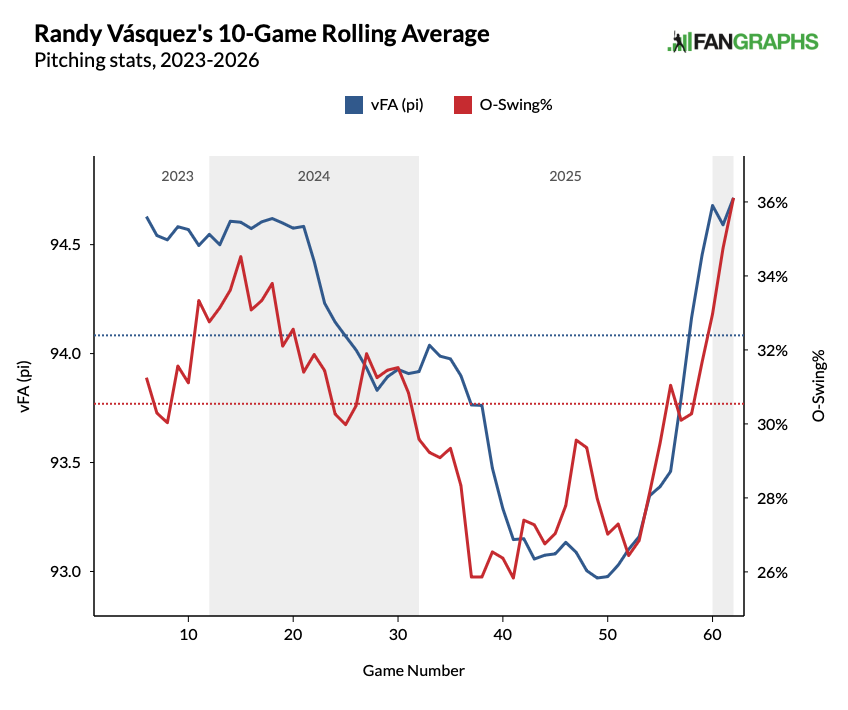
In their place, he’s turned to a classic: the four-seam fastball. He’s thrown it 33.5% of the time in 2026, compared to just 21.0% last year. It’s a better fastball, too. He’s throwing it quite a bit harder at 94.8 mph, or about two full ticks faster than last year. He’s also getting an extra inch of rise and extra inch of run, coaxing batters to chase the pitch out of the zone. That’s helped him to nearly double his whiff rate on the pitch to a whopping 30.4%.
It’s not just a useful tool to get ahead. Vásquez is throwing his four-seamer nearly 40% of the time in two-strike counts. Our new Paired Pitches tool helps illustrate why this is so effective. Vásquez has a broad, diverse arsenal that can access pretty much every part of the zone at every speed. He’s always scored above average by the various arsenal metrics developed by Baseball Prospectus. He’s simply unpredictable. Righties have to respect that a fastball up might be a sinker that bites back towards their hands or a cutter that fades away. And lefties have to respect the slower, north-south movement — attempting to stay back while trying not to be late.
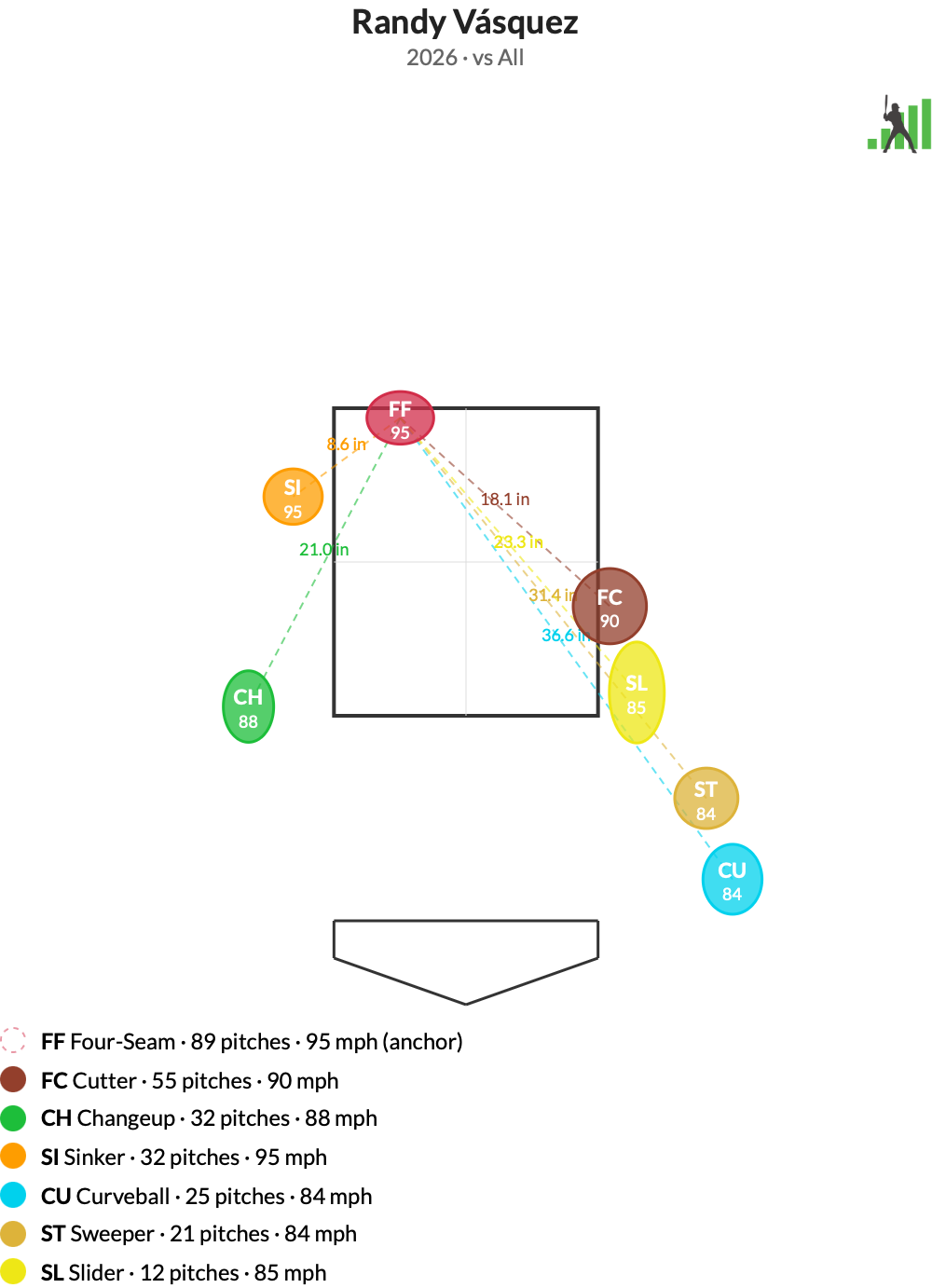
At 93 mph, batters could still sit hope to sit and adjust. Maybe they had a hard time guessing what was coming, but they didn’t have the threat of missing the fastball hanging over their heads. At 95 mph, however, all of that changes. Batters now have to truly guess, and they’re not guessing well. Vásquez has thrown 79 pitches way out of the zone this year, in what Baseball Savant calls the “chase” and “waste” zone. Batters have swung at 23 of them — the eighth highest rate in the majors.
This swinging strikeout on the four-seamer is a great illustration. You can see Ceddanne Rafaela trying to process all of this in real time, considering whether the pitch is about to break back over the plate or fall out of the bottom of the zone or fade towards the — whoops, it’s already gone:
The next question, then, is whether this velocity might stick around. This is where I’m going to again fall back on September 2025. Vásquez was throwing hard when he returned to the majors last year, and we can see that velocity has continued into 2026:
Still, where did it come from? This time last year, Vásquez wasn’t in the best standing with the Padres. He’d shown up to camp out of shape, and the team put him on a strength and conditioning program to build up his velocity and stamina, as The Athletic’s Dennis Lin reported in March. His progress really took off when he began working with Yu Darvish, who taught him how to recover between starts, helped him study scouting reports, and kept him accountable to his own development.
Padres pitching coach Ruben Niebla told The Athletic that this relationship, and the payoff, provided Vásquez with a bit of clarity on his identity as a pitcher:
“Being a pitcher is not just about what he does on the mound. A lot of it is, like, the discipline of what he does off the mound, right? It’s the four days in between. It’s a routine. That routine builds confidence.”
This is the part where I have to temper expectations. We’ve only seen this new version of Vásquez for a few weeks in 2025 and separately for a few weeks in 2026. As Eric Longenhagen has noted in earlier scouting reports, Vásquez profiles more like a multi-inning reliever because of his small stature, his violent delivery, and his general lack of consistency. I don’t know that any of that has really changed to this point.
Still, this is an encouraging development for the Padres, who continue to look for value from the quartet of arms they got as part of trading Juan Soto to the Yankees. Drew Thorpe was barely on the team, dealt to the White Sox in the Dylan Cease trade four months after the Soto deal. King has flashed greatness, but has struggled with injury and inconsistency. Jhony Brito hasn’t thrown a pitch in the majors since 2024. While King could still pan out and has been good enough that the Padres re-signed him this offseason, he’s nearly 31 and will hit free agency again sometime in the next three years. A good version of Vásquez could contribute through 2030.
Plus, the Padres simply need pitchers, period. They ranked 26th in our preseason positional power rankings, and their rotation at the moment is a hodgepodge of reclamation projects with tenuous bills of health. If this indeed what Vásquez is capable of, it’s a lot easier to see them finishing the year around average. And as Ben Clemens recently pointed out, a good starting pitcher would do wonders for the Padres’ playoff odds.
This all amounts to a very April story. The pitcher with the lowest strikeout rate in baseball over the last three years is suddenly striking out tons of batters over his first three games. A team desperate for any positive sign from their rotation is suddenly staring one in the face. Is this all just wishful thinking? Well, that’s for the next 5 1/2 months to decide.
Ryan Blake is a contributor for FanGraphs and Lookout Landing.
Cease and King contributed to playoff runs – hard to say the Padres didn’t get value there. Arguably, they should have had a different approach to the Soto trade but seems like they wanted to maximize their window. Vasquez’s development is almost a bonus.