
Redrawing the MiLB Map: Visualizing the 2021 Landscape
Last year, as part of the negotiations over a new Professional Baseball Agreement (PBA) with Minor League Baseball, Major League Baseball introduced a proposal that would dramatically reimagine the minor leagues. The proposal included plans to shift the timing of the amateur draft and realign some parent-club affiliations, league geographies, and club levels. Most importantly, it proposed stripping more than 40 clubs of their affiliated status, though it also suggested that some of the newly unaffiliated teams would assume other formats, either as so-called professional partner leagues, or as amateur summer wood bat leagues. The plan got us thinking about how access to in-person baseball across the United States would change. We were interested in how many people would lose their ability to watch affiliated baseball in person, or would see that access shift from the relatively affordable confines of the minor leagues to more expensive major league parks.
Those studies relied on a New York Times list of teams reportedly slated for contraction, as well as Baseball America’s excellent reporting. Thirteen months, a pandemic, and one extremely contentious negotiation later, MLB has informed minor league teams of their proposed fates, with 120 franchises “invited” to be part of the new, MLB-developed minor league system. Many are still reviewing the terms of their “invitations”; several find themselves occupying a new rung on the minor league ladder, or with a different parent club than before.
Meanwhile, 25 clubs find themselves ticketed either for summer wood bat leagues, including the newly formed MLB Draft League, or for pro partner leagues for undrafted players and released minor leaguers. Eighteen teams face futures that are, as of this writing, uncertain, though as Baseball America’s JJ Cooper notes, “Major League Baseball has indicated that it will pay entry fees for these teams that were left out of affiliated baseball to join new leagues. MLB will pay their way in, but as a condition those teams are expected to waive a right to sue.” The complete list of the 43 franchises slated to lose their affiliated status can be found below. Of the 43, 11 are full-season clubs:
| Team | Previous League | New League | Format |
|---|---|---|---|
| Auburn | New York-Penn | TBD | TBD |
| Batavia | New York-Penn | TBD | TBD |
| Billings | Pioneer | Pioneer | Pro partner league |
| Bluefield | Appalachian | Appalachian | Summer wood bat |
| Boise | Northwest | Pioneer | Pro partner league |
| Bristol | Appalachian | Appalachian | Summer wood bat |
| Burlington | Appalachian | Appalachian | Summer wood bat |
| Burlington | Midwest | TBD | TBD |
| Charlotte | Florida State | TBD | TBD |
| Clinton | Midwest | TBD | TBD |
| Danville | Appalachian | Appalachian | Summer wood bat |
| Elizabethton | Appalachian | Appalachian | Summer wood bat |
| Florida | Florida State | TBD | TBD |
| Frederick | Carolina League | MLB Draft | Summer wood bat |
| Grand Junction | Pioneer | Pioneer | Pro partner league |
| Great Falls | Pioneer | Pioneer | Pro partner league |
| Greeneville | Appalachian | Appalachian | Summer wood bat |
| Hagerstown | South Atlantic | TBD | TBD |
| Idaho Falls | Pioneer | Pioneer | Pro partner league |
| Jackson | Southern | TBD | TBD |
| Johnson City | Appalachian | Appalachian | Summer wood bat |
| Kane County | Midwest | TBD | TBD |
| Kingsport | Appalachian | Appalachian | Summer wood bat |
| Lancaster | California League | TBD | TBD |
| Lexington | South Atlantic | TBD | TBD |
| Lowell | New York-Penn | TBD | TBD |
| Mahoning Valley | New York-Penn | MLB Draft | Summer wood bat |
| Missoula | Pioneer | Pioneer | Pro partner league |
| Northern Colorado | Pioneer | Pioneer | Pro partner league |
| Norwich | New York-Penn | TBD | TBD |
| Ogden | Pioneer | Pioneer | Pro partner league |
| Princeton | Appalachian | Appalachian | Summer wood bat |
| Pulaski | Appalachian | Appalachian | Summer wood bat |
| Rocky Mountain | Pioneer | Pioneer | Pro partner league |
| Salem-Keizer | Northwest | TBD | TBD |
| State College | New York-Penn | MLB Draft | Summer wood bat |
| Staten Island | New York-Penn | TBD | TBD |
| Trenton | Eastern | MLB Draft | Summer wood bat |
| Tri-City | New York-Penn | TBD | TBD |
| Vermont | New York-Penn | TBD | TBD |
| West Virginia | South Atlantic | TBD | TBD |
| West Virginia | New York-Penn | MLB Draft | Summer wood bat |
| Williamsport | New York-Penn | MLB Draft | Summer wood bat |
So how many Americans will see their ability to watch affiliated baseball in person disappear under MLB’s proposed system? And how many will see their primary point of access shift to major league teams, or to the new Pro Partner and summer wood bat leagues? With the exact contours of MLB’s plan now known, we thought we would refresh our analysis.
First, let’s recap our methodology. To work out how the closure and reclassification of these minor league teams will affect access to baseball, we went to the map. More specifically, we took the geographical center of each ZCTA (a close relative of ZIP Codes used by the Census Bureau) and calculated the distance as the crow flies from each ZCTA to each ballpark in America. From there, we took the minimum of all of those distances for each ZCTA for the relevant subset of stadiums. That gave us the shortest distance to baseball for each geographical center. We then matched the distance with the population of each area. Linear distance isn’t perfect — it doesn’t account for roads, traffic, or natural barriers, for instance — but given the size of the dataset, it seemed like a reasonable compromise.
We calculated these distances across several subsets. We looked at the current affiliated minor leagues only, the affiliated minors as well as the majors, and also all professional baseball including independent leagues. For 2021 access, we took several slices as well: only the new affiliated minor league system, the new system plus big league clubs, that group plus indy ball, and finally several different variations on including the new pro partner and summer wood bat leagues. In that way, we found the distance from every part of the continental United States to various definitions of relevant live baseball.
From there, we applied some discretion. For each state, we estimated a reasonable distance that fans would be willing to travel to see a baseball game. Live in Montana? You might be willing to drive 100 miles to see a game, because you might have to be willing to drive 100 miles to do all sorts of things. Live in New Jersey? Driving 100 miles might be a three-hour proposition depending on traffic. In dense areas, we used a 35-mile maximum. Those aren’t the only two possible acceptable travel differences; in Tennessee, for example, we used a 50-mile maximum. We classified each state in this way, then used those maxima and our previously calculated distances to determine whether a ZCTA has access to professional baseball. In all the charts and tables below, when you see “dynamic” distance being calculated, it refers to this flexible range.
This method has several shortcomings. The aforementioned issue with linear distance is the most serious, but there are others. We don’t account for public transportation, which could make some routes far easier than others. We also don’t account for variations within a region: In California, for example, parts of the state are dense and urban, and other parts are rural, sparsely populated, and farther-flung. We’re considering both groups the same way, one of the limitations of our method. Finally, we don’t consider other high-level baseball. If you live near a good college baseball team, you might not care if there’s a minor league stadium 75 miles away if you can just watch Vanderbilt or Mississippi State instead. The scope and variation of the college baseball landscape is such, however, that we chose to limit our dataset to existing professional teams. If you’d prefer to add college programs in yourself, our dataset is available at the end of this article. We’d be very interested in what you find!
In addition, all of our calculations assume access to a car, public transportation or, in some limited cases, a bike route. Transit access is a serious issue — proximity doesn’t mean much if you don’t have a way to get there — but it’s one that is unlikely to be addressed directly by MLB, though the league and its teams can certainly do their part by making easy access to public transit a priority in the selection of new ballpark sites. Still, we think it’s important to acknowledge, especially if we’re assuming a variable understanding of what is “close” when considering how accessible affiliated baseball is.
With those limitations in mind, how many people are losing close access to baseball? That depends on your definition of how many people currently have close access to baseball. If you’re interested in access to the affiliated minors specifically — 160 teams in 2019 and 120 in 2021 — the change is meaningful. First, here are the number of Americans within various distances of a minor league game as of 2019:
| Miles | Millions w/Access |
|---|---|
| 25 | 133.4 |
| 50 | 213.6 |
| 75 | 249.1 |
| 100 | 263.0 |
| 150 | 285.4 |
| Dynamic | 218.6 |
In 2021, there will be fewer affiliated teams. Millions of people will lose close access:
| Miles | 2019 | 2021 | Change |
|---|---|---|---|
| 25 | 133.3 | 118.8 | -14.5 |
| 50 | 213.6 | 200.5 | -13.1 |
| 75 | 249.1 | 242.7 | -6.4 |
| 100 | 263.0 | 264.8 | 1.8 |
| 150 | 285.4 | 285.2 | -0.2 |
| Dynamic | 218.6 | 201.3 | -17.3 |
If your definition of baseball is more expansive, it follows that more people have access to it. For example, here’s the same calculation as above, repeated for the affiliated minor leagues, the majors, and the major independent ball circuits:
| Miles | 2019 | 2021 | Change |
|---|---|---|---|
| 25 | 204.7 | 192.3 | -12.4 |
| 50 | 256.3 | 247.3 | -9.0 |
| 75 | 278.2 | 272.2 | -6.0 |
| 100 | 290.3 | 286.9 | -3.4 |
| 150 | 302.4 | 299.9 | -2.5 |
| Dynamic | 264.3 | 254.5 | -9.8 |
If you expand the universe to include the nine-team Pioneer League, which will be a pro partner league in 2021, the number of people losing access to baseball shrinks:
| Miles | 2019 | 2021 | Change |
|---|---|---|---|
| 25 | 204.7 | 195.2 | -9.5 |
| 50 | 256.3 | 250.2 | -6.1 |
| 75 | 278.2 | 274.4 | -3.8 |
| 100 | 290.3 | 289.2 | -1.1 |
| 150 | 302.4 | 302.5 | +0.1 |
| Dynamic | 264.3 | 256.7 | -7.6 |
New pro partner leagues aren’t the only novel feature of MLB’s new plan. Sixteen teams will also become part of summer wood bat leagues, unaffiliated with any major league team and instead drawing their player pool from the amateur ranks. For a small number of fans, this will change nature of their access and could alter the caliber of baseball they can watch in-person:
| Miles | 2021 (millions) |
|---|---|
| 25 | 3.4 |
| 50 | 2.4 |
| 75 | 1.1 |
| 100 | 0.9 |
| 150 | 0.0 |
| Dynamic | 3.7 |
Is this equivalent to the access these people currently have? It’s not yet clear. As Baseball America’s JJ Cooper noted when discussing the teams of the MLB Draft League, which is geared toward draft-eligible college players (high schoolers are also eligible to play), few potential first-round picks are likely to play for fear of hurting their draft stock. But he also notes that the New York-Penn League, which will supply four of the Draft League’s teams, hasn’t been teeming with first rounders of late either. For some fans, the experience of going to the ballpark is the thing: The quality of the play on the field is less important than the assurance of a cheap ticket and a cold beer at a nearby game at all. Still, there are likely to be fans for whom the move from drafted players with some chance of making the majors (however long their odds may be) to amateur players who are sometimes years away from the Draft is a move in the wrong direction.
That’s what the data look like in the aggregate. The numbers, though, are impersonal. What does it look like when 17.3 million people lose in-person access to minor league baseball? It’s a nationwide issue, from Florida to Oregon. Here are the areas losing access to minor league games between 2019 and 2021:
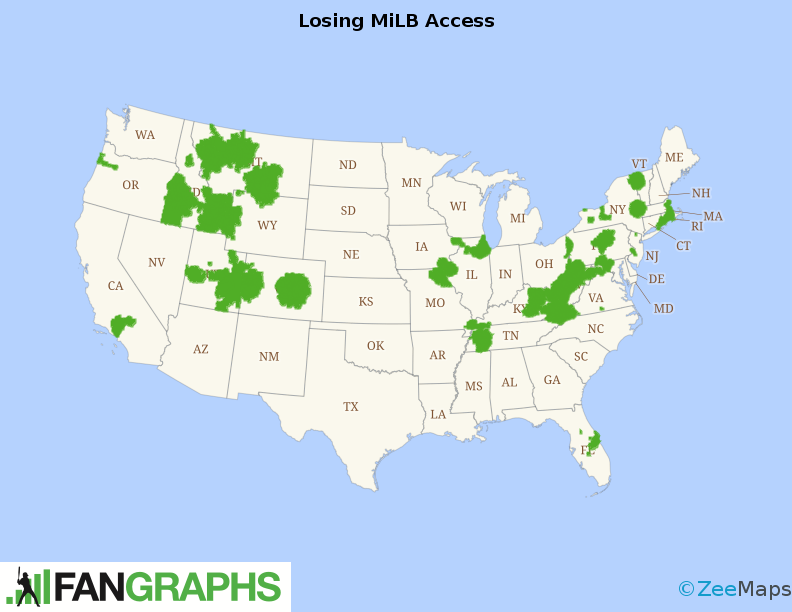
Appalachia and the Mountain West are hit the hardest, but the closure affects every part of the country. Some of these regions might surprise you; the Chicago area, for example, doesn’t seem like a spot that is likely to feel short of baseball. The loss of the Low-A Kane County Cougars, however, means that people in that area will need to venture into the city to catch the Cubs or White Sox if they want a baseball fix. Here you can see the areas that lost access to minor league baseball but have a major league park available:
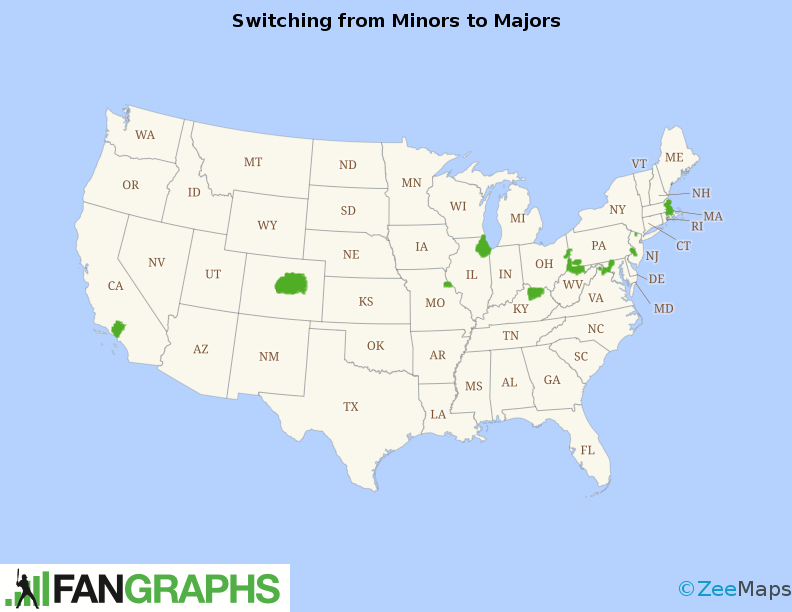
The highlighted regions cover 17 million people, but they don’t tell the full story. 10.3 million people will go from having only major league access to having a nearby minor league team, largely in the Minneapolis and Boston areas thanks to the St. Paul Saints and Worcester Red Sox.
Still, that’s a net of roughly 6.7 million people who will go from affordable games to pricier affairs. As we noted last year:
The average minor league ticket ran around $8 in 2016, and a night for a family of four cost roughly $65. It’s safe to say that that isn’t the case in the major leagues.
The areas switching from minor league to major league baseball aren’t the only places where there will still be baseball to watch. 9.6 million people will lose access to the affiliated minor leagues, but gain access to the newly created pro partner or summer wood bat leagues:
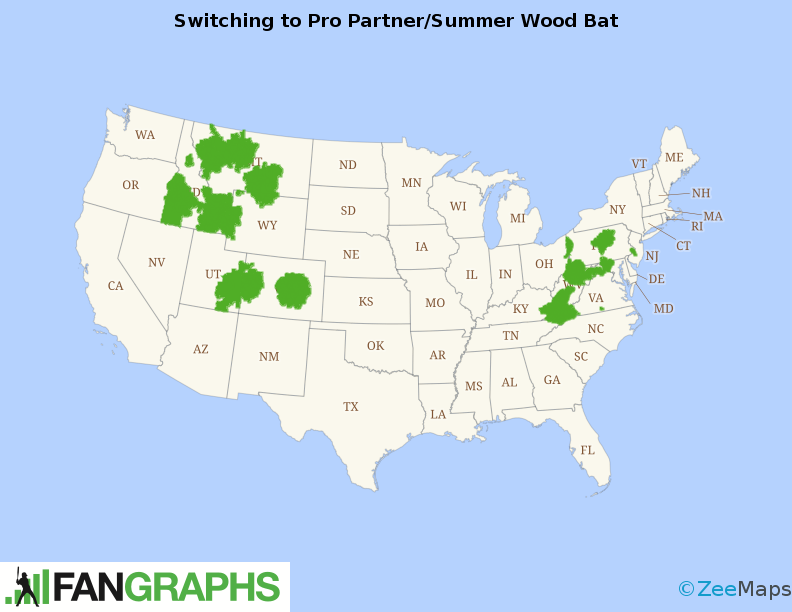
As we mentioned above, this is likely to be a closer fit to the atmosphere of the minors, if not necessarily the talent level. Anyone who wanted to attend a minor league baseball game for the dollar beverages and cheesy local billboards on the outfield walls will still feel at home at these games, but those looking for the talent density of old might be disappointed.
For an unlucky few, however, baseball will simply disappear. Just over five million people will go from having a nearby minor league team to having nothing — no affiliated minors, no major league clubs, no indy ball, and no new pro partner leagues or collegiate wood bat leagues:
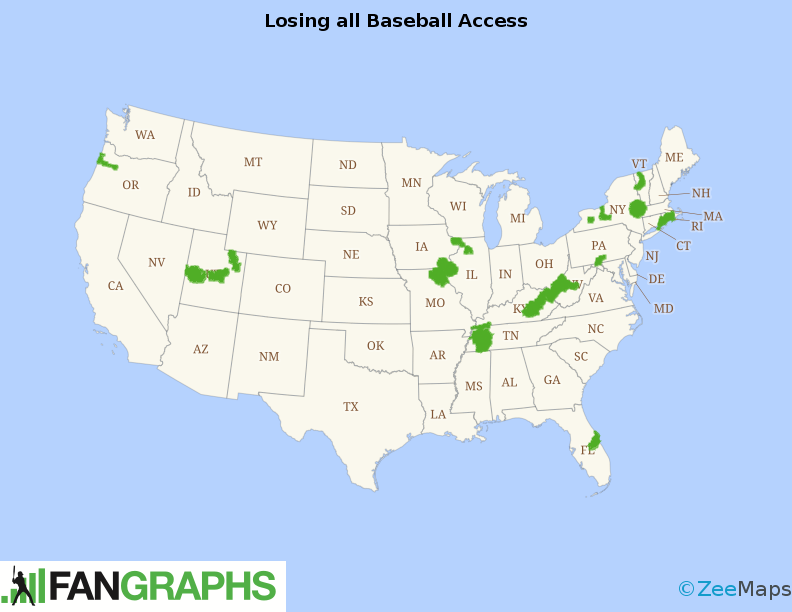
Some of those affected will have other options, as we previously mentioned; the ultimate fate of 19 teams is still unclear, after all, and there is college ball. We also haven’t considered existing summer wood bat leagues in our analysis, which will soften the blow for some. For many of the 5.2 million, however, live baseball will simply stop being something they have access to.
So what have we learned? 5.2 million people across the U.S. will lose their access to close, in-person baseball. Nearly 23 million people who had minor league access will now have to go elsewhere — to different leagues, different pools of players and, perhaps, different price points. (On the other hand, 10.3 million people who only had major league access will gain minor league access; thank you, St. Paul Saints, Worcester Red Sox, Somerset Patriots, and Sugar Land Skeeters.)
What this all means — for player development going forward, for the types of players who get a chance to play affiliated ball (or don’t), for the ticket takers and marketing interns and hot dog folks at the 18 franchises whose futures are still uncertain, for the game of baseball — will take a while to sort out. Teams lauded for their player development, like the Yankees and the Dodgers, will see their player pools shrink. The travel conditions, pay, and facilities for minor leaguers will improve somewhat, but there will be far fewer of them to enjoy it. Many major league teams will see their affiliates move closer to home, while some communities will see affiliated baseball move much farther away. Perhaps most meaningfully (and concerningly, depending on your view of MLB and its motives), control over affiliated baseball — over professional baseball in the U.S. — has been further consolidated.
Part of our work at FanGraphs will be weighing the various costs and impacts of an MLB-developed minor league system and helping you understand what it means for the game and your enjoyment of it. Today, though, our project is to say a bit more about what this means for baseball fans who might want to watch the game in-person when it is safe to do so again. More than 40 million people attended a minor league game in 2019 — more than half the 69 million that attended a big league game. How essential that experience is to minting the next generation of fans is hard to say, but accessible baseball close to home seems unlikely to hurt the cause. People enjoy minor league baseball, with its future stars and career journeymen, its funny team names and affordable tickets. For many of those folks, going to the park just got harder.
Finally, a quick research note. Did we fail to address a particular distance of access you were interested in? Do you want to make your own maps or slice ours differently? You can look at our raw data output here. This spreadsheet contains the output of our distance minimization algorithm (courtesy of the Geopy Python package) for each of our permutations, listed by ZCTA. It also contains mapping to our dynamic distance choices, as well as ZCTA-to-state conversions. Want to use a different dynamic distance algorithm or dive deeper into a specific region? You can do any of that with this dataset. Want to add more ballparks? You’ll need your own minimization algorithm, but you can find the latitude and longitude coordinates of every ballpark in our analysis here and the coordinates for each ZCTA here.
Meg is the managing editor of FanGraphs. Ben is a contributor to FanGraphs.
Jackson, TN lost their affiliation? Dang, they invested pretty heavily in that park (including fairly substantial taxpayer funds I believe), and that was a NICE park (as far as minor league stadia go).
ETA: and Southern League champs in 2010, 16, 18, and 19. Nice stadium + plenty of recent success = sorry suckers. =/
I think this analysis may actually underestimate the loss of baseball in different areas. For the teams moving to non-affiliated ball, they’re going to find it extremely difficult to make ends meet when they no longer have MLB playing player/coach salaries, I’d think. Maybe they try to scrape it out for a few years, but it seems like the economics of indy ball are challenging to say the least.
The frustrating part is that MLB should be promoting baseball everywhere and anywhere. I know they’ve said their own research shows that the biggest factor in becoming a fan is playing / watching when you’re a kid, so why they’d limit that now seems extremely short-sighted. I wonder if there’s a way MLB could help transition some of these leagues to a corporate status where they can “donate” money to them and write it off (either as a donation or loss).
I wonder how much these thoughts played on the leagues contraction decisions. I think though, for the purpose of this study, major college baseball programs should be included. That’s pretty good baseball too. I’m not sure if that would make a big difference.
This got me thinking that the decision to nix baseball predominantly in the northern great plains and Appalachia may have been due to demographics as much as travel. Appalachia, or significant parts thereof, suffer from poor economic conditions. The Mountain West has some of the longest and coldest winters in the country. Maybe MLB figured that they wouldn’t lose that many future fans in these areas because the kids there do something other than baseball already (Mountain West) or can’t afford to play anyway (Appalachia). Pretty damning from an inclusion standpoint.
There is a non-paywalled list of cities which received an invitation from MLB to become affiliated partners on the MiLB website, for those interested. I wanted to see if my hometown, (Erie, PA) the current AA affiliate of the Tigers, was actually contracted as previously leaked. Thankfully, it wasn’t.
Why do places continue to hyperlink articles that are behind paywalls? Does anyone have a list of the 25 cities that were offered wood bat leagues or the MLB Draft League?
Why do sites that rely on financial support from their readers link to sites that rely on financial support from their readers?
Joe Sheehan wrote a great newsletter on this issue. He brought out good points in regards to a majority of players in minors are there just to provide context to the top prospects. The other key point is that the affiliates being removed were not drawing fans. Less than 1000 per game in a majority of the teams, while you state the potential market place in this article, I think the market has spoken that for some of the teams the area can’t support the teams.
Since moving to the suburbs of Chicago from Wisconsin for the 1991 season, Kane County has finished in the top three in the Midwest League in attendance in 28 of their 29 seasons.
Is that Charlotte not NC? NC has been offered by the White Sox
Yes – that should be “Port Charlotte” (as in the Stone Crabs, formerly a Rays affiliate, in the Florida State League) rather than Charlotte, the AAA home of the White Sox’ affiliate.
The team plays in Port Charlotte, FL, but is called the Charlotte Stone Crabs.
Port Charlotte is not totally losing access to MiLB – while the Florida State League team (Stone Crabs) is likely to disappear, they played at the Rays’ spring training site, which is also home to their Gulf Coast League team.
“Who did this?” with 200+ million potential baseball fans as Hannibal Buress and Rob Manfred as Eric Andre
It’s hardly the biggest injustice and I am sure there are all kinds of inside baseball (so to speak) reasons for it, but it’s really disappointing that Staten Island got dropped. The stadium is lovely, the views of Lower Manhattan are fantastic, the ferry is free (and tall boys for the ride are cheap). One of the most pleasant and affordable New York summer evenings you could have. I can’t imagine someone won’t be playing there again soon.
I never managed to catch a game there, and always wanted to. Either I had too much going on, or they were out of town, or the season was over / hadn’t yet started.
It appears Hagerstown may be packing it in as they are having a 75% sale of everything.
If there is a poster child for why some teams are being relegated to oblivion it is Hagerstown. When MLB states that many minor league facilities fail to meet certain standards they were probably looking at the dilapidated dump there, but in my most recent, and last, game there I did get to see Juan Soto mash a dinger.
Does anyone have a map of what the new Minor League Landscape will look like on a map, with like all the International League teams mapped out and listed with their affiliated MLB team, or all the affiliates of each team listed on one map? Couldn’t find one easily on the Internet…
The Northeast is a completely different area than any other and to say that Worcester, Mass was lacking in minor league baseball is not quite accurate. There were teams in Pawtucket, Hartford, Lowell, Manchester and Norwich all within an easy drive for much of the area. As an avid fan I have attended games at all these venues as well as a trip to Wappinger Falls every summer to watch the Hudson Valley Renegades but now that the Yankees have taken over that franchise I will no longer be making that trip.
It’s good that some of these teams in the mountains are going to operate as indy or wood-bat leagues, but to be fair, those are awful places to develop talent. With balls not breaking right at altitude, it’s not really relevant unless you’re going to be playing half of your games in Colorado, and even then it’s not clear that it’s good for their minor leaguers.
Just another move clearly demonstrating MLB’s ongoing desire to kill fan interest in the game of baseball.
The Salem-Keizer Volcanoes had one of the most weirdly upbeat press releases for an existential threat I think I’ve ever seen.
Either MLB genuinely has intentions that are both uncharacteristically generous and unprecedently well-planned… or I’d like to have what he’s smoking.
So looking at that last map, there are some patches of green that fall suspiciously close to a couple of areas that have often been proposed as locations for the next two MLB expansion teams…
Very much looking forward to the Missoula Mudslides
While the ultimate fate of 19 teams remains unclear, some teams seem to have better prospects of transitioning to pro partner or summer wood bat leagues than others—due to factors such as geography, market size, ownership, etc.
Auburn, Hagerstown, and Batavia have had issues with attendance and facilities, and their prospects (no pun intended) don’t look good. Other teams like Tri-City, Lowell, and Lexington could fit within the existing geographic footprints of pro partner leagues, while teams like Salem-Keizer and Port Charlotte (which played at the Rays spring training site) don’t have many realistic options. Ownership also matters; Staten Island was offered a spot in the Atlantic League, but declined and has decided to file a lawsuit against the Yankees instead. As some independent teams have shown—Long Island, Somerset, Sugar Land, St. Paul, etc.—an affiliation is not required for success, so there might be hope for some communities losing affiliated baseball to maintain access to the game at a high level.
That said, what MLB is doing here is really unnecessary, and not in the best interests of the game. This is a great column, and hopefully FanGraphs publishes updates as we learn more about the fate of the teams losing affiliation and whether the 120 teams decide to accept their invitations.