
Riley O’Brien, Best of Both Worlds

In pitching, there’s a fundamental tension between the two best results you can obtain: strikeouts and grounders. Strikeouts are obviously the best, but grounders are incredible too. Batters put up a .232 wOBA when they hit the ball on the ground, as compared to .462 in the air (popups are another category of good batted ball, but I’m lumping them in with aerial contact today for simplicity’s sake). The thing is, the pitches that induce strikeouts tend not to induce grounders, and vice versa. Sinkers don’t miss bats, and four-seamers don’t keep the ball on the ground. It’s quite the bind.
There are, of course, pitchers who can do both. Nolan McLean springs to mind. There’s peak Zack Britton, Framber Valdez at his curve-spinning best, some good Cristopher Sánchez games perhaps. For the most part, though, it’s really hard to do both. I came up with a simple rule to measure how good pitchers were at it last year: divide grounders by two, add strikeouts, subtract walks, and divide by total batters faced. Aroldis Chapman, Jhoan Duran, and Andrew Kittredge paced the league in it last year, with Shohei Ohtani and Mason Miller rounding out the top five. Those guys were all incredibly effective.
It’s early in the season, of course, but do you know who’s leading baseball in this ratio in 2026? Well, it’s Mason Miller. Oops. I guess breaking baseball will do that. If you’re striking out 70% of the guys you face, of course you’ll lead this measure. But the only other player above 50%? That’d be Riley O’Brien, the new Cardinals closer, who has been one of the best stories in baseball so far this year.
If you’re not familiar with O’Brien’s work, that’s okay. Before 2025, he wasn’t all that notable: 10.1 career innings pitched, a 9.26 FIP, and more than a walk an inning. He was twice DFA’ed (by the Reds and Mariners); the Cardinals acquired him from Seattle for cash. But in 2025, O’Brien turned a corner. He cut his walk rate to a manageable 11.1%, ran an unsustainably low .252 BABIP, and posted a 2.06 ERA (3.61 FIP) over 48 innings of work. After St. Louis moved Ryan Helsley at the deadline, he even joined the team’s closer committee, finishing with six saves.
O’Brien is a great example of the tradeoff between grounders and strikeouts. He’s sinker-dominant, sitting 97-99 with excellent movement. He mixes in two versions of a slider, a hard one and a sweeping one, depending on who he’s facing. For the most part, though, it’s sinkers for breakfast, lunch, and dinner. He’s thrown the pitch 60% of the time this year, a career high, and it’s running a juicy 75% groundball rate (his career mark is 62%). If you want to keep the ball on the ground, this is a great way to do it.
If you want to strike guys out, this plan makes substantially less sense. Sinkers don’t miss bats. O’Brien’s own past is a great example of that. Even last year, when he took a huge step forward, his strikeout rate was 22.6%, roughly league average. Again, he was still plenty good. You don’t have to strike the world out to be a good reliever, so long as you don’t let opponents hit home runs. Grounders are great!
I’ve mentioned that O’Brien is throwing more sinkers this year. Now let’s just take a quick peek at his strikeout rate to see how much it plummeted, and… Wait, what?
| Year | K% | BB% | GB% | SwStr% | Whiff% |
|---|---|---|---|---|---|
| 2024 | 23.9% | 17.4% | 38.5% | 9.8% | 24.7% |
| 2025 | 22.6% | 11.1% | 54.1% | 10.9% | 24.4% |
| 2026 | 33.3% | 0.0% | 69.0% | 13.5% | 28.9% |
Yeah, O’Brien is going full Britton at the moment. He has a career-high groundball rate. He has a career-high strikeout rate and a career-low walk rate. It’s only been 13 games, but it’s been a phenomenal 13 games. He’s never had a stretch this good in any of those three categories, let alone all three at once.
How’s he doing it? First and foremost, he’s throwing a hellacious sinker, one that’s meaningfully better than it was a few years ago. Take a look at the pitch metrics below, as well as our two models’ opinions of the offering. He’s changed the shape in a way I personally think is good, and he’s also learned to locate it far better:
| Year | Velo | H-Break (in) | V-Break (in) | PB Stuff | PB Command | PB Overall | S+ Stuff | S+ Command | S+ Overall |
|---|---|---|---|---|---|---|---|---|---|
| 2024 | 96.8 | -10.1 | 4.7 | 64 | 34 | 46 | 120 | 75 | 96 |
| 2025 | 98 | -9.5 | 3.7 | 61 | 45 | 50 | 104 | 98 | 104 |
| 2026 | 98.1 | -10.4 | 3.1 | 64 | 56 | 60 | 112 | 119 | 132 |
The models have always liked O’Brien’s sinker shape, but they’re both a lot more interested in his locations in 2026 than they were in the past. Sometimes, it’s tough to figure out what pitching models see when it comes to location. But in O’Brien’s case, it definitely isn’t. Here’s where he located his sinker in 0-0 counts in 2024 and 2025:

That’s a 52 command grade, basically average. On the first pitch of an at-bat, hitting the zone is key. Here’s where he’s throwing his sinker to start batters out in 2026:
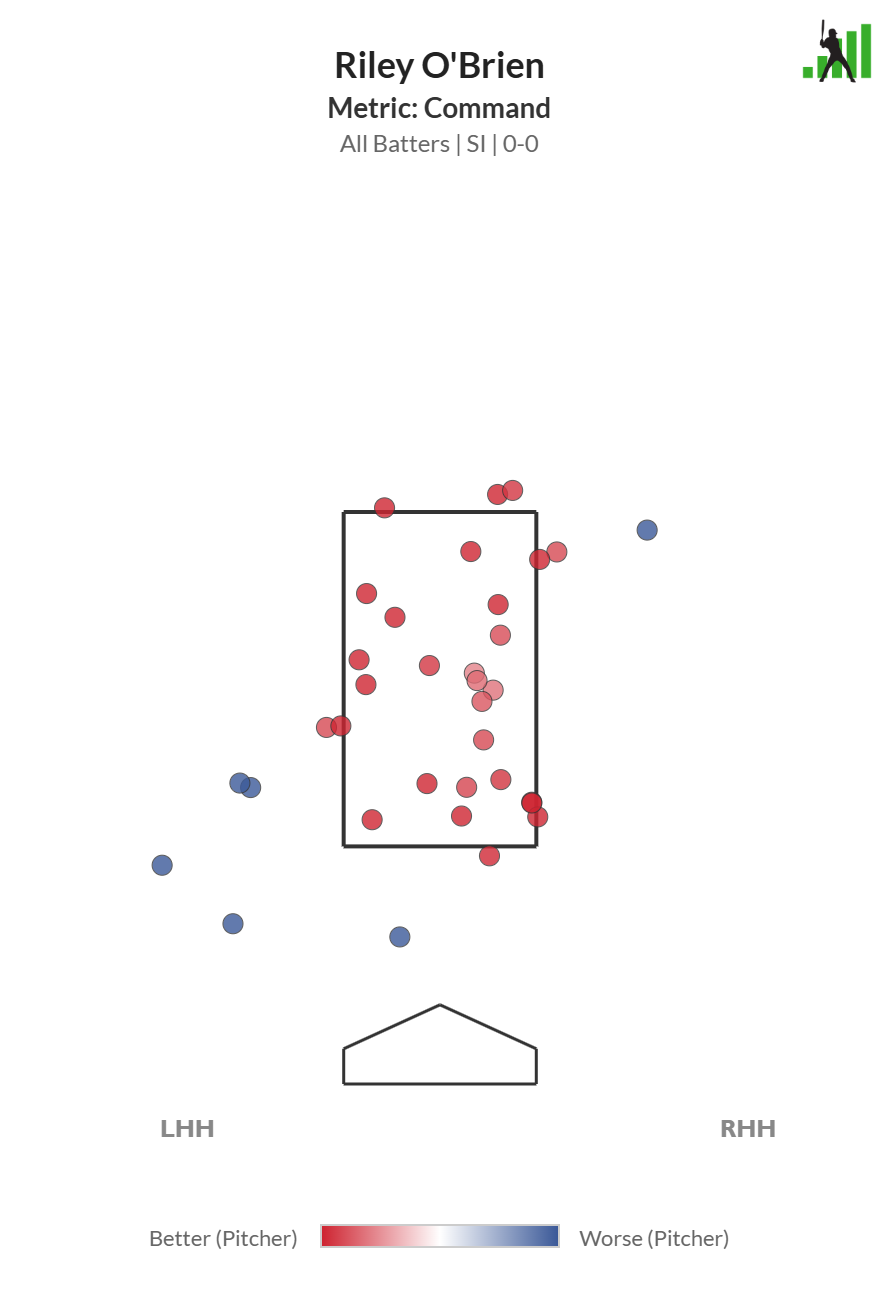
Ah. That’s a 71 command grade, with no real blemishes; few wasted pitches, few meatballs. Meanwhile, when he got to two strikes, he let hitters off the hook too often, whether by grooving one or missing badly:
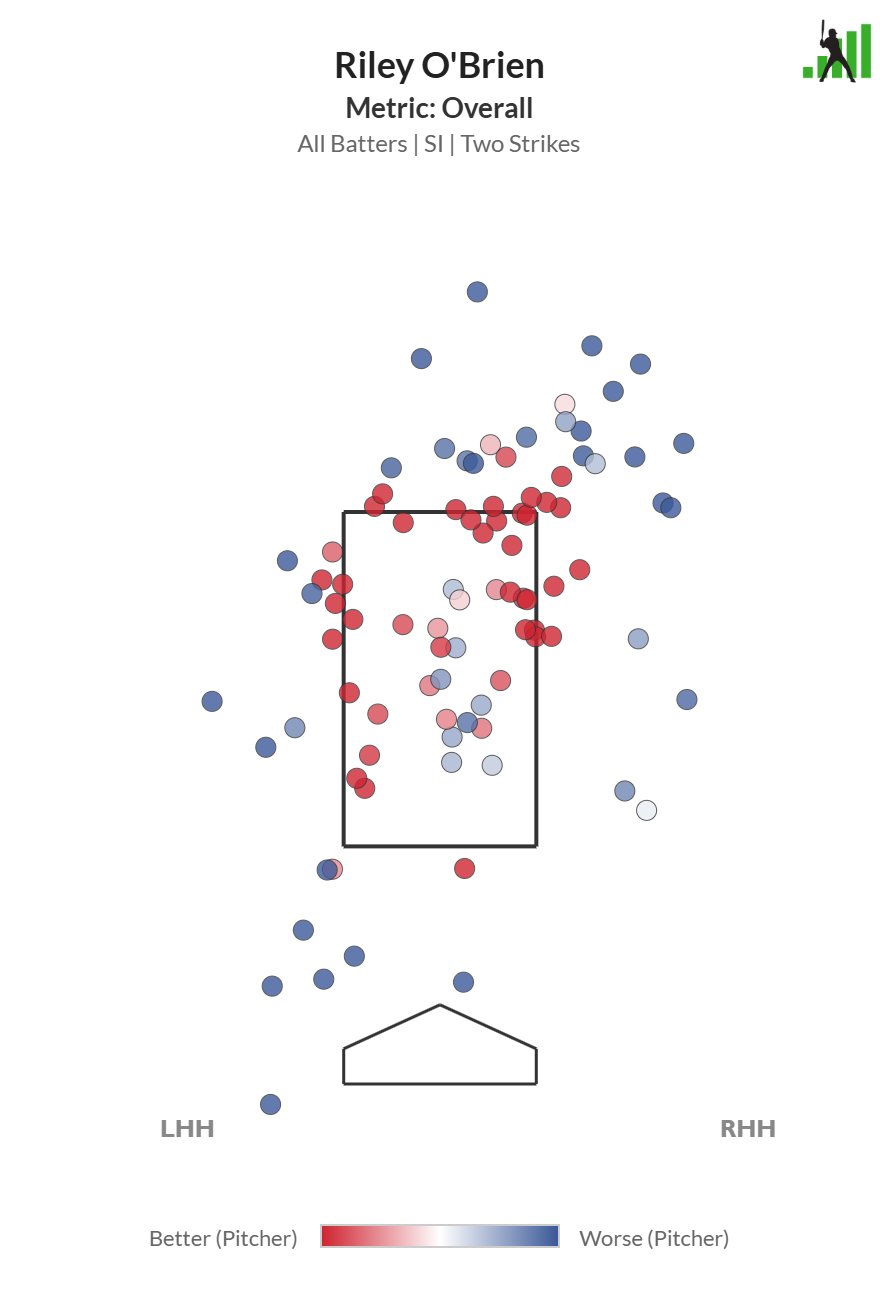
If you’re keeping score at home, PitchingBot loved the raw physical shape of these two-strike sinkers, hated the location, and thus gave them an average grade overall. Now take a look at his two-strike locations in 2026:
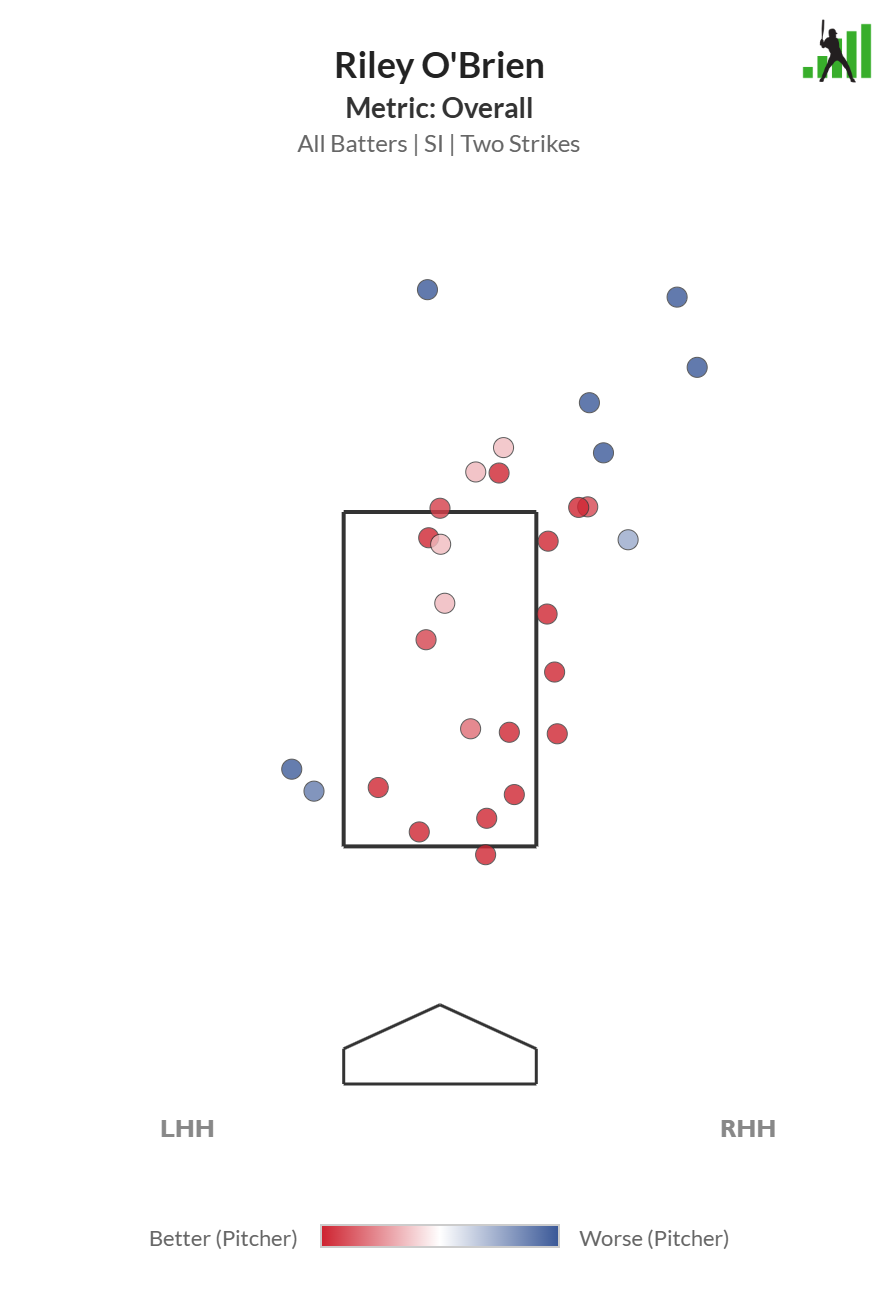
The stuff is essentially the same, but these locations are comically better than the old ones. Very few bad misses in the center to go with fewer wasted pitches? It sounds too good to be true. Given how few dots there are in those plots, it’s easy to understand how fleeting this may yet prove to be. But for now? It’s pretty darn great.
Now, some of the value of these great locations comes from ending the at-bat right there. O’Brien has thrown 29 two-strike sinkers and gotten nine strikeouts, which is an 86th-percentile putaway rate. But more importantly, he’s transitioned away from doing one of the worst things you can do as a pitcher: give your opponent something to hit when they’re behind in the count.
In 2025, batters hit .350 with an xBA of .363 when they made contact with one of O’Brien’s two-strike sinkers. That’s a complete disaster, to put it mildly. I enjoy this Baseball Savant view of it. Here’s where opponents tagged his two-strike sinkers in 2025:

Here’s where they’re putting them in play in 2026:

You don’t have to be a data scientist to see that the second picture is better than the first. Nothing center cut, nothing elevated; the average launch angle on those balls is a goofy -11 degrees. It’s small sample season, no doubt, but that’s still exceptional.
Normally, this would be the part in the article where I show you how O’Brien’s other pitches have complemented this improvement in sinker command. There’s just one problem: That hasn’t happened. He’s doing a worse job locating his slider and sweeper than in prior years. Our models concur that they’re both down a hair in stuff. He’s converting fewer two-strike breaking balls into outs than he did in 2025. You can’t look at his secondaries and find any trace of improvement. They were already solid, and they remain solid, nothing more. The sinker is where the change has come.
This seems like it should be too good to be true. All O’Brien did is start throwing his sinker to better locations? But honestly, basically yes. As it turns out, command is monumentally important when it comes to results. Stuff is stable. If you can spin the ball, if you can throw it hard, if your arm slot creates deception, those things remain true pretty much every time you throw the ball. Command isn’t like that. It’s hugely variable. The best pitchers in baseball throw horribly located pitches. The worst pitchers in baseball dot the corner at the perfect time every now and again. This makes me a little worried about O’Brien’s performance, in that his improvement comes exclusively from a category that is much less stable than most of the things I use to predict performance. But on the other hand, there are good reasons to assume that O’Brien’s command is a true change in talent level.
O’Brien didn’t start throwing a sinker until joining the Mariners in 2022. He transitioned to the bullpen at the same time, increasing his velocity by around 4 mph in the process, and he continued to throw harder as he acclimated to life as a reliever. Even though he’s 31, most of his time in professional baseball scarcely prepared him for his current form. He was a soft-tossing starter who mixed a four-seam fastball, a curveball, and a changeup. Now he throws three completely different pitches, and his current slider moves faster than his old heater. His walk rate spiked when he started throwing a sinker, because he simply couldn’t command it. It’s reasonable to expect some kind of learning curve when it comes to location. He’s gotten better every year, and even if he backslides from his current elite form in the second half of 2026, there’s no reason to expect him to fall all the way off. After all, improving continuously for years is a good sign that continual improvement will continue.
I obviously don’t think that O’Brien is as good as his 2026 statline – he has a 0.00 ERA. But I do think that he’s a great example of the old adage that many relievers could be dominant if they could figure out where the ball is going. I mean, come on. This guy touches 101 with a demonic fastball, one that averages 3.5 more inches of drop than the average high-velo sinker. His slider, the one I described as unchanged from last year? It’s a 92-mph slider! His sweeper breaks 17 inches. When you get right down to it, O’Brien’s raw stuff looks like a natural fit in a closing role. That’s true of many relievers these days. But for a lot of those guys, the devil is in the ability to locate that nasty stuff. O’Brien was a clear example of this in the past. Now he’s an example of how quickly someone can go from intriguing to undeniable.
Ben is a writer at FanGraphs. He can be found on Bluesky @benclemens.
Great, great article. I can use the information in this article to help evaluate pitchers in the future. You took a subject I find difficult and put it in terms I can understand. I cannot be the only person who is glad you wrote this. Thanks.