
Scouting the Mariners’ Return for Austin Nola
Sunday’s seven-player deal between the Mariners and Padres was the deadline’s biggest trade so far, impacting this year’s playoff race and both teams’ roster construction for years to come. While the most immediate effects will be seen in San Diego, the Mariners continued to collect talented, young players with their spyglass fixed on a long-term rebuild by acquiring Taylor Trammell, Ty France, Andres Muñoz and Luis Torrens (covered here) in a trade centered around catcher Austin Nola.
The headline prospect of the package is Trammell, a 23-year-old 50 FV prospect (meaning I expect him to be a an everyday player who generates around 2 to 2.5 annual WAR — commensurate with a good everyday player — over the course of his pre-free agency seasons) who was with San Diego’s big league club throughout spring training, then played during summer camp intrasquads, and has since been at the Padres’ alternate training site at the University of San Diego. Trammell spent all of 2019 at Double-A, albeit with two different orgs because he was also part of last year’s massive, three-team Trevor Bauer deadline deal that sent Trammell from Cincinnati to San Diego; Seattle is his third organization in 13 months.
Trammell is ranked toward the top of the 50 FV tier of prospects, 68th in all of baseball, because a) he’s fairly close to the big leagues and b) he has a few core attributes that I consider especially important. Chiefly, Trammell has a good idea of the strike zone, and he’s a good athlete who has good on-field makeup/competitiveness. I know the latter two sound hokey and perhaps antiquated, but they do drive some of my thinking related to prospect floor or certainty because, anecdotally, I think good athletes who try hard tend to turn into good players.
A career .270/.363/.406 hitter, Trammell has the ball/strike recognition (12% career walk rate) and contact potential to one day be a leadoff man. I say contact potential because I don’t think his bat is quite as polished as it appeared to be at the lower levels. He’s a short-levered hitter who can turn on pitches on the inner third of the plate, and he grinds out long, tough at-bats, but while Trammell has some all-fields spray ability, he struggled with velocity up and away from him during the spring and summer intrasquads. To my eye, he has done some tinkering with his hitting footwork, which may have been an attempt to tease out more in-game power, though I’m skeptical that will ever be part of the profile. I think a contact/on base-oriented approach fits best with Trammell’s swing and physical ability, though admittedly punting on his power potential (those Futures Game rockets he hit a few years ago were highly unusual) caps his ceiling. It’s tough to be an impact player without thump, which is part of why I have a solid regular FV on Trammell rather than a big, star-level one.
Defensively, I have Trammell projected in left field because of what I think is a problematic lack of arm strength based on my looks at him in Arizona, but this spring he told the media that was something he had been working to remedy, and I have no idea where that part of his game is at right now. I still have him projected in left field for the moment, but think he could be a very special corner defender because of his speed/range.
To touch on the load-bearing aspects of the profile again, Trammell sees a lot of pitches and gets on base, has gap power, can really run, and could be a superlative corner defender. The Reader’s Digest comp is Brett Gardner, but even though Trammell hit no worse than .277 at any stop during his first three pro seasons and hit .375/.423/.583 during the 2020 spring, I think his swing and approach to contact need refinement if he’s going to hit enough to lead off.
Seattle got another splashy young player in 21-year-old Andres Muñoz, a power two-pitch reliever with an arm action like Craig Kimbrel’s whose fastball was parked at 99 and touched 103 mph last year. Muñoz made his major league debut last year as a 20-year-old and struck out 30 batters in 23 innings with the Padres.
The first of the many 2020 Padres pitching injuries that would eventually necessitate all these trades, Muñoz made one spring appearance (his velocity had been trending down throughout last year) before having Tommy John in late March. He likely won’t be back until late in the 2021 season, and perhaps not until 2022.
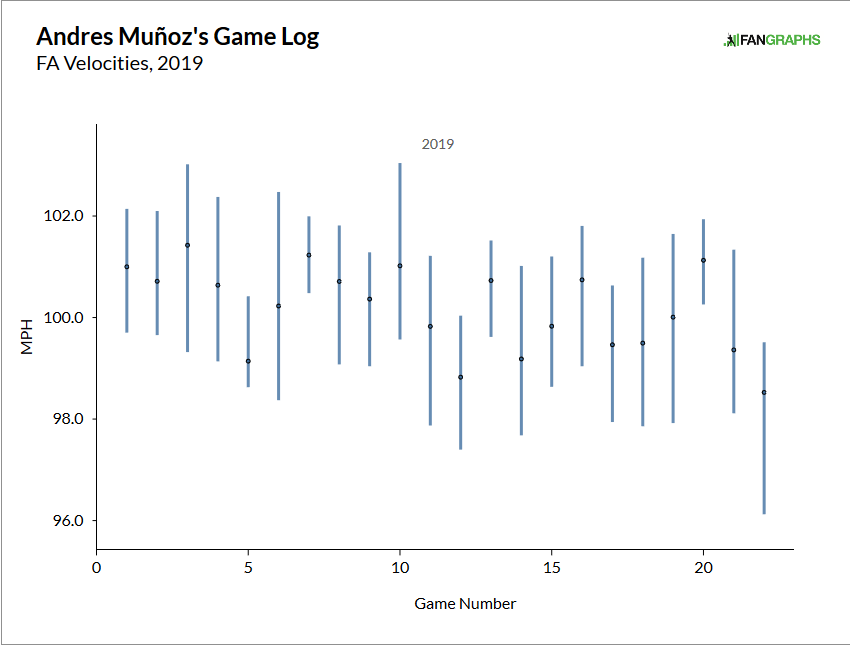
As Mariners fans know after watching Thyago Vieira come and go very quickly, a closer cannot live on velocity alone. Luckily Muñoz has a power, two-plane breaking ball in the mid-80s that he improved his feel for locating competitively throughout last season. The combination of elite velocity and a plus secondary pitch give Muñoz late-inning ceiling, assuming all is well coming out of rehab.
And finally, the Mariners added Ty France, who was blocked by several well-established veterans in San Diego and could not find regular playing time. France was a 34th rounder out of San Diego State, a bit of a whiff by the amateur arm of the scouting industry since France was on a good college team that played well at a heavily-scouted Regionals just ahead of the draft. France hit but did not produce much power during his first two pro seasons, then started to slug as he reached the upper-levels, something that was initially discounted because of his age and the hitting environment at some of San Diego’s upper-level affiliates.
He became so dominant (.399/.477/.770 at Triple-A in 2019) that it was impossible not to give him a shot, even though Manny Machado was playing third base in the big leagues. The Padres experimented with him at second base late last summer, but France didn’t improve enough to prevent San Diego from acquiring Jurickson Profar in the offseason, and now Jake Cronenworth has seized control of that position.
I like France’s hit/power combination enough that I think he’ll be a valuable role player, though he’s a relatively free swinger who is only capable of playing positions (1B/3B) that typically require better on base ability to be considered an average or better regular. And it’s not as if he isn’t also blocked in Seattle, at least for now. Evan White already has an extension and is locked in at first base. A resurgent Kyle Seager would certainly help some contenders, but his 2022 club option becomes a player option if he’s dealt, and that’s a barrier. Dylan Moore is playing well, and in acquiring Trammell, the Mariners officially have a crowded, upper-level outfield picture with Kyle Lewis, Jarred Kelenic, Julio Rodriguez, Jake Fraley, and others either fighting for playing time in T-Mobile, or warming at the team’s camp site. The universal DH certainly bolstered France’s value, and he could share short-term platoon at-bats with José Marmolejos at DH, and spell Seager and the corner outfielders against the occasional lefty.
Let’s take a step back and look at the Mariners intermediate future. They have the glut of young outfield prospects mentioned above in addition to Moore and the injured Mitch Haniger, who is signed through 2022. Both Haniger and Tom Murphy, who is now part of an upper-level catching contingent that includes Luis Torrens and Cal Raleigh, are interesting trade chips for the near future. Evan White is locked in at first, as is J.P. Crawford at short, who looks like an above-average regular on the strength of his glove and on base skills. The jury is still out on Shed Long Jr., who has not hit in just 75 big league plate appearances, but will have to soon because he isn’t a good defensive second baseman. I think we’ll start to see the younger relief prospects (the big arms, like Juan Then, Muñoz, Sam Delaplane) and true rotation cornerstones (Emerson Hancock, Logan Gilbert, maybe George Kirby) start to debut next year, with the starters coming a little later. There is going to be attrition due to injury and failure, especially on the pitching side, so Seattle will need to find a way to build continuous depth behind the ones who do pan out.
Eric Longenhagen is from Catasauqua, PA and currently lives in Tempe, AZ. He spent four years working for the Phillies Triple-A affiliate, two with Baseball Info Solutions and two contributing to prospect coverage at ESPN.com. Previous work can also be found at Sports On Earth, CrashburnAlley and Prospect Insider.
It’s interesting I never thought of USD as a great hitting environment because it’s right down by the ocean, whereas SDSU is in a dryer, hotter part of town. I’m happy to be wrong, but power there seems like power anywhere.
He was referring to Amarillo/San Antonio and especially El Paso, not USD.
That is a monster return for a guy who is hitting unusually well compared to virtually every underlying indicator and past performance and might not stick at catcher. Dipoto did the smart move that virtually no rebuilding team does–he sold high on the guy with a lot of team control and unsustainable performance. Jonathan Villar and Michael Fulmer and many others were held in the same situation but Dipoto cashed out and I suspect the deal is going to look very good long-term.
I actually think you can find decent evidence that Nola’s hitting ability has legitimately improved (he controls the zone, and his Statcast numbers are real strong), and that he’s an average/above-average defensive catcher…and still like this trade a lot for the Mariners. If Nola were 27 instead of 30 (soon to be 31) I think keeping him would have been a more reasonable conclusion, but this return is simply too big to not make the deal.
In response to both Sportszilla and matt:
Hm, that is interesting. So something has changed, that’s good. But also we don’t know if it’s just a hot streak, if he can stick at catcher long-term, and what the decline is going to be like since he’s already over 30 and a catcher. Hopefully the fact that he’s new to catching will help with the last part, although it hurts him on the second part.
To be fair, he will still be a useful player as long as he either keeps hitting or keeps playing catcher, it’s just that he probably will probably either decline or stop catching and there’s a chance for both of them to happen or be relatively steep. Usually when major league players get traded for FV50s they’re a little more predictable than this.
The thing is Trammell isn’t the normal type of 50 FV. He’s a weird prospect with significant risk and if he doesn’t have arm for center it puts a lot of pressure on the bat in left. Nola has his own risks for sure, and he’s likely not suddenly a superstar but Padres did not pay a star return for him and they have 4+ years of control of him. Should be clear I totally get why Seattle did this, I just don’t think it’s an absurd overpay for the padres
I don’t think there’s much fear or concern over Trammell’s arm or the need to get power out of him in LF. Assuming they keep him, he could very well end up as the 4th outfielder. Seattle could get away with that because both Lewis and Kelenic can handle center.
This is a classic example of future value vs present value and how that matters to teams at different points on the win curve. The Padres are in win-now mode. The Mariners aren’t. So the Padres are willing to pay for a player that’s productive now (even if he faces a steep decline in a couple of years) with players that might be more productive in couple of years but aren’t going to help them win right now. And to turn it around, the Mariners are willing to give up a player who could give them wins right now, in a season that doesn’t matter, in exchange for possibly worthless (and possibly big payoff) lottery tickets.
Nola is 54th in xWOBA, 2nd among catchers, it’s a logical deal both ways imo even if Padres did overpay a bit. Adams is also a nice piece. Trammell has lots of upside but there are changes need to be made. France is a interesting bat first corner guy (don’t see how he sticks at second with lack of range). Muñoz needs to make tweaks to the delivery or else he’s going to be a major injury risk going forward, when healthy he could be a top 10 reliever. He’s a max effort head wack guy which is problematic but FB/SL combo is filthy. I like this deal for Seattle, maybe I’m being a Padres homer but I also get it from SD’s perspective
France had caught in the minors/ in spring this season. Being that Nola didn’t learn to catch till AAA, I wonder if that is the plan with him as well.
That would seem to be a good move for everyone.
Yeah, Dipoto just killed it. Every way you look at this deal the Mariners improved.
How do you give up more for Austin Nola than you do for Mike Clevinger?
I see what you’re saying, but relative impact and supply-and-demand make a difference too. Clevinger is going to get 6, maybe 7 starts and joins a staff that was already in the upper third in the league. Nola is going to be a near-everyday catcher for a team that was sitting almost at the bottom of the league for production out of the catcher’s spot. And while Clevinger is a real talent and a big name, he’s probably not the only good pitcher available (Lance Lynn is somehow good and probably available ); more importantly, he’s not this season’s best pitcher in baseball, and however SSS it might be, Nola is currently the best-hitting catcher.
Where Clevinger does have disproportionate value, of course, is the playoffs. But as we know, that can be a bit of a crapshoot even in a normal year — especially for pitchers (Clayton Kershaw says hello). And your best-in-baseball catcher plays everyday in the postseason too.
I’m not sure they did. Cantillo’s a very good 45–the only reason he’s not higher is because he still has a few levels to climb, and the secondary pieces are comparable / better and more numerous. Plus they threw in a couple extra guys in the Nola trade.
I’m surprised that we’re even comparing them too, but I also think that there’s a good argument that they gave up more for Clevinger than Nola.
I completely agree with your take on Trammel even the bit you say is hokey (more against MLB’s preference for fans to scan the numbers and treat players as overpaidz drones), wouldn’t be surprised if Torrens emerges before he does, and am glad to see a little JP Crawford notice too at the end
I’m really liking the talent the Mariners have managed to get together the past couple years, maybe stating the obvious at this point
Haven’t we been saying emerging young core about the Mariners since they were THE #8 ORG?
Weren’t they ranked “THE #8 ORG (sic)” after Zduriencik’s first season? If I’m recalling that correctly, then no, we haven’t been saying ’emerging young core’ about them since then.
That leadership got put on a very hot seat and responded by re-emptying the cabinet and letting all bread they did keep dry out in the open air. Early in the Dipoto era, he used the vets already there to try and Red Paperclip (https://en.wikipedia.org/wiki/One_red_paperclip) his way into a playoff berth, but decided to “sell a year early” on many of the tradeable vets.
After Gillick’s reign of zero prospect development, The Mariners have had waves of well regarded prospects and top picks fail: from Ackley, Smoak (partially), Montero to Anderson (the Sushi Chef), Hultzen, Zunino (partially), and the other #3 pick Catcher. In fact, other than Kyle Seager, the only position players who have developed had to escape Seattle to do so: Adam Jones, Chris Taylor, Ketel Marte, Shin-Soo Choo. But these are the first wave of a different regime. I don’t think the city is cursed.
Clement was the catcher you were thinking of.
So how does the PTBNL work? Is it a pool of players or is it just a binary choice of traded player did well so player A is going or traded player didn’t play well so player B is going? If it is either or, do the teams set the terms of what good versus bad play is? And when is the deadline for PTBNL if any?
They put every prospect’s name on a small piece of paper and put it in a hat, mix them up real good, and let fate decide. Each team gets one do-over, though they don’t have to use it.