
Singled Out: Mariners Uncover Truth in Opening Week
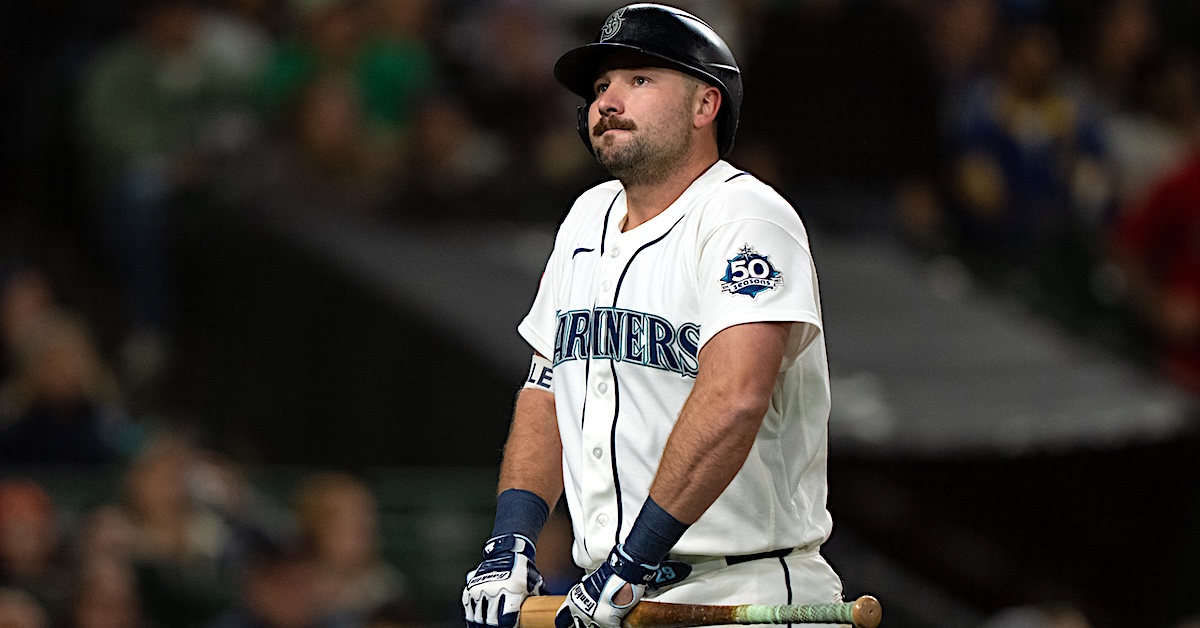
The outcomes are truer than ever.
The Mariners did not record a single in their first two games of 2026. No team had ever done that in major league history. In fact, only eight teams have ever gone back-to-back games without a single, according to MLB.com’s Sarah Langs.
| Player | PA | 1B | 2B | 3B | HR | K | BB |
|---|---|---|---|---|---|---|---|
| Brendan Donovan | 8 | 0 | 1 | 0 | 1 | 5 | 2 |
| Cal Raleigh | 8 | 0 | 0 | 0 | 0 | 7 | 1 |
| Julio Rodríguez | 8 | 0 | 0 | 0 | 0 | 5 | 1 |
| Josh Naylor | 8 | 0 | 0 | 0 | 0 | 0 | 0 |
| Randy Arozarena | 8 | 0 | 1 | 0 | 0 | 1 | 3 |
| Luke Raley | 8 | 0 | 0 | 0 | 2 | 3 | 0 |
| Dominic Canzone | 7 | 0 | 0 | 0 | 2 | 0 | 1 |
| Cole Young | 6 | 0 | 0 | 0 | 1 | 4 | 0 |
| Leo Rivas | 6 | 0 | 0 | 1 | 0 | 2 | 1 |
| Total | 67 | 0 | 2 | 1 | 6 | 24 | 9 |
The reason is obvious. The Mariners didn’t hit a single because they didn’t put the ball in play very often. And frankly, how could they? Guardians pitchers threw less than 40% of their pitches in the zone, and the Mariners were forced to lay off them, drawing walks in 13.6% of their plate appearances during those two games. When the Guardians did enter the zone, the Mariners struggled to make contact, striking out 35.8% of the time. That means only 34 (50.8%) of their plate appearances ended with a batted ball. And because the Mariners employ a number of sluggers, six of those batted balls flew over the fence.
That left just 28 balls in play that could have fallen for singles. Most were grounders gobbled up by one of the best infields in the majors. The rest were fly balls and popups easily snagged in Seattle’s cool, small outfield (T-Mobile Park suppresses BABIP almost as well as it encourages strikeouts). Three balls did eventually land in play for hits — they just happened to go for extra bases.
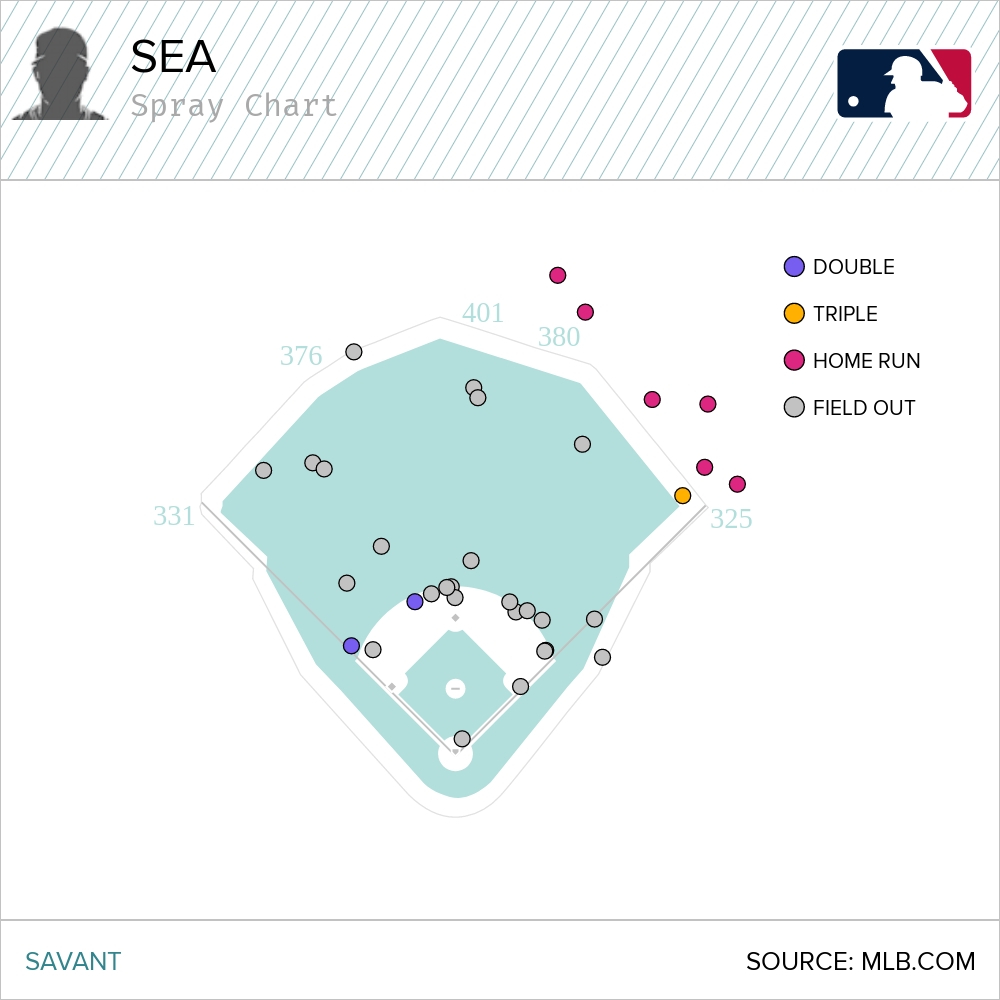
Cal Raleigh collected the Mariners’ first single in the third inning of Saturday’s game. It was his first ball in play of the season, after starting the year 0-for-8 with eight strikeouts and a walk. This is actually a nice piece of irony that Raleigh, of all people, would be the one to pick up the first single. He swings hard, up and to the pull side, and it’s rare to see him plop one into center. Nearly half his plate appearances in 2025 ended in one of the three true outcomes. He even had a 12-game stretch in July without a single, double, or triple, registering a .000 BABIP across 54 plate appearances. Was this a slump? Far from it. He drew nine walks and hit six homers to post a 127 wRC+ over those two weeks. He’s become one of several exemplars for the three true outcome approach (and aesthetic):
| Player | wRC+ | TTO% | K% | BB% | HR% |
|---|---|---|---|---|---|
| Mike Trout | 120 | 52.3% | 32.0% | 15.6% | 4.7% |
| Nick Kurtz | 170 | 51.1% | 30.9% | 12.9% | 7.4% |
| Kyle Schwarber | 152 | 49.9% | 27.2% | 14.9% | 7.7% |
| Aaron Judge | 204 | 49.6% | 23.6% | 18.3% | 7.8% |
| Cal Raleigh | 161 | 48.9% | 26.7% | 13.8% | 9.9% |
| James Wood | 127 | 48.9% | 32.1% | 12.3% | 4.5% |
| Shohei Ohtani | 172 | 48.3% | 25.7% | 15.0% | 7.6% |
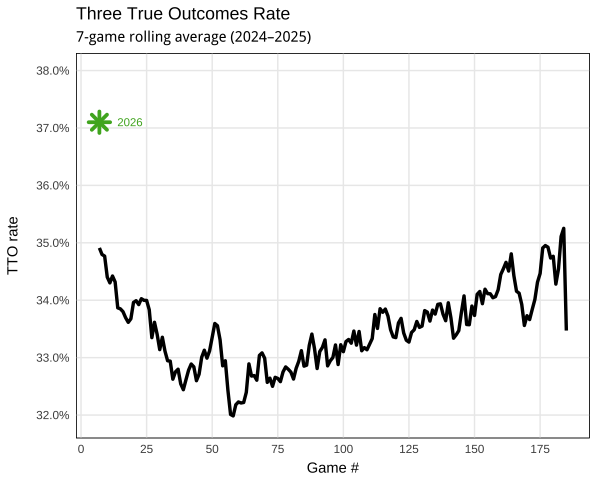
That’s a list any player would like to be on, but there might be a bit more competition to top it this year. The rate of three true outcomes has exploded across the league in the early going this season, jumping from 33.7% in 2025 to 37.1% through the first tranche of games in 2026. If it were to hold, that would be the highest mark ever. Still, we’re only one week into the season, and things will change. How?
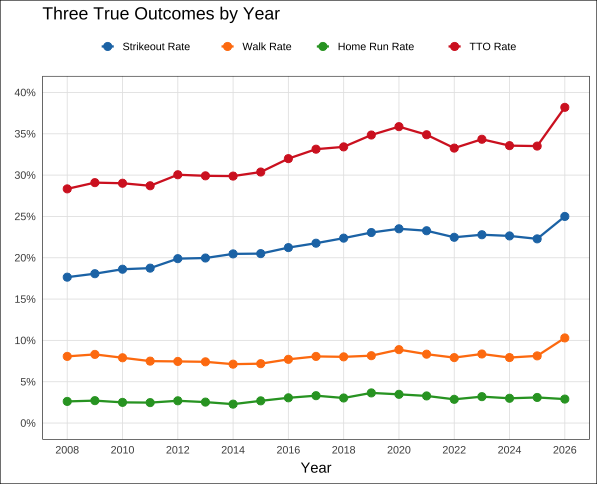
The main reason three true outcomes are up is strikeouts are up. The league strikeout rate sits at 24.5%, which would be the highest mark for a full season. This is interesting. The league’s strikeout rate appeared to plateau in 2019 after decades of growth. It even shrunk a few ticks in recent years, as batters countered increasing velocity and modern bullpen usage with new efficiencies of their own. But it seems they weren’t quite prepared for the leap in ability pitchers displayed in the first week:
| Year | K% | Whiff% | Four-Seamer Velo (mph) | RP% |
|---|---|---|---|---|
| 2026 | 24.5% | 27.9% | 94.9 | 44.5% |
| 2025 | 22.2% | 25.3% | 94.5 | 41.6% |
| 2024 | 22.6% | 25.3% | 94.3 | 41.4% |
| 2023 | 22.8% | 25.8% | 94.2 | 42.2% |
| 2022 | 22.4% | 25.6% | 93.9 | 41.7% |
Now, the sample is extremely small, and it’s biased for a number of reasons. For instance, it includes data from each team’s best starting pitchers, and we’ll see pitcher performance go down as attrition mounts and teams turn to lesser options. This sample also includes more relievers than it will come July, as teams are reluctant to let their starting pitchers go deep into games this early in the season. We haven’t seen the shape these metrics will take in 2026.
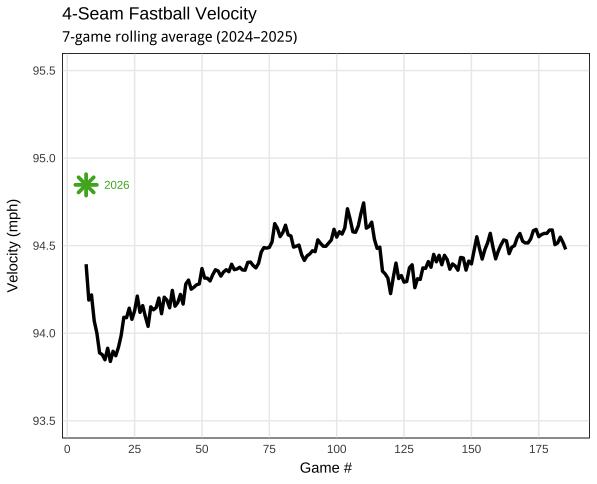
To illustrate this, I found the seven-day rolling average for all these metrics across the pitch-tracking era using the pitch-level data available from Baseball Savant. Velocity tends to spike immediately, drop, and then slowly climb throughout the summer.
The same is true of whiffs, although the rise doesn’t happen until the very end of the season, as teams begin managing their bullpens like it’s the playoffs:
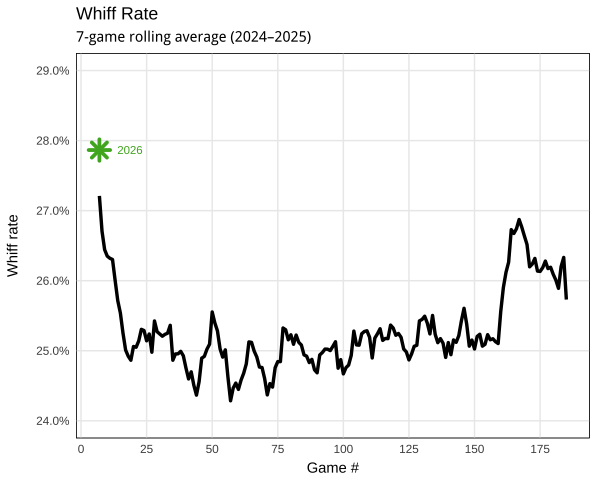
I don’t expect the current strikeout environment to hold all year, and I expect batters to slowly catch up, as they always do. That said, what we’ve seen to this point in 2026 is still quite extreme. The league’s four-seamer velocity of 94.9 mph is the highest-ever mark over any seven-day stretch. The league’s whiff rate of 27.9% is tied with the first week of 2025 for the highest ever over any seven-day stretch. The league’s strikeout rate is not quite the highest ever, but it’s very close. These figures aren’t outliers by any means and are only notable to the thousandths-place decimal, but there’s at least a bit of early signal that we haven’t found the ceiling on all this.
The first week of 2026 also represents the highest seven-day walk rate since 2009 at 9.8%. Now, it’s not that weird to see whiffs and velocity trending up, because they have been trending up for a while now. But walks? Walks aren’t trending. They’ve been pretty danged consistent at the plus-or-minus 8% for years and years. I think we’re likely to see this rate self-correct over the next few weeks:
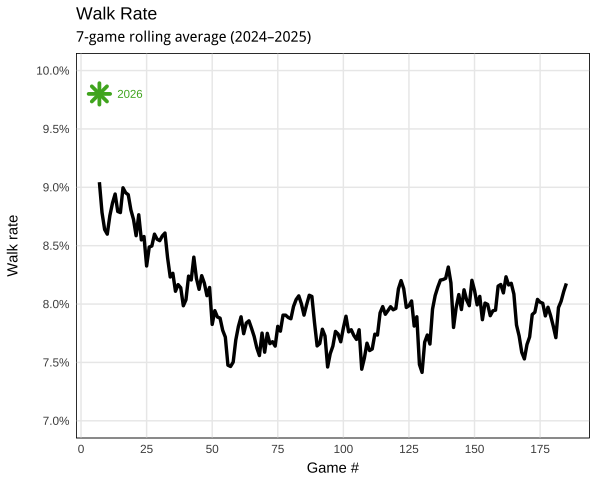
What’s interesting, however, is just how poor pitchers’ aim has been so far. More than a third of pitches have been thrown in the chase and waste regions — those regions so far out of the zone they’re rarely called strikes (0.1% in 2025). This would represent a massive increase over any other year in the pitch-tracking era. I can’t do the same weekly analysis with zone rates, and my assumption is this isn’t unheard of in small samples. But the historic rate of walks will continue until pitchers hone in, likely sooner than later.
The final truth, of course, is home runs. Unlike the stats above, home runs start low and grow throughout the season as the weather gets warm and the ball carries more:
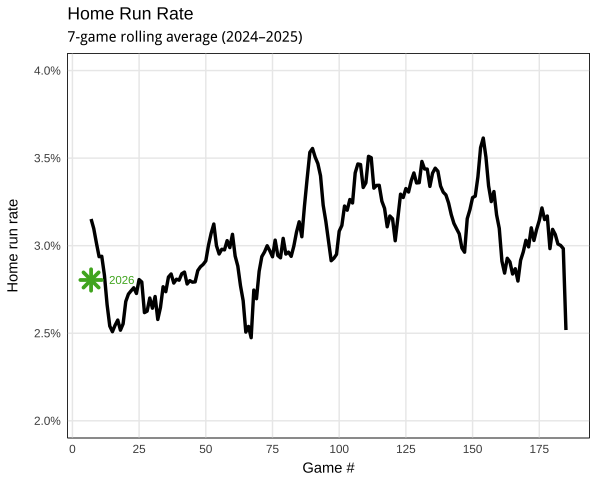
I don’t see anything notable, big or small, in the rate of plate appearances ending in a home run (2.8%), nor the rate of fly balls turning into home runs. I also don’t see evidence that the balls are juiced this year (though my only qualification to make that statement is my ability to find the drag dashboard on Baseball Savant).
That said, the league’s contact profile in the first week is interesting. While batters have shown significantly more swing-and-miss, the contact they do make is highly likely to be in the air and to the pull side. Not only that, but the barrel rate on those pulled flies is at an all-time high. I’m not sure whether that will lead to more homers as the season goes on — these rates have trended up for years, while home run rates have not. But I think this implies batters are continuing to change their approach, aiming for the shallowest part of the park and away from the historically excellent defenders in center field.
OK, to recap: 1) Strikeouts are up, and though they will probably come down, the trend is still somewhat notable; 2) walks are way up, but will probably come down, assuming pitchers can find the zone; and 3) homers are normal, even if batters seem to be trying very hard to hit them. The first week of 2026 represents the highest rate of plate appearances ending in a three true outcome since… the final week of 2025. We are, roughly, here:
The Mariners have hit many singles since those first two games. It was a bizarre feat made more likely by the current state of the majors: Guardians pitchers avoided the zone, Mariners hitters swung for the fences, and good defenders took what remained. But it should be clear that, even in a modern environment, such an event is far from the norm. There are still plenty of singles in baseball, still plenty of action. The sport is not dying. In fact, looking at the list above of players with the most three true outcomes, I kind of think we like this style of play.
Ryan Blake is a contributor for FanGraphs and Lookout Landing.
I am constantly consumed with the fear that this great game is turning into little more than a few home runs, far too many strikeouts and, as a consequence, far fewer brilliant defensive plays or even routine defensive plays which enable us to see the amazing talent of Bobby Witt, Jr, Cedanne Rafaela, Andres Gimenez and many more. Their athletic grace is a thing to behold and a big part of the beauty of baseball. The game needs more singles, a lot more, and fewer home runs. It is a better game when the league average is around .270 and only real power hitters hit over 25 HR’s. 1954, for example, the batting average, excluding pitchers, was around .270 and Larry Doby led the AL with 32 HR’s. There were men on base all the time, there were hit and run plays all the time. Hits exceeded strikeouts by two to one while pitchers averaged 4.2K’s/9. This season is off to a rough start in regards to the continued, and increasing, imbalance between pitching and hitting. Even without pitchers dragging the batting average down, it stands at .232. How many 6’5″ or taller pitchers were there in 1893 when the distance from the rubber to the plate was set at 60’6″? Need I answer? The time has come to deaden the ball and increase the distance from the rubber to the plate so hitters can react and put the bat on the ball and a better balance can achieved.
I am ready for a debate. I think that many on this site have never seen the style of baseball that I describe. Are there, among the regulars here at Fangraphs, those who prefer the TTO style that is prevalent today? I personally don’t but it is still baseball, and like a steak, it is nearly impossible to screw it up too badly.
I think some really sick people would comment and say they like it more, but they don’t realize that they don’t mean it. many people on this site mistake the successful outcomes that comes from TTO for “ideal” baseball. I’m sorry to go there – but this is a problem of capitalism. The most efficient way to score runs or plant crops or build an apartment building are often the worst ways to go about it spiritually. We are living in the world of monocrop baseball. I’ve seen it suggested that moneyball itself led to the financialization and optimization of our modern world. the seeds of destruction of all beautiful things were sown in the game we love. Its heartbreaking and for some reason I feel like i come back to baseball because it helps me understand this process in the larger world. and there are still glimmers of beauty and randomness that come through, like in last years WS. even in the places that have been most damaged by analytic thinking, hope remains. but its becoming harder to come by, especially if you’re watching the mariners apparently.
Not really a debate per se, but here goes…
I actually agree that more action in the field is objectively more exciting than alternative outcomes. Especially because in my opinion, watching great defenders is actually the best part of baseball.
The problem comes twofold. The first is how do you reduce home runs and strikeouts without either increasing walks or changing park dimensions so doubles/triples are significantly easy to get and become the new home runs. Especially because if you change outfield dimensions too much you’ll actually reduce the number of good hitters in the lineup as teams adjust to having three true center fielders.
But let’s say you do it. Maybe you lower the weight and increase drag on the ball so it can still be hit/thrown hard but performs worse in flight. And maybe you lower the mound.
The problem is that things don’t actually change that much. It’s still better to hit balls in the air than on the ground. It’s still better to trade balls in play for walks.
Even more so, it’ll still be mathematically bad to risk runners on base in plays like suicide squeezes, hit and runs, or sacrifice bunts.
Some of the “enjoyment factor” of baseball in the past was people doing things that were objectively not increasing their chance to win the game.
Do people really want teams to purposely start doing things that lower their chance of winning the game? Because that’s something that I just can’t really abide by as a viewer. It complete takes me out of the game when a manager just allows a player with heavy platoon splits to get chewed up unnecessarily. Or sac bunts in a situation where it doesn’t even logically make sense why it would increase run scoring (hello, bunting over the Manfred man).
Basically the moment teams start doing things that I know are bad I’m completely out of the game.
The key to everything is the ability to hit the ball. If that could be increased then all other elements of the game would easily return to a more enjoyable and interesting level. The reason hitting the ball in the air is so much more valuable is because home runs are the most efficient way, almost the only way, to score runs as the game is played today. If contact was increased and BABIP remained between .275 and .290 then scoring would be similar to today. In 1954 it was 4.38 R/G and in 2025 it was 4.45 R/G. The same ways to score that worked in 1954 would quickly make a comeback and a better game would be enjoyed. It is clearly obvious that it is much more difficult to make consistent contact with fastballs which average around 95 mph and are increasing steadily. Add all the other advances in the development of new pitches, there was no splitter or sweeper then, to the tremendous increase in velocity and, as sad trombone says on another thread, it is a miracle that the hitters can even hit .250. To those who say that it is the other stuff that is actually what is getting hitters out, the reason is that hitters must be so prepared for high heat that they have little chance to react to the increasing arsenal today’s pitchers have. There are no similar additional weapons for hitters. This wouldn’t have been a problem if baseball had recognized this and gradually increased the distance between the rubber and the plate but it was asleep at the switch and now has a problem that might turn into another 1968 quickly. There is no need to reconfigure ballparks. Adjusting the ball has become common in recent years and can easily be dialed back. One of these years the number of K’s/9 will reach 10 or higher, and no player will hit .300. In 1968 only Carl Yastrzemski, at .301, managed to do it in the AL and last year only Trea Turner, at 304, did it in the NL. The game changed the rules after 1968 and it is possible that such a scenario might open some eyes in the game and with the public and bring about a much needed adjustment to the present pitcher-hitter structure.
I can appreciate athletic defensive plays. I enjoy goofy bits of business that occur when the ball is play and the weather is being unkind.
But, to me at least, the crux of the game is the pitcher-batter matchup. So, yeah, watching Luis Arraez slap pitches around isn’t my idea of a good time.
I’m aware I’m in the minority on this, simply based on thumbs in various comment threads. That is my personal aesthetic preference.
That’s my preference as well. Maybe should have teased this out a bit more — I’m sure I’ll return to this at some point this year — but it’s hard for me to look at the list of TTO% guys and think I don’t love TTO baseball. I love big stuff ending in a three-pitch strikeout, I love a great battle ending in a 10-pitch walk, and obviously I love home runs — everybody loves home runs. I wrote about this with Raleigh last week, noting that he hit so many home runs in 2025 that his stardom transcended baseball. I don’t think anyone could achieve a batting average or stolen base total that would get them to that level. I think that says something about what we (the royal we) value in baseball.
Of course, it’s possible I only like TTO from the guys capable of doing it at an elite level. It’s not that fun to watch someone strikeout and fly out 300 times a year with nothing to show for it. But I also think the same goes for batters grounding out the other way 300 times a year. I think it’s greatness that we prefer, and greatness at the moment is achieved by perfecting the TTO approach.
Is watching a lineup of nothing but low average sluggers with 30+% K rates enjoyable? It is if you like a game of silent music, and yes it is more enjoyable watching defenders make plays on those 300 outs that aren’t strikeouts. I have difficulty watching game after game with 20 or more strikeouts, and I fear that it is heading in the wrong direction, possibly more rapidly than many realize. A lineup of contact hitters with high OBP’s coupled with a diverse group of gap hitters and power hitters sounds like it might be more fun to watch than the game as it is played today.
my brother bosoxforlife, i hate to tell you but its not that the game is turning into what you fear – its already happened. its over. the remaining baseball fans are true cultists, who take a perverse pleasure in predicting outcomes of this over analyzed game (the existence of this website is a testament to that). thats why fantasy and gambling have taken over the game. even team fandom is vanishing. its all very bad.
randomness is good. the entropy that follows making contact is good. but the powers that be have determined those moments of uncertainty do not lead to good outcomes.
This is so bleak. I hate hate hate it. everyone keeps on saying that the boys will adjust and start learning to make contact again, beating shifts, etc. not happening. this is optimized baseball and its here to stay. this is a game with a set of parameters that unfortunately were no match for the cold logic of analytics, which removed as much uncertainty as possible from those parameters. the rockies and nats – god bless their souls – were the last true holdouts against this version of baseball. they were soundly and thoroughly defeated.
In total agreement! I guess it’s too late and I am just shoveling human waste against the tide. “Everyone” who thinks that enough human beings can be found who can react to the ever increasing number of 100 mph heaters has their brain where the sun don’t shine. The tragedy is that the Lords Of Baseball couldn’t see what was happening with the rapid evolution of the human race and adapt as the other major sports have. Can you imagine that I played college basketball, in the front court, at 6’1″ in the early 60’s and Kentucky won the NCAA Championship in 1964 without a player over 6’5″ yet the distance from the rubber to the plate hasn’t changed in 133 years. It is, indeed, bleak.
I think you have the causality backwards. The boys all want to make contact, but pitching is winning out. If fastball velocity keeps going up, so will strikeouts.