
Mariners, Top Prospect Colt Emerson Agree on $95 Million Contract
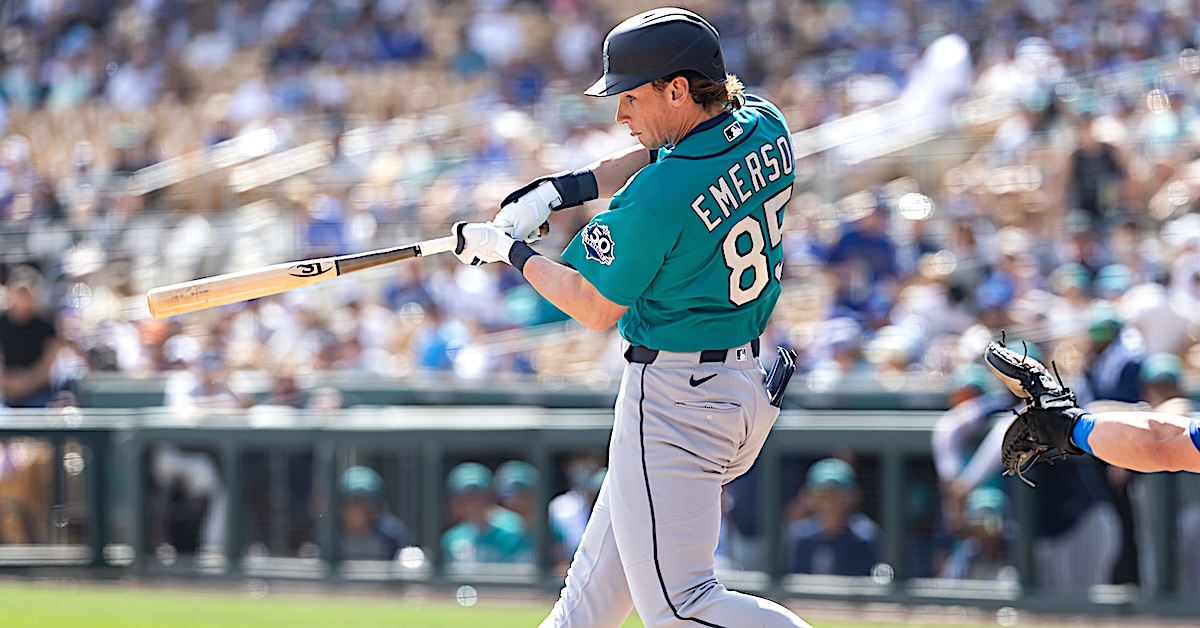
Apparently not wanting to be left out of the flurry of contract extensions handed out over the last two weeks, the Seattle Mariners signed a big one of their own, locking up infield prospect Colt Emerson to an eight-year contract that guarantees him $95 million over the next eight years. This includes a $1 million salary for 2026, meaning that the contract goes through the end of the 2033 season, with the Mariners holding a 2034 club option that could staple another $25 million onto the back of the contract. Emerson’s deal also includes a no-trade clause and bonuses for All-Star selections and Silver Slugger and MVP awards, de rigueur in deals such as this.
Emerson, who doesn’t turn 21 until July, is widely considered Seattle’s top prospect by most sources, whether you prefer our prospect team, Keith Law over at The Athletic, old friend Kiley McDaniel at ESPN, Baseball Prospectus, Baseball America, or mean ol’ ZiPS. That’s no small feat to pull off when you’re in the same organization that has high-end pitching arms like Ryan Sloan and Kade Anderson.
While Emerson doesn’t have one mind-blowing tool that absolutely obliterates the cognitive pathways of watchers, he’s very accomplished at basically everything he does. He’s not going to regularly blast Stantonian shots, but he’ll hit his fair share of home runs, ZiPS thinks 15-20 a year if he played home games at a neutral site rather than T-Mobile Park. Emerson is willing to draw walks, but he still retains a fundamental aggression at the plate; that’s a good thing, as being too passive is a frequent pitfall for prospects who take a good amount of free passes. There’s no whiff problem hiding in his advanced stats, either. He’s not a burner on the basepaths like Trea Turner or Bobby Witt Jr., but at the same time, he’s not me with a belly full of Cool Ranch Doritos, a 32-ounce deli container of beer, and a hamstring that hasn’t gotten a whole lot of use since the Clinton administration. It doesn’t seem like there are any serious concerns about his sticking at shortstop, and the coordinate-based method that ZiPS uses for minor leaguers sees him as a solid B+ defender at the position. Let’s crank out those projections.
| Year | BA | OBP | SLG | AB | R | H | 2B | 3B | HR | RBI | BB | SO | SB | OPS+ | WAR |
|---|---|---|---|---|---|---|---|---|---|---|---|---|---|---|---|
| 2026 | .231 | .310 | .353 | 515 | 67 | 119 | 23 | 5 | 10 | 65 | 49 | 128 | 9 | 93 | 2.4 |
| 2027 | .234 | .313 | .361 | 538 | 72 | 126 | 25 | 5 | 11 | 70 | 52 | 129 | 9 | 96 | 2.8 |
| 2028 | .235 | .314 | .364 | 557 | 76 | 131 | 26 | 5 | 12 | 75 | 55 | 128 | 9 | 97 | 3.0 |
| 2029 | .237 | .317 | .370 | 575 | 82 | 136 | 27 | 4 | 14 | 80 | 58 | 127 | 9 | 100 | 3.4 |
| 2030 | .241 | .321 | .380 | 590 | 85 | 142 | 29 | 4 | 15 | 84 | 60 | 126 | 9 | 103 | 3.9 |
| 2031 | .241 | .321 | .380 | 590 | 85 | 142 | 29 | 4 | 15 | 85 | 60 | 123 | 9 | 103 | 3.9 |
| 2032 | .244 | .326 | .390 | 589 | 86 | 144 | 30 | 4 | 16 | 86 | 61 | 123 | 9 | 107 | 4.2 |
| 2033 | .246 | .327 | .392 | 589 | 87 | 145 | 30 | 4 | 16 | 87 | 61 | 123 | 8 | 108 | 4.3 |
| 2034 | .246 | .327 | .392 | 589 | 86 | 145 | 30 | 4 | 16 | 88 | 61 | 123 | 8 | 108 | 4.4 |
While on the surface, these numbers might seem a tad underwhelming, you also have to take into consideration that pitcher-friendly T-Mobile Park, home of the Mariners, takes a lot of air out of the raw numbers. Forecasting a long-term run of three- or four-win seasons for a 20-year-old who has barely played at Triple-A as a median outlook is a fantabulous projection. That age is important; the contract is surprisingly safe given the player Emerson is right now, but he’s young enough that there’s significant upside beyond the median outlook. For an eight-year deal, ZiPS would have offered him $109.3 million.
The top of Emerson’s comparable players list in ZiPS has very few guys who didn’t work out. Roy White (developed initially as a second baseman) wasn’t a Hall of Famer, but the Mariners would be quite happy if Emerson hit like White did in his prime. Dickie Thon is one of baseball’s great what-ifs, and may very well have been on a Cooperstown path until a Mike Torrez fastball hit him in the face in 1984. Francisco Lindor ought to be giving his speech someday (though Emerson doesn’t have his glove), and Chipper Jones has already made one. Jurickson Profar and D’Angelo Jimenez were both top prospects who had their careers derailed by serious injuries; coupled with Thon, perhaps ZiPS is suggesting that Emerson be cautious and not walk anywhere near where a moving company is hoisting a piano or an anvil up to a fifth-story apartment.
You can tell a lot about someone’s values by what they choose to spend their money on. Any team can say how excited it is about a prospect’s future, but a club doesn’t give the largest deal in history to a minor leaguer who has yet to make his MLB debut — eclipsing Jackson Chourio’s 2023 contract extension — unless it is sure that he will be a core contributor for years to come. With Emerson signed and Michael Arroyo an excellent prospect on the way — ZiPS is especially excited, ranking him 12th in baseball — the writing is definitely on the wall for pending free agent J.P. Crawford’s future in Seattle past 2026.
(Technically, you could argue that Emerson’s extension is the second-largest contract given to a minor leaguer before his major league debut, behind Yoshinobu Yamamoto’s deal with the Dodgers, but there’s a real philosophical question about whether to consider Nippon Professional Baseball the best minor league in the world, or a major league that’s not quite as strong as MLB. Either way, I think there’s a difference between Emerson and Yamamoto, who signed as a 25-year-old after winning three straight MVP awards in his country’s highest league.)
Whatever the next CBA looks like, don’t expect to see the number of deals like this diminish around baseball. MLB’s system of service time has always given these types of deals huge upside, though they didn’t really become super popular until John Hart went all-in on the strategy back in the 1990s for Cleveland. In fact, I’d argue that the relative benefit of signing your own players compared to free agents or making trades has increased over the last 15 years. Throughout history, teams always had more knowledge about their own players than opposing ones, but until recently, they didn’t really have much more data on their own players than those on other teams. Someone who works in a front office told me this winter that ZiPS projections were equal to their own club’s for players on the 29 other teams, while their internal systems did a bit better than ZiPS with their own players. One of my long-term projects, which has not yet borne fruit, is to get a team to give me data on how its internal projections for its own players perform relative to those for players in other systems.
But let’s get back on topic! A contract like Emerson’s does come with some risk, but all contracts do, whether they’re with a 20-year-old getting his first full taste of Triple-A, or a 28-year-old veteran with five All-Star appearances. The question comes down to whether that risk is factored into the price. I believe that Emerson’s new contract does account for that possible downside. Thumbs up to the Mariners, who made a good enough move that I’ll refrain from making any .540 jokes for the next two months.
Dan Szymborski is a senior writer for FanGraphs and the developer of the ZiPS projection system. He was a writer for ESPN.com from 2010-2018, a regular guest on a number of radio shows and podcasts, and a voting BBWAA member. He also maintains a terrible Twitter account at @DSzymborski.
Thanks for this thoughtful write up! I’m curious though what his projections through 2034 would look like if he played in a ‘neutral’ ballpark?
(PS I just moved back to Seattle from the mid-Atlantic and oh boy it sure is cold and damp and marine-layer-y at T-Mobile Park on opening weekend…)
Depending on what club they work for, this could be really impressive praise. Or not!
I said this on the Cooper Pratt article because the news on these came out around the same time…but the price on these pre-majors deals has gone up so much. Virtually everyone likes Colt Emerson as a prospect, but he isn’t going to be in the majors this year unless the Mariners change course (they’ve stuck with Leo Rivas at shortstop while Crawford is out).
Yeah, he did better at AA last year than Jackson Chourio but I don’t think you can say he has the same upside–even now.
But it all makes sense if the price on these sorts of deals has gone up.
You don’t think Emerson is gonna be in the majors at all? I think they’re only going with Rivas now because it’s a short term injury for Crawford. If it was a long term injury, I think Emerson would have been starting at SS already.
I’d personally be pretty surprised if he’s not up by mid-season at least due to an injury anywhere. Just slide Donovan from third to wherever the injury happened and plug Emerson in at third (or maybe it’s Donovan himself who gets injured). Then Emerson replaces Crawford next year.
I think we’re looking at post all star break unless there’s a serious, long-term injury that happens in the next couple of months.
We can rule out short-term injury to Crawford, and if they didn’t do it for Crawford it’s hard to see them moving everyone else around if Donovan or Young get hurt and it’s not expected to keep them out for months. But those are the most likely scenarios for him to get in the lineup.
I would agree that a long-term injury to Crawford would do it. A long-term injury to Donovan could do it, as Emerson has gotten sporadic reps at third base fairly since he entered the Mariners system, including one game this year. A long-term injury to Young or sustained underperformance by him might do it, since they could shift Donovan to second.
My guess is that even if Young or Donovan are super injured or ineffective (ineffectiveness more likely to happen for Young than Donovan, check out his xwOBA) what’s going to happen is Rivas is going to fill in and they’re going to give Young a lot of reps at whatever position they want him to fill before calling him up. And unless that happens, they’re just going to keep him at shortstop as the heir apparent to Crawford.
They wouldn’t make the call on underperformance for at least another month, and the chances of dealing with a serious injury at some point in the year increases cumulatively as the year goes on. And it will take some time for them for them to give him more reps at those positions–he’s still mostly doing shortstop.
And maybe that’s the right call? I’m looking his Statcast metrics and it’s pretty wild. He’s got something like a 50% hard hit rate in AAA over his roughly 30 events and not one of them has been a barrel. And yeah, it’s only 30 events, but that’s not the right direction for his bat to be going when he hits the ball hard. He could probably hold his own if he got promoted to the majors but it’s not guaranteed, and he does seem to have more to learn.
Local stenographers quote Dipoto to the effect that Donovan’s versatility paves the way to add Emerson to the roster in the event of any injury, whether to an infielder or an outfielder.
Except they didn’t with Crawford! So clearly it’s not just that. There has to be some other threshold that it has to clear, whether its duration or to a specific position.
i imagine because they only expect Crawford to miss a handful of games – he’s on AAA rehab assignment now and might well be activated by Friday.
Now that Crawford has been activated, I think we can confidently say that Emerson not being promoted in the 1 game between him signing the extension and Crawford returning doesn’t give us any useful information beyond that they didn’t want to debut him to cover a 7 game absense before he signed the extension.
Just because they didn’t do it at the start of the season doesn’t mean they’re not gonna do it in June or July, especially if the injury is to someone who’s not performing so well that they obviously have to have their job back when they return.
Emerson is extremely likely to come up and play this year with the Mariners. The Mariners don’t leave top prospects in AAA for very long.
I think Emerson is very likely to be playing in Seattle this summer.
I personally don’t think an injury (especially a short-term one) is a good reason to call up your top prospect if you’re not confident he’s ready. If he was ready now, he’d be in the bigs. But they decided to let him marinate in AAA instead. But there’s a good chance he plays his way out of there soon.
And I think this contract is an extremely strong sign that the Mariners anticipate calling him up this year.
I think that this is something I can agree with. They don’t think he is ready now. Whether he is ready around the all star break for a similar opportunity or not, I don’t know.
I really don’t think it will take them long to think he’s ready. He hit better at the end of spring training than the beginning. One month of reps at 3b, and some demonstration of ability to handle experienced pitchers, and they won’t want to keep him down. Everyone’s getting a bit more rest in Seattle this summer, unless there’s an injury.
Apparently the word is that he’s going to take over at third base everyday at some point this summer and Donovan will return to a roving utility role. So I am guessing they are going to give him a month of reps at third and see how he is doing.
Dan, could we get the ZIPs contract projections for Cooper Pratt? Emerson’s deal, while richer, feels safer to me.
I think it’s Pratt’s exceptional defensive projections that make that one “safer”. Kid might be 3 WAR across the board just on that alone.
Eric and co. did not have that high a grade on his defense. They have a 55 on his fielding, which does not lead to a 3 WAR baseline.
They have a 55 on his *shortstop* fielding, which means they expect +10 Def as his normal.
Add in solid steals+baserunning, and the hitting threshold for 3 WAR is a 95 wRC+.
Only six shortstops reached +10 def in 2025. Those were guys like Nick Allen (70 fielding), Joey Ortiz (70 fielding), and Jeremy Peña (60 fielding). 55 fielding would be more like +5 def, and Pratt isn’t expected to reach a 95 wRC+ consistently in the majors either.
When I wrote “Def,” I wasn’t referring to FRV.
I was referring to the statistic “Def.”
There were six shortstops who cracked 10 Def last year and ten who reached 9 Def.
3 FRV over 150 games comes out to 10 Def.
The Erick Aybar Zone has entered the chat
FWIW (which is not much), I think Brandon Crawford illustrates the range of outcomes here pretty well.
The Brewers are likely projecting someone like 2015 Brandon Crawford. I think that is really unlikely and that we’re looking more at 2013 Brandon Crawford.
Plus defense is totally possible. League average offense is totally possible. I just don’t think we’re looking at double-plus defense at shortstop like Crawford, nor a guy who is 10% above league average on offense.
If he doesn’t work out at all, he looks a lot like 2019 Brandon Crawford.
Frankly, 2017 Crawford with 15 steals comfortably earns Pratt’s contract, even with the $18-24m guaranteed pre-arb and teams placing a premium on batting runs.
…but there’s obviously no guarantee Pratt turns out that well.
Yes, I know. That’s why I said:
Only six shortstops reached +10 def in 2025. Those were guys like Nick Allen (70 fielding), Joey Ortiz (70 fielding), and Jeremy Peña (60 fielding). 55 fielding would be more like +5 def.
+5 Def at SS is -2 FRV over a full season.
That is not how any scouting report describes him.
If you use the “at SS” splits to eliminate DH days, three additional shortstops ended up with 9.5-9.9 Def last year.
7 cracked 10 in 2024, with Rocchio, Ahmed and Seager missing it do to playing time.
8 cracked it in 2023, with Rojas and Crawford missing the cut to playing time.
10 made it in 2022, with Kim and Allen missing the cut to playing time.
7 cracked 10 in 2021, with Swanson at 9.9 and Farmer missing the cut to playing time.
So…yeah.
+10 Def is an entirely reasonable number to use approximate 55 defense at SS, assuming a full season of playing time.
Defense doesn’t get you paid in arbitration, though – Stott’s at $5.9m his second time through arbitration, while Gleyber made $6.2m in 2022, coming off a 1.4 WAR season.
Ben also mentioned recently that teams consistently value Off more than Def on the open market.
The Cards are considering a Wetherholt extension and curious how ZIPs would have him compared to Emerson. Could we get a ZIPs contract value for Wetherholt?
I’ll piggyback on this & ask for the same on Kevin McGonigle.
Wetherholt is on another plateau when compared with Emerson and Pratt. 17 HR’s, along with a very impressive contact rate, at AA and AAA in 109 games just leaps off the page to me. The 425′ HR he hit on a pitch well outside on Opening Day added a lot more shine to his resume. He is giving off Mookie Betts vibes with the bat. There is always risk but the Cardinals should be considering taking a risk, and a big one, on him, perhaps in the neighborhood of 9 for $150M. McGonigle is also doing more than could be reasonably expected of a very young rookie and I will be watching closely to see who turns out to be better.
I’ve said this other places, but the rub I have with this it seems overly aggressive in the timing to me. This is a dude with 203 PA between AA and AAA, and 0 PA in the majors. Granted, looking good in the high minors in even those limited PAs as a 19-20 year old is impressive. But prospects with longer track records bust all the time.
I don’t really see why the team couldn’t have waited and collected more data while Emerson was in AAA this year. Unless he goes absolutely nuclear, I don’t see how the price could increase all that much. That’s why I find the timing of this extension (and the Cooper Pratt extension as well) so odd. There seemed to be no risk at all in waiting to extend because the price isn’t going to go up while the prospect is in AAA.
This is more than Jackson Chourio got 2 years ago, when he was the same age but had over 3x AA-AAA PAs as Emerson (Chourio didn’t hit quite as well, but was still above average). Chourio had an extra team option tacked on at the end as well compared to Emerson so more team-friendly in that aspect, and he had a clear path to MLB playing time. But the key difference is that Chourio was about to debut and was tabbed for significant playing time – if he played well, the price was going to go up. Not so with Emerson (and Pratt), who are still in AAA for the foreseeable future.
I feel like there’s a bit of a contradiction in arguing that the Mariners would have greatly benefited from waiting and collecting more data while also saying that waiting wouldn’t have impacted the price very much. Either his next few months in AAA tell you something meaningful in which case the price should change or its relatively inconsequential in which case not a big difference between signing him now verses in June or July. The Mariners decided to go the slightly higher variance route by signing him with less information but probably at a slight discount to what they would have gotten if they waited until he performed well at AAA or in his initial stint with the Mariners.
I should clarify my position in that I don’t think the price for the Emerson extension could have gone much higher with more AAA information. This was already the biggest pre-debut extension in history. It might go a bit higher with a few months of good AAA hitting, but not substantially.
On the flipside, if there was a cratering of performance or catastrophic injury, the price on the extension could get a fair bit lower/more team friendly, or you might elect to not give the extension altogether. That is very valuable.
Thus, I see no real reason not to wait in that the price could only go up maybe a little, but could go down a lot.
I think I can buy your line of reasoning on Pratt more. If he truly establishes as a top prospect this year in AAA (and Brewers might be thinking he will!), then the price goes up a fair bit from 8/50. Emerson, I just don’t see it with what they are already paying him, not before a major league debut. We might disagree about that.
There’s also the aspect of these extensions where, well, you are paying major league money this year to players who may not contribute much at the major league level this year. By waiting, you may also get an extra year of prime-year control, or at least not have to pay an extra year of MLB salary for no MLB benefit.
There’s not much precedent here for minor league players to be making MLB money (without flaming out in the majors first). As far as I can tell, every single one of these 0-days-service-time extensions was following by a near-immediate MLB debut with no more time marinating in the minors. I’ll be watching these guys closely in the minors because I think they’ll be the first of their kind, prospects who haven’t debuted but are making major league money.
I hear you, I just think that if both parties are being rational than if waiting to see if there is a cratering of performance or catastrophic injury over the next couple of months has a fair bit of value to the Mariners than the flipside should be that if those worse case outcomes don’t occur than the contract Emerson gets in a couple months should reflect that and be larger assuming his agent is doing their job. It should be something of a zero sum game where if the Mariners are paying for something (in this case more information over the next couple of months) that value should be accurately reflected in the contract he signs. My guess is that the contract wouldn’t differ dramatically because, as you say, the chance of a bad tail outcome is very unlikely.
I also think that Mariners could end up promoting him pretty aggressively, Dipoto talked about him playing 3B this year yesterday, so the timeline to work something out while he’s still in AAA may be quite short.
In any case, it’s an interesting question. Thanks for the discussion!
Are no-trade clauses for extensions, especially these very early extensions, actually the industry norm? I don’t think they are.
Between the Emerson / Pratt extensions and the rumors around Wetherholt and Griffin it sure feels like something is up right now.
Someone yesterday said they don’t know *why* these sorts of deals are suddenly all happening now, just that it seems way too much of a coincidence that this is happening on the eve of a huge CBA renegotiation. I would like to echo that. This is all very strange to me, we had something like 7 of these deals in the last two decades and we might raise that number by over 50% in these few weeks.
It definitely feels like owners are hedging against cost-controlled years getting shorter somehow.
Yeah I think maybe they’re hoping they can trade that for a cap.
I need to read up on permissive subjects and “duty to bargain” in collective bargaining but I seem to recall that there are some structural incentives for the union to “just say no” to the cap and never let it go beyond that. Where as long as they refuse to go any further than that they will never have a duty to bargain over it. Which would mean that’s what they would do and we would never get to a reduction in service time.
It has been a really long time since I’ve been involved in collective bargaining though, so my memory could be super wrong.
The trade off is to create an age-based rolling system. Teams would give up a lot to get one extra year of team control for star players. I like a system where any appearance at all counts as a service year, but teams get seven, but also you can reach free agency with six years at age 29 and with four years at age 30 and everyone gets it at age 31.
You can work around the edges but the main trade off is getting seven full years for the phenom players but all the regular players are guaranteed to get to free agency by a certain age.
I’ve been thinking that as well, the timing is odd. These are very aggressive signings.
In addition, to my knowledge, these are the first extensions of their kind in that these are not players who have debuted or will debut imminently – the intent is the let them marinate in the minors for at least a little longer. Every single other 0-days-service-time extension I can find on record was followed by a near-immediate MLB debut (or as immediately as possible if signed in the offseason).
These guys are getting paid MLB money to play in AAA for the immediate future. I can’t think of an example where this was the case where the guy hadn’t at least debuted and flamed out a bit (or was injured) in the majors. That makes the timing even more conspicuous to me.
I am curious about what the 20%/80% projections look like for Emerson if you could provide them, Dan or direct me where to get them. Thanks.
The message I see is, don’t worry about us manipulating service time, you’re good no matter what. And don’t worry about the next CBA, you’re good no matter what. Emerson presumably will want to be called up as soon as possible, but now at least he can look at it as the M’s maximizing their season (and treating JP, who has been there longer than anyone else,right) with no motive involving when he’s going to get paid.
“suggesting that Emerson be cautious and not walk anywhere near where a moving company is hoisting a piano or an anvil up to a fifth-story apartment.“
RIP Teddy Valiant