
Stay Away From Mookie Betts!

In-zone rate is one of the most fascinating stats in baseball. It definitely means something, but you sometimes need to sort through a couple different factors in order to determine just what that something is. If pitchers think they can knock the bat out of your hands, they’ll come right after you inside, but if they’re scared you’ll do damage, then they’ll nibble around the edges. If you chase too much, they’ll look to tempt you outside the zone, but if you make good swing decisions, you can force them to throw it over the plate. Fastballs end up in the zone more often than breaking balls and offspeed pitches, so if you struggle to catch up to velocity, you’ll see more pitches in the zone. There’s always some randomness thrown in for good measure too, but generally speaking, that’s the matrix.
If you combine all those factors, you’ll see that most of the time, players who take big hacks see fewer pitches in the zone than those who just try to put the ball in play. Since 2021, Salvador Perez and Bryce Harper have seen the fewest pitches in the zone, while Myles Straw and Ha-Seong Kim have seen the most. But there are some elite players who combine the best of all worlds: They make good swing decisions and they combine power with contact ability. If you hang it, they’ll bang it, and if you bury it, they’ll spit on it. These players usually end up with a zone rate that’s somewhere in the middle, simply because there is no one good way to pitch to them. Think Joey Votto, Alex Bregman, and our subject for today: Mookie Betts.
If you’re a baker, you might be fond of the kitchen sink cookie: the cookie where you mix anything and everything that might be delicious into the dough. Pecans and peanut butter chips? Sure. Toffee bits and white chocolate? The more the merrier. Betts is baseball’s version of the kitchen sink cookie, studded with athleticism, coordination, savvy, skill, versatility, maybe even some shredded coconut. There’s no such thing as a right way to pitch him. He has weak spots, but he’s excellent at hitting the kinds of pitches that are usually located in those spots because he’s good against every kind of pitch. He’s never excelled against pitches at the top of the zone, but he destroys four-seam fastballs. If you want to beat him up there, you really have to hit the very edge, because if you miss high, he won’t swing, and if you miss low, he’ll clobber it. He’s also had trouble low and away, but again, he’s always been solid against the breaking pitches that most righties try and throw there.
This year, Betts is batting leadoff in front of reigning AL MVP and current Triple Crown candidate Shohei Ohtani and perennial MVP candidate Freddie Freeman. There’s nobody in baseball with better lineup protection, so you could be forgiven for assuming that he has been seeing a lot more strikes this season. He has not. In fact, his zone rate has fallen from 49.1% in 2023 to 45.4% this season. That drop of 3.7 percentage points is tied with MJ Melendez for the second largest among all qualified players, behind only Anthony Volpe, who went from 50% to 46.1%. That leaves Betts with a zone rate in the 13th percentile of all qualified players.
So far, 10.1% of the pitches Betts has seen have been in the waste zone, and 24.4% have been in the chase zone. Both of those numbers are the highest he’s ever recorded. Just 23% of the pitches Betts has seen this year have been in the heart zone. That’s the lowest rate he’s ever recorded, and it’s also eighth lowest among the 196 players who have seen at least 400 pitches this season. Pitchers are avoiding him like never before, and it’s not just that he’s seeing fewer strikes. They’re trying to execute a specific plan.
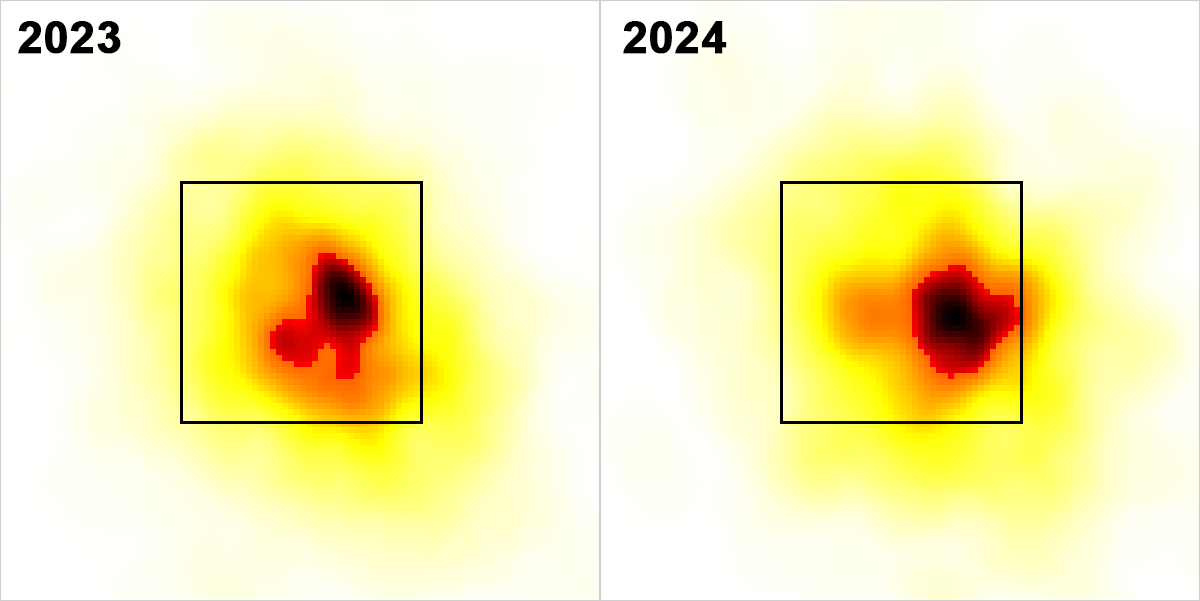
They’re trying to hit that outside corner. Betts is seeing fewer four-seamers, and more sinkers and offspeed pitches. Those offspeed pitches, as well as the breaking balls he’s seeing, are more concentrated on the outside edge of the plate.
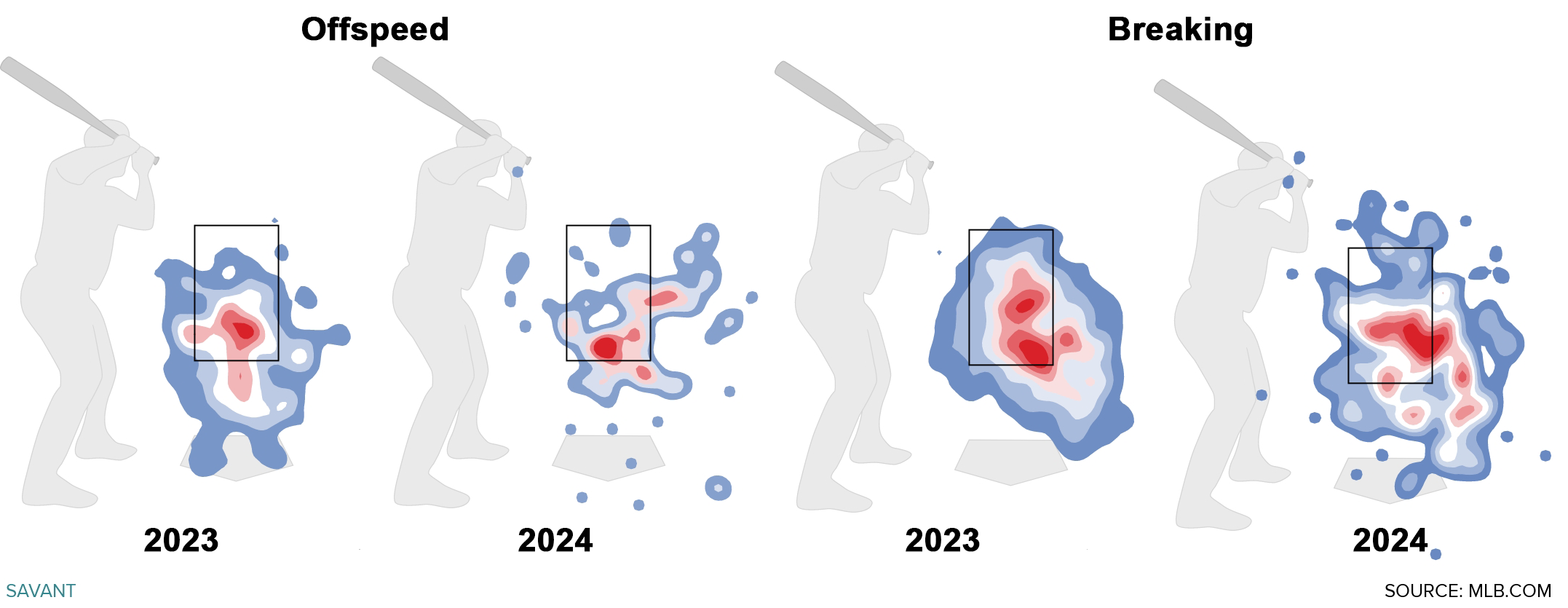
Strictly speaking, this plan is not working. Betts is already sitting on a major league-best 3.0 WAR, and his 193 wRC+ is second only to the 217 mark of the player who is, in theory, protecting him in the lineup. It’s hard to argue that the league has finally figured out a player who’s currently on pace for 12.8 WAR.
However, this plan is absolutely changing the shape of the production Betts is putting up. First, the good news: He’s running a career-high 16.3% walk and a career-low 9.6% strikeout rate. His 1.71 walks per strikeout are miles ahead of Vinnie Pasquantino’s 1.36 in second place. Now the bad news: Betts’ hard-hit rate and 90th percentile exit velocity are down significantly. His pull rate is down to 32.6%, the lowest of his entire career and a drop-off of more than 13 percentage points from 2023. He hasn’t hit a homer since April 12 or an extra-base hit since April 28. Here’s what that looks like in heat map form. The map below shows Betts’ value according to Runs Above Average per 100 pitches.
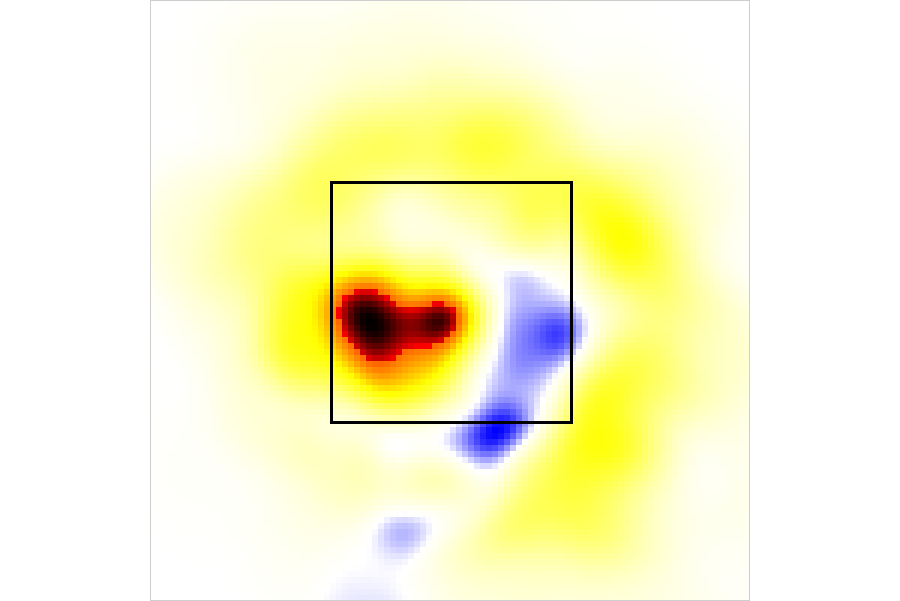
If you’re a pitcher, that makes it pretty clear: outside good, inside bad. Even with Ohtani and Freeman looming, it might make sense to try to hit your spot on the outside corner and risk giving up a walk. Furthermore, this plan is not without precedent. If you go back and look at the heat maps of the pitches Betts has seen in recent years, one of them jumps out as similar to this season.

In 2021, pitchers tried a similar tack, aggressively going after the outside corner. Betts ended up with a 131 wRC+ — the worst mark he’s had since 2017. If you’re an opposing pitcher with no good options — which is to say any pitcher who finds themselves 60 feet, 6 inches away from Mookie Betts — why not try an approach that has, at least grading by the ridiculous curve of Betts’ stellar production, worked before? Look at how many of his hits (especially his extra-base hits) went to left field last year.
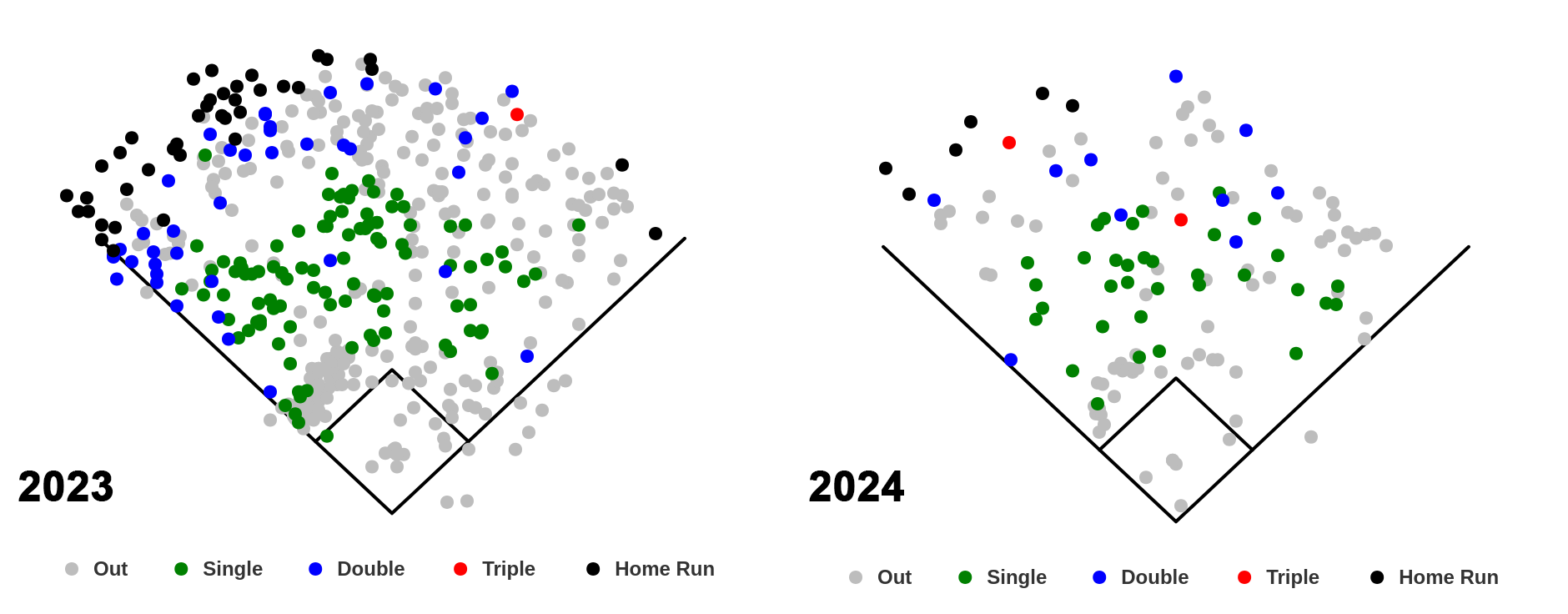
Right field is just a sea of gray outs with a few green singles sprinkled in. In 2023, Betts had a .602 wOBA when he pulled the ball, .396 when he hit it straightaway, and .189 when he hit it to the opposite field. Why not do everything you can to keep him from pulling the ball and encourage him to hit it the other way? Unfortunately for opposing pitchers, this tactic requires a high level of precision. Betts doesn’t seem to mind taking his walks, and on the rare occasions when he does get a pitch to hit on the inner half, he’s making the most of it.
However, there are a few signs that he’s had to adjust to combat this approach. He appears to be setting up closer to the plate this season. In the pictures below, I’ve copied and pasted a second home plate right next to the actual home plate to give a better sense of scale.

In theory, moving a few inches closer means that the inside pitches Betts usually mashes are now a little bit further inside, which should give him less time to turn on them. Furthermore, his chase rate is up a bit from last season, and it has been rising in recent weeks.
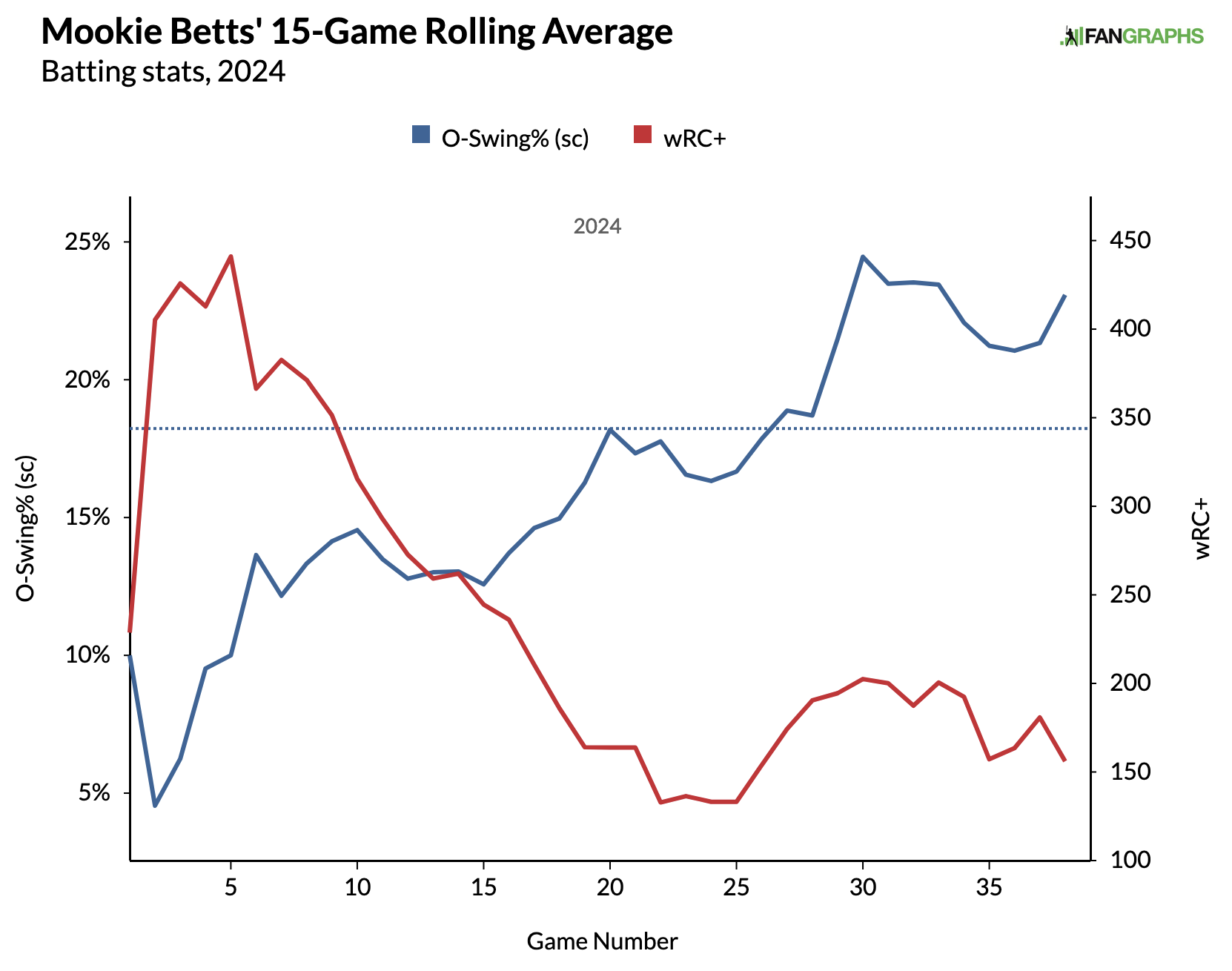
This could just be regression. Betts has an 83 wRC+ over his last nine games, but it’s not like he was going to run a 250 wRC+ and a 12% chase rate all season. However, he really is chasing more — not a lot, but more than he did in April and more than he did in 2023. We’ve seen him move closer to the plate, and it’s certainly possible that seeing so few pitches in the strike zone has made him a little bit sick of waiting for his pitch and more likely to swing at something he shouldn’t. We’re only a fifth of the way through the season, and all the numbers you’ve seen so far are likely to continue to regress to the mean. Betts will likely face more pitchers who are bold enough to challenge him inside (or at all). But for now, it looks like he’s still adjusting to this new approach.
Davy Andrews is a Brooklyn-based musician and a writer at FanGraphs. He can be found on Bluesky @davyandrewsdavy.bsky.social.
He is noticeably flying out to right field a lot lately but in 5 years of watching him a lot I think that comes in waves mixed with his insane hot periods. He was unbelievable in August 2023 and then kind of pedestrian in September and October. He is noticeably swinging outside the zone less than he ever has in his Dodger career as well which I think is really the best adjustment he can make with Ohtani hitting behind him.
I don’t think he was ever going to keep that pace up, since at least part of his crazy line took place in Korea and I have no idea how anyone does park adjustments for MLBers playing in Korea.
One of the weird things about Betts’s offensive production is that he’s not running a sky-high BABIP and he’s on pace for only about 22 homers or something like that over 650 PAs, and he’s still running a 193 wRC+. I suppose a .455 OBP will do that, and he has a fair number of doubles.
But it’s still weird to look at someone running a wRC+ at that level without a ton of homers. Here are the highest wRC+’s since 2007 with fewer than 25 homers (minimum 500 PAs):
Chipper Jones, 2008 (22 homers, 534 PAs, 174 wRC+)
Miguel Cabrera, 2015 (18 homers, 511 PAs, 165 wRC+)
Yandy Diaz, 2023 (22 homers, 600 PAs, 164 wRC+)
Buster Posey, 2012 (24 homers, 610 PAs, 164 wRC+)
Jose Altuve, 2017 (24 homers, 662, 160 wRC+)
Aside from Cabrera’s 2015, it looks like everyone had a higher HR-per-PA percentage than Betts, and Cabrera was playing in a low-offense environment in a stadium that swallows home runs. It must be really hard to run an OBP high enough to be a super-elite hitter in major league baseball without hitting a ton of homers to keep pitchers off your back, but pitchers are giving Betts that treatment even without all the homers this year.
I’m still in awe of the fact that he can move to shortstop at age 31 and not be a liability there. That just doesn’t happen.
I’m more in awe of the ridiculousness of him playing corner outfield for 10 years while being a perhaps good defensive shortstop.
It’s not as if being a good defensive shortstop at 31 is rare, but how exactly was this not somehow discovered earlier?
He came up as a second baseman, but Boston had Bogarts and Pedroia so they moved Betts to the OF and he was so good there that I guess no one ever thought about moving him until they had to.
Also, the OF on those Boston teams was pretty bad so they needed him there. In his rookie year (2015), it was guys like Jackie Bradley Jr, Hanley Ramirez (-1.5 WAR) and a cast of journeyman.
I’m surprised that Mookie Betts has about the same in-zone rate as Anthony Volpe
The main problem I have with this theory is that he just ended a stretch ten days ago where he went 11-19 with three doubles, a triple and a pair of walks. Do you think the pitchers held a general meeting and voted to pitch him outside? Or was some regression from his absurd start perhaps expected?
Some regression expected sure and it’s a pretty small sample size. But in terms of pitchers attacking him away this year, I would be surprised if teams were not doing their own research to game plan how to mitigate the key players of the dodgers offense and came to similar conclusions.
I assume it’s negligible but I’m wondering if there’s been a change in the league waste zone % and chase zone %? And how much higher are his rates this year relative to his career? I actually see league zone% slightly up from last year which would make this all that much more surprising.
I’m also curious when he made his adjustment to stand closer to the plate. “Chasing” an outside pitch in 2023 has a worse expected outcome relative to Betts “chasing” in 2024 since those pitches are effectively translated 6 inches closer to him. I’m wondering if this was decided in spring training and pitchers are throwing that much more outside to avoid him or if he recognized it at the beginning and made an in season adjustment.