Archive for Nick Blackburn

Nick Blackburn Loses Margin for Error

This past March, the Minnesota Twins locked up Nick Blackburn with a four-year, $14 million contract. The deal covers the right-hander’s final pre-arbitration season in 2010, his three arbitration years and includes an $8 million option for 2014, Blackburn’s first season of free agent eligibility. Minnesota’s 29th round pick in the ’01 draft established himself as a solid rotation cog over the 2008 and 2009 seasons, using surgical command (1.81 BB/9) to compensate for a paltry punch out rate (4.4 K/9). His FIP over that period was 4.38, and his xFIP was 4.52. Blackburn managed 2.5 WAR in ’08, and improved to 3 WAR in ’09.

In 2010, CHONE (4.29 K/9, 1.86 BB/9, 4.42 FIP) and ZiPS (4.21 K/9, 2.06 BB/9, 4.65) expected more of the same from Blackburn. Instead, the 28-year-old has been battered for a 6.40 ERA in 97 innings. That’s the second-highest mark among qualified starters. Granted, Blackburn’s ERA does overstate the depth of his struggles — his BABIP is .324 (.314 career average), his rate of stranding base runners is 66.2% (69.9%) and his home run per fly ball rate is 14.8% (10.7%). But even so, his xFIP has ballooned to 5.14.

Blackburn’s already-low K rate has nosedived into Kirk Rueter-esque territory. He’s striking out just 3.15 batters per nine frames, by far the lowest among qualified starters (Aaron Cook is second, at 3.97 K/9). Nick’s swinging strike rate, 6.5% in 2008 and 5.4% in 2009, sits at an MLB-low 2.9% (Rodrigo Lopez is next, at four percent; the MLB average is 8-9%). His overall contact rate has spiked, from 86.7% in ’08 and 88.1% in ’09 to an MLB-high 93.7% this season (81% MLB average). In addition to missing even fewer bats, Blackburn has issued more walks — his BB/9 total is 2.51.

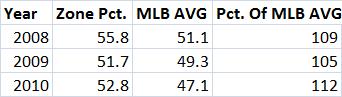
The scuffling Twins starter is still putting plenty of pitches within the strike zone:

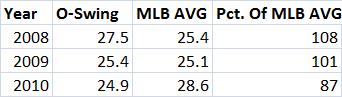
When Blackburn does throw one off the plate, however, batters aren’t chasing near as much:

What has changed for Blackburn? Let’s take a look at his Pitch F/X data from TexasLeaguers.com over the past three seasons. First, here’s his pitch selection and performance in 2008 and 2009:

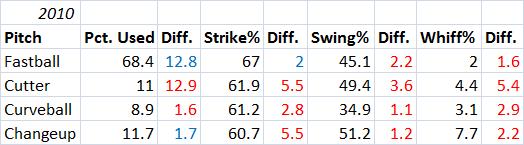
And now, 2010. I included a “difference” column for strike, swing, and whiff rate, comparing Blackburn’s performance in 2010 to 2008 and 2009. Blue indicates an increase compared to 2008-2009, while red indicates a decline:

Blackburn’s using his fastball and changeup more often, at the expense of cutters and curveballs. He throws a ton of strikes with the fastball, but the whiff rate is abysmal. Blackburn’s inducing fewer whiffs on all his pitches, and keep in mind those ’08-’09 rates were already extremely low. When he does go to his cutter, curve or change, Blackburn’s getting fewer strikes.

In 2008 and 2009, Blackburn was an average starter because of his fantastic walk rate. But, with more free passes and even fewer K’s, he has been a replacement-level arm in 2010. A guy like Blackburn has little margin for error — he’s a ground ball pitcher (48 GB% this season), but not a Tim Hudson-like worm burner, so any decline in his K/BB ratio is going to do serious harm. If Blackburn’s going to be a two to three win pitcher moving forward, he’s going to have to return his strikeout and walk rates to those 2008-2009 levels.


Sophomores: The AL Central

Major League Baseball players, generally speaking, have reputations for being superstitious people. One of the more popular superstitions in baseball is that of the “sophomore jinx.” The dreaded disease has ruined the careers of many a promising young rookie. Over the next week or so, we’re going to take a look at how many of the 2008 rookies from around baseball are surviving in 2009 as they attempt to evade The Sophomore Jinx. The American League Central division is up first.

Chicago White Sox

The Chicago White Sox club did not employ many rookies in 2008. In fact, Cuban defectee and middle infielder Alexei Ramirez was the only rookie to see extended playing time for the club. Ramirez, 27, had a fine debut season, although his walk rate was noticeably lacking with at 3.6 BB%. On the plus side, the lanky infielder has almost doubled that rate in 2009 to 7.0 BB% while maintaining an almost identical 12.8 K%. His triple-slash numbers has dropped from .290/.317/.475 to .252/.302/.345. Ramirez’ impressive power display from 2008, which resulted in 21 home runs in 480 at-bats, has bottomed out in 2009 with his ISO dropping from .185 to .093. His offense value has obviously decreased significantly, but he’s moved from second base to shortstop where his defense has been better than average, which helps soften the blow.

Kansas City Royals

This may be more of a case of playing above one’s own head, than being bitten by the sophomore jinx. Shortstop Mike Aviles, now 28, burst upon the scene in KC in 2008 and was one of the club’s biggest offensive threats throughout the second half of the season. The infielder, who had a fairly undistinguished minor league career, hit .325/.354/.480 with 27 doubles and 10 homers in 419 at-bats. The walk rate at 4.1 BB% and a healthy BABIP of .359 were perhaps early warning signs that his numbers would see a dip in 2009. So far this season, Aviles has been a disappointment with his walk rate dropping to 3.2 BB%. His triple-slash line is just .183/.208/.250 in 120 at-bats.

The former No. 1 overall pick in the 2006 draft, right-hander Luke Hochevar had a mediocre rookie season in 2008, even without considering his lofty draft status. He posted a 5.51 ERA (4.43 FIP) and allowed 143 hits in 129 innings of work. His rates were nothing special at 3.28 BB/9 and 5.02 K/9. Realizing he was far from dominating, KC sent him down to triple-A to begin the 2009 season but recalled him when injuries and ineffectiveness reared their ugly heads. In 29 innings, Hochevar has a 5.60 ERA (5.53 FIP) with 25 hits allowed. He has also walked 10 batters with just nine strikeouts (2.96 K/9). With a 56.7 GB%, Hochevar, 25, has at least been keeping the ball out of the air on a regular basis.

Detroit Tigers

Outfielder Josh Anderson spent the 2008 season as a member of the Atlanta Braves organization where he was unable to break into a long-term, regular gig with the club (He played in 121 triple-A games) despite its lack of outfield depth. The speedy athlete hit .294/.338/.426 in 136 at-bats. He also stolen 10 bases in 11 attempts. Traded to Detroit prior to the 2009 season, the 26-year-old outfielder is hitting .250/.286/.325 with 10 steals in 12 attempts in 120 at-bats. It’s clear why he’s been in three organizations in three years; he’s a borderline fourth outfielder.

Every year the pitching-poor Texas Rangers organization seems to give up on a young arm too soon. In 2008, it was right-hander Armando Galarraga. That year, he posted a 3.73 ERA (4.88 FIP) with 13 wins while allowing just 152 hits in 178.2 innings of work. He posted rates of 3.07 BB/9 and 6.35 K/9. The low strikeout total was a minor cause for concern, as was the home-run rate at 1.41 HR/9. Galarraga has been a mess in 2009. He has a 5.56 ERA (5.93 FIP) with 80 hits allowed in 69.2 innings of work. He’s also walking one more batter for every nine innings, so there are a lot of batters getting on base. The right-hander’s HR/9 rate has jumped to 1.81 despite pitching in a spacious home park.

Cleveland Indians

Despite a hot stretch in 2008, Ben Francisco’s career so far has reeked of ‘tweener.’ He lacks the range to play center field on a regular basis and he lacks the pop in his bat to perform regularly at the corner outfield positions. In 2008, the outfielder posted a triple-slash line of .266/.332/.438 with 15 home runs in 447 at-bats. This season, he’s hitting just .245/.311/.392 with five home runs in 204 at-bats. At the age of 27, there is not much upside, although with a BABIP of .290 and a line-drive rate of 20%, we could see some modest improvements on the triple-slash line.

Southpaw Aaron Laffey, 24, narrowly missed losing his rookie status in 2007 by two-thirds of an inning. He posted similar numbers in 2007 and 2008, which meant both low walk and strikeout totals. The biggest difference was that his FIP jumped by more than a run in 2008 to 4.88. Laffey has spent time in both the starting rotation and bullpen in 2009 (as well as the minors) but he has a respectable ERA and has allowed fewer hits than innings pitched. The bullpen is probably the best place for a starter who uses his fastball 78% of the time despite averaging out at 87 mph.

If you’re a fan of FIP, you’re probably not a fan of Jensen Lewis. The right-handed reliever has posted pretty good superficial numbers over the parts of the past three seasons that he’s been in the Majors. However, his FIP has gone from 2.49 to 4.59 to 5.54. His line-drive rate was also a worrisome 24.5% in 2008, although it currently sits at 11.5%. His HR/9 rate has gone from 1.03 to 2.30 in the past two seasons. For what it’s worth, Lewis does have a nice K/BB rate at 3.00.

Technically a rookie despite having years of pro experience in Japan, right-handed reliever Masa Kobayashi falls under the category of the one-year trick pitcher, and his debut season was not all that good (4.55 FIP, 65 H in 55.2 IP).

Minnesota Twins

It’s hard to believe that it wasn’t long ago that people were calling outfielder Denard Span a first round draft pick bust after he was taken out of a Florida high school with the 20th overall pick in 2002. The left-handed hitter, though, shook off the gossip and seized hold of a playing-time opportunity in 2008. His triple-slash line was solid for a player with his skill set (ie. speed) at .294/.387/.432 with 18 steals and six homers in 347 at-bats. Span, 25, even showed a willingness to walk a little bit (12.6%) while keeping his strikeout rate below 20%. His 2009 season has been an almost mirror image, although his power numbers are down and his ISO has dropped from .138 to .094.

Another 2008 rookie outfielder, more was expected from Carlos Gomez because he was the key name in the Johan Santana trade with the New York Mets. Gomez wowed a lot of people with his raw skills and potential, but there were a lot of hollow numbers, including his on-base percentage at .296. The 142 strikeouts were also troubling for a player that produced .360 slugging percentage, but it helped to explain the .258 batting average. His BABIP was .332 with a line-drive rate of 17.4… oh, if only he could put the bat on the ball more consistently. At 23, Gomez has time to learn and improve but he’d probably be better off getting regular playing time in the minors.

Left-hander Glen Perkins, 26, slipped into a starting rotation role in 2008 despite spending part of 2007 in the Majors as a reliever. He had an OK season for a No. 4 or 5 starter. Perkins won 12 games and posted a 4.41 ERA but his FIP was 5.14 and his strikeout rate was just 4.41 K/9 (It’s never a good thing if your ERA matches the K rate). He allowed 183 hits in 151 innings of work. Despite his less-than-stellar rookie season, the Minnesota club kept him in the rotation in 2009 but he’s responded with a 5.36 ERA (4.46 FIP) and 50 hits allowed in 47 innings of work.

Nick Blackburn, 27, is basically a right-handed version of Perkins. Neither pitcher throws very hard and they both rely on excellent command and control. In 2008, Blackburn allowed 224 hits in 193.1 innings of work. This year, he’s given up 86 hits in 84.1 innings. His strikeout rate has dropped from 4.47 to 3.95 K/9. The good news is that Minnesota has found its No. 4 and 5 starters for the next five years in Perkins and Blackburn.

A Minor Review of 2008: The Twins

The Graduate: Nick Blackburn | Born: February 1982 | Right-Handed Pitcher

The Twins featured a very inexperienced starting pitching staff in 2008 and Nick Blackburn was no exception. Entering the season, he had just six games of MLB experience but he provided 193.1 innings and posted an ERA of 4.05. Blackburn did not miss a lot of bats by allowing 224 hits, with a K/9 rate of 4.47, so he relied heavily on his defence. He won’t hurt himself with walks after posting a rate of 1.82 BB/9. Blackburn is not going to be a star, but he should be an innings-eater for the foreseeable future.

The Riser: Ben Revere | Born: May 1988 | Outfielder

You’d think a former first round pick (2007) would already be pretty highly though of – but most analysts felt Ben Revere was a huge overdraft. Do they still think that after his first full season in pro ball? Not so much. Revere flirted with hitting .400 for much of the minor league season. He showed a far more advanced bat than expected, and does a little bit of everything well – except hit for power (.113 ISO). He finished the season with a line of .379/.425/.497 with 44 stolen bases (13 CS) in 340 at-bats. If Revere needs to work on one thing in particular, it is his patience at the plate. More walks (7.4 BB%) could help him become an even more effective lead-off hitter.

The Tumbler: Deolis Guerra | Born: April 1989 | Right-Handed Pitcher

The crown jewel of the John Santana trade with the Mets prior to the 2008 season, Deolis Guerra took a huge step back and may have put too much pressure on himself to impress his new club. It’s also possible that he was over-matched as a 19-year-old in High-A ball, although he spent most of 2007 there as well and posted better numbers. Guerra went 11-9 in 2008 but posted a 5.47 ERA thanks in part to 138 hits and 71 walks in 130 innings. He also struck out just 71 batters. The good news is that Guerra has plenty of time to right the ship.

The ’08 Draft Pick: Tyler Ladendorf | Born: March 1988 | Shortstop

An offensive-minded shortstop, Tyler Ladendorf posted gaudy numbers in junior college and showed the ability to hit for average and power – with speed on the base paths. He found pro ball to be a little more difficult, though. In 147 Rookie League at-bats, Ladendorf hit .204/.287/.293 with one home run and six stolen bases. He posted rates of 10.4 BB% and 19.7 K%. Expect better numbers in 2009 now that he has his feet wet.

The ’09 Sleeper: Wilson Ramos | Born: August 1987 | Catcher

Wilson Ramos is finally attracting some much-deserved attention as an offensive-minded catcher. It will be interesting to see how Minnesota gets his bat into the line-up when he’s ready, given the presence of Joe Mauer. Ramos had his third straight solid offensive season and produced a line of .288/.342/.434 with 13 home runs in 452 at-bats. His ISO has averaged .146 in each of the last three seasons. With a career walk rate around 7.5%, he could stand to be a little more patient, while also trimming the strikeouts (22.8 K%). Defensively, Ramos has improved his receiving skills and features a dangerous arm behind the plate (41% CS in 2007, 43% in 2008).

Up Next: The Pittsburgh Pirates


Trio of Twins

The Minnesota Twins have been one of the more surprising stories in baseball this year, given that relatively few people gave them any sort of significant shot at contending at all. Yet, as we approach the 100-game mark of the season, the Twinkies are 55-43 and sit just a half-game behind the White Sox for first place in the AL Central; additionally, they are only one game behind the Red Sox for the Wild Card. For a team performing well to be considered a surprising story, the implication exists that either the franchise floundered in the recent past, like the Rays, or that its components are largely unknown commodities to the more general public.

Since the Twins have made the playoffs quite a bit this decade the surprise factor stems from their players not receiving massive amounts of publicity. Ipso facto, while most people could recite the 25-man roster for numerous teams in the league I would be willing to wager one of the toughest would be the Gardenhire Gang. Think about it. Their top slugger won the home run derby and the commentators present couldn’t even pronounce his name… let alone remember he won an MVP not too long ago. Their starting centerfielder is more commonly known outside of Minnesota as “that Johan trade guy.” And the only members of their starting pitching staff most people know about are Livan Hernandez, who doesn’t deserve to be one of the only members recognized, and Boof Bonser, whose name is, well, Boof. Point blank, you don’t forget a guy named Boof.

This last notion is really a shame because their success in the starting rotation has largely been reliant upon the performance of the other three: Scott Baker, Nick Blackburn, and Kevin Slowey (Glen Perkins you get honorable mention). This trio does not possess lights out “stuff” nor do they fire the ball past hitters with plus-fastballs. Instead, they limit their baserunners and have been quite adept at stranding those that do happen to reach base. Baker has been better at this than his two colleagues, stranding 82.4% of runners, a number behind only John Lackey at the top of the AL leaderboard. A number like this certainly isn’t expected to be sustained, so his performance from here on out will likely hinge upon just how far that rate drops.

None of the three had extremely significant service time so the reliability of their pre-season projections was not as high as, say, Livan’s, but they have essentially either matched these projections or have outdone them in the first 59% of the season. Going forward, Baker is projected at an FIP of 3.90, with Blackburn at 3.93 and Slowey at 4.12, all very respectable numbers. Their strikeout to walk ratios are not expected to be as high as we have seen thus far but are not likely to plummet all the way down towards J.C. Romero-ville. Lastly, their BABIPs are all either on the average or right around the corner so they haven’t necessarily been of extreme benefit in that department.

Here are their numbers this year, followed by what can be expected from here on out:

Scott Baker (now): 3.99 FIP, 1.16 WHIP, 4.86 K/BB, 1.52 BB/9
Scott Baker (2nd): 3.90 FIP, 1.26 WHIP, 3.08 K/BB, 2.13 BB/9

Nick Blackburn (now): 3.86 FIP, 1.27 WHIP, 3.56 K/BB, 1.37 BB/9
Nick Blackburn (2nd): 3.93 FIP, 1.29 WHIP, 2.58 K/BB, 2.16 BB/9

Kevin Slowey (now): 3.98 FIP, 1.13 WHIP, 4.69 K/BB, 1.42 BB/9
Kevin Slowey (2nd): 4.12 FIP, 1.19 WHIP, 3.00 K/BB, 2.13 BB/9

Their projections from here on out are calling for higher walk rates which in turn raises the WHIP and lowers the K/BB. This means more baserunners will reach and their barometric success (such as ERA) will be determined by an ability to strand them. There are plenty of “if’s” that must be met for the Twins to sustain their success and have a legitimate shot at winning the division, but I don’t consider it to be out of reach. Baker, Blackburn, and Slowey might not be the most well-known, or most exciting pitchers in all of baseball, but they have definitely been solid performers expected to continue producing at a quality level, most likely under the radar.


The Unluckiest April Pitchers

When discussing the early season productivity of a player it is important to remember that the barometric statistics analyzed by those on television often have better evaluative indicators beneath the surface. Many of these indicators deal with luck, or a lack of luck, and provide a more telling window into what should be expected from the player in the coming weeks and months. Dave Cameron wrote earlier today about Nick Johnson and how, based on his high percentage of line drives but low BABIP, Johnson has experienced an unlucky streak this month. Using a slightly expanded method to the ones currently used to determine luck (relative to GB/FB/LD and BABIP) I decided to figure out the unluckiest pitchers of the month.

Initially the method consisted solely of BABIP and the difference between FIP and ERA (FIP-ERA) but I then extended it to include their current W-L records. Though anyone at least casually versed in statistical analysis will explain the faults of a W-L record, fans that simply love the game without analyzing anything equate W-L records to quality.

A pre-requisite also found its way into the criteria in that the FIP could not be above 4.30, a cutoff I usually look for when determining the difference between good and average. This way players like CC Sabathia and Barry Zito could be avoided; players who, despite having large FIP and ERA discrepancies, still had very high FIP and ERA counts. In summation, the players I considered to be the unluckiest were those with high FIP and ERA discrepancies, a high BABIP against, and a W-L record that does not do a good job of representing the quality of games pitched. This left me with the following four candidates:

    Nate Robertson: 6.91 ERA, 4.18 FIP, -2.73 FIP-ERA, .333 BABIP, 0-3 W-L
    Nick Blackburn: 3.45 ERA, 2.72 FIP, -0.73 FIP-ERA, .347 BABIP, 1-1 W-L
    Ian Snell: 4.45 ERA, 3.03 FIP, -1.42 FIP-ERA, .358 BABIP, 2-1 W-L
    Zach Duke: 5.34 ERA, 3.97 FIP, -1.36 FIP-ERA, .369 BABIP, 0-2 W-L

So, of these guys, whom do you consider to be the unluckiest this month?


Twins Find Another Gem

The Minnesota Twins have been producing quality starting pitchers for years. From front of the rotation aces in Johan Santana and Francisco Liriano to useful innings eaters like Brad Radke, Carlos Silva, Scott Baker, and Boof Bonser, as well as a nifty trade chip in Matt Garza, there is seemingly never a shortage of quality pitchers taking the hill up in Minneapolis. It’s been a strength of the organization and the backbone on which a perennial division contender was built.

Well, it looks like they’ve done it once again. After losing Santana and Silva this winter, they handed a rotation spot to Nick Blackburn, a former 29th round selection in the 2001 draft who turned himself into a prospect through a volume of minor league success. As we can see from the pitch type data available here on FanGraphs, Blackburn’s stuff isn’t overpowering; he throws a 92 MPH fastball, an 88 MPH cut fastball (the pitches labeled as sliders are probably also cut fastballs), and a 75 MPH curveball, along with one or two change-ups per game. None of these pitches are a true knockout pitch, which is part of the reason his strikeout rates aren’t particularly high, and he wasn’t taken seriously as a prospect before 2007.

Through three starts, however, Blackburn is solidifying himself as a legitimate major league starting pitcher. Below are the two graphs that tell the story of his skillset and why it works.

Nick Blackburn’s BB/9

Nick Blackburn’s GB/FB/LD

Through his first 17 innings of 2008, Blackburn has shown impeccable command (less than two walks per nine innings) and pounded the zone with sinkers (60% groundball rate). While this isn’t as sexy as blowing hitters away with 96 MPH fastballs or a power curve, the combination of throwing strikes and getting ground balls is a proven winner. This is the Aaron Cook/Jake Westbrook path to success – pound the strike zone with pitches at the knees, don’t put anyone on base without making them swing, and let your infielders do the work.

Blackburn’s minor league data suggests that he probably won’t keep getting groundballs at quite this rate, and he’s unlikely to post an ERA below 4.00 this year, but he’s clearly showing that he’s got enough movement on his sinker and command of three pitches to keep hitters off balance and succeed as a pitch to contact starter. Chalk up another success story for the Twins pitching development machine.