Archive for Trevor Cahill

The Revitalization of Trevor Cahill

We had a pretty good idea of who Trevor Cahill was: owner of a career 4.13/4.27 ERA/FIP, back-end starter, ground ball pitcher. He lost his rotation spot while pitching for the Diamondbacks in 2014. During 2015, he was released by the Braves after a failed transition to the bullpen, and, after opting-out of a minor league contract with the Dodgers, there was the possibility that this might be the end of any meaningful career for him. Still only 27 years old, he wouldn’t have been the first fringy starter to flame out of the league.

In late August, however, he signed a minor league deal with the Cubs, and two weeks later they called him up to the major league bullpen. Something pretty drastic had happened over the course of his time in the bullpens of the three teams he was employed by during 2015, and it all seemed to culminate in his 17 September and October innings for Chicago: he posted a stellar 27% K-BB% during that stretch, returning successfully to his ground ball ways (61.8%) and a 2.12/3.13 ERA/FIP.

Those 17 innings were, of course, a tiny sample size. But in those innings, as well as his successful work during the playoffs, we glimpsed who the new Cahill might be, and it was the pitcher the Cubs think they just signed to a low-risk, one-year, $4.25 million deal last week.

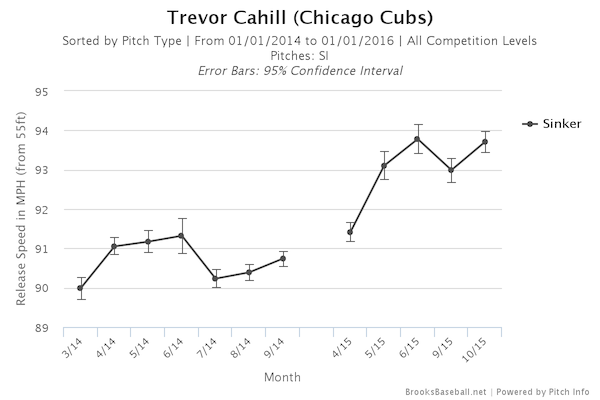
First, we saw a big velocity jump from Cahill in 2015. He almost exclusively throws a sinker as his main fastball, and he increased its velocity in 2015 by about two and a half mph from its highest point in 2014. Take a velocity look at a chart for his sinker for the months of 2014 and 2015, courtesy of Brooks Baseball:

Cahill_Sinker_Velo

Read the rest of this entry »


One Night Only: A Mountain Out of a Cahill

Cinco de Mayo is Spanish for “the Fifth of Mayo.”

Feel free to use that tidbit of information early and often.

Texas at Oakland | Wednesday, May 05 | 3:35 pm ET
Starting Pitchers
Rangers: Colby Lewis (R)
32.2 IP, 10.47 K/9, 3.58 BB/9, .280 BABIP, 38.8% GB, 5.7% HR/FB, 3.61 xFIP
Projected FIP: N/A (FAN) 3.99 (CHONE) 4.39 (ZiPS)

A’s: Trevor Cahill (R)
178.2 IP, 4.53 K/9, 3.63 BB/9, .276 BABIP, 47.8% GB, 13.2% HR/FB, 4.92 xFIP (2009)
Projected FIP: 4.56 (FAN) 5.08 (CHONE) 5.05 (ZiPS)

This Is Not About Colby Lewis
Even though it’ll probably seem like it most of the time, Colby Lewis will not, in fact, be the only guy on the field this afternoon in Oakland. In fact, there are a couple-few players who — despite lacking Lewis’s direct connection to the godhead — have actually managed to distinguish themselves as worthy of the baseballing enthusiast’s attention.

Not the least of these players is Oakland starter Trevor Cahill. Cahill — along with other young Oaklanders Brett Anderson and Andrew Bailey — made his debut last year, and was actually rated as the organization’s number-two prospect (behind Anderson) in Baseball America’s 2009 Prospect Handbook. Despite having thrown only 37 innings of ball above Double-A before 2009, Cahill’s excellent K rate (9.96 K/9) over that time — combined with Oakland’s youth movement — created a space for him in Oakland’s rotation. Back in December, our man Dave Goleblahblah justified the confidence the A’s would’ve had in his success:

Sure, Cahill’s command sometimes abandoned him. But he drew as much praise as any pitching prospect in the game. And why not? In addition to all of those Ks, Cahill was a groundball machine. He burned worms at a 56.4% clip in 2007 and kept the ball on the ground 61.5% of the time in 2008. Generally, strikeouts and groundballs have an inverse relationship: one comes at the expense of the other. It’s rare to find a young pitcher so adept at making batters whiff or chop the ball into the dirt when they do manage to make contact.

In light of those expectations, it’s fair to qualify last year as a bit of a disappointment. After having missed a lot of bats at lower levels, Cahill posted a mark of only 4.53 K/9 in 2009. Nor was his walk rate of 3.63 BB/9 anywhere near low enough to let him be effective in the mold of Carlos Silva circa 2004-2008, or even Rick Porcello of last year.

The question for this start — for Cahill, in general — is whether he’s able to get some breathing room between his strikeout and walk numbers. Perhaps the answer is in altering his repertoire. As resident cyborg Dave Allen wrote last year:

Like many ground ball pitchers Cahill throws a lot of fastballs (almost 70% of the time), and the problem is he has not been very good at getting them in the zone. His fastballs are in the permissive pfx zone 50% of the time, compared to the 55% for the average fastball. This is one of those things that seems like a small difference but is not. The variation is fastball zone percentage is narrow, so 50% is quite low, and over the course of the whole year those extra balls really pile up.

A little snooping over at Texas Leaguers reveals that, last year, Cahill got swing-and-misses on 5.5% of his two-seam and only 3.3% of his four-seam fastballs. Though his changepiece generated whiffs 13.5% of the time, he threw it too rarely to bring his overall whiff rate to league average.

What’s peculiar is the almost complete absence of Cahill’s knuckle-curve, a pitch Baseball America described in 2009 as “nasty… a swing-and-miss pitch with hard downward movement.” Texas Leaguers shows a curve, but the whiff rates are modest, and the drop, though fine, isn’t otherworldly.

Okay, It’s a Little Bit About Colby lewis
The reader might not have access to ESPN Insider, which means the reader might not know that ESPN’s Jason Grey — while less immodest in his prose stylings on the matter — is also smitten with Mr. Colby Lewis. Gray has been riding the CPL train since at least March 9th, when, after attending an Angels/Rangers spring training game, he wrote of Lewis:

He worked two innings Monday. He did allow a solo homer to Mike Napoli (a big bomb to center field on a hanging curve), but was otherwise impressive, throwing 20 of his 26 pitches for strikes, working very quickly and efficiently, and being aggressive. He reached 92 mph a few times and had very good cutting action, and also showed he could throw his fastball to both sides of the plate. He mixed in a curveball that ranged from 74-79 mph that was sharp at times, but a bit inconsistent. He also mixed in some good 82-83 mph sliders, and even ran it in the back door against a few lefty hitters. There was a lot to like, and it was hard to believe I was looking at the same pitcher I saw a few years ago. I snagged him for $4 in the AL LABR (League of Alternative Baseball Reality) auction Saturday, and was happy then to do so. I’m even happier after seeing him Monday.

One of us! One of us!

All-Joy Alert
Three All-Joyers are likely to appear in this evening’s game: Mr. Lewis, Adam Rosales, Ryan Sweeney. Other All-Joyer Kurt Suzuki, unfortunately, is injuricated.

If I Had My Druthers
• Rosales, Suzuki, and Sweeney would all somehow turn a triple play together.
• Colby Lewis would somehow turn a triple play all by himself.
• He’d also turn the beat around.


Draft Reviews: Oakland Athletics

2008 Draft Slot: 12th overall
Top Pick: Jemile Weeks, 2B, University of Miami
Best Pick: Jemile Weeks
Keep an Eye On: Jeremy Barfield, OF, Texas junior college (Eighth round)
Notes: Son of Toronto great Jesse and brother of Cleveland’s Josh, Jeremy Barfield has good bloodlines and plus arm strength that would make his father proud. He’s only appeared in 11 low-A ball games so far this year but he’s started well with a .359 average and four homers. Barfield, 20, also had a solid debut and may have slipped a bit in the draft due to some makeup concerns. Jemile Weeks, brother of Milwaukee’s Rickie Weeks, has yet to appear in a regular season game due a hip injury, although he is expected back by the end of May. Given that speed is a big part of his game, it remains to be seen what kind of long-term impact the injury will have, if any. Prep outfielder Rashun Dixon (10th round) is another player to keep an eye on, although he’s very raw.

2007 Draft Slot: 26th overall
Top Pick: James Simmons, RHP, UC Riverside
Best Pick: Sean Doolittle, 1B/OF, University of Virginia (Supplemental first round, 41st overall)
Worst Pick: Grant Desme, OF, Cal Poly U (Second round)
Notes: With five picks before the third round, the A’s picked up some minor league depth, as well as a few players who could make an impact in Oakland before too long. The draft would have been even better if the club had been able to come to terms with Daniel Schlereth, who went to Arizona 26th overall in ’08, Collin Cowgill, who was also drafted by Arizona in ’08, and Seth Blair, who headed to Arizona State University and could be a top pick in 2010. Already 23, Grant Desme is currently playing in low-A after appearing in just 14 games during his first two seasons, due to injuries. Even if he can get back on track, he needs to move quickly. RHP James Simmons was supposed to move quickly but hasn’t and should top out as a No. 3 or 4 starter. The excitement over Sean Doolittle has been tempered a bit now that he’s posted modest numbers at both double-A and triple-A.

2006 Draft Slot: 66th overall (Second round)
Top Pick: Trevor Cahill, RHP, California high school
Best Pick: Trevor Cahill
Worst Pick: Matt Sulentic, OF, Texas high school (Third round)
Notes: When you lack picks before the second round, you need to make the most of the choices you do have. Oakland did a nice job with Trevor Cahill, who is already in the rotation, but Matt Sulentic hasn’t looked all that good outside of his debut season in 2006. He’s still young (21), though, and hit .309 last year in high-A ball (in a good hitter’s park). Andrew Bailey, currently working out of the A’s bullpen, was a nice find in the sixth round.

* * *

2009 Draft Slot: 13th overall
Draft Preference (2006-08): College bats or prep arms
MLB Club Need: Third base, First base, Starting pitching
Organizational Need: Center field, Third base, Left-handed pitching
Organizational Strength: First base, Second base, Right-handed pitching
Notes: Thanks to the free agent signing of Orlando Cabrera, the A’s will be in unfamiliar territory this season: The club will not have any supplemental picks and it lacks a second round selection. The organization will really be tested to find quality over quantity as this is a similar situation to 2006, when the club still managed to nab MLB starter Trevor Cahill with its first pick (second round) and reliever Andrew Bailey in the sixth round.


A Talented Pitcher on the Cahill

Given the number of recent trades, it is easy to forget about some of the talented arms originally drafted by the Oakland Athletics. Right-hander Trevor Cahill is one of the top arms in the system. He was originally selected out of a California high school in the second round (66th overall) of the 2006 draft.

Cahill had a nice start to his pro career in 2006, although he made just four appearances. He allowed two hits in nine innings and struck out 11 batters. The next season, in the Midwest League, Cahill allowed 85 hits (7.26 H/9) and 40 walks (3.42 BB/9) in 105.1 innings. He also struck out 117 batters (10.00 K/9).

Cahill began 2008 in High-A ball and continued to pitch well. He allowed 52 hits (5.36 H/9) and 31 walks (3.19 BB/9) in 87.1 innings. The 20-year-old also struck out 103 batters (10.61 K/9). He was then promoted to Double-A where he currently has allowed 16 hits and 11 walks in 27 innings pitched. Cahill has also struck out 23 batters. He has done an excellent job keeping the ball on the ground with a groundball-out-to-air-out ratio of 4.09, up from 1.73 in 2007.

With his lethal combination of movement, heavy low-90s fastball and swing-and-miss curveball, Cahill is a pitcher to watch in 2009… if not sooner.