
Taj Bradley’s Star Turn
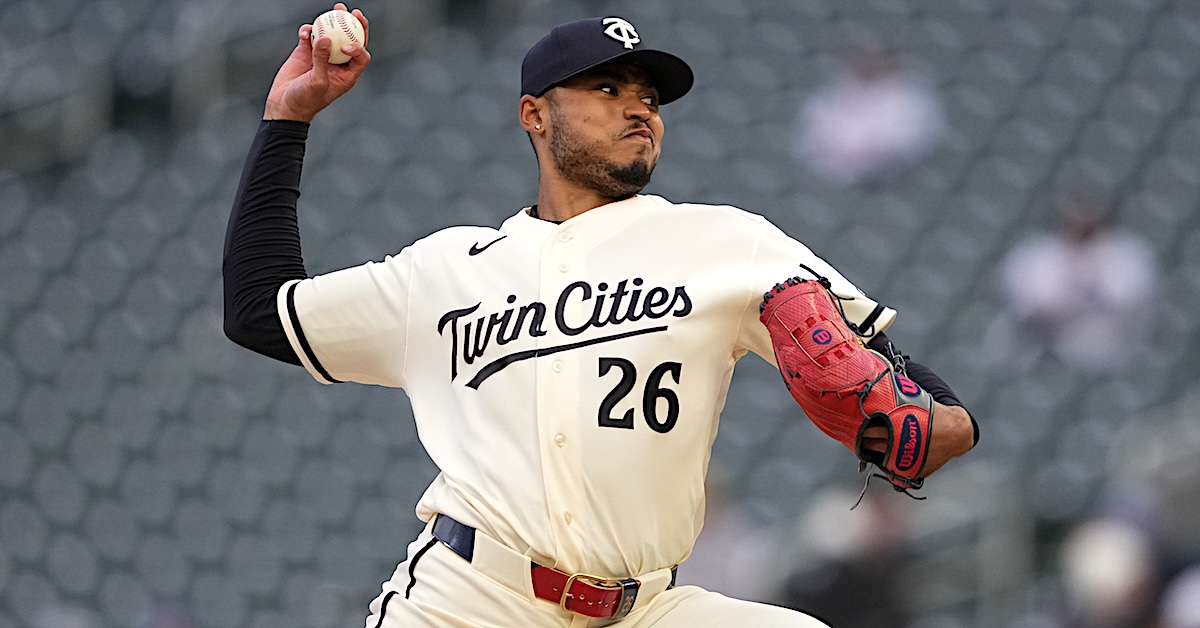
Entering the 2023 season, Taj Bradley was the no. 36 prospect in baseball, a 22-year-old ace who overmatched his opponents to such a degree that he forced himself to the majors for the back half of the year.
In 2025, Taj Bradley was traded straight up for Griffin Jax, a 31-year-old reliever who has accrued exactly zero wins above replacement for the Rays since that trade.
In 2026, Taj Bradley has been one of the best pitchers in the major leagues.
That’s some roller coaster. And while my first instinct is to take Bradley’s first four starts with a giant grain of salt, this isn’t your average “random dude has good stretch” story. Bradley truly is one of the most dynamic pitchers in the world. He’s electric on the mound. He wasn’t a 55-FV prospect by accident. So let’s take a look at what he’s changed, what he hasn’t changed, and whether this recent run of dominance looks like the portent of a new skill level or just a blip on the graph.
As a prospect, Bradley pounded the zone with a mid-90s fastball. He throws from a high arm angle and generates near-perfect backspin as a result. I think that evaluators were probably a bit too high on his fastball as a prospect, because I don’t think we had the same understanding of the importance of pitch plane then. Despite great velocity and movement, his pitch has never been a bat-missing force. He generates a league-average rate of swinging strikes with it; backspin all you want, but Bradley’s high release point means that his pitch doesn’t have the shallow approach angle to miss bats at the top of the zone.
In the minors, this wasn’t evident; Bradley’s velocity and command pretty much knocked the bat out of opposing hitters’ hands. But in the bigs, opposing hitters were up to the task. His fastball has been hit around throughout his major league career, with double-digit homers hit off it in each of his first three seasons. Many pitching prospects encounter that specific obstacle – these major leaguers sure can cover fastballs – but Bradley has been particularly susceptible to it.
A quick side note: Both PitchingBot and Stuff+ rate Bradley’s fastball highly. I was curious why, so I cracked open PitchingBot and shook it around until some insights dropped out. The model doesn’t give Bradley’s fastball high marks when it comes to missing bats; it has a below-average expected swinging strike rate, an accurate reflection of reality. However, it gives Bradley’s fastball high marks in two other fields: drawing called strikes and limiting contact quality. In particular, the model thinks his fastball should induce more popups and grounders, fewer line drives, and less hard contact than your average four-seamer. That hasn’t played out in practice, obviously, but I see where it’s coming from, and I’ll be watching to see if that starts happening in games.
In any case, Bradley’s fastball hasn’t changed much this year, so we’ll have to look elsewhere for changes. First stop: his other best pitch as a prospect, a cutter that he can run all around the strike zone or snap off as a chase pitch. Bradley made an excellent change to the pitch over the winter. He altered its shape significantly, losing ride and gaining glove-side break. He also took a mile an hour off of it, even while his fastball has sped up. That creates a larger movement differential – it separates from the fastball by three inches more than it did last year – and a pitch more suited for attacking the bottom of the strike zone. He’s drawing more chases, and batters are making less contact. Both PitchingBot and Stuff+ love this change, and I completely agree.
Bradley uses that cutter about 20% of the time. He also mixes in a low-90s splitter at the same rate, and the splitter is yet another pitch he’s changed meaningfully this year. This one is simpler. Last year, he had a hard time killing lift on the pitch. He generated 5.5 inches of induced vertical break, too much even for a hard splitter. For reference, Yoshinobu Yamamoto’s similar-speed offering gets about 1.5 inches of IVB. In 2026, Bradley’s splitter has lost nearly two inches of IVB, which means it separates more from the rest of his offerings, back to the shape he threw it with in 2024.
This version of his splitter is turning batters into pretzels despite inconsistent command. For example, this is not where you want to locate a splitter with two strikes:
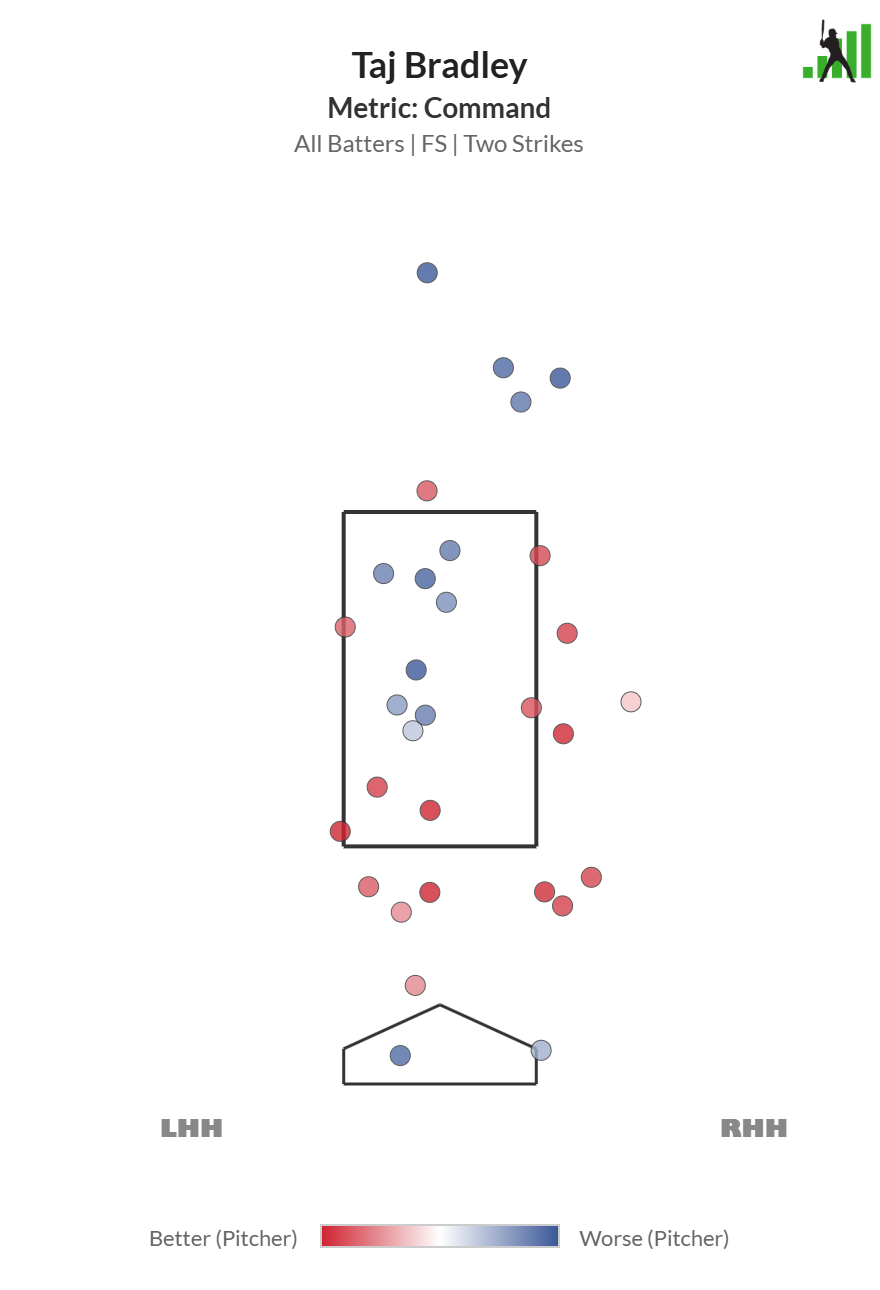
He threw 25% of those pitches in bad, mid-plate locations, hugely more than league average (10%). But that’s par for the course for Bradley; this is just how he throws his splitter. When he throws it below the zone, though, it vanishes:

And when he leaves it up, he gets his fair share of takes. The pitch below was overturned on review to a strikeout:

When opponents do put a splitter in play, it’s often on the ground. His 56.1% groundball rate on that pitch is the highest in his arsenal, and that informs how he uses it. All told, it’s been his best pitch this year – it’s been great at missing bats, great at drawing bad takes, and also great at inducing weak contact. You can’t really do it much better than that.
For the sake of completeness, I’ll also mention Bradley’s curveball. While everything else in his arsenal is hard – a fastball that touches triple digits, two secondaries that sit around 90 mph – his curve is slow and looping. He uses it frequently as an out pitch, and it helps the other out pitches play up; high cutters and splitters look very similar to low curveballs out of his hand. I’m not enamored with the pitch on its own, and he hasn’t made a ton of changes to it this year, but I do like the way it pairs with the rest of his arsenal.
These pitch modifications are mostly small changes around the edges, but they add up. When every single pitch gets a little sharper, it’s not just a linear effect. In isolation, a small improvement wouldn’t be a huge deal, but our pitching models agree that Bradley’s stuff has improved by roughly one standard deviation in the aggregate, the result of every pitch getting a bit better.
There’s a big mystery here, though. Bradley is missing more bats, no doubt. But he’s still not missing many! Out of 43 pitchers to throw 20 or more innings so far this year, Bradley’s 11.4% swinging strike rate is 22nd, dead average. His called strike rate is 30th. And yet he’s striking out 31.2% of opponents, ninth best out of that group. In other words, he’s running hot on the strikeout front compared to its component statistics.
There’s an easy counterpoint here, though. Bradley has always done this. To use a larger sample, I looked at his whole career. There have been 64 pitchers who’ve thrown 400 or more innings since the start of 2023, his first season. Bradley is 17th in strikeout rate, 25th in swinging strike rate, and 61st in called strike rate. In other words, he’s always done better than you’d expect merely from looking at how many bats he misses and how many hitters he freezes.
How is that possible? I think it has something to do with his north/south attack. He throws from a weird arm angle. His pitches don’t break the way most pitches of a similar type do; his curveball is pure 12/6, his cutter acts like a gyro slider, and his fastball has nearly no arm-side fade at all. The timing’s all messed up. Balls aren’t where opponents expect them to be. Bradley gets a lot of awkward swings, a lot of foul balls, a lot of at-bats where his opponents smack two crushable fastballs foul and then wave meekly at a diving cutter.
Is that going to keep resulting in a 1.25 ERA and 1.87 FIP? Of course not – but I assume you didn’t need me to tell you that. It’s so early in the season that ERA and FIP are still phenomenally noisy. Bradley hasn’t allowed a home run yet, for example, and that’s not going to be the case by season’s end. He has a 90% strand rate – league average is 72%. Luck is going to even out somewhat. I don’t think he’ll keep striking out as many batters as he has so far, even. But a slight regression from this version of Bradley would still leave the Twins with a very good pitcher.
The big takeaway here is that regression looks like it’s going to push Bradley to an ERA with a three handle, a massive improvement on his career mark to date (4.67). He’s not a completely different pitcher. He’s still, in large part, the same guy he was last year: high slot, fastball-first, secondaries that work the strike zone vertically. But when you turn everything up just a little bit – an inch of drop here, an inch of ride there, faster fastballs and slower cutters – the results follow. Bradley has always struck out more batters than you’d expect from his swinging and called strike rates – and now he’s getting more of both.
As an aside, this is a great example of why the whole “never trade with the Rays” thing is overblown. The Rays make a ton of trades. They win more than their fair share, because they’re very good at player evaluation. But talent level isn’t stationary, and no one knows the future. Sometimes players improve unexpectedly. Sometimes players get worse unexpectedly. Sometimes teams have different timeframes and different needs. The Rays needed relief pitching last season, and Bradley wasn’t in good form last summer. It doesn’t have to be more complicated than that.
The bottom line is this: I don’t think that Bradley has completely reinvented himself. He’s not suddenly the best pitcher in baseball. But he’s a great example of the long arc of pitcher development, and a good reminder that small changes can have a big impact. In a lot of ways, Bradley is the same guy he always was. But that guy was already pretty close to stardom. It certainly appears like dialing up all of his pitches by just a notch or two was enough to turn him from a league-average arm into an excellent starter.
Ben is a writer at FanGraphs. He can be found on Bluesky @benclemens.
THANK YOU FOR SAYING THIS
The whole don’t trade with the Rays thing hasn’t been true at least since the 2020-2021 offseason when they traded Blake Snell.
My theory about this is that people forget every trade the Rays didn’t win because it doesn’t fit into the schema they have about the Rays. It’s a lot easier to remember details of what happened when you have a heuristic to slot it into. And this goes double for huge volumes of information like “Rays trades”. Even if you throw out the minor ones that don’t really matter, I bet the Rays have made at least 40 trades with players whose names you would recognize starting with that 2020-2021 offseason.
I will say as a Twins fan, the Bradley-Jax trade in particular made me really wary because it was seemed so wildly out of character for the Rays. 2.5 years of a reliever for 4.5 years of a struggling but still young and talented starting pitcher? It just made me really wonder if they knew something about Bradley that the rest of us didn’t.
For every Junior Caminero for Tobias Myers, there’s giving up Joe Ryan for a rental of Nelson Cruz.
Some other trades they lost:
Manzardo for Civale
Paredes for the junk drawer
Caballero for Everson Periera for Steven Wilson
A bunch of other trades are either 40 man roster management or just fine. 6 seasons of Ryan Pepiot for one season of Glasnow is fine. Brody Hopkins for Randy Arozarena is fine. Joe Boyle and a pick for Jeffrey Springs is fine.
They’re an above average front office and they do a lot with limited payroll but I don’t think they’re smarter than everyone else.
I think I made a list of every trade they made at one point, but the Twins and Padres have done great trading with the Rays. They clearly have seen something in several guys that the Rays did not.
As a Twins fan, I’m very interested to see how Bradley continues his development and enjoyed reading this take. There are two other aspects of his performance that I’m curious about as well, unrelated to pitch quality.
The first was his eyebrow-raising comments about how he never really paid attention to scouting reports before last season’s trade. This is possibly impossible to quantify, but I do believe development is not just physical, so if he’s putting more work into understanding his opponents and how to attack them, that’s should lead to better results.
I’ve also seen some evidence that pitchers who work vertically may benefit more from the ABS challenge system and that breaking/offspeed pitches near the top of the zone could be a way to get more called strikes.
& while we never know what is going on with an organization, you wonder if TB KNEW he wasn’t paying attention to scouting reports & was “fed up” or thought he wasn’t serious about his craft so they got rid of him at least partially due to that.
& then maybe that served as a wake up call to Bradley.
Wouldn’t be the first time something like that happened. Guy got along on raw stuff all the way until he hit MLB & never needed to look at scouting reports until he faced MLB hitters.
All I know is he has serious talent- I watched that game vs Detroit & his dominance sure didn’t appear flukey to me.
It’s also possible that they were never presented in a way that made sense to him. Sometimes a different voice helps.
I didn’t see Bradley’s comment, but I have heard other pitchers say that they prefer that the catcher handle the scouting report so they can focus on preparing physically and teams have been ok with that.
Isn’t this missing the quote that he decided to give a shit about scouting reports post trade, but was ignoring them with the Rays? Seems like a notable input.
I’m just hoping he’s a legit number two or so. That would be great. How does one make small changes in outcomes like this? Is his stride, release, other, different?
Bradley has induced the least soft contact of any qualified starter in the major leagues (5.6%) and is running a career worst ground ball rate (35.2%), yet has somehow managed to avoid allowing a home run. Given that he isn’t missing bats at a higher frequency either, he hasn’t become an excellent starter so much as the luckiest one in the league. His ERA for the rest of the season is much more likely to start with a 4 than a 3.
I don’t know about “much more likely”. His ZiPS ROS forecast is a 3.84 FIP.
Bradley’s average exit velocity allowed is 94.3 mph, the worst of any qualified starter by far. Zac Gallen and Davis Martin are tied for second worst at 93.1 mph.
If he were missing bats at a higher frequency and/or keeping more balls on the ground then those would be possible indicators of a genuine breakout, but neither has occurred.
ZIPS knows about those factors (I think). He doesn’t need to “break out” to have an ERA under 4. If you wanted to say it’s as likely that his ERA will be over 4 as under, I wouldn’t quibble. “The Twins might have a new ace” is certainly hyperbolic at this point.
Bradley’s career ERA is 4.67 and his career FIP is 4.24. As noted, nothing in his metrics other than his velocity has actually improved. Several of his metrics have gotten worse. I’m not seeing anything to support a much better ERA or FIP for the remainder of the season than what he has done in the past.
That is part of it, but his xFIP and xERA both converge on a mid 3 estimate.
I think some of what has happened has to be “luck” in the traditional sense like you say, but I think that the other part of it is a different type of “luck”: The two games where gave up a ton of fly balls were in stadiums that suppress homers. Because of that I would keep an eye on the stadium splits. In MN (or DET, or KC) it’s not nearly as big a deal as at Rate Field (CHW) or whatever CLE’s stadium is now.
He’s been the worst starter in the league at inducing soft contact, is one of the worst in the league at inducing ground balls, and is one of the worst in the league at allowing the ball to be pulled. I think the models are looking at the elevated strike out rate and assuming that he is missing more bats when his contact and swinging strike rates are showing that is not the case.
The other thing about the Detroit game in Minnesota- It was very cold, like upper 30’s.
Definitely a game where the weather suppressed flyball distance. What happens when the weather is 80?
I was still impressed by him, but, am now wondering if some of it isn’t at least a little flukey.
There is definitely some luck going on here, and there will be home run regression for sure. But the xFIP is 3.28, the SIERA is 3.06, and the xERA based on xwOBA allowed is 3.32, all more than solid, so he’s definitely doing something right.
His wOBA allowed is 0.279, his xwOBA allowed is 0.292; his slugging allowed is 0.277, his xSLG allowed is 0.324. The exit velo allowed is a red flag, but he has a very high average launch angle allowed (17.9), and hasn’t given up many barrels. He might be giving up hard contact, but Statcast doesn’t seem to think it’s particularly dangerous contact. Whether that is sustainable, well, I guess we’ll find out.
His BABIP allowed sits at 0.352, 13th worst in the league right now among qualifiers, and a figure that would have been dead last among qualified pitchers last year. That should come down, particularly for a flyball-oriented guy.
As Ben mentioned, Bradley is middle of the pack in both swinging strikes and called strikes, but even in the past he’s managed to have good K rates even with that in mind, so I’m more inclined to believe that’s somewhat sustainable. He probably won’t stay >30% K rate, but high 20s is definitely possible.
I’m not sure if I buy the early season ERA estimators that he’s a low 3 ERA guy now, but I could definitely buy that he’s a mid to high 3 ERA guy.
Those models all assume that his 31.2% strikeout rate is legitimate when the underlying metrics show that it isn’t. His 2026 swinging strike rate is identical to his career mark, and his Location+ performance has actually been worse than his career mark. His Contact% and Z-Contact% are also slightly worse than his career marks.
Yes, and that is a bad thing. The closest qualified starter to him is teammate Simeon Woods Richardson (18.2), who has been getting shelled.
His BABIP is high because has allowed more hard contact than any other starting pitcher in baseball, and because he has allowed the thirteenth highest line drive percentage.
Truth be told, I was a bit confused by the line drive rate myself when seeing how good the xstats are. I agree with you that the hard contact and line drive rate are not generally good signs, but that should be reflected in subpar Statcast expected stats, which it isn’t. I think we would have to dig deeper and actually look at the batted ball events themselves to parse this out. Part of it is the high K rate to start the year, I agree on that, but Bradley is middle of the pack among qualifiers by xwOBAcon, which strips out the effects of Ks and BBs and only looks at batted balls, so he’s not getting shelled despite the league-worst avg EV. There is something about Bradley’s batted balls allowed that’s driving this performance.
I agree with you that I don’t think it’s in the cards to maintain a > 30% K rate, as I stated above. But I don’t think he needs to in order to be successful. Bradley ran a 28.0% K rate in 2023 on a 26.0% CSW rate in 100+ innings, and he ran a 26.6% K rate in 2024 on a 26.6% CSW rate in 100+ innings (2025 is the anomaly here where everything was down across the board). He’s currently running a 27.0% CSW rate, so I see no reason why he can’t run a high 20s K rate, he has done it before.
On the launch angle, I wouldn’t agree with your general statement that this is blanket portending bad future performance. You can succeed with higher average launch angle while allowing higher hard-hit rates, as guys like Nick Pivetta and Robbie Ray did last year. But those guys were probably true talent high 3 ERA pitchers last year, not studs. That’s where I think Bradley probably is right now. He’s had home run and strand luck leading to the absurdly low ERA and FIP, and he’s on a K hot streak leading to some of the low 3 peripherals. But even if the Ks regress a bit, he can still be pretty good with this profile.
A great feature of Fangraphs is the Game Log. It covers all seasons. From it, I learned that at the start of the 2024 season, Bradley had a 14-game stretch in which nearly everything went right. ERA: 2.41. FIP: 3.41, xERA 3.47. And then the wheels fell off. The remaining 11 games of the season: ERA: 6.51, FIP: 5.07. xERA: 5.14. So far, in Minnesota, the opposite has occurred. A 6+ ERA in 6 starts in 2025 and a 1.25 ERA in 4 starts in 2026. Let’s see if he has actually changed from the 4.2ish xERA pitcher who often has the one bad inning during the game.
This article is a tour de force. Perfectly done analysis that is fun to read; I really enjoyed it.
Funny how Andrew Friedman’s no longer being with the Rays has coincided with their not having as good of a reputation for sharp trades,
Also, excellent analysis Of Taj by Ben.
Yes, but also: Trea Turner.