
It’s April 16. Time to Take a Victory Lap on the Brandon Lowe Trade.
Three weeks into the 2026 season, I find myself looking around the league and being astonished by how right I was about everything I thought was going to happen. I’m already on the board in the Effectively Wild predictions game with Artemis II taking off before the first 117-mph batted ball, and my off-the-wall prediction that Mickey Moniak would lead all no. 1 picks in home runs is somehow on track. This despite Moniak starting the season on the IL.
If I’m going to get all my victory laps in this season, I’d better start now, beginning with Brandon Lowe being a great pickup for the Pirates.
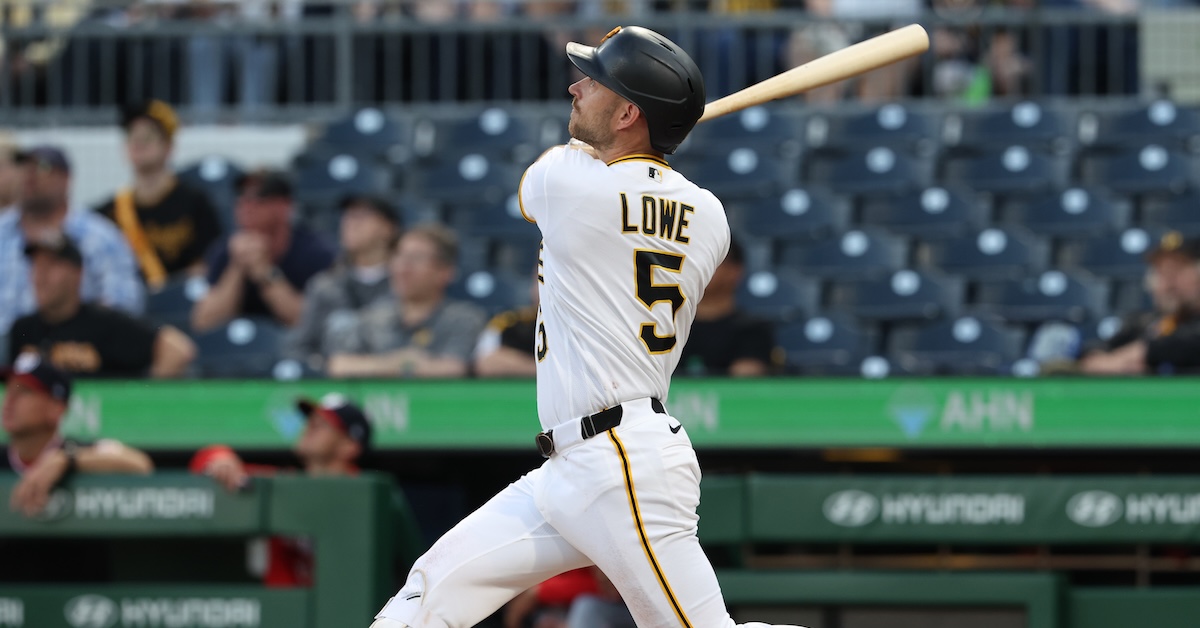
Lowe wasted no time endearing himself to the Yinzer crowd, as he went deep twice on Opening Day. Lowe’s total of dingers has since swollen to seven. That’s good for second in the league behind Jordan Walker, which tells you how early in the season it is. But Aaron Judge, Yordan Alvarez, and Sal Stewart (speaking of guys who started hot) are also part of that second-place tie. It still takes a certain quality of hitter to go deep so many times so early in the year.
I always thought Lowe was an inspired get for the Pirates, especially since they paid so little to acquire him. It was a three-team deal with the Rays and Astros, which brought Lowe, Jake Mangum, and Mason Montgomery to Pittsburgh from Tampa Bay, with Mike Burrows going to Houston. I don’t want to spend too much relitigating this trade, but Lowe’s gotten off to a hot start as Pittsburgh’s starting second baseman.
Montgomery has been used as a high-leverage reliever, where he currently has a 42.5% strikeout rate and a 5.40 ERA, so maybe we should let those marbles settle for a minute before passing judgment. Mangum is a weird player (I wrote about why last year) who was way better than I expected as a rookie; he’ll never hit for power, but he’s probably fine as a fourth outfielder and pinch-runner. That’s not a bad haul for a starer the Pirates weren’t going to use anyway.
I’ve been a big fan of Lowe’s since his days at the University of Maryland, where he shared an infield with LaMonte Wade Jr. and future big league reliever Jose Cuas, but I’ll be the first to admit he’s a limited player. He strikes out a lot; 27.1% for his career, and 26.9% in 2025. When the Rays traded Lowe, he’d played enough to qualify for the batting title just once in four years, and his walk rate had been on the decline two years running.
Lowe is not a very good defensive second baseman, and that criticism has gone from a nag to a blaring alarm as he’s hit his 30s. And despite terrific power numbers, he’s merely an OK on-base guy (.314 OBP from 2022 through 2025) who doesn’t actually hit the ball especially hard.
All that said, the real reason the Rays got rid of him for cheap was his $11.5 million salary. (Say what you will about Lowe’s limitations, he’s at least as good as Gavin Lux and better than Richie Palacios and Taylor Walls.) That’s a lot for Tampa Bay, and it would’ve been a lot for the Pirates under normal circumstances, but for an up-the-middle guy who would probably hit 20 to 30 home runs and post about 2 WAR in a full season, that’s not much at all. The fact that the Pirates — usually the sport’s most miserly franchise — would make such a move was profoundly encouraging.
Because the Pirates have already completed the two hardest steps toward building a contender: They have the best pitcher in the National League in Paul Skenes, and by all appearances, they have a superstar shortstop in the making in Konnor Griffin. But they sucked at a bunch of different positions, including second base.
Actually, second base itself was pretty bad last year; only first base and DH produced fewer total WAR league-wide than second base. Second basemen also tied with center field for the lowest league-wide wRC+ by defensive position. (The weakest offensive position is supposed to be catcher, but I’m assuming Cal Raleigh screwed up the curve by himself.)
Even by that low bar, the Pirates’ second basemen failed to cover themselves in glory in 2025: 1.3 WAR (20th out of 30 teams) and a wRC+ of 80 (23rd out of 30). Lowe beats those figures in his sleep. If he strikes out a lot, you live with it. If he’s a terrible defender at second, well, you’ve got Ryan O’Hearn in the outfield—Lowe is the least of your worries.
As much as I loved this trade for Pittsburgh, I did not foresee that after 16 games, Lowe would be hitting .250/.375/.633. His 1.0 WAR is three tenths of a win from what all Pirates second basemen produced on the aggregate last year. His .383 ISO wouldn’t just be a career high for him, it would be a career high for Judge.
Lowe is currently running a .211 BABIP; he’s a fly ball hitter, traditionally, and therefore not a big BABIP guy. Even so, that figure would usually portend better batted ball luck down the line. Statcast data, as you might expect, shows the opposite. Lowe is currently outstripping his xSLG by more than 160 points, and his EV90 of 103.5 mph is merely 127th out of 189 qualified hitters at the moment. His bat speed is also down from previous years, which I mention not to ring alarm bells but merely to point out that he hasn’t unlocked some hitherto undiscovered fast-twitch ability.
Lowe does two things really, really well. First: He kills fastballs. Last year, he hit .278 and slugged .564 off four-seamers; he was one spot above James Wood on the leaderboard for wOBA on four-seamers, and 13th in the whole league in run value created.
Lowe has seen 73 four-seamers in 2026. He swung at 28 of those and put seven of them in play, including three that landed in the seats. Lowe has seen 42 fastballs of all kinds in Statcast’s heart zone. He’s slugging 1.133 on those pitches, 15th out of 336 batters who have seen 50 or more fastballs so far this season. Here’s one:
Look, you can’t throw 92 middle-middle to any decent hitter in this league, but Lowe is better at dispatching those than most. That’s thanks to his second special ability: Over Lowe’s career, 23.1% of his batted balls have been pulled and in the air; the league average over that time is 16.7%. This is where damage gets done. Pull-side line drives turn into doubles and triples, pull-side fly balls turn into home runs.
Statcast’s expected stats (e.g. xSLG) take into account launch angle and exit velo but not batted ball direction. Over a big enough sample, that evens out, but the fact that Lowe’s in-air pull rate is 26.7% right now gives us some insight into how he’s hit seven home runs in three weeks with lackluster exit velo numbers.
All seven of Lowe’s home runs this season have come to the pull side, as did 19 of his 31 dingers last year and 111 of his 164 career major league home runs. PNC Park is a good spot for him then; it’s only 320 feet out to the right field foul pole, which is the fifth-shortest right field porch in the league.
The venue’s famous 21-foot right field fence might cost Lowe the odd wallscraper, but what we’re looking at here is basically a mirror image of the Crawford Boxes in Daikin Park in Houston; it’s 315 feet out to left field there, with a 19-foot wall. You know who plays there: Mr. In-Air Pull Rate himself, Isaac Paredes. Last year, Paredes had a 14th-percentile hard-hit rate, and his EV90 was 224th out of 277 batters with 300 or more plate appearances. This is not a guy with a ton of pop.
Nevertheless, Paredes hit 20 home runs in 438 plate appearances. Half of those 20 home runs came at home and to the pull side. I don’t think Lowe is going to rip off 45 wallscrapers, buoyed by the proximity of the right field wall. But he won’t have to in order to be an asset to a Pirates team that needs all the pop it can get, whatever form it takes.
Michael is a writer at FanGraphs. Previously, he was a staff writer at The Ringer and D1Baseball, and his work has appeared at Grantland, Baseball Prospectus, The Atlantic, ESPN.com, and various ill-remembered Phillies blogs. Follow him on Twitter, if you must, @MichaelBaumann.
I’ve always been a fan of BLowe (not to be confused with JLowe or NLowe, both of whom I also kind of like). I can see him getting 30 HRs again this year in PIT — a .240/.320/.520 kind of line that actually is very valuable in a low run-scoring environment.