
The Incomparable Adam Wainwright
I’ll forgive you if you thought Adam Wainwright was cooked in 2018. He landed on the IL after three middling starts (12 strikeouts in 15.2 innings, a 3.45 ERA and 5.20 FIP), made a single short start in May, then didn’t pitch again until September. His sinker had never been slower; his curveball had never had less bite. At 37, that’s a scary combination, and it hadn’t come out of nowhere; he posted an ERA of 5.11 in his previous season, along with career-worst marks in K%, BB%, and FIP.
Three years later, Wainwright is a down-ballot Cy Young candidate. He’s accrued as much WAR as the next five Cardinals starters combined. St. Louis probably won’t make the playoffs, but it won’t be because of the once and current ace, a timeless wonder having his best season since before tearing his Achilles in 2015. How has he done it? I’m glad you asked.
Major leaguers are so good these days, on both the pitching and hitting side. Batters have never hit the ball harder on contact or tried so hard to hit home runs. It’s scary out there for a pitcher; any contact could leave the park at the drop of a hat. Pitchers have compensated in the obvious way: throwing pitches that avoid contact. Swinging-strike rate and strikeout rate are both marching inexorably higher, with occasional step changes (the sticky stuff crackdown, for example) fighting the tide.
Wainwright doesn’t have that option, though. If you asked him candidly, I’m sure he’d love to throw 95 mph and snap off sliders that turn into Pitching Ninja GIFs. But that was never his game, and he wasn’t going to suddenly turn into that kind of pitcher at age 39. In fact, when Wainwright began to decline, that was the common diagnosis. An aging sinker-first pitcher in the age of four-seamers? Sounds like a recipe for failure.
That’s all true! Wainwright’s sinker virtually never induces an empty swing. That’s not even a new thing; he’s only had one year in his entire career with a swinging-strike rate above 5% on the pitch. He’s only had a whiff rate higher than 10% in two of his 14 seasons. When batters take a cut, they mostly hit the ball.
In a vacuum, that’s a pretty bad pitch. Luckily, pitching doesn’t happen in a vacuum. For one thing, everyone would suffocate. Even in a metaphorical vacuum, context matters. For example, take a look at league-wide swing rates on sinkers by count:
| Count | O-Swing% | Z-Swing% | Heart Swing% |
|---|---|---|---|
| 0-0 | 14.4% | 41.9% | 47.9% |
| 0-1 | 28.7% | 71.3% | 78.5% |
| 0-2 | 29.9% | 78.5% | 87.5% |
| 1-0 | 22.4% | 58.8% | 67.1% |
| 1-1 | 28.1% | 73.0% | 81.8% |
| 1-2 | 31.5% | 81.7% | 90.2% |
| 2-0 | 19.7% | 59.2% | 66.2% |
| 2-1 | 30.3% | 76.8% | 84.9% |
| 2-2 | 36.1% | 83.7% | 90.2% |
| 3-0 | 4.0% | 15.0% | 16.8% |
| 3-1 | 26.6% | 72.6% | 80.3% |
| 3-2 | 41.4% | 89.2% | 94.8% |
That’s a big pile of data, but you can think of it this way: in zero-strike counts, batters are passive. In every other count, they’re extremely aggressive in the strike zone, even more so over the heart of the plate. Even in a 3–1 count, batters swing nearly three-quarters of the time at sinkers thrown for strikes. There’s no sitting and waiting here; batters know that two-strike counts are bad for their health and that fastballs are good to hit. Throw them a bone, and they won’t pass at the chance.
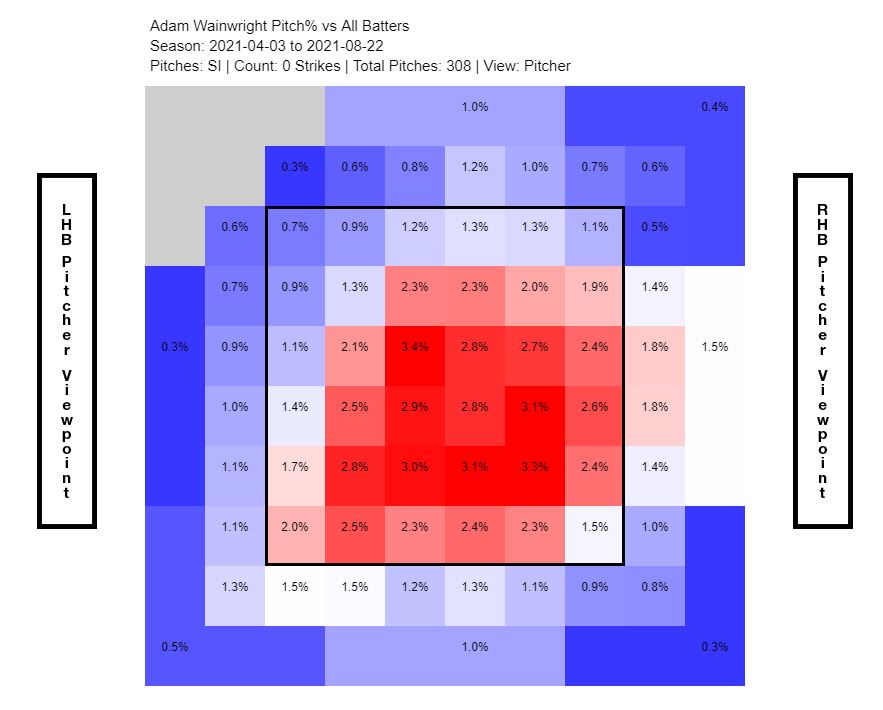
With no strikes, Wainwright doesn’t mess around:
With one strike, he turns into a surgeon. Seriously, it’s hard to overstate how impressive this location chart is:
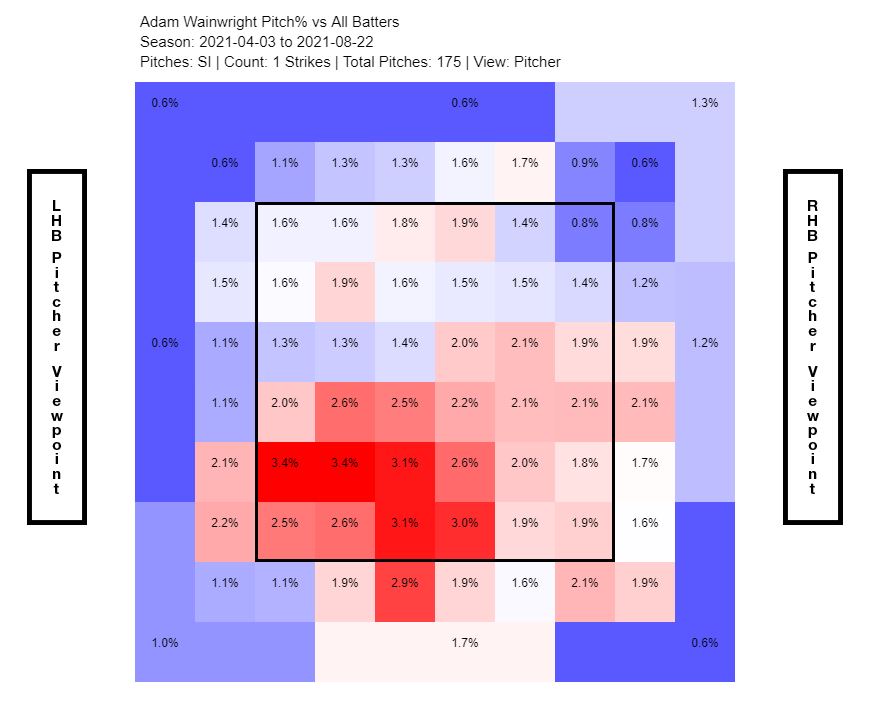
He simply doesn’t give in. If you want to swing at a sinker — and again, batters do — you’re going to be swinging at a miserable one, on the knees and at the corner of the zone. He’s not quite as clean with two strikes, but honestly, it would be hard to be that good:
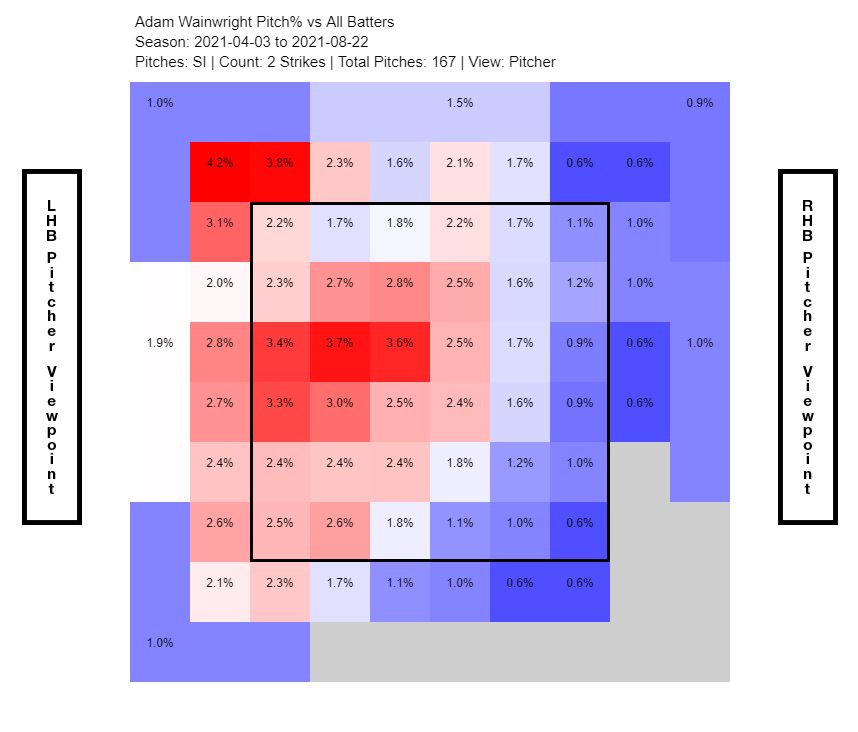
Still, the net degree of difficulty is outrageous, and that location is still excellent. Wainwright is in the top 25% of the league when it comes to avoiding the heart of the strike zone with his sinker (in one- and two-strike counts). He’s also in the top 25% of the league when it comes to hitting the shadows of the zone — the area just inside or just outside of the strike zone boundary. In other words, he’s great at getting the ball over the plate, but not all the way over the plate.
That’s key, because even if you give up contact, where you give up contact matters. When batters put sinkers over the heart of the zone in play, they produce a wOBA of roughly .400. That’s roughly what Juan Soto and Joey Votto are producing on the year as a whole. That’s not a place you want to live. Give up contact in the shadow zone, and things aren’t so bad. Those batted balls have produced a .320 wOBA, which is roughly league average production. Contact is supposed to be the dangerous thing; overall average production includes strikeouts and walks. If that’s the downside when batters make contact, you’re doing well.
That’s not enough to explain all of Wainwright’s sinker-based mastery this year; even when you locate it perfectly, batters can still go out and get it. As we already covered, they’re really good these days. But batters have underperformed their expected production when they put a Wainwright sinker into play. Why? Well, it helps to have Harrison Bader patrolling the outfield:
It also helps to have Nolan Arenado patrolling the infield:
In fact, Wainwright is first in all of baseball when it comes to outs saved by the defense behind him. He gives them plenty of chances by limiting walks, strikeouts, and home runs, and the Cardinals have rewarded him with a whopping 18 outs above average.
That’s no slight on Wainwright, though. This Cardinals team is built to convert balls in play into outs. Their everyday lineup sports seven plus defenders at the eight available spots, with Dylan Carlson the lone minus. But even Carlson has excelled with Wainwright on the mound; right field has been worth two outs above average this year behind the Cards’ old ace — more than Arenado’s third base spot has added, per Statcast.
So far, I’ve focused on Wainwright’s remarkable ability to throw in and around the zone without giving up layups (or open corner threes, depending on which basketball analogy you prefer). That helps him limit walks; his 6% walk rate is stellar, particularly for a pitcher without the stuff to throw it down main street and challenge hitters to catch up.
That’s only half the picture. That sinker, valuable as it’s been at stealing strikes early and dotting corners late, isn’t striking anyone out. Well, it isn’t striking anyone out swinging at least. He’s generated 32 called strike threes with the pitch this year, the third-best mark for any sinker. Watch this nonsense and marvel:
That’s legitimately perfect. When you’re throwing fastballs in the 80s against borderline MVP candidates, there’s no margin for error. An inch further inside, and it would have been ball two; an inch over the plate, and Reynolds likely would have swung. That pitch — a front-door strike that starts over the hips to lefties and a back-door robbery to righties — has served Wainwright well all year, as has some judicious receiving by Cardinals catchers (largely Yadier Molina):
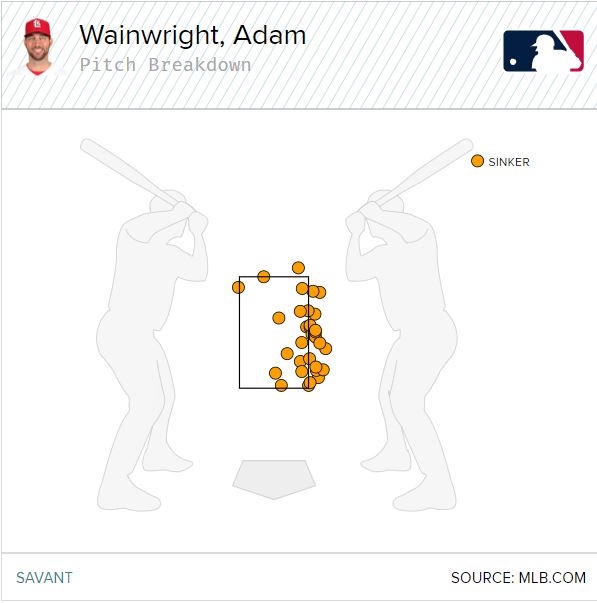
That’s the location of all of his called strikeouts on sinkers, and if you’re a batter, there aren’t many good options. It’s hard to put a good swing on a ball there, but taking it obviously didn’t work out either.
Still, you can’t strike everyone out with the bat on their shoulders, which means curveballs. That’s been his best pitch throughout his major league career, and this year is no different. It’s a giant, two-planed curve, one of the fastest-spinning pitches in the majors despite mid-70s velocity. The combination of slow speed and hellacious break means that the pitch drops a preposterous 66 inches from its initial trajectory on its way home. This one to Ke’Bryan Hayes started out at eye level:
On the other hand, this one to Bryce Harper went from mashable fastball to “hey where’d it go?” in a hurry:
Not everyone can throw a curve with so much bite. Even fewer know how to use it, and Wainwright is a master of the craft. Those big silly hooks that go from hittable to bouncing are fun, but look where the run value has come from this year:
| Zone | Run Value |
|---|---|
| Heart | -10.7 |
| Shadow | -3.6 |
| Chase | 1.2 |
| Waste | 3.2 |
The shadow and chase numbers are misleading, because you can live with some balls (positive run value for the batter, of course) if you get the occasional strikeout. But the majority of the value comes from throwing a slow pitch right down the middle. It’s wild!
Roughly half of that comes on called strikes. Only Julio Urías has thrown more curveballs for a called strike to open at-bats. Wainwright has 87 on the year, 44 of which have been middle-middle. It’s so hard to pull the trigger on those, even if you know they’re coming; batters have swung only 33% of the time. Even when they swing, Wainwright seems to win; he’s allowed only two hits on these grooved 0–0 curveballs all year, though one was a homer. He’ll throw a curve for a strike in any count, but he’s most prolific to start at-bats.
If batters do swing at these heart-zone curves, they mostly make contact. It’s hard to miss bats with a curveball that you send right down the pipe. Batters have come up empty on only 14% of their swings at center-cut curveballs this year. That’s a roughly average rate. But making contact isn’t the same as making solid contact. In fact, when batters manage to put these center-cut breaking balls into play, they don’t do all that well, hitting .250 with a .486 slugging percentage on fair contact, good for a .305 wOBA (.339 xwOBA). That compares to a league-wide number that hardly looks like the same pitch type: a .344 batting average and .622 slugging percentage, good for a .401 wOBA (.393 xwOBA).
How can Wainwright get away with it? He’s probably getting a little lucky. More relevantly, batters pretty much never face anything comparable to the slow hook. The list of players whose curveballs get more total movement isn’t a list: it’s just Rich Hill (Paolo Espino is in the neighborhood, to be fair). It will hardly surprise you to learn that Hill, too, fares well even when batters hit curves he throws over the heart of the plate. The massive two-plane break is simply hard to square up.
Wainwright throws three other pitches: a four-seam fastball with solid ride, a mid-80s cutter he uses to mix up his fastball looks, and a changeup he sprinkles in against lefties. Those help keep hitters off the curve and sinker, but the two pitches that he’s always thrown best have done the heavy lifting this year.
That miserable 2018 season that opened this story might have provided the catalyst that brought Wainwright to his current form. He might not have pitched very often, and he might not have pitched very well when he was available, but he came out slinging curves early and often. He threw 30% or more curves in seven of his eight starts after never throwing 30% curves in a year before 2018. Heck, he almost never threw 30% curves in a single start before 2018, much less a full year. Only 20% of his previous starts had been so curve-heavy. Since the start of 2018, 85% of his starts have been at least 30% curves, and more than a quarter have featured 40% breaking balls. It’s an admirable move: when his fastball wasn’t cutting it, he simply started jamming his best pitch more often.
Can his superlative form continue? Time is still undefeated, so it can’t go on forever. He’s gotten help from his defense — partially by design, but still. He’s hitting his spots perfectly; just a little worse, or even just a little slower, and the magic might stop working. There’s no reason to think it’s happening this year, but eventually, nothing keeps going.
Instead of thinking about the future, though, think about the difficulty of the present. Every single time that Wainwright faces a batter, he has to beat someone with better physical tools. If he misses his spot, he’s throwing a low-velocity fastball into the nitro zone. If he overcooks a curveball and hangs one, same deal.
And he keeps doing it! Batter after batter, he walks a tightrope successfully. He keeps the ball in play. He lets the defense help him. But plenty of the time, it’s just him out there, his curveball against the batter. Every single pitch is a chance to fail, and Wainwright just keeps… not failing. It’s a singular accomplishment, and as the game changes more and more around him, it’s an absolute joy to see him keep succeeding.
Ben is a writer at FanGraphs. He can be found on Bluesky @benclemens.
Bravo Mr. Wainwright
In an era that’s defined by 100mph fastballs up in the zone and 90+ mph sliders, it’s awesome to see an old dude shoving with an upper 80s sinker and a big Uncle Charlie. Great stuff.
Another great article, Ben. The older SP who survive without velocity provide master classes for the youngsters. Coaches can’t teach command and sequence as well as a veteran can demonstrate it.
Pitchers like Wainwright, Kershaw and Greinke are so fun to watch because their style is downright elegant.
I posted a Waino topic a few days ago on the Cardinals subreddit, focusing on the emergence of his sinker. He is using it exactly as often as he has in the past, but the results are loads better:
2014: .305 BA/.492 SLG, .376 wOBA
2015: (barely pitched)
2016: .381 BA/.614 SLG, .428 wOBA
2017: .273 BA/.433 SLG, .327 wOBA
2018: .319 BA/.511 SLG, .387 wOBA
2019: .333 BA/.535 SLG, .397 wOBA
2020: .200 BA/.415 SLG, .326 wOBA
2021: .177 BA/.234 SLG, .235 wOBA
As you say, he isn’t getting whiffs from the sinker, so it’s all about location and utilizing that elite defense behind him. He’s also getting a boatload of called strikes. For reference, Baseball Savant ranks Waino’s sinker in the top-30 of all pitches in MLB this season. His swing-and-miss percentage of around 9% with the sinker is the only single-digit percentage anywhere near the top of the list. You have to drop all of the way to Martin Perez’s sinker, which is ranked as the 167th-best pitch in MLB, to find another single-digit percentage.
I noticed the spin rate on Wainwright’s sinker is about 60-70 RPM higher than his average rates over the last six years or so, so that might be a factor, as well.
Great post Ben. This led me down a bit of a rabbit hole where I found that Cardinals pitchers this season have the worst BB-rate, worst K-rate AND most HBP of any pitching staff in the majors. It’s honestly incredible that the team is even above .500 when the pitching has been so thoroughly awful. You can’t fix everything at once, and considering the team plays in a pitcher’s park and has an elite defense (3rd best in the majors this year) it might make sense to just accept the putrid K-rate and go out and find pitchers who can limit walks. It flies in the face of modern baseball analysis but “pitching to contact” might work for the Cards.
‘The Right Way’…
I agree that “pitching to contact” might work for the Cardinals. It didn’t work for Cabrera last night. He inherited 2 baserunners and a 4 run lead. He threw 13 pitches and gave up six hits, the last a home run. He left with a 4 run deficit.
Has any pitcher ever allowed 8 runs to score on 13 pitches???
The Cardinals pitching does have one success story. They lead the National League in HR/9. They don’t give up many HRs.
That’s basically what Mozeliak did in-season: dropped non-strike-throwers like Gant, Martinez (injured), Oviedo, Poncedeleon, Webb, Woodford, etc.
And he added a bunch of old dudes who just throw slow strikes on the corners: Happ, Leblanc, Lester, McFarland, Garcia, Miller. Even guys who are already there — Kim, Mikolas — already fit that profile.
It’s been incredible to watch Waino come back and have such an incredible season at 39/40. Hopefully he comes back next year, and has a full healthy season. With one more full season of starts in the rotation, and a full season from Molina, the Yadi/Waino battery could set the record for most career starts together. It’s astounding to think of that happening in the modern age- two guys good enough to have a 20 year career, who both are one team lifers, who both came up at the same time, and were durable year in year out. That’d be a hell of a record to go out on.
Listening to the post game of a Pirates/Cards game on the way home from watching Wainwright blank the Buccos (and double his hit total for the year, with a ground rule double to boot). The Pirates crew was saying that if both he and Yadi came back next year, they would be the first battery both 40 or older ever. Not sure if that’s true, but with Yadi coming back next year I hope Wainwright doesn’t hang it up.
Your instinct that the Pirates’ crew may have been wrong about age 40+ batteries is correct – http://www.highheatstats.com/2012/03/the-graying-of-batteries/
Actually, I think it’s easier than it used to be now that pitchers are no longer as likely to retire early due to blowing out their arms, but it would still be an impressive record.
That’s true, but I feel like increased player movement makes it less likely. Not a ton of one team guys anymore. Right now among starting pitchers, who else is there that’s over 32 or so and a one team guy? Kershaw comes to mind, but I’m struggling to think of anyone else.
There is also the pressure on catchers to sit more, which balances out some of the pitching stuff too. now so many catchers only play 100 or 120 games. It’d be a lot harder to have the same catcher catch all of a given pitchers starts. The Cardinals have prioritized that with Yadi/Waino, resting Yadi to make sure he can catch all of Waino’s starts (when he’s not hurt)
“He’s accrued as much WAR as the next five Cardinals starters combined” is pretty good, but not nearly as good as it sounds.
The only less impressive #2-#5 slots to compare it to are the Rangers and Pirates. Dane Dunning also has more fWAR as the next five Rangers starters combined. But that’s because Kyle Gibson is 1 behind him, and then every other starter has 0 or negative fWAR. Meanwhile, Tyler Anderson has more fWAR than the next three starters on the Pirates. That makes him sound better than Dane Dunning and Adam Wainwright, but he’s not. Tyler Anderson had 1.3 fWAR for them.
And Anderson also now pitches for the Mariners.
I didn’t think it sounded good or impressive. More damning about the rest of the team. If he’d been putting up an 8 WAR season, then sure.
This was the Cards year, it seems. They got a Cy Young level season from a 39 year old coming off what seemed like a career cliff. They found a closer, and a damn good one. They got normal years from their two position player superstars, both now in their 30’s so not many of those left. Yadi was Yadi and stayed healthy. Some of their younger guys showed up too, including Tyler O’Neill who came out of nowhere. They played the second easiest schedule in baseball (only second because the first, Milwaukee, got to play St Louis while the Cards had to play the Brewers). And yet … they’re a .500 team. I don’t like where this franchise is heading, not one bit.
That’s one way of looking at it. Another would be that their entire starting rotation sans Waino has missed most of the year with injuries (Flaherty, Martinez, Hudson, Mikolas, Kim) while the depth guys were all uniformly awful (Gant, Ponce de Leon, Woodford, Oviedo). “Weak pitching depth” would have been a fair criticism before the season started, but even so I don’t think many would have foreseen the rotation imploding to the degree that it did.
Yeah pitching injuries hurt a lot, obviously. Maybe it’s just me, but I didn’t like their rotation anyway going into the season, and it’s not getting better unless Liberatore shows up in a big way. Waino’s obviously on his last legs. Martinez is awful in general. Hudson is up and down and Mikolas is injury prone (and 33). Kim was actually great this season when healthy, and got in 20 starts so far. This was pretty predictable, to be honest.
Check your facts. Waino is obviously NOT on his last legs (unless he decides to call it quits himself), Martinez was only bad last year and this year and is gone after this season anyway, Hudson has always been good before needing TJS and will be fully healthy by Opening Day, Mikolas isn’t that injury prone, and Reyes will be moving into the rotation next year.
It’s shocking that this team is even over .500. They’ve given 26 starts to below replacement-level pitchers. And that doesn’t include the 19 given to other guys barely over replacement-level. Their starters have 6 WAR combined. They’ve broken the MLB record for most walks with the bases loaded, and will likely break the record for most hit batters too. The bullpen has been under constraint strain and has been pretty awful for long stretches.
The injury rate is astounding. They’ve used 30 different pitchers this season. 12 different guys have started games for them, and none of them have been openers/bullpen games (at least not intentionally). Only one guy on the entire staff has thrown 100 IP.
PLUS their offense is below-average. The fact that they’re over .500 despite all of that is actually pretty encouraging.
To be fair, they’ve done an impressive job picking up quality guys off the scrap heap either through the waiver wire or under the radar trades. Of those guys, only Justin Miller has been a clear miss, while the jury is still out on Lester.
Those starting pitching numbers are also misleading, since they’ve gotten excellent work from Flaherty, Kim, and LeBlanc when they’ve been healthy, as well as Happ since they traded for him, while C-Mart actually had quite a few good starts with his ERA having been ballooned by giving up blowouts whenever he didn’t have a good start.
But yeah, they’ve done a really good job holding it altogether just to be in the position they are now, still slightly in contention.
They actually had quite good pitching depth at the beginning of the season. It’s just that like you said somehow all that depth regressed terribly out of nowhere all at once, while Carlos Martinez would either pitch well or throw an absolute clunker up until he got hurt.
On top of that, the bullpen also vastly under-performed expectations with Hicks missing most of the season to injury, while the likes of Webb, Helsley, Fernandez, and Whitley (the former stinking it up so badly he had to be DFAed and reassigned to AAA when no one claimed him), as well as the starter depth when used as long relievers save for some decent work from Woodford there, all pitching significantly worse than they had before. Andrew Miller also sucked up until he missed a month with a foot blister, and now he’s back on the IL with a blister on his other foot.
It’ll be interesting to see if any of these guys can get back on track next season, but the Cards definitively need to shore up their pitching depth in free agency this offseason.
The pitching depth is the problem. They didn’t think that it would be, although Carlos Martinez and John Gant won’t be here next year (Gant is already gone). Relying on Mikolas was also pretty risky. I think that a skeptic would have correctly noted that relying on those three was risky for various reasons (injury, inconsistency) but it would seem to be a bit more obvious to everyone involved.
If they can find three credible starters on the free agent market to line up behind Flaherty and Mikolas next year (Wainwright and Kim could be two) then they’ll probably be fine, since Liberatore and Thompson will be waiting in AAA as depth, and Dakota Hudson is still working his way back from injury but has options. But if they go into the year relying on Hudson and/or Liberatore in the opening day rotation, watch out. They could be fine but if Oviedo and Ponce de Leon are your depth options again instead of Hudson and Liberatore they’re playing with fire.
They’ll only need 1, maybe 2, free agent starters, since Hudson will be healthy and in the rotation in time for Opening Day next year, while Reyes will probably also join the rotation next year. (Hudson looks like he might even pitch this season!)
That being said, they will need to invest in some depth behind them and some major bullpen improvements in free agency.
waino is bueno still
I’ve submitted this question to Jay during his chats but haven’t been lucky enough to get a response yet. I really wonder if Waino would be getting some serious HoF conversation if he hadn’t missed two prime years due to TJS and the Achilles. Give him those seasons and you’re looking at another ~30 wins, 300+ K’s, and 8 WAR. Not to mention the resume fillers of 2 World Series rings, a signature playoff moment, entire career with one team, and Roberto Clemente award
Even if you leave the 2011 Tommy John in there, you can make it look pretty interesting by having him not snap his Achilles in 2015 and having a full length 2021. He was worth 4.9 fwar in 2014. Say he gets to 4 war that year, versus the 1 win he put up. Make 2020 a normal, 30 start year, and he gains another 2ish wins. 2021 he is already over 3 wins, so I don’t feel too bad about doing that.
Even if you don’t bump up any of his aging curve after the Achilles (which seems kinda silly), he gains about 5 wins, including leading the Cardinals to another NL Central title in 2015, and maybe further. I don’t think he’s a hall of famer, but I do think that he had a shot until he tore his Achilles.
I’ve said it before on this site: to be a hall of famer, you have to beat your projections/expectations for a decade. Some guys do it right out of the gate (Pujols, Ken Griffey Jr) and basically lock it up no matter what the decline years look like. Some guys do it mid career by torching the league for a decade from like 25-35 and then hanging on for a while as a competent player (Rolen, maybe, though he isn’t HOF yet). And then you have guys that just seem eternal and laugh at aging curves until they’re 40 or so and put up really strong production long after the computer thought they’d be toast (Beltre is a good example here).
Just went back to watch that last out of the 06 World Series and oh my god Joe Buck’s call was *horrible*
Absolutely the best thing about this otherwise very mediocre Cardinals season. I hope he’s back next year so he and Yadi can ride off into the sunset together.
It’s fun to watch. There’s nothing more thrilling than a great defense making great plays. Having a crafty franchise icon walking the tightrope on the mound is even better.
I was at the 88 pitch 2 hitter a week or so ago, it really was something to watch. Bader made 2 or 3 highlight plays, but otherwise it was just perfect command.
This article has made me finally _consider_ forgiving Beltran in 2006. (But the trash cans still…)
JUST ANOTHER CRAIG EDWARDS CARDINALS PUFF PIECE
(I know it’s not, I just miss saying it.)
It has been a treat to watch Adam throw this year, with every start Adam and Yadi make moving one step further in the games thrown by the same battery, and the stuff Adam has shown this year has been remarkable. One of the highlights of a uneven season. Come back for another year, let all of us enjoy the mastery one more time!
Even as a die-hard Pirate fan (and he has simply owned us throughout his career, he’s 20-7 lifetime and his next most wins against an opponent is 18 against the Brewers), I have to root for him and Yadi to have one more farewell tour so they can become the battery with the most starts together. He’ll probably not make the HOF since he’s unlikely to get to 200 wins, but he’s had a hell of a career.
His 2016 is a reminder how valuable it is to eat innings as a pitcher. a 4.62 ERA sounds bad for a NL starter, but he got 2.8 WAR for doing it because he pitched nearly 200 innings….not a fault of anyone, just shows the importance of not playing like crap on the mound and doing it a lot.
It’s hard to believe he was the pitcher who ended the 2006 world series, striking out Brandon Inge. Time flies by….the dude is almost 40 now.
By age 39, you’d expect his skills to wane, right?
Take my upvote, damnit
Technically, people asphyxiate in a vacuum, not suffocate.
Carlson is only a defensive minus in CF. When he plays his normal position of RF, he’s above-average defensively like all the rest (including whether DeJong or Sosa starts at SS).
I’d love to see him go another couple seasons and see a playoff start again. STL would explode if they managed next season, Yadi’s supposed last. They could even retire together for a nice storybook end.
And the dude is a gucci philanthropist. I loved his smile yesterday when Bader made one of his patented diving gabs ending with a somersault. Love the dude. The Mad Dog redeux…
I’m sure many of you disagree, but I believe Wainwright is proving this year that, as long as you keep the walks and homeruns in check, for many MLB pitchers the quality of the defense behind them has more to do with success than the quality of the pitches. I think the Angels and Orioles are good examples proving that bad defense can kill a team ERA as well. How often do you see teams with very bad defenses and a great team ERA? It’s very rare! Sure high strikeout guys can be good anyway, and sometimes a pitcher can do fine having most of his balls go to the one or two decent defenders on a team with otherwise bad defense. But, team era is greatly influenced by team defense and for the right pitchers it can make or break them.
Well, it’s partially that and partially the fact that limiting hard contact on balls in play is still a significant pitching skill in itself. Don’t dismiss Wainwright’s own contributions just because he’s also getting help from a good defense.
Mr. Wainwright you are a Man-God. You have won me two of my fantasy baseball championships, twelve years apart. I will die defending your hall of fame case online from villainous baseball writers. My life for you.