
The Math Behind the Extra Innings Home Field Disadvantage
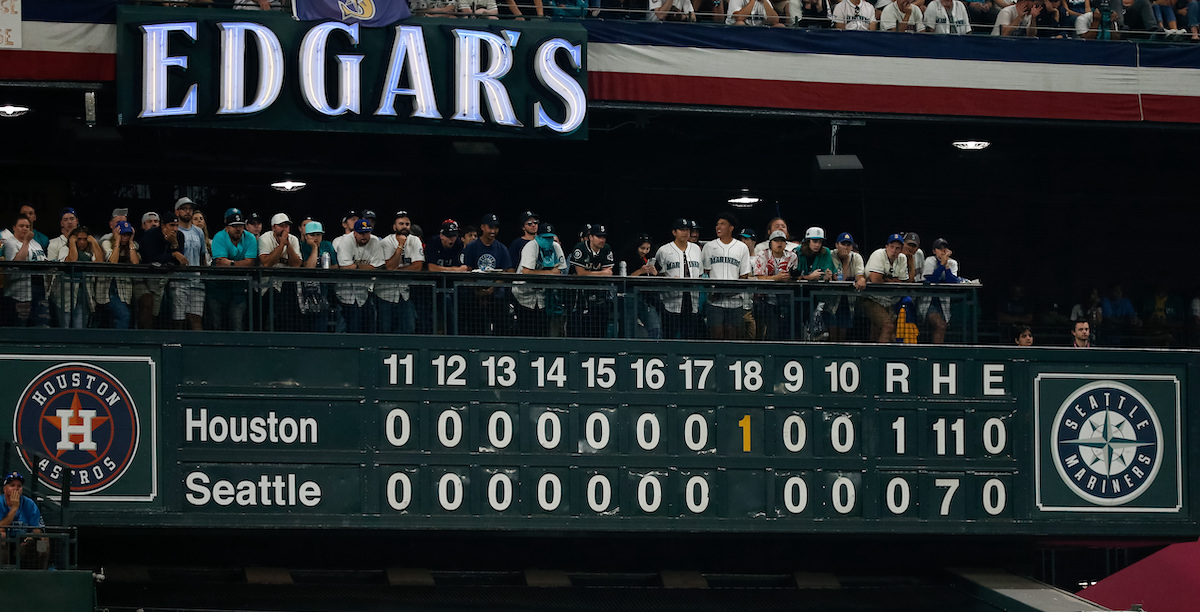
Home teams don’t win enough in extra innings. It’s one of the most persistent mysteries of the last five years of baseball. Before the 2020 season, MLB changed the extra innings rules to start each half of each extra frame with a runner on second base. (This only occurs during the regular season, which means the 18-inning ALDS tilt between the Mariners and the Astros in the picture above didn’t actually feature zombie runners, but the shot was too good to pass up.) They did so to lessen the wear and tear on pitchers, and keep games to a manageable length. Almost certainly, though, they weren’t planning on diminishing home field advantage while they were at it.
In recent years, Rob Mains of Baseball Prospectus has extensively documented the plight of the home team. Connelly Doan measured the incidence of bunts in extra innings and compared the observed rate to a theoretical optimum. Earlier this month, Jay Jaffe dove into the details and noted that strikeouts and walks are a key point of difference between regulation frames and bonus baseball. These all explain the differing dynamics present in extras. But there’s one question I haven’t seen answered: How exactly does this work in practice? Are home teams scoring too little? Are away teams scoring too much? Do home teams play the situations improperly? I set out to answer these questions empirically, using all the data we have on extra innings, to get a sense of where theory and practice diverge.
The theory of extra inning scoring is relatively simple. I laid it out in 2020, and the math still works. You can take a run expectancy chart, start with a runner on second and no one out, and figure out how many runs teams score in that situation in general. If you want to get fancy, you can even find a distribution: how often they score one run, two runs, no runs, and so on. For example, I can tell you that from 2020 to 2025, excluding the ninth inning and extra innings, teams that put a runner on second base with no one out went on to score 0.99 runs per inning.
That’s the relevant situation that road teams face in extras. They have a runner on second with no one out to start the inning, and they’re trying to score runs. They’ve been fairly successful at it, scoring 1.00 runs per inning across the 1,354 extra innings in my sample. That’s statistically indistinguishable from the overall major league average. Break it down by frequency of result, and you still can’t see much difference:
| Scoring | Regulation | Top of Extras |
|---|---|---|
| 0 Runs | 45.6% | 47.5% |
| 1 Run | 31.1% | 28.3% |
| 2 Runs | 11.7% | 11.1% |
| 3+ Runs | 11.6% | 13.1% |
The difference in run-scoring frequency is right on the border of statistical significance, but the direction makes sense. Visiting teams put up exactly one run slightly less frequently than a naive run expectation, which tracks with how extra inning games work. As Jaffe’s research demonstrates, strikeouts increase in extra innings. The defensive positioning and strategy in extra innings prioritizes maintaining a tie; teams play the infield in and try to make plays at the plate at a higher rate in the 10th inning than in the second, naturally enough. For the most part, though, visiting teams in extras are scoring exactly how we’d expect based on the broad performance of the league as a whole over the past half decade.
With that data in hand, we can focus on the home team. Unlike most analyses, we already know what we’re going to find here in broad strokes. Visiting teams convert the runner on second base into runs at the same rate they do in regulation innings. Home teams must not be, what with them winning fewer extra inning games than you’d expect and all. But how and where do they come up short? The data has to be our guide.
Consider the situation where the visiting team fails to score in the top half of the inning. A naive expectation, completely ignoring the particular strategies each team might deploy in extras, suggests that the home team would score around 55% of the time – one minus the chance of scoring no runs after starting with a runner on second and no one out. What has actually happened? The home team has scored about 56.5% of the time. How many runs they score – and thus, the run expectancy – is pointless. If they score in this scenario, that’s enough to win. Here, at least, home teams are performing exactly as you’d expect from the way they score runs during regulation innings.
Let’s move on. What happens when the home team starts the bottom half of an extra inning down by a run? Using our naive probabilities from up above, you’d expect them to score zero runs and thus lose 45% of the time. Instead, they’re coming up empty 49.1% of the time. You’d expect them to score one run and tie the game, sending it to another frame, a further 31% of the time. In reality, though, teams only scratch out that tying run 29% of the time. Finally, you’d expect home teams to score twice and win about 23% of the time, but they’re doing so only 22% of the time. In other words, after the visiting team gets ahead in the top of the inning, they close the game out more frequently than you’d expect based on the league’s overall production with a runner on second base and no one out.
That gap explains a substantial portion of the home field disadvantage associated with the new extra innings rule. Home teams have started the bottom half of an extra frame with a one-run deficit 389 times under the new rules. If they scored the same way they do in regulation, they’d end up with 177 losses, 91 wins, and 121 times where they re-tie the game and send it to a further extra frame. Instead, they’ve racked up 191 losses, 86 wins, and 112 times scoring a run and keeping the game going. That net shortfall of 19 games – 14 more losses and five fewer wins – is about two percentage points of winning percentage across the entire population of extra inning games. Per Mains, home teams won at a 49.3% clip in extras from 2020 through 2024, as compared to a 52.2% rate under the classic extra innings rules.
If we’re looking for specifics, it would behoove us to zoom in on why teams can’t cash in that zombie runner often enough to tie the game. That’s the sticking point in this analysis. In regulation innings, that runner scores far more frequently than in extras. It’s not hard to understand why. The defense is different, after all. With a runner on third and one out, the defensive team has a wide array of options. They could bring the infield in and pitch for a strikeout. They could concede the run. They could intentionally walk someone to set up a double play.
In the early innings, teams almost always concede the run in exchange for a strategy that is most likely to record some type of out, run-scoring or otherwise, which seems wise. Playing to the score doesn’t make much sense when most of the game is still left to play. In the later innings, however, most defenses will switch tactics, prioritizing lead preservation over the highest chance of generating an out.
As an example, consider home teams playing defense in the top of an extra-inning frame. When a runner reaches third with no one out, the visiting team scores 82% of the time. When a runner is on third with one out, they score 65% of the time. These numbers are roughly in line with what happens in the same situation in regulation; the visiting team scores a hair less often in extras than in regulation, but within the margin of error. Maybe the defense is expending effort trying to prevent that one run, but the offense is expending an equal amount of effort trying to score it (running on contact, shortening swings in pursuit of balls in play, etc.), and the net result is that visiting teams cash in runs at essentially the same rate whether they’re playing in regulation or extras.
Take a look at the home side of things, on the other hand, and you’ll see a difference. When the home team puts a runner on third with no one out in a tie game in extras (small sample alert), they only cash in that runner 75% of the time. A runner on third with one out? They score 58% of the time. Down a run, those numbers are roughly the same. The sample is small on all of these, of course, but there’s no denying what has happened so far. That’s meaningfully lower than you’d expect from the scoring environment that prevails in regulation. In other words, home teams aren’t as good at cashing in runners from third in extra innings, whether you’re comparing them to regulation baseball or to visiting teams in extras.
Why is that? Defensive positioning and strategy is my best guess. When the visiting team faces a runner on third with no one out in a tie game in extra innings, they have no choice: They’re stranding that runner or the game is over. You can take a lot more risks with your back against the wall. You can pitch for strikeouts, intentionally walk hitters you don’t want to face, play the infield and outfield ridiculously close, try to throw out the runner at home even if it’s a long shot, or even bring in your best strikeout pitcher to tilt the scales in your favor. It’s not quite the same when you’re up a run, but teams are still willing to sell out to stop a run from scoring in that situation, far more so than in the top half of the inning or earlier in the game.
In fact, this aggressive defensive posture is nothing new. From 2010 through 2019, to pick a pre-zombie-runner sample, home teams were similarly inept at getting a runner home from third base in extra innings – or if you’d prefer, defensive squads were similarly good at preventing that run from scoring. The only reason it’s more noticeable in home field advantage now is because we’re seeing these situations more often. In the old days, getting a runner on third base with no one out in extra innings was vanishingly rare, and getting a runner there with one out wasn’t exactly common. Now, it’s almost a given.
Said another way, home teams have always been at a disadvantage, relative to their regulation winning percentage, in extra innings. Mains’ research bears that out, and I’ve looked into it before with similar findings. That’s partially because of a situation where they’ve historically performed worse than the visiting team: scoring a runner from third with less than two outs. That situation happens more frequently now than it used to. It’s a classic unintended consequence – no one thought too much about home teams’ underperformance in these spots because it almost never came up. That imbalance just didn’t matter much without an automatic runner in place. Put someone on base to start the frame, though, and converting runners into runs starts to matter a lot more.
If you’re like me, there’s one thread still nagging at you. If defenses are so good at stopping runners from third from scoring, why don’t we see it in the results I quoted for home team winning percentage when the visiting team fails to score? It’s because we’re missing a variable: bunts.
See, home teams are less efficient at converting runners on third into runs, but in tie games, they get runners to third base with one out more frequently than you’d expect. They do so by bunting. Sure, Doan’s research found that teams weren’t bunting enough in extra innings, but it also demonstrated, far beyond the shadow of a doubt, that teams bunt much more than they do in regulation innings. Starting the bottom of a tied extra inning with a bunt is a winning play. It increases win probability meaningfully from a naive estimate. It just so happens that it increases win probability by enough that it offsets the subsequent challenges that the home team has driving that run home.
I find this puzzle fascinating. It just feels wrong that home teams have a disadvantage in extra innings, the very time when getting to see what your opponent did first should matter most. But as it turns out, home teams have always struggled, on a relative basis, to cash in “easy” runs in extras. The new extra inning rule creates more chances to cash in easy runs. Just like that, you end up with a mysterious outcome – home teams aren’t winning enough. The key factor that creates this counterintuitive home field disadvantage has been around for a long time. We just never noticed it before the zombie runner turned “Can you get that dude home?” from an extra-innings afterthought to a high-frequency challenge.
This article has been updated to correct the rate at which both home and away teams score with a runner from third, correcting an earlier transcription error.
Ben is a writer at FanGraphs. He can be found on Bluesky @benclemens.
Are there differences in pitcher utilization? When up a run in the 10th I imagine the road team always uses their very best RP, but does the home team when tied in the top of the 10th?
So I initially planned on that being part of this article, but the truth is that I had a really hard time actually teasing it out of the data. There’s a lot of controlling to be done to make the results unbiased (at least, I thought so when trying to do it) and I couldn’t handle it well enough to feel comfortable including it. If someone better than me at math wants to take a crack at it, let me know!
It probably can’t truly be done. I do think this is your answer, though: the road teams are probably using their closer/ace reliever to pitch the 10th more frequently than the home teams. These pitchers likely strike out more hitters than the average reliever, too, which is especially crucial with the ghost runner. If they can keep him at 2B after the first batter, the threat of a sac fly is neutralized, and the entire strategy of the inning changes.
This is the inherent issue with a runner starting on 2B: you can make three consecutive outs yet still score a run. I feel like we see more first-batter bunts from road teams than we do from home teams down by a run, as home teams don’t seem content to play for a re-tie and an 11th inning. While their run expectancy may be higher by not bunting, their frequency of scoring is likely a bit lower.
Is there a way to calculate the weighted average full-season stats of the pitchers who have pitched in the top of the 10th and compare it to the same calculation for the bottom of the 10th?
Both teams should use best pitcher available in tie games late and extras. If the home team does that less frequently it’s an unforced error
Well, actually, as we know, at home the “closer” typically pitches in the top of the ninth in a tie game, to hold things where they are and give his team a chance for the walk off. After all, it’s impossible for there to be a subsequent save situation in such a game. By contrast the road team usually doesn’t have their closer pitch the bottom of the ninth, preferring to hold him back for the possible save situation. To the extent the “closer” is synonymous with “the best pitcher” it might be interesting to see if in games tied after 8 innings, home team are doing better than might be expected in the ninth inning.
I’m not sure your assumptions about closer usage by the road team are still operative in 2025.
It probably depends on how rested the bullpen is (including the closer himself) and how many other good relievers they still have available as to when exactly the road team will use their closer in a tie game in the 9th inning and beyond.
Still, I’d imagine he’d be held off by the road team by at least an inning on at least some occasions.
Both teams should based on what exactly? If the home team is facing the bottom of the lineup in extras I’m more inclined to not use my closer there than in the next inning. There’s too many other factors at play to simply say the best reliever should always be used.
Hence the conundrum of extra innings as a home team, you don’t know what your team will have to do offensively to win the game prior to committing to which reliever you’re using in an extra inning.
It sounds like you’re saying home teams should maximum blitz and full court press like road teams do in extra innings.
Look, I wouldn’t make a statement like that without strong factual backup, and I haven’t found a causal link yet, so I’m hesitant to say that. But if I were managing the team, I absolutely would.
In that sense, the home team is at a disadvantage on defense. Extreme strategies to prevent one run from scoring probably increase the odds of a big inning, but that dynamic is irrelevant to the road team defending in a tied game or one-run lead.
It’s not completely irrelevant to the road team protecting a one-run lead. In particular, you can’t get too wacky with your outfield positioning because you have to protect against the possibility of a walkoff inside-the-parker.
Wouldn’t there also be an element where visiting teams can employ more aggressive defensive tactics because giving up 2+ runs is irrelevant. The high end downsides for visiting teams aren”t the same as home teams face.
It reminds me of the inverse of college football overtime- the visiting team is like the team that goes second in overtime in college football. It knows more information (how many runs it scored) and can plan its pitching and defensive strategy accordingly. Now conversely the home team can do this offensively too but this tells me the defensive strategies (walking bases loaded, defensive positioning, which reliever type to use, etc) have more influence than the hitting strategy shifts (bunt, swing for lofted sac fly, etc).
Sure, but the home team can likewise employ offensive tactics designed to score just one run, such as sacrifice bunts, trying to just hit a fly ball deep enough for a a sacrifice fly, pinch-hitting and pinch-running, first and third double steals, and trail runners purposely getting into rundowns.
Although, I suppose artkarn is correct that the defense has better options.
Can someone please tell this to the Yankees, who have gone 0-for-5 in scoring the ghost runner on the road?
I will beat this drum to the death, but it’s the right thing to do:
1) Eliminate the zombie runner immediately.
2) Declare a Draw if still tied after 12 innings (regular season only).
Solves the “problems” leading to zombiehood, without fundamentally changing the nature of the sport.
I’d argue something like “zombie runners” start in the 13th in the regular season — three “normal” extra innings. It’d make some stat-keeping a bit harder, but the zombie runner existing creates its own set of scoring rules.
I’d also argue declaring ties is a fundamental change to the nature of the sport. Note that I am not opposed to it per se, but it does change how standings are determined significantly.
The other point is that the auto-runners have highlighted an existing nuance of baseball strategy and a corner case has become commonplace, but the nature of it hasn’t necessarily changed.
My absolute preference would be the old rules. I get nothing but joy from extra baseball. Though, of course, I can just turn it off and go to bed if I need to and I understand why teams and players what to keep the games to a reasonable and predictable length.
So, given that, bringing the runner in after 11 or 12 innings would be fine, and a big improvement over the current rules, but so would ties. I really don’t understand why folks hate ties so much.
10th inning-straight up. 11th inning-start with man on 1st. 12th inning-start with man on 2nd. 13th inning-start with man on 3rd.
This proposal is terrible, especially when you argue your intent is to keep from fundamentally changing the nature of the sport. Baseball doesnt have ties, and it literally never has. You want to introduce ties. YOU are fundamentally changing the nature of the sport.
Extra innings are more tense than they ever have been, and that leads to more focus and excitement. The right thing to do is for you to accept that you are just wrong about this. Ties in baseball are orders of magnitude worse in all ways than the Manfred Man.
I’m not advocating for ties, but it’s not true to say it doesn’t have ties and literally never has. Ties happened quite a bit in the early days of MLB when there were no lights in ballparks. They also still occur when a game is postponed and has no bearing at the end of the season – the Cubs finished 2016 at 103-58-1.
It is true that ties technically exist, but they are rare (even back when games were called for darkness), and the games are often replayed, particularily when they have an effect on the standings. That would not be possible if they became a somewhat more common occurance.
Just because there have been ties doesn’t mean making ties a regular occurrence isn’t fundamentally changing the game. It absolutely is. Going further back, the next tie I found was in 2005. Meanwhile, there have been hundreds of extra inning games beyond 11 innings the past 20 years. With a lot of that being impacted by the ghost runner in the last few years.
So you’re talking about changing the game from having 2 tie games in the past 20 years to it being more like 2 tie games a month.
I didn’t even talk about changing anything. I was just pointing out that baseball “literally never has” had ties is factually incorrect.
I always kinda liked the way hockey handles ties (where even the loser gets a point for making it to OT). Not exactly sure how it’d be integrated, and it would reduce the stakes of extra innings, but I suppose if I’m annoyed by the artificial pressure imposed, then I’m ok with that in general.
The zombie runner broke a fundamental aspect of the sport (though you could argue that the automatic intentional walk broke this first), in that you actually needed to do something to get on base. I am waiting for the zero pitch inning (two automatic IBB, an attempted pickoff that is misfielded, but then the runners are thrown out in an all time TOOTBLAN) – or the zero pitch walk off (again, pick off goes for an error, the zombie runner scores) – those scenarios are very unlikely, but I dislike that there is an extreme edge cases where we could have 0 pitches. The ties is just reintroducing something that has been pretty much legislated out of the game. (I very rarely downvote, and I did down vote you, because you said it baseball has literally never had ties. And how can you not be pedantic about baseball?)
Are extra innings more tense now? I think you can tell that the rule intended to just shorted regular season games, as they don’t have the zombie runner in the postseason… you know, the tensest, most important, most watched, most profitable games.
Extreme edge cases exist in all aspects of the sport. For example, it’s possible for someone to have an on-base percentage lower than his batting average (due to how sacrifice bunts and sacrifice flies count as plate appearances but not at bats). A pitcher can get more than 3 Ks in an inning with the third strike rule. There are technically ways to get 4 outs in an inning, even though only 3 of them will actually be counted.
There are also other ways a pitcher can make an appearance and throw zero pitches, such as if he picks off an inherited runner for the third out or gets injured before throwing a pitch.
While there wasn’t previously a way to pitch an entire half inning without throwing a pitch, it’s not an issue that such a way does now exist.
I do like those statistical quirks you’ve mentioned. I don’t like the zombie runner for philosophical reasons – because it breaks the idea that the runner is on base because somebody did something – whether that is a hitter hitting a double, walking then stealing, an error then a balk, however, the players had to do things. I also dislike that the IBB is automatic now, for similar reasons – though I understand the pros for it. The IBB is still at least the result of somebody making a decision, and having to do something – even if that somebody is the manager, and the something they have to do is make a gesture to the umpire. I do realise that in 20 years time, everybody will probably accept the zombie runner as just the part of the game, and those who were against it at the time will fade away like those opposed to the DH.
To me, the reliver coming in and throwing 0 pitches while recording an out, is a really fun quirk (them throwing 0 pitches and leaving because of injury is absolutely not fun) – because those runners were caused by the previous pitcher(s), batters and fielders doing things. I do get that people will see a 0 pitch inning as a fun statistical quirk – and if it ever happens, I’ll probably be watching and rewatching the clip of the outs/walkoff repeatedly while laughing – but I just really don’t like the zombie runner.
“Are extra innings more tense now?”
Regardless of whether you’re for or against the zombie runner, extra inning games in the regular season are absolutely more tense than without them.
The zombie runner not being used in the playoffs isn’t because of a lack of tension.
You could have stopped after the first.
The really long extra-inning games were pretty darn rare and never really needed fixing.
If the concern is pitcher usage I’d rather allow some sort of roster exemption (like with double headers), but after the fact, to let the involved teams bring up a fresh arm or two for the next day.
I never understood why it couldn’t be 10th inning, no zombie runner. 11th inning, zombie starts at first. 12th inning and thereafter, zombie starts at second.
I think if they’re going to have the zombie runner, they might as well go for it properly. Each team at the start of the season chooses their cannon of zombie runner to play in extra innings. You could go “zombie horde” – where you start with more runners on each inning – you get a runner on 1st in the 10th, runners on 2nd and 1st in the 11th, bases loaded in the 12th, bases loaded and a run scored in the 13th, etc. Or “Walking Dead fast zombies”, where you keep the zombie runner on 2nd for each extra-inning, but any non-successful pick off attempt means the runner takes the next bases. I can’t think of any more modes, but I’m sure we could come up with a few more. It would be then quite fun for the teams to try and work out which is the best strategy.
So, having thought about this, if I were made commissioner of baseball (and wasn’t allowed to just simply get rid of the zombie runner), I’d announce on the first day of Winter meetings that each team would have to pick their extra innings rule, and would have until 9am the following day to submit their rule. Failure to do so would result in that team getting no free runners in extra innings.
Teams could pick the Zombie Horde, Walking Dead Fast Zombie and:
Ghost Runner – the ghost runner starts on 2nd, and can’t be tagged or forced out, as ghosts don’t have corporeal form. However, they can’t advance unless the batter puts the ball in play – so no stolen bases, advancing on a wild pitch for the ghost (as ghosts can’t leave where they are haunting). All subsequent runners are normal runners.
Vampire Runner – if the Vampire gets out (eg tries to steal third and is thrown out), he rises again on the last base he occupied when the pitcher next throws a ball, and the out is removed. If the base is occupied, the runner is out (killed) by the returning vampire.
(I am not being 100% serious – but I do like the idea of encouraging a wider range of possible strategies – I would really like teams to have distinctive identities and ways they play)
It absolutely changes the nature of the sport when tie games are regularly added to the standings! Absolutely not!
That is a really interesting question – and not one I’ve ever thought of before. Is changing how the game is played on the field (micro rules changes, perhaps) a bigger or smaller difference to changing how the game ends in some cases, and then how teams are ranked (macro rule changes). By considering the standings, are we actually considering the sport itself, or the accountancy of the sport? Is baseball in Japan more different to baseball in the US because they use a different ball, or because they call it a tie if the scores are level after 12 innings? (I assume there are other on and off field rules which make Japanese baseball different to MLB, like the foreign player limit in the NPB)
I actually like the zombie runner.
There is no tying in baseball
Except for all the ties.
I am 1000% behind the “MLB needs ties” idea. No one wants to watch an 18 inning regular season game, and it Fs up the bullpens for days afterwards. If you can’t get it done in 12 innings, everyone goes home. There are 162 games to figure out who is the better team, I don’t think a few ties is going to create chaos, and aren’t we in the middle of a ‘speed up the game’ initiative anyway?
Other sports (NHL, NFL, soccer) seem to get by just fine with ties, so it’s not like sports fans will find the notion unbearable.
Can we just simplify this down to that it easier to prevent one run when you are trying to prevent only one run from scoring (infield in, etc.)? In regulation play, the downside is that you are more likely to give up multi-run innings, but since this often does not matter in extra-innings, it is a risk worth taking for the defense.
I would have thought the answer was simple, ahead by a run or two the visiting team will use their best reliever/pitcher available. Versus the home team will likely use their closer slightly less, but enough less to make the home team’s chance diminished. And if the home team does use their closer in the top half and he shuts down the visitors, then if I am the visiting manager I am more inclined to use my closer.
I think game theory would explain this quite well, the team that gets the last choice on which pitcher to use should have a statistically meaningful advantage…. especially in a game with 0.0000 probability of it being infinite.
Apply this logic to a regular ninth inning. Or pre- Manfred Man rules. Why does the zombie runner alter the effect?
Maybe it doesn’t
Maybe teams are just getting smarter about reliever usage
Maybe but the evidence presented here (via BP which I don’t happen to subscribe to) is that there’s been a change correlating to that specific time period.
Needs more analysis.
This article made me think playoff football overtime rules vs extra inning baseball. In overtime rules of playoff football, it’s better to be on offense 2nd. On offense you will know exactly what you need to score, and if you need points you will be willing to go for it on 4th down right away. That is not true for the 1st team on offense, they do not have the luxury of knowing they can go for 4th downs at the start of their drive.
In baseball, the 2nd team to be on defense (always the away team) knows exactly what they need to win or at least tie. That means as you say Ben they can play risky from the jump because there are no alternatives. Just like in football the team going 2nd on offense can play risky immediately because they must, and that allows for a better chance of winning.
I agree that the best pitcher for the situation is always the correct answer. When games are tied going into the 9th, the Home Team generally uses their closer. In a close game previous innings are likely to have been consumed by high leverage pitchers. This leaves the best pitcher available as someone lower in the Team’s hierarchy.
Another wonderful article by Ben. Ben’s got the data, and I have my visual… advantage Ben. Home team down by a run, seemingly wit no outs and runner on 2nd is taking full swings and trying to score 2 not 1 run in their half of inning so win game. They don’t play for just a run until there is one out and the runner did not advance. Yes, infield in, velo pitchers = strikeours, but both teams have that. I am thinking home team should play for the ne rn and take chances. Betting on 2 seems like betting vs. the house.
99% of home teams NEVER bunt the runner to 3rd in extras when down by 1 run. They settle for praying one of their next 3 batters gets a hit in this insanely low hitting environment.
Do hitters even practice bunting anymore? And who wants to bunt when you can be the hero and walk off with a single?
It’s a lot harder to properly bunt upper 90s with movement (up in the zone!) vs the knee high 91 mph 1982 fastballs that Joe Morgan is thinking about, even if you practice a lot. An underrated difference in eras.
Practice it more. The same high velo machines that are used to practice hitting 97 to 101 can be used to practice bunting it.
“Why don’t the players just get better at baseball? Have they considered practicing?”
I used to be fortunate enough to have access to Petco Park every day for home team drills and BP.
For nearly three weeks straight years ago Dave Roberts was on the field everyday working on the art of bunting with Travis Jankowski. Every. Single. Day.
Bunting is a skill that can be mastered through practice and dedication. Is it as easy as people that never played at a high level think? Absolutely not. But don’t pretend that the fundamentals of bunting can’t be perfected through repetition.
I will point out a few things here:
Not bunting does not preclude being able to advance runners without hits. Runners are allowed to advance on outs that are not bunts, after all. While it is not a 100% guarantee that you will give up the out by bunting (errors and bunt base hits do happen), it’s a very high percentage chance that you will.
If, as is stated here, the home field team has a disadvantage in extras, why would reduce your chances of scoring 2+ runs, thus winning in this inning — and not reducing your chances to tie the game anyway that significantly, to play for a non-guaranteed opportunity to continue playing at an inherent disadvantage?
Put more simply: assuming a generic 50/50 probability for winning at the start of a generic extra inning is an incorrect assumption, at least empirically.
I could see arguing to play for the tie at home in extras in a few cases:
1) You know you have a distinct advantage moving forward through the game: disparity in team quality, opponent has used key bullpen arms, etc., that it modifies the probability in your favor enough to balance the inherent disadvantage if the game were to continue.
2) The cost of a loss is much larger than a normal regular season game, where the value of avoiding a loss justifies the attempt to keep the game going at all costs.
Regular season games are almost never “win at all costs”. Maximizing your probability to win tonight’s game often is not the smart move because future considerations should be in play. The calculus varies — if you’re playing a team where a tiebreaker and/or HFA in the playoffs could be at stake, you might play a little more to avoid the loss. Obviously, as there are fewer games left on the schedule, the outlook doesn’t need to consider that much further in the future.
“Not bunting does not preclude being able to advance runners without hits. Runners are allowed to advance on outs that are not bunts, after all. While it is not a 100% guarantee that you will give up the out by bunting (errors and bunt base hits do happen), it’s a very high percentage chance that you will.”
We’re in an era where simply making contact is the hardest it’s ever been let alone actually trying to guide the ball to the right side of the infield.
“If, as is stated here, the home field team has a disadvantage in extras, why would reduce your chances of scoring 2+ runs, thus winning in this inning — and not reducing your chances to tie the game anyway that significantly, to play for a non-guaranteed opportunity to continue playing at an inherent disadvantage?”
The home team is contributing to and creating that disadvantage by not being willing to take measures to simply tie the game and move on to the next inning. Instead they are playing for the win despite being down. As for the scoring 2 runs part, I haven’t looked at the chart but I’m pretty sure you have a higher likelihood of scoring 1 run with one out and a runner on 3rd than 2 runs with no outs and a runner on second.
“Regular season games are almost never “win at all costs”. Maximizing your probability to win tonight’s game often is not the smart move because future considerations should be in play.”
That’s quite the assumption but I can understand and get behind that reasoning if the home team has completely depleted their bullpen.
Actually, does it being a very low contact, high power era mean you should bunt the runner over to 3rd even less often? From the Run Expectancy article, runner on 2nd, 0 outs is 1.12 expected runs, runner on 3rd, 1 out is 0.86 runs this year (and runner on 2nd no out has more expected runs than runner on 3rd, one out). It doesn’t show the distribution of runs, but I would also take a slight hit to the chance of scoring 1 run if it increased the chance of scoring 2 runs.
It depends on the hitter at the plate. I should have made a caveat at the beginning of this discussion that I’m primarily talking about the guys in the lower third of the lineup.
“When the home team puts a runner on third with no one out in a tie game in extras, they only cash in that runner 43% of the time. ” – this is impossible for me to believe. This should be close to 90%, no? Are you sure about this?
2nd, I’m confused about why (paragraph 7) teams scoring 56.5% of the time when “normal” results suggest 55% is “exactly as you’d expect”, but that (paragraph 8) expecting the home team to score twice 23% of the time and them only doing it 22% of the time is a significant difference.
All that said, this is still a fascinating outcome. I had always assumed that the new rule would benefit the home team because they “know what they have to do” based on the their knowledge of what the visitors did in the top of the inning.
Oh you are totally right. I had a transcription error here, the top half of my spreadsheet froze when I was copying the numbers into this. Both visiting and away team scoring rates from third were including a ton of blank cells in their calculations. It should be 82% for the away team and 75% for the road team – a similar gap, but with both teams scoring more often. The same thing is true for one out – both score more often than the nubmers in the original article, but the road team scores more frequently than the home team. Great catch, thank you – I updated the article to reflect that.
As to the second, yeah, fair. Probably just because I was trying to focus on the home team’s OTHER outcomes – it’s weird to me that they wouldn’t have more big innings if they score 0 more often.
Thanks for the response (and correction)!
Hey Ben (if you see this), your article about home field advantage in extra innings spurred some research. Have you noticed that teams have better home records this year versus the previous four years by a considerable margin?
MLB home winning percentage: .566 (through May 27), 92-win pace
2024–.522 (full season), 85-win pace
2023–.521 (full season), 84-win pace
2022–.533 (full season), 86-win pace
2021–.539 (full season), 87-win pace
I couldn’t figure out how to find the home winning percentage through May 27 for previous seasons, so I used full-season totals. Perhaps this is something that evens out over the rest of the season?
I noticed this 2025 trend towards the beginning of May. Not only are they eclipsing the recent four year trends but they are also far above the 2000-2024 mark which off the top of my head is about 52.5%.
I will say that when I looked at the trend at the beginning of May that home teams were winning at a 62%!!!! rate so i’s already started to regress to the mean.
I generally think it’s a fluke but we’ll see.
So, bunting is inefficient?
Would it be fair to say home teams are too afraid of big innings from the road teams in extras, whereas they should try to focus only on that first run?
Nailed it.
“Brevity is the soul of wit.” – a man wearing tights.
I wonder what the comparison is between zombie runner extras vs man-on-2nd-0-outs in tied games in the 7th-9th innings? Part of the excitement, a properly loaded term for everyone involved, of extra innings is the imminent win with any scoring changes. Defenses play smart, gamblers sober up, strong teams won’t get the top of the order up again. This makes it more apples to apples as far as the sudden death nature of the historical analysis.
Give the home team the option to bat 1st or 2nd in extras?
Did you consider the possibility that, on the whole, visiting teams that are able to play to a tie after 9 innings are simply better than the home teams which didn’t win the game in 9 innings?
Overall, the home team wins 54% of all games (regular and extra inning). Over the course of an entire season, an 81-81 “true talent” team would be expect to go 87-75 if they played all their games at home. The same team would go 75-87 if they played all their games on the road. The home field advantage is worth 6 wins over a season in which 1/2 of the games are played at home.
When two equal “true talent” teams play 9 innings of baseball, a certain percentage of games will be tied-at-9. We would expect a lower percentage of tied-at-9 when the home team was the stronger true-talent team. Likewise, we’d expect a higher percentage of tied-at-9 games when the visiting team was the stronger true-talent team. On the whole, we’d expect more tied-at-9 games to occur between weaker true-talent home teams and stronger true-talent visitors.
Rob Mains article from January 2025 stated that home team winning percentage is .493. Isn’t this about what we’d expected in a scenario where, on the whole, a better visiting team is playing a weaker home team in a setting (extra innings) where perhaps the overall leverage of the situation negates some of the home field advantage?
Great article, I am curious how many home teams burn their closer in the 9th of a tied game to play for extra innings which could also influence the pitcher they put out in the 10th.
Even the best closers fail in extra innings. Munoz has allowed two runs this season and both were blown saves in extras.
Could the occam’s razor here just be that home teams tend to use their closer at the top of the 9th in a tie game, while away teams tend to sit on their closer until they have the lead?
Here’s the stat I would look for:
Down by one run in the bottom of the 9th, how often do home teams force extra innings or win? If the numbers are similar for the 9th, 10th, 11th, you don’t have an extra innings problem, you have a ‘home teams struggle against the closer’ problem.
I don’t like the ghost runner. Call me old-fashioned.
What I’d like to see (but will never happen):
Even going above and beyond all of the other weirdness of your suggestion (why 5 outs?), what is the logic for this specifically?
“I find this puzzle fascinating. It just feels wrong that home teams have a disadvantage in extra innings, the very time when getting to see what your opponent did first should matter most.”
What this demonstrates is that the effect of strategic adjustments is greater on defense than offense. Thus, from the relevant perspective, the home team “goes first” and it’s the away team that gets to make the more important decisions with better information.
I have long suspected it has more to do with 9th vs 10th inning reliever utilization.
If a team has, say, three good relievers and one exceptional reliever, they will save that ace reliever for the 10th (or 11th inning) where they know a 1-2-3 inning is needed and just throw good relievers in the 9th (and 8th). Prior to the rule change, you would often use that exceptional reliever in the 9th (or even 8th, if the heart of the order was up).
Road teams have the advantage of knowing how many runs they score in the top of the 10th inning (and 11th, if necessary, etc.), and can choose strategically whether to use that ace or save him for later. Home teams kind of have to just guess and hope they use him in the right inning.
Consider college football OT. Nearly every team that wins the OT coin toss chooses to play offense 2nd/last. Knowing what you need to win or extend game allows for more specific strategy and also going for it on 4th down (desperation).
I should clarify. Offense controls the ball in college football. In baseball defense has more control over the ball. Having the ball 2nd is desirable for both.