
The New Cody Bellinger Has Been Here for a While Now

NEW YORK — It’s hard to stay under the radar when you play at Yankee Stadium, but Cody Bellinger is giving it his best shot.
Splitting time between all three outfield positions, the 30-year-old Bellinger is quietly putting up the second-best season of his entire career. With 4.6 WAR entering play Wednesday, he ranks 18th among all position players. Drafted out of high school in 2013, Bellinger debuted with the Dodgers at age 21 in 2017 and immediately looked like a star. He took home Rookie of the Year honors with a four-win campaign, won the MVP in 2019, and then saw his career derailed by a fractured fibula and multiple shoulder dislocations. The Dodgers non-tendered him after he ran a combined 69 wRC+ in 2021 and 2022, and he signed a pillow contract with the Cubs for 2023. He got back on track with a 136 wRC+ and 4.4 WAR, signed a three-year deal to stay in Chicago, and then got traded to New York after he took a step back in 2024. That step back is starting to look like a blip.
This season, Bellinger been the most valuable Yankee not named Aaron Judge. His 129 wRC+ ranks fifth among the team’s regulars, and he’s tied with Austin Wells for the lead with nine fielding runs. Bellinger’s 28 home runs are his most since his 2019 MVP season.
He is having an interesting year at the plate. In some ways, he looks the same as he has for the past three seasons. Deserved Runs Created Plus, a Baseball Prospectus metric that measures deserved performance rather than actual results, had him at 106 in 2023 and 111 in his down 2024 campaign. This season, he’s at 108. In other words, DRC+ thinks Bellinger has performed at pretty much the same level for the past three seasons, despite the dip in his actual performance and his xwOBA last season. That’s the first big piece of news here. DRC+ thought Bellinger’s step back last year was undeserved, and the fact that he’s returned to his 2023 performance level makes that easier to believe. As Dan Szymborski wrote earlier this week, Bellinger has put himself in position to decline his 2026 option and look for a new deal. The idea that, under the hood, he’s been this good for three years in a row makes him that much more attractive a target if he ends up hitting the open market come November.
Even a cursory look at Bellinger’s stats will tell you that although he’s hitting extremely well, he’s a different player than he was before the shoulder injuries. He doesn’t hit the ball as hard. He sees more pitches in the zone because pitchers aren’t quite as scared of him, and he’s much more aggressive than he used to be. Platoon splits provide a great example. Early in his career, Bellinger had pretty standard platoon splits, running a 140 wRC+ against righties and a 124 wRC+ against lefties. In his bounce-back 2023 season, he started running severe reverse platoon splits and smashing lefties. He was more or less even in 2024, but now he’s back to smashing lefties again, as you can see from this slender table.
| Year | RHP | LHP |
|---|---|---|
| 2023 | 121 | 165 |
| 2024 | 109 | 106 |
| 2025 | 110 | 181 |
What is Bellinger doing differently against lefties this season? For starters, he’s been much more patient against them. Although his chase rate against righties has stayed roughly the same from 2024 to 2025, his chase rate against lefties has fallen from 37% all the way to 28%, and his swing rate on pitches in the zone has dropped by a small amount too. He’s gone from a minuscule 1.2% walk rate against lefties in 2024 to a more reasonable 7.4% this season. Asked about the change before Wednesday’s game, Bellinger said he wasn’t deliberately dialing back his aggressiveness: “I think it’s just a matter of where my swing is at right now, and the understanding of my swing and how I want to approach everything.”
It’s not just that Bellinger is swinging less. He’s swinging less against sweepers, specifically, which have always given him trouble, and he’s swinging more often at curveballs, which he’s always crushed and is now absolutely demolishing. Hitting coach James Rowson attributed this approach to Bellinger’s innate ability to recognize the movement patterns of pitches, synthesizing information like the pitcher’s mechanics and release point to decipher not just what pitch is coming, but also how much it is breaking and where it will cross the plate. “He is as good at recognizing shapes of pitches as anyone I’ve ever seen,” Rowson said before Tuesday’s game. Bellinger has always had this skill to some degree, but it seems to have improved over time as he’s seen more pitches at the big league level. He’s running a career-low 13% strikeout rate, both because he’s not chasing and because he’s making a ton more contact. Seeing Bellinger whiff less shouldn’t be much of a surprise. Take a look at his career contact rates.
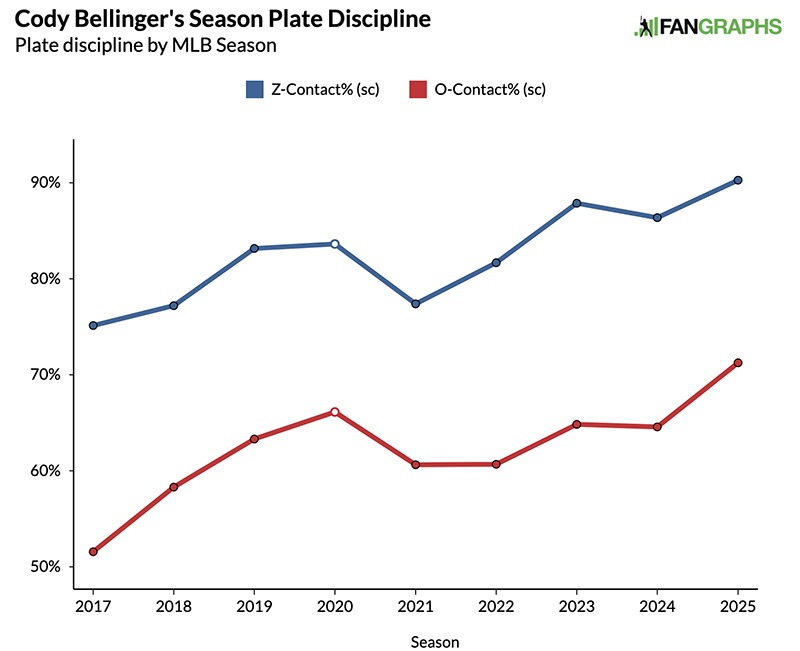
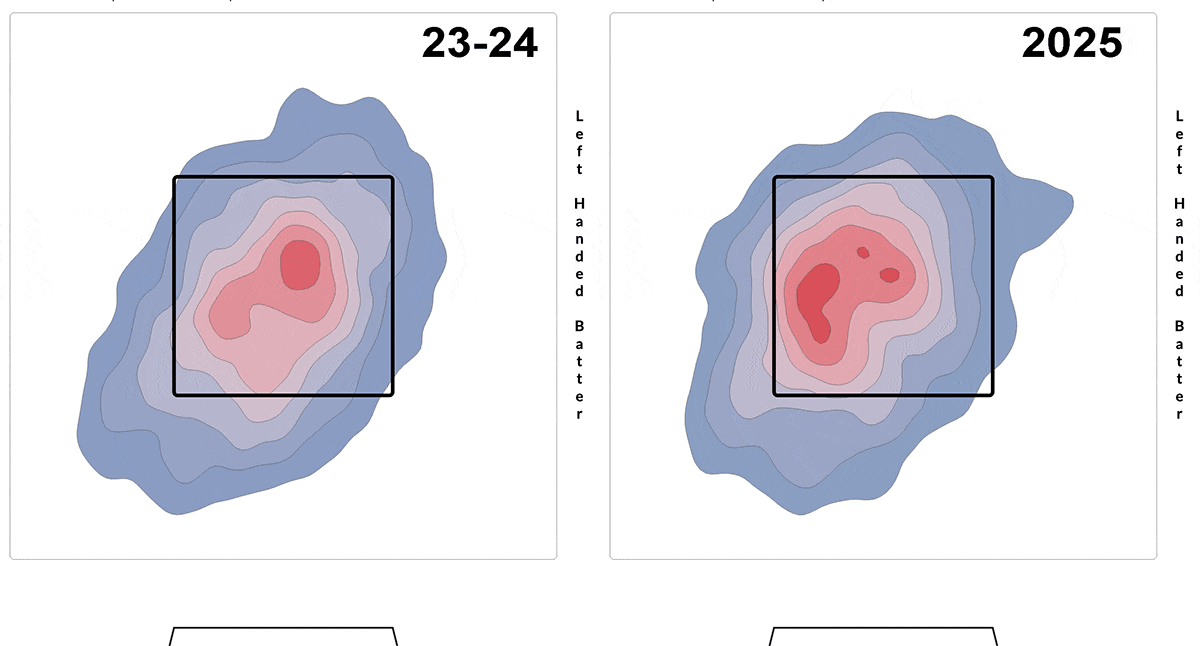
Both lines dropped during his two years in the wilderness, but his contact rate on pitches in the zone has been trending upward for most of his career. This latest increase has coincided with Bellinger’s best hard-hit rate since 2020 and his highest 90th-percentile exit velocity since 2021. He’s more patient, he’s making more contact, and he’s hitting the ball harder than at any point since he first injured his shoulder. It sounds like he’s just making better swing decisions, focusing on the ones that he can do the most damage against, but it’s not quite that simple. Let’s look at where he’s traditionally done damage. The heat maps below show his slugging percentage per ball in play. I’ve combined the last two seasons so that we can compare them with this year. There’s a big difference.

Like many players, Bellinger was at his best against pitches right over the heart of the plate. His hot zone also extended toward the inner half. This season, he has a couple different hot zones. He’s still scorching those pitches over the middle, but now he’s also punishing pitches up and in, and he’s doing well on thigh-high pitches on the outside part of the plate, as well. He can rake against pitches thrown to these different locations because his swing is more adaptable than it was in previous seasons. “I think adjustability is like a superpower, right?” Bellinger said. “I can hit balls in different quadrants of the zone. I can shorten up, take my stroke — you learn that through success and failure. You just kind of build it, and I’m at a position now where my swing, my mind, I’m [in my] ninth year in the big leagues now. So before, I felt like I was just more out-athleticizing the game and there wasn’t much mental fortitude going on there. It was just, you know, be athletic and rip it.”
It’s no accident that Bellinger has developed an ability to hit that pitch on the outer half. He’s done so out of necessity. Take a look at the way pitchers have changed their approach against him.
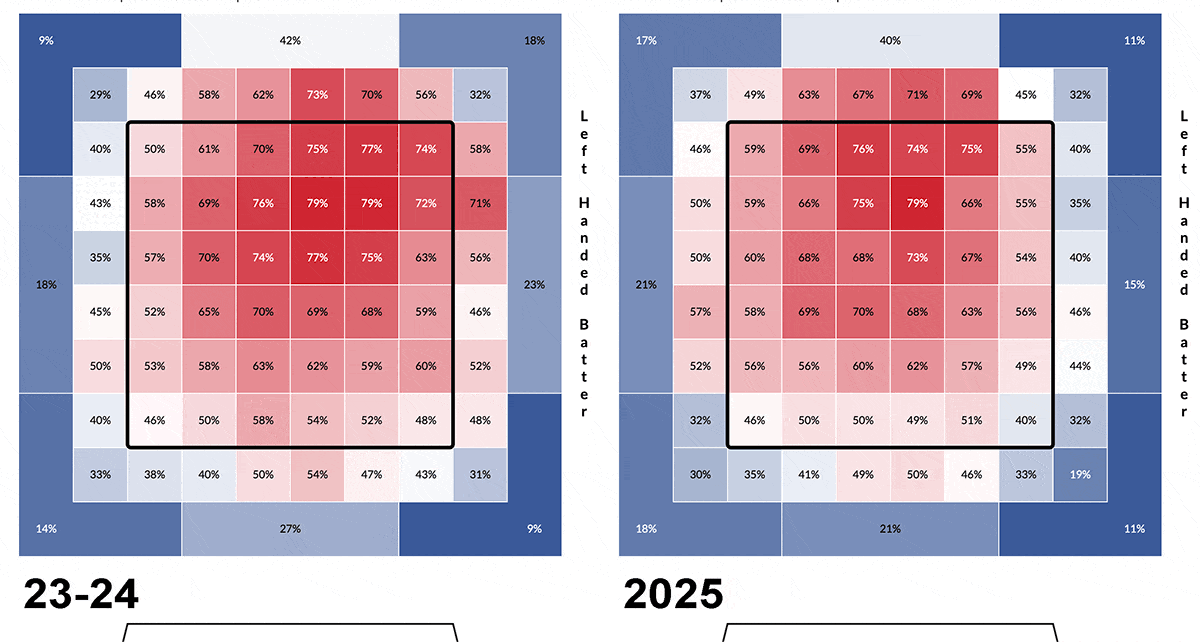
Knowing that Bellinger loved the ball middle-in, they started attacking the outside part of the plate. Not only has he demonstrated that he can handle that pitch, but he’s even started to look for it. The heat maps below show his swing rates. He’s gone from focusing on the inner half to looking for the pitch up and out over the plate. “I think it’s just an idea of my swing and keeping my barrel in the zone as long as possible,” he said.
With opposing pitchers targeting the outside part of the plate and Bellinger obliging them by swinging at those offerings, you might expect him to be pulling the ball less often. He’s not. His 43.5% pull rate is his highest since 2022. Bellinger has long levers and a long swing (longer than 87% of all qualified players, according to Statcast), and he runs one of the league’s higher pull rates, both on inside pitches and those over the outer third. “He can do what he wants to do with that [outside] pitch,” Rowson said. Bellinger is aware that he pulls the ball when he’s going well, but he understands that setting out to pull the ball leads to bad results. “The second you start trying to pull, [it is] bad news, in my opinion,” he said during spring training. “Put my swing on the inside part of the baseball, and good things happen.” Before Wednesday’s game, he acknowledged that it’s not always that easy. “Especially here at Yankee Stadium, getting pull-happy is tempting,” he said, before explaining the benefit of staying inside the baseball. “[It] ultimately keeps your direction from not flying off to right field… If you’re thinking pull, your margin of error is so short in this game, especially with the velocity and everything going on.” The pull-by-not-trying-to-pull approach is working just fine. Bellinger is now putting more than a quarter of his batted balls in the air to the pull side, his highest mark since 2019.
I don’t mean to make it sound like what we’re seeing from Bellinger is entirely new to this year. Remember, as I said earlier, Bellinger’s DRC+ is basically unchanged over the past three seasons, and his wRC+ is still lower than it was in 2023, the first time the baseball world proclaimed that Belli was back. Yes, he can get the barrel to more parts of the zone now, and he’s making tons of contact and pulling the ball in the air more often, but he hasn’t suddenly reached a new peak. That said, these changes make it easier to believe that this version of Bellinger has staying power. He may not be in line for another MVP, but he is deserving of and likely will receive some down-ballot votes this year, and the underlying metrics are pointing in the right direction. It’s hard to argue against a player who’s making better swing decisions, whiffing less, and hitting the ball harder.
At this point, something may be nagging at you. If Bellinger’s offensive performance has only rebounded to its 2023 level, then why has he surpassed his 2023 production level? It’s the defense. For only the second time in his career, Bellinger is pretty much exclusively playing in the outfield, and he’s putting up some of the best defensive metrics of his career. The numbers below represent just his performance in the outfield. The numbers on the left are the totals, and on the right they’re prorated to a 150-game season.
| Year | Innings | DRS | FRV | DRP | Year | DRS | FRV | DRP | |
|---|---|---|---|---|---|---|---|---|---|
| 2017 | 366 | 4 | 3 | 1.4 | 2017 | 14.8 | 11.1 | 5.2 | |
| 2018 | 507 2/3 | 6 | 4 | 2 | 2018 | 16.0 | 10.6 | 5.3 | |
| 2019 | 1082 | 21 | 10 | 7.4 | 2019 | 26.2 | 12.5 | 9.2 | |
| 2020 | 336 2/3 | 5 | 3 | 3.3 | 2020 | 20.0 | 12.0 | 13.2 | |
| 2021 | 714 1/3 | -2 | 2 | 3.7 | 2021 | -3.8 | 3.8 | 7.0 | |
| 2022 | 1223 | 0 | 5 | 1.5 | 2022 | 0.0 | 5.5 | 1.7 | |
| 2023 | 686 | -3 | 3 | 3 | 2023 | -5.9 | 5.9 | 5.9 | |
| 2024 | 794 | 0 | 0 | 0.7 | 2024 | 0.0 | 0.0 | 1.2 | |
| 2025 | 1135 | 14 | 9 | 9.6 | 2025 | 16.7 | 10.7 | 11.4 |
Over the past few years, Bellinger’s fielding had trended down far enough that it was fair to wonder whether his time as an elite defensive outfielder was over. This season has put a stop to that. All sorts of factors are at play here. When asked about Bellinger’s defensive revival this year, Yankees third base and outfield coach Luis Rojas raised several factors. He mentioned that the team has worked with Bellinger on adding a hop to his pre-pitch routine in order to optimize his first step. He also talked about Bellinger’s competitiveness. “He challenges me all the time on plays that he gets in the outfield,” Rojas said. “[Bellinger] says, ‘Hey, what was the catch probability percentage on that one? I think I had a really bad first step.’” The Yankees have their own proprietary catch probability metric, and Bellinger is constantly pushing himself to beat those numbers.
Rojas also cited the change in venues as a possible reason for Bellinger’s improved outfield defense. Wrigley Field can be tough because of the wind, because of the hard brick wall festooned with ivy, and because of the sun balls that come with all those day games. Because balls tend to go for home runs there, Wrigley can also provide fewer chances for outfielders to show off their range. With Trent Grisham earning an everyday role in center field and Aaron Judge moving back to right, Bellinger has spent more time than ever in left this season, and Yankee Stadium’s left field is particularly spacious. Consequently, in 2025, Bellinger has seen 17 three-star chances, balls with a catch probability between 51% and 75%, compared to just six in 2024. For a player who grades out a bit better than the average outfielder in terms of both jump and sprint speed, that’s a whole lot more chances to rack up value. Some of that improvement has come from simply getting more opportunities to show what he can do.
In a way, Bellinger’s results at the plate and in the outfield follow a similar trend. He is seeking information from coaches and making real changes. You can see them both on the field and in the numbers. But it’s not 100% clear whether his true talent level has actually improved or whether things are just starting to break his way a bit more than they did last year. The adjustments at the plate don’t look fluky, and he’s on pace to put up the third 30-homer season of his career while striking out less often than 91% of the league’s batters. Maybe this is just who Bellinger is.
Davy Andrews is a Brooklyn-based musician and a writer at FanGraphs. He can be found on Bluesky @davyandrewsdavy.bsky.social.
Loved this in particular.
For the commenters (basically all of them) who know more about defensive metric than me: Has anyone created an opportunity neutral defensive statistic to compare players?
I believe this would be more messy and complicated and, if anything, would detract from our understanding. Different players could be good at different types of plays — like, Judge is generally a good outfielder, but is slow. Maybe judge is really good at making somewhat hard catches (50-100%) but bad at making spectacular plays (who knows, just a guess / example). Meanwhile someone else might be very fast and make some spectacular plays but be inconsistent leading to some easy misses. So a general metric would miss out on the personalized intricacies, and a personalized metric wouldn’t have enough data to be reliable / would miss out on genuine skill changes, etc.
Home: .303/.357/.566/.923
Away: .248/.307/.432/.739
I was curious if this would be mentioned in the article. I wonder how it would affect his free agency
Thank you. 1st thing I thought of was let’s see the splits. He’s not Soto, he won’t be awesome anywhere else, though he can cover the OF grass a bit better the Juan does….
I think he’ll opt out and get a decent deal, but if I were him, I’d try to get NY to renegotiate so he can stay in the Bronx for another several years. They’ll both benefit.
Bellinger isn’t quite as extreme a player as someone like Isaac Paredes but he is also a guy whose offensive contributions will look very different by stadium. In the “expected home runs by park” section of his statcast page he would have 31 if he played all games at NYY and 19 if he played all games at SF.
For that reason I have a hard time seeing a lot of teams lining up for him, especially since most of the stadiums where his bat would play the best have teams that are the least likely to aggressively go after a star in free agency (Reds, Brewers, Rays, Athletics).
Maybe the Phillies or Astros, or maybe a team like the Angels makes an ill-conceived run at him…but it’s hard to see more than a couple of teams taking his numbers at face value. He is out slugging his xSLG by 50 points!
Have to imagine the Yankees will bring back one of Grisham or Bellinger, and if Grisham has really lost a grade of CF defense you have to figure they pivot to the more established bat. It probably won’t be a long-term deal though, the lift and pull merchants operate on such a razor’s edge, with any decline in bat speed, barrel control, or athleticism possibly collapsing the entire profile
I would agree they are very likely to bring at least one back. But I get the sense that it will be a lot easier to come to terms with Grisham than Bellinger. The latter has shown he believes in his value and is willing to wait.
Of course he’s outperforming his xSLG, he pulls the ball in the air! If a guy outperforms his QOC metrics three years in a row, the logical conclusion is that there’s something about his profile the x-stats are missing, and there’s an obvious culprit in his pull rate.
It’s a park-dependent profile but I don’t see why a team would have reservations about a guy who never strikes out, is extremely good at pulling the ball in the air, and plays excellent defense at all three spots in the outfield.
Right, but it matters *how* he is outperforming those metrics and sadt explained it.
Cedric Mullins has outperformed his xstats basically his entire career because he pulls the ball at Camden Yards
Then he got traded to CitiField and that stopped working
Citing the “expected HR by park” of SF — a stadium with an overall HR park factor of 81 — will make anyone not named Aaron Judge look bad.
It’s not just San Francisco. He would have 24 or fewer in 14 different stadiums! This isn’t super surprising, his xHR is 26, but it’s really wild because tons of stadiums are in the 23-24 range and then the Yankees, Reds, Rays, A’s, Phillies, and Astros are between 31 and 34. It’s pretty clear where he is most valuable, and it’s not where most teams are looking to hire a left handed outfielder.
Also, about SF:
There are definitely some power hitters who would be much better fits for the Giants. Most of them are right handed power hitters, for example, Austin Riley would be projected for 19 in SF, compared to 16 now. I bet you could find dozens of right handed power hitters whose homer output would be less affected by SF’s stadium than Bellinger.
But there are some left handed hitters who would be penalized a lot less there. Some are names you would expect like Oneil Cruz, Matt Wallner, Riley Greene, and James Wood. Others you might not have guessed: Wilyer Abreu, Brice Turang, Jesus Sanchez, Jarren Duran, and Colt Keith.
The thing that Bellinger has in common with most other players who would struggle in SF is that they are left handed hitters who don’t smash a ton of “no doubters.” Instead he hits a lot of “mostly gone” which don’t fare so well in a lot of stadiums. It’s normal to have more “mostly gone” than “no doubters” but some players (like Greene and Abreu) are a lot closer than others. In that way Bellinger is a pretty normal player.
SF is interesting. Judge would lose quite a few homers there because he hits a decent amount of oppo homers that don’t go as far. Then I looked at Raleigh, and he hardly loses any. Because he has prodigious power from both sides of the plate, and he’s pull heavy from both sides as well. So basically, the ideal SF hitter is someone like Mantle or Raleigh (this year at least).
I’m a Yankee fan and have watched Bellinger all year. He does everything well. His rounded skills make him a good bet to age well. He’s still fast, still plays good D and runs the bases well. He changes his approach with two strikes in order to make contact. I really hope the Yankees keep him.
Cubs fans really liked him, too. Easy guy to root for. Good guy to have in your clubhouse as well. Glad he’s been good for you guys.
Just wanted to add that I really like the gif animations showing the years in the same space as opposed to consecutive images in the article. It makes it really easy to see the changes.
I wonder what goes into him being able to hit the up and in pitches more and him being able to pull more fly balls from a swing perspective. Did he change his swing much?
Also, it seems like he’s not relying on shortening up his swing with two strikes like he did in 2023, which got him a bunch of line drives that went for a high babip. He’s instead hitting the ball harder. Granted, that might just be him pulling the ball more. I think seeing if his swing speed has changed would also be good info.
“DRC+ thought Bellinger’s step back last year was undeserved, and the fact that he’s returned to his 2023 performance level makes that easier to believe.”
Maybe I’m misunderstanding DRC+ here, but I think it might be more accurate to say that 2023 and 2025 are undeserved and 2024 is more accurate. A 108 DRC+ isn’t that high even if DRC+ tends to have tighter bounds than wRC+.