
The Power of a Picture
Baseball is truly a game of goops and gunks. Clubbies prepare pearls with Lena Blackburne Baseball Rubbing Mud. Position players paste their bats with pine tar and pamper their gloves with leather conditioner. Trainers soothe sore muscles with Icy Hot or Tiger Balm, and coaches spray the field with foul streaks of tobacco juice. Between innings, players wolf down caramel-filled stroopwafels specially designed to replenish high-performance athletes while fans slather hot dogs with mustard, ketchup, relish, chili, and blindingly yellow nacho cheese sauce that is, in fact, none of those three things. And of course, pitchers have been known to secret everything from sunscreen to petroleum jelly to Spider Tack on their person. If it defies easy categorization as a solid or a liquid, there’s a place for it at the ballpark.
Rosin sits somewhere in the middle. It’s powdered plant resin that sits on the mound inside not one but two cloth bags, but it doesn’t work its magic in that form. It requires a liquid to coax out its adhesive properties. The only approved liquid is sweat, for which a player might go to their hair or their forearm, but even then, there are limits. David Cone demonstrated the power of rosin after Max Scherzer’s ejection last April. With just a small amount of water and rosin, enough to create only the slightest discoloration on his fingers, Cone could create enough tack to make the baseball defy gravity.
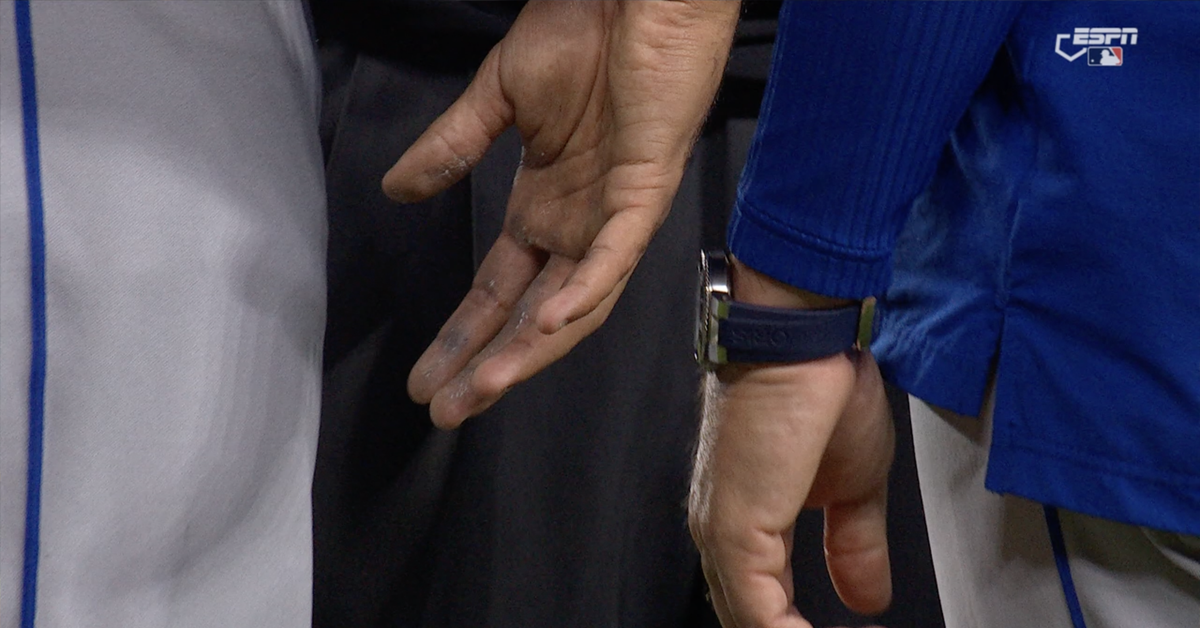
Keep mixing more and more sweat and rosin together – throw in some dirt for good measure or maybe throw in something a little stronger than sweat – and the concoction can cross the line and become too sticky, not to mention getting gloopy or grainy and starting to build up on the pitcher’s hand. After his ejection, Scherzer told reporters, “my hand was a little clumpy from the rosin.” If you saw the closeup of Edwin Díaz’s crusty right hand from ESPN’s Sunday Night Baseball broadcast, you’ll understand what he meant.
I have spent too much time staring at that closeup. I’m not sure what constitutes the right amount of time to stare at Díaz’s hand, but whatever it is, I have definitely exceeded it. I have brought the screenshot into Photoshop and zoomed in until the pixels swirled into an incomprehensible blur. I have played with the contrast and brightness, making whatever it is on his hand jump off the screen like the stripes of a clownfish under ultraviolet light.

I have stared for long enough that I found myself no longer analyzing the accretion and discoloration and starting to notice the finer details: The piping on Díaz’s pants. The way the array of stadium lights hit his hand to create five distinct sets of shadows just in front of the piping. The pleating of the umpire’s pants. The ribbing on Mets manager Carlos Mendoza’s sleeve. The fact that Mendoza seems to be wearing a $2,500 Aquis made by Swiss watchmaker Oris.
With the notable exception of Michael Pineda, who was nabbed 10 years ago thanks to an extremely visible patch of pine tar on his neck, I’m a bit surprised that we haven’t seen closeups like this before. Maybe it just took the extra cameras and relative objectivity of a national broadcast to make it happen. In the narrowest sense, the picture doesn’t change anything. Even if you hadn’t seen it, you had to imagine that Díaz’s hand looked and felt off in some way. And even if Díaz wasn’t using anything more than sweat, rosin, and dirt – and personally, I’m inclined to believe that he wasn’t – he clearly used enough that his hand crossed the line and merited an ejection.
But in the context of baseball as a whole, this picture, which shows so clearly the substance on the hand, has changed the contours of the story. A little information is a dangerous thing, and the picture allows everyone to become an amateur sleuth. Since the league started cracking down on sticky stuff, the ejections have followed a set pattern. We see a short video clip of the umpire talking things over with the manager and the offending hurler, and then after the game we get three quotes:
First, the pitcher insists that he was within the rules and tells the story of how he implored the umpires to believe him. “I just said I used the same thing as always,” said Díaz. “Rock rosin, sweat, and I put my hand on the dirt a little bit because I need to have some grip on the ball.”
Second, the manager supports the player, throwing in some amateur materials science for good measure. “I got his back,” said Mendoza. “I truly believe what he was telling us. Edwin said it was rosin and sweat. The one thing that he did say was that it was humid so he had to go to it a lot more than earlier in the year when it was cold. Maybe that had something to do with it. I believe my player and I’ll stand by it.”
Third, the umpire delivers a vanishingly brief quote to a pool reporter, resorting to poetry in order to express the delicate interplay of tackiness and human perception that determines the legality of a pitching hand. Quoth umpire Vic Carapazza:
I told him it’s too sticky
And we have to take action.
I knew
Right when I touched it. It was
Way
Too
Sticky.
It definitely wasn’t
rosin and sweat.
We’ve checked thousands of these.
I know
What that feeling is.
This was very sticky.
And then, having heard from all interested parties, we move on. But clearly, those quotes aren’t enough to really put a picture in your mind, because now that we have an actual picture, the set pattern has broken down. In this case, we got each kind of quote, but the visuals gave the story drama, along with enough staying power and enough specific questions that reporters were able to shake loose several more interesting details.
For starters, Díaz said he protested his innocence by encouraging the umpires to smell his hand: “I just said, ‘Hey, you can check my hand, smell my hand.’ They didn’t smell anything.” I’m dying to know what scents he thought they would have been hunting for, and generous though his offer was, it’s hard to blame the umpires for declining it. “Never smell anything that someone is trying very hard to convince you to smell” is a rule that everyone learns at an early age. But what I love is that when you see the quote out of context, there’s some ambiguity. It’s not immediately clear whether Díaz is saying that the umpires refused the smell test altogether, or whether he’s saying that they did take a whiff and decided they didn’t smell anything untoward. Either way, as a last line of defense, “They didn’t smell anything” is hard to top.
Carapazza’s line is equally evocative: “We’ve checked thousands of these.” These, meaning human hands. Not only is he correct, he’s underselling it. The number is actually in the hundreds of thousands. The umpires check those human hands at the top and bottom of every inning, which means that they get through a couple thousand every month. Since MLB instituted its tactical tactile tackiness enforcement policy in June of 2021, they’ve gently examined roughly 260,000 hands. They have found exactly eight wanting.

We also learned practical things, because this story made Major League Baseball feel enough pressure to lift the veil just a little bit. According to Will Sammon, the umpires decide whether or not to give the pitchers a chance to wash their hands based on “if the umpire feels the player crossed a line with being sticky… In instances where a player has been allowed to wash up, the umpire felt something tacky but not sticky – they have been trained on the difference – or the situation involved discoloration or dirt without any tackiness.” It would seem that Díaz’s dread right hand, which bore the unhappy triad of stickiness, dirt, and discoloration, never stood a chance.
From Andy Martino we learned how exactly Major League Baseball trained its umpires to tell the difference between tacky and sticky, between acceptable and ejectable:
Several people stood in a line, substances applied to their hands.
Some of the test cases used Spider Tack, others sweat and rosin, others pine tar, and so on, without being told which was which. Their instructions were simple: If the hand was sticky, an ejection was warranted.
“It was actually not hard,” said one person who participated.
Some of this story must be spin. It’s a tactical leak to disseminate the idea that not only is it possible to detect a doctored hand, it’s downright easy. I’m not sure I buy the premise, at least not out there in a game situation rather than in the pristine setting of MLB’s test kitchen. That said, the story sounds real enough. How else would you train umpires? But it also feels, in a certain way, just like the stories we usually hear about sticky stuff ejections. It’s hearsay that doesn’t quite put a picture in your mind, and every answer raises a new question.
Did this happen in a conference room at MLB headquarters? How closely did it resemble a middle school science fair? Who volunteered or got dragooned into serving as a test hand? Who actually doctored the hands? Who was teaching the umpires the exact location of the line between tacky and sticky, and how much gunk is too much gunk? Were the players or their union involved? If the procedure was so scientific and completely above board, why save it for an anonymous leak rather than trumpet it as a step forward?
I doubt we’ll get answers to these questions any time soon. The truth tends to come out in drips and drabs. But as we learned this week, a picture is all it takes to shake a little more loose.
Davy Andrews is a Brooklyn-based musician and a writer at FanGraphs. He can be found on Bluesky @davyandrewsdavy.bsky.social.
I want to know more about this training protocol. Was it double-blind? What was the sample size? Were there controls?
And also who’s hands were used? Were they all the same size hands, were they men’s or women’s hands? Did they have well manicured nails?
I’m more interested in knowing who’s sweat was used.
The simplest way to solve the issue to safely make it to the mound would be to have all pitchers wash their hands before entering the game and then use rosin and sweat after the check. Trevor May had a good video after the Diaz event explaining the reliever preparing to enter the game. My guess is Diaz is experiencing anxiety and overdid his warmup with the bullpen ball and his hand had too much of the ball rubbing off on his hand, which May says is real thing. Scherzer also did an interview bringing up these same points and continued to explain his frustration with the gray area with tackiness. I’ve heard players mention using technology to determine outliers with spin rate to help identify an abundance of tackiness. In Diaz’s case they argued he doesn’t rely on spin rate and that technology wouldn’t be a good indicator. Regardless it is a heavy blow to a surging Mets team, not being without Diaz, but losing a roster spot for 10 games.
I’m frustrated that the umpires can decide whether a pitcher should be ejected or can stay but needs to wash his hands. Either it’s too sticky or it’s allowable, there shouldn’t be a “too sticky but we’ll give you a second chance.”
Stickiness is a spectrum. The pitcher is adding stuff (dirt, sweat, rosin) in real time while pitching a baseball game. If it is possible to go over the line with legal substances, then pitchers will sometimes go over the line by accident.
And it’s not all that clear a line in the first place, given that it depends on an Ump’s judgment in the field without instruments it can’t be.
Given all this, sometimes a warning, “I think that you’re really close to the line, go wash your hand before the start of the next inning” is not an unreasonable thing to say.
Right, it’s not a bright line either way. It’s just a matter of whether umpires can, at their discretion, place players into two categories or three. I see no reason why the former is better.
Why?
Bingo. The umps get two layers of subjective judgment – whether or not it’s sticky, and whether or not it’s too sticky to wash. It’s ridiculous. Swab the pitchers hand and send it to a lab. If there’s nothing else there, the UMP gets suspended for 30 days without pay.
But that won’t happen because the umps union is stronger than the MLBPA.
Maybe Diaz should’ve gone for the ‘here pull my finger’ approach rather than the ‘here sniff my finger’ approach.
…Rosin? Is that not obvious?
I’m glad someone is finally talking about the important issue here: Carlos Mendoza’s ugly Oris wristwatch. Even adjusting our standards for pro athletes’ preference for overpriced, oversized ostentation, that thing is bad. Not a fan of this recent “handmade Swiss boat anchor” trend in managerial accessorizing.
Aaron Boone’s watch looks like something he bought at Wheelworks.
? An aquis is relatively tasteful. Pretty standard mechanical dive watch, not all that big either. Would you prefer if he wore an apple watch lol
Crisco, Bardahl, Vagisil
Ooh I love the final round of “$25,000 Pyramid!”
Things not to use as sunscreen…
things on Edwin Diaz’s hand on any given Saturday night…
uh, things you can use to cook in place of bacon grease in a pinch.
PASS, go on to the next one!
One account I heard claims that the white specks are from the ball leather from his bullpen throwing. I think if it was rosin it would be white all over, and not little specks.
Lets see…copy, paste in Word, delete the images…word count = 1,667
Wow, this picture was worth well over a thousand words!
Rosin is pine sap. Rock rosin is just the brand. If it’s somewhat damp and on something warm it smells very piney. Asking for the ump to smell his hand is rational except that it could be used to cover up other substances. Honestly they need to figure out a better system than a judgement call that could eject someone who is within the rules. David Cone’s example just underlines the point.
Also considering some players pee on their hands including pitchers it might be better to smell than touch!
A quibble, but umps have done 260k hand checks. They haven’t checked 260k hands. Unless you mean in the sense that our cells are constantly replacing themselves with new matter and I’m not the same person I was minutes ago. Then yeah, they’ve checked 260k hands. You never step in the same river twice.
I’d rather have a pitcher being able to grip the ball and throw it where they want than throw a slippery ball that could cause serious damage.
The player is responsible for throwing the ball accurately, not the substances. If a player can only throw accurately if using banned substances, the league is within their bounds to say “we want the best pure athletes, not the best enhanced players, so get güd m8 or gtfo the league”. When it comes to enforcing their rules, all I care about is being as objective and neutral as possible (no special treatment for Ohtani or Judge or whomever else) and hoping they change the dumb parts.
That said, I would watch the shit out of an “anything goes, steroids and spitballs” league, but that’s not what we have.
I wonder if he had lost a bit post injury and started doing this again while in milb or something
“gently examined roughly” is delightful prose
10 games losing both the player (who happens to be the Mets closer and best reliever) and the roster spot seems like an extremely harsh penalty for using a legal substance. How much is too much? Who’s to say?
I think if the check happens prior to the inning, the player should always be allowed to wash his hands. This subjectivity is really absurd.
Talk about poetry:
Several people stood in a line
Substances applied to their hands
Some of the test cases used Spider Tack
Others sweat and rosin
Others pine tar
And so on
Without being told
Which was which
Their instructions were simple
If the hand was sticky
An ejection was warranted
It was actually not hard