
The Tigers’ New Acquisition: A Teheran-Type, or Something Different?
In their contribution to the recent flurry of league activity, the Tigers and Pirates quietly made a deal last Monday: Pittsburgh sent right-hander Dario Agrazal to Detroit in exchange for cash considerations.
While the trade didn’t make headlines, it may still provide insight into Detroit’s 2020 plans. Agrazal, who turns 25 in late December, debuted this season with Pittsburgh and appeared in 15 games, making 14 starts. His results were mixed: He posted a 4.91 ERA and a 5.90 FIP over 73.1 innings, striking out only 13% of opponents while walking 6%. Among pitchers who threw at least 70 innings, Agrazal had the third-lowest strikeout rate in the majors.
Upon first glance, pitching to contact seems like a poor strategy in today’s three-true-outcome game, and Agrazal may ultimately be no more than a spare arm in Motown; we’re guessing that he’ll start the season in Triple-A. Still, under the right circumstances, Agrazal has the ability to turn into more than organizational depth.
One scout last Monday compared Agrazal to Julio Teheran, telling The Athletic’s Emily Waldon that Agrazal is “a backend starter, a pitchability guy with fringe stuff.” Another scout told Waldon that they believed the move was an “analytics-based” acquisition. Certainly, those are both thought-provoking perspectives, especially the comparison of Agrazal to a reliable mid-rotation starter like Teheran.
The two share a few things in common. Both Agrazal and Teheran rely heavily on their sinkers and each generated above-average results on the pitch: Agrazal held hitters to a .334 xwOBA against the sinker, while Teheran limited opponents to a .272 mark. Though both were better than league average, Agrazal’s sinker is likely to be classified more as “good” than “great,” while one could claim the opposite for Teheran. Still, having written about Teheran earlier this year, I was intrigued by the comparison. Looking at their sinkers, you can certainly some points of similarity, particularly the horizontal movement and spin rate.
| Player | Pitches | Velocity (mph) | xMov | zMov | Spin Rate (rpm) |
|---|---|---|---|---|---|
| Dario Agrazal | 625 | 91.2 | -9.5 | 5.9 | 2233 |
| Julio Teheran | 675 | 89.4 | -9.1 | 2.6 | 2264 |
Still, these are distinct pitches pitches. Agrazal’s sinker is a touch harder and has more vertical movement. To help visualize this, take a look at GIFs of both pitchers’ sinkers.
First Agrazal:
Now Teheran:
In both the data and the GIFs, we can see that Teheran’s sinker is flatter than Agrazal’s, which means we can probably find a better comparative sinker for Agrazal than Teheran. That isn’t great news for Agrazal, as Teheran’s sinker is the gold standard: hitters put it on the ground 55% of the time, and have hit only two home runs off of it over the past two seasons.
In order to find a better comparison, I went to the data, querying the most similar sinkers based on horizontal movement, vertical movement, and velocity. Here are the three best comps for Agrazal’s pitch:
| Name | Pitches | Velocity (mph) | xMov | zMov | Spin Rate (rpm) |
|---|---|---|---|---|---|
| Dario Agrazal | 625 | 91.2 | -9.5 | 5.9 | 2233 |
| Kyle McGowin | 145 | 90.9 | -9.7 | 6.0 | 2396 |
| Mike Wright | 133 | 92.2 | -9.6 | 5.6 | 2101 |
As we did before, let’s go to the GIFs to see these pitches in action.
Agrazal again:
Wright:
McGowin:
The shapes of these three pitches do look similar, though they generated wildly different results. Agrazal and Wright had success with their sinker last season, while McGowin mostly didn’t.
| Name | wOBA | xwOBA | GB% | pVAL |
|---|---|---|---|---|
| Dario Agrazal | .354 | .334 | 44.5% | 0.7 |
| Kyle McGowin | .614 | .558 | 42.4% | -10.5 |
| Mike Wright | .325 | .372 | 44.8% | 0.8 |
The groundball rate column looks particularly interesting. Despite the difference in overall results, all three pitchers generated relatively similar groundball rates with their sinkers. That makes sense, given their similarities but it prompts a question: if all three pitchers produced similar batted ball results, then why are their respective xwOBAs so different?
The answer is simple: exit velocity. For McGowin, hitters crushed the pitch, with an average 94.5-mph exit velocity. Wright was better at 91.5 mph, but neither pitcher came close to inducing soft contact at the same rate as Agrazal, who held hitters to an 86.4-mph average exit velocity against the sinker. (For another comparison, Teheran allowed an average exit velocity of 90.0 mph on his sinker.) Among the 153 pitchers with at least 10 batted balls against their sinker, Agrazal’s average exit velocity allowed put him in the 92nd percentile. Wright fell into the 22nd percentile, McGowin the 5th percentile.
This all comes with the caveat that a pitcher does not have total control over the quality of contact they allow — sometimes a hitter who should have barreled a pitch just misses, and the pitcher gets more credit for that than he deserves. But, over a large sample, there are examples of pitchers who consistently limit hard contact. Dallas Keuchel, for example, has done this for years. The question the Tigers are likely asking, though, is whether this is something they can expect from Agrazal going forward.
I broke down all 161 batted ball events against Agrazal’s sinker from 2019 in search of potential outliers that may indicate regression. There were a handful of abnormally low exit velocities, which were classified as mathematical outliers. That does not mean that Agrazal’s average exit velocity was a fluke; the median exit velocity against it was 89.3 mph, which is still quite good. The 3-mph difference between his median exit velocity and average exit velocity may point to at least some regression in the future, however. With that said, I feel more confident in believing that Agrazal has a knack of limiting hard contact. Of the 123 pitchers with at least 25 batted balls against their sinker, Agrazal’s median exit velocity ranked in the 80th percentile, near Kyle Hendricks and Dustin May, both of whom have excellent sinkers:
| Rank | Player | Median EV (mph) |
|---|---|---|
| 1 | Sandy Alcantara | 82.9 |
| 2 | Wilmer Font | 83.9 |
| 3 | Oliver Perez | 84.8 |
| 4 | Jimmy Cordero | 85.3 |
| 5 | Tyler Rogers | 85.3 |
| 6 | Andrew Chafin | 85.6 |
| 7 | Sam Coonrod | 86.0 |
| 8 | Zack Britton | 86.3 |
| 9 | Jordan Hicks | 86.5 |
| 10 | Manny Banuelos | 87.5 |
| – | – | – |
| 22 | Kyle Hendricks | 89.0 |
| 23 | Wes Parsons | 89.2 |
| 24 | Dario Agrazal | 89.3 |
| 25 | Jonathan Hernandez | 89.5 |
| 26 | Dustin May | 89.7 |
To discern how Agrazal induces soft contact, I explored similarities within the batted balls at or below 80 mph. Of Agrazal’s 161 batted ball events, 45 outcomes, or 28%, fell into this bucket. Of those, 35 came against right-handed hitters. And there is indeed a commonality between them:
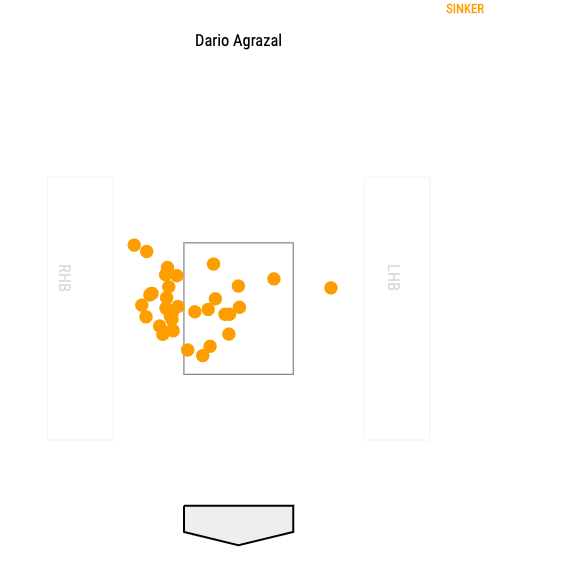
Because his pitch moved in towards right-handed hitters, Agrazal jammed them. As a result, he lowered his average exit velocity, generated groundballs, and found success with the sinker. If this is a repeatable skill, it’s a good one, and it could keep him in the majors longer and more often than most evaluators suspect.
For a rebuilding club such as the Tigers, this is exactly the type of pitcher to take a flier on. Another solid year with the sinker from Agrazal, coupled with further development of some of his secondary stuff, and the Tigers might be thanking the Pirates for this innocuous acquisition made on a November Monday.
Devan Fink is a Contributor at FanGraphs. You can follow him on Twitter @DevanFink.
some of the GIF’s broken? 403 Forbidden
Appears to be a Gfycat issue, not on our end. We expect it to fix itself soon.
I guess the thing about Teheran was this place projected him as a clear #1 up until, what, his second year in the majors? I could be wrong, I just remember his FV being SUPER high, and then not living up to it.
His velocity has dropped each season since he debuted in 2011. He was 92-96 in his early days, but has been sitting 88-92 in his last few seasons. The script would probably read much differently if he maintained mid 90’s velo throughout the years.
Well, the Tigers do need someone to start this year. Why not sign a guy who could turn into a useful back-end starter? The worst thing that could happen is that he’s bad and they’ll cut him. He’s kind of in the same position as whoever they get in the Rule 5 draft. I think he’s probably less deserving of a shot than Sterling Sharp of the Nationals (a starter in AA who might be able to stick all year on an MLB roster, and unprotected in the Rule 5), but the Tigers have enough room for both if that’s the direction they want to go.
love the tigers. they just have a backwards front office. Need to give reps to top tier prospects who are called up since they are rebuilding mode and not in win now mode. Yet they do the opposite. Reps go to 35 years olds with no future, or 5 year guys who have never performed.
The top tier propsects that get called up, have to perform “immediately” or they get sent back down to AAA(likely hurts them), or relegated to 1 game a week where they will never figure it out. You think since they are dead last and rebuilding they would do the opposite and develop for the future of 2022, and give the reps to those top prospects, but they don’t. Backwards.
I mean bregman for example, literally went 0-50 when he debuted…..astros stuck with him and let him figure it out. Dozens of other examples like this. The wins and losses don’t matter right now for tigers. this is perfect time for developing future.
On another topic, but sticking with the Tigers!….i have never seen a AAA manager speak about a top prospect publicly the way Doug M did at Toledo this year with OF Daz Cameron, Mike Cameron’s son. Hopefully he’ll bounce back. No wonder they fired Doug ha! Basically said, “he should be valeting cars” or something along those lines. Bitter guy.
Tigers farm is on the up! Really building a pipeline, but they need a less is more approach. Build up the techniques, swing adjustments, fielding tweaks etc, and not the mental games. It seems like way too many mind games and mental things going on at the farm than technique helping. The goal is to not ruin the players, but help them ha!
Not a fan. Yeah the sinker/changeup combo is solid on paper, but he doesn’t strike anyone out and his breaking ball is basically non-existent. There really isn’t much upside here, and the Tigers have a ton of mediocre options available already. They’re also a team completely lacking an infield, so trying the groundball/shift paradigm here doesn’t make sense from that perspective either. I can’t understand them rushing to add players with no upside rather than taking some shots at guys like Cotton, A. Sanchez, Bundy, etc. Of course the Tigers do nothing but pick up everything the Pirates cast off, which is obviously genius, so this comes as no surprise.
This is way overly harsh for a very small deal lol. They got an MLB arm to eat MLB innings, something they need to have in order to field a team. The existence of this deal doesn’t change their ability to get an infielder in the slightest.