
Things Have Turned Out Pretty Well for Jake Mangum
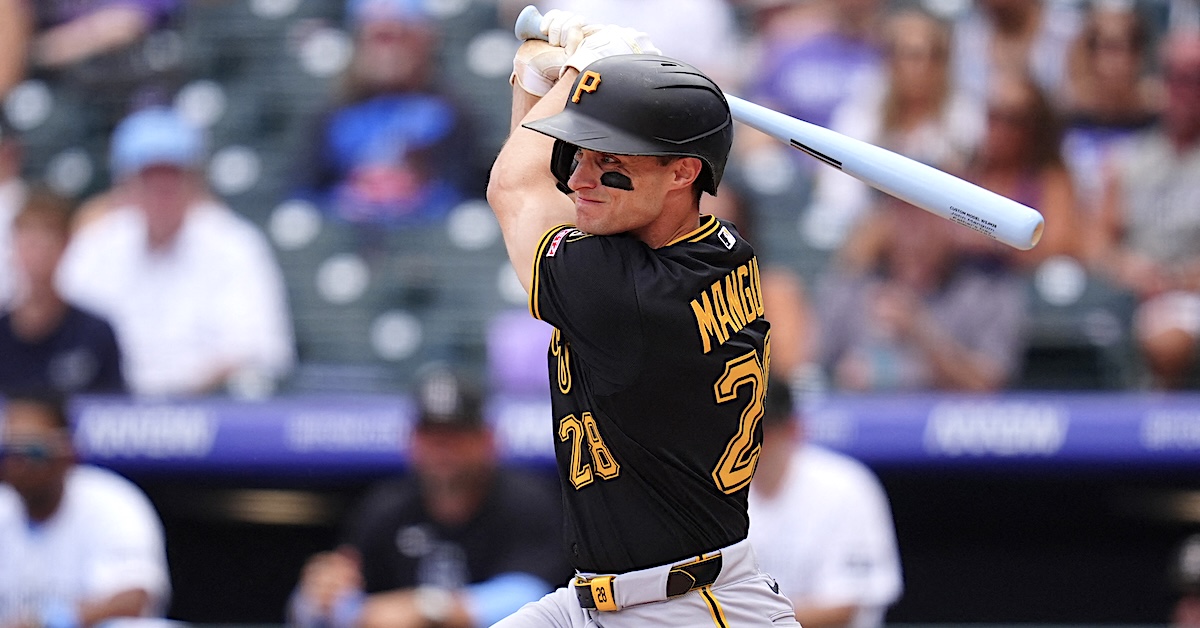
Not counting RotoGraphs posts, Jake Mangum has been a featured player in three articles on this site since the start of last season. In two of those — one each by myself and David Laurila — the phrase “Old School” appears in the headline.
I wouldn’t put too much stock in headlines, especially my own, but in this case it tells you everything you need to know.
Mangum, a legend at Mississippi State, has a style of play that firmly rebukes generations of baseball wisdom. That’s why I wrote about him last April; if you hate hitters who strike out too much and look to hit doubles and home runs instead of dinking drop shots behind the infield, Mangum is your man.
The reason nobody hits like this is that it’s incredibly inefficient. Modern pitchers, with their triple-digit velocity and hateful sweepers, strike out too many batters for offenses to put together a conga line. If a hitter slows down his bat to avoid strikeouts with men on base, he’s as liable to hit into a double play as he is to drive in a run.
I’m sympathetic to the argument that the modern three-true-outcomes-heavy style of play can be boring, but it’s easy to forget that while ballplayers are professional entertainers, they get paid to win by whatever means are expedient. Say what you will about Mangum’s playing style: It’s not expedient.
The modal outcome for a player like this is a career as a Triple-A veteran, and until last spring that’s where it looked like Mangum was heading. He can switch-hit, and run, and play center field; if a player like that gets along well with his co-workers, he can play in the upper minors for a decade — and maybe get the occasional stint in the majors as a fifth outfielder — before embarking on a coaching career.
But after being traded (as a player to be named later both times) from the Mets to the Marlins to the Rays, Mangum found himself in an unexpectedly advantageous position: As an outfielder with a couple legit major league tools in an organization with zero outfield depth.
Last year, Rays outfielders were 24th in the league in WAR, 26th in wRC+, and 30th in ISO. So Mangum got 428 plate appearances over 118 games, in which he hit .296/.330/.368 (95 wRC+). That’s… fine in a vacuum, but his 1.8 WAR led Rays outfielders in WAR by more than a win.
The Rays rewarded Mangum by including him in the three-team trade that sent Brandon Lowe to Pittsburgh. Perhaps they figured that with Chandler Simpson coming up, they only had room for one slap-hitting outfield speedster.
I don’t think Plan A was ever for Mangum to be an important player for the Pirates. But just like last year, a personnel crisis for the team has turned into an opportunity for Mangum himself.
With less than a week to go before the trade deadline (all stats from here on out are current through July 27), the Pirates are very much in the playoff hunt: They’re 55-52 and tied for the last NL Wild Card spot. As I write, they’re about an even bet (48.6%, to be precise) to make the playoffs. One year ago today, Pittsburgh’s Playoff Odds were literally zero.
The Pirates haven’t had a record this good on this date since 2018. They haven’t had Playoff Odds this good on this date since 2015, which is the last year they made the postseason. All this despite some serious flaws in the roster.
Most relevant to Mangum, the Pirates’ Opening Day center fielder, Oneil Cruz, couldn’t get through the first inning of the regular season before this happened.
Cruz hasn’t played in nearly two months, thanks to broken bones in his hand. Mangum has played in 40 of Pittsburgh’s 42 games since Cruz went down, 37 of them as a starter. In that time, Mangum is hitting .308/.345/.385, which is a wRC+ of 102. He’s batted leadoff in the past 13 games he’s started.
This novelty act is now a genuinely important player for a Wild Card contender. All while toting around a deeply flawed offensive game.
| Stat | BB% | K% | OBP | wRC+ | HardHit% | EV90 | BatSpd | Contact% | Chase% |
|---|---|---|---|---|---|---|---|---|---|
| Value | 4.8% | 17.4% | .348 | 98 | 25.2% | 99.2 | 67.3 | 81.8% | 46.9% |
| Rank* | 209th | 65th | 61st | 142nd | 217th | 221st | 219th | 60th | 226th |
Very, very few big league regulars swing the bat as softly as Mangum does. He’s in the third percentile for bat speed and the fourth percentile for HardHit%. Baseball Savant has credited only three of Mangum’s batted balls as barrels all season. Last Friday, Christian Yelich barreled three balls in one game.
And a lot of Mangum’s positive attributes are overstated. He’s a plus-plus runner, and he’s stolen 19 bases this year, but he’s also been caught six times. That’s still above the break-even point for stolen base percentage, but he’s 55th in success rate out of the 93 players with at least 10 stolen base attempts this season. Mangum is an average defensive center fielder: plus-2 FRV, which places him in an 11-way tie for 17th among the 44 players with at least 200 innings in center.
The best bat control players never strike out — Simpson, Luis Arraez, Steven Kwan, Nico Hoerner, and Ernie Clement are all in single digits in K% — while Mangum is striking out about as frequently as the heavy-swinging Yordan Alvarez and Bobby Witt Jr.
Mangum fouls off a lot of pitches — 43.5% of his swings this season have led to foul balls, which is the 10th-highest ratio out of 199 players with at least 500 swings — but that’s a value-agnostic stat. Fouling the ball off is better than missing it entirely, but it’s not the point. You could argue that stockpiling foul balls is one way to work the count, which is an essential function of a leadoff hitter. But Mangum is also running the highest chase rate in the majors this year, so he doesn’t run many deep counts. He’s seeing 3.68 pitches per plate appearance, which is 186th in the league.
So we’ve got a contact hitter who swings at everything, never walks, never hits the ball hard, and actually strikes out as much as some sluggers. He’s a speedster whose center field defense is only average, and his basestealing isn’t as valuable as the raw numbers suggest. All the quiet competencies a grinder is supposed to do well are either an illusion or overstated.
And yet, Mangum has been incredibly important to the Pirates because he’s done one big thing extremely well: He gets on base.
Yes, the Pirates’ success this season has had a lot to do with hitting big on big prospects: Cruz, Paul Skenes, Konnor Griffin, Braxton Ashcraft, Nick Gonzales. (Even if, Ashcraft and Gonzales notwithstanding, those players have been hurt, inconsistent, or both, for big chunks of the season.)
But what’s gotten them over the hump, or at least onto the hump, has been a series of smaller moves that turned deficiencies into areas of at least OK-ness. All of a sudden, they have the depth not only to fill out a lineup, but to weather injuries to Griffin and Cruz, as well as a key on-base guy like Spencer Horwitz. Mangum doesn’t do too many things well, but he’s sprinkled enough detritus into the outfield to get on base more than a third of the time. The little things I could take or leave, but Mangum is doing a hitter’s most important job well enough to be a key player on a potential playoff team.
Michael is a writer at FanGraphs. Previously, he was a staff writer at The Ringer and D1Baseball, and his work has appeared at Grantland, Baseball Prospectus, The Atlantic, ESPN.com, and various ill-remembered Phillies blogs. Follow him on Twitter, if you must, @MichaelBaumann.
Great profile on an interesting player!
“Sprinkled enough detritus into the outfield to get on base” is a phenomenal way to describe a slap-happy singles hitter.
I love how this ended up being a positive piece and yet my primary takeaway is “man, Mangum sucks even more than I thought”
Dude’s in the first percentile in Chase% but 73rd percentile in K rate. That’s different. He isn’t an 80 grade hit tool guy; probably not even a 70 (currently at a 21% Whiff rate). 3rd percentile Bat Speed and bottom half Squared Up percentage.
His maxEV would put him 76th in baseball if it were his EV90 (he’d be tied with Ivan Herrera). He only has two home runs, but they both would have been out of 29/30 ballparks (one wouldn’t have escaped Oracle Park, but the other was a 30/30).
Despite that, he’s running a slightly above average wOBA. None of this makes any sense.
The primary difference maker in his profile seems to be a preternatural ability to leg out infield hits. He’s hitting the ball on the ground over 60% of the time, and 15.4% of his groundballs are infield hits, which is pretty easily the highest mark of any hitter the last two seasons (min. 700 PA). Matt Shaw is a tick higher if you drop the minimum PAs to 500, but Shaw has a pretty average LD/GB/FB distribution and is thus hitting ground balls at a much lower rate than Mangum.
It’s starting to look like the modern Moneyball strategy is valuing speed, solid up the middle defense, and opposite field ground balls, as MIL and TBR are respectively 1-2 in GB% and 2-3 in oppo%. If that’s the case, Mangum is the modern-day Kevin Youkilis, as he has the highest GB% & oppo% of any hitter with 700 PA over the past two years alongside a 95th percentile sprint speed.
Tampa Bay and Milwaukee are also 1 and 2 in total bunt hits this season. What’s old is new!
Also as a note, Mangum has 4 bunt hits this year, tied for 17th in the league. So he has that in his toolkit as well, but it’s a minor part of his success this year at best.
In regards to being unusually good at legging out infield hits, shades of Norris Hopper (look him up).
mhm, not even if you normalize for BABIP. Then again his BABIP has been locally consistent in two years in the majors, he has a .300 average in 1000+ PAs in AAA, which is a good sign of traditional contact. And he must have an excellent eye for strikes that are good to him. tbh that is kind of an area that we as a Community haven’t conceptualized well. Like you know, you could have that skill in of itself without being either Vlad Sr. or Jack Cust, or so.
Also is it possible that in the 85-05 era teams kept this type of player around less as AAA-AAAA-3.5th outfielder types in their late 20s?
I was looking at his swing data on Savant, and he’s not an outlier in terms of quality of contact: he’s on time and squaring up below average but in the middle of the pack, surrounded by guys who are known as good hitters. His swing speed & launch angle* mean he’s not barreling balls, but that Whiff% doesn’t translate to a lot of bad contact: when he’s not fooled, he’s not rolling it over or popping up (unlike a lot of TTO guys who are actually FTO, with the fourth being lazy flies and easy rollers to the opposite side).
*worst thing a soft swinger can do is put it in the air
The baserunning discussion gives him short shrift: while his base stealing is only OK, his overall BsR is 2.4, which is top 25 among 175 players with 300 PAs—0.3 behind Elly De La Cruz, who has 30% more PAs. I think people like to praise De La Cruz’s baserunning as valuable?
It’s a weird profile, but it is adding up to a 2.2 WAR/600, which is a hell of a thing for a 4th (5th?) OF.
I’m not counting on him sustaining it, but a team that was planning on running out a Reynolds/Cruz/O’Hearn outfield in PNC was always going to be a team that should keep a few fourth OFs on hand. Which must be why Billy Cook is still a thing.
I also wonder about Mangum’s defense–small sample size, but +2 in 338 innings in CF is a very good rate. The problem is that -1 in 185 innings in LF is a bad rate. Too soon to tell, all over.
Fascinating profile. A riddle inside of an enigma on this one.
I’ve watched Mangum a lot this year and he swings at too many pitches out of the zone. It leads to foul balls or worse soft contact right at infielders. He hits into more double plays than someone with is speed and hustle should.
Overall, he is a fine player that should start twice a week and provide late inning pinch running and defense most of the time.
Nasim Nunez is a similar player. Gets on base with zero power.