
Trade Season Comes in Like a Lamb
With the draft and the All-Star Game out of the way, the next waypoint on the baseball calendar is the trade deadline. In other words, it is officially Trade Season. And the Royals and Pirates kicked it off on Wednesday morning with the first deadline deal. I got a little excited; sometimes, when the Royals and Pirates make a deal, you end up with Sir Francis Drake’s invaluable contribution to the defeat of the Spanish Armada at the Battle of Gravelines in 1588.
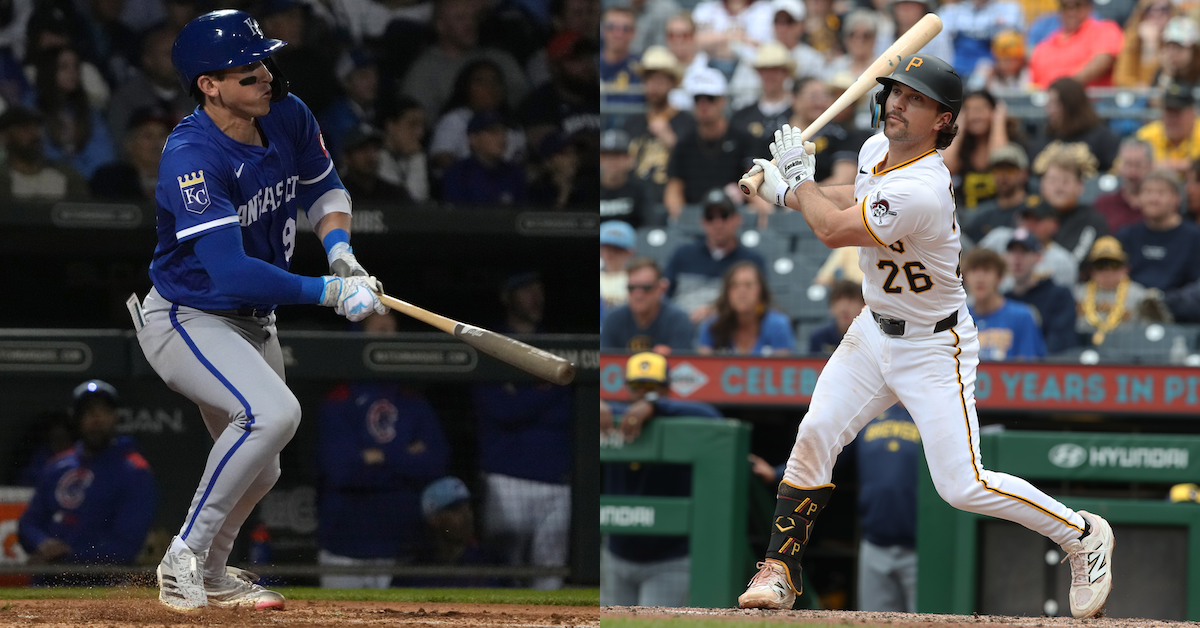
This was not one of those times. Kansas City sent minor league infielder Cam Devanney to Pittsburgh in exchange for Adam Frazier.
OK, so on the one hand, the Royals’ second base situation could not be much worse. Last year, Michael Massey was about a league-average hitter with a low OBP but a little bit of pop; I was definitely open to the possibility there was something there. He’s currently on the IL with a wrist injury he sustained while rehabbing an ankle injury, and not to be insensitive, but the Royals don’t miss him much. In 44 games and 176 plate appearances at second base, Massey has hit .202/.221/.258 this year.
The second-most commonly used Royals second baseman this year is Jonathan India. Again, I thought he could be a useful piece when Kansas City picked him up over the winter; he gets on base, at least. But in 39 games at second, he has just two home runs and a .353 slugging. Better than Massey, but not what I’d call good.
At the break, the Royals are 47-50, with an 11.6% chance of making the playoffs. Almost all of that postseason potential is in the Wild Card spots, because the Tigers have already lapped the field in the AL Central.
I know the orthodox viewpoint, at least for people in jobs like mine (people who are good at math and won’t shut up about it), is that the Royals should pack it in and reload for 2026. But I disagree. Especially in a market like Kansas City, there’s value in maintaining the momentum this team built with its surprise run to the ALDS last year. Besides, the Royals’ second base situation is a blessing in disguise.
Through 101 games, the Royals have bled nearly a win compared to replacement level, and four wins compared to the Tigers, through anemic production at second base. On the other hand, that makes this situation both easy and cheap to fix.
At least in theory. I am skeptical that Frazier represents such an upgrade.
Since 2020, Frazier — now 33 years old — has had one OK season as an infielder-without-portfolio for the Orioles in 2023, and one genuinely good half-season with the Pirates in 2021, which precipitated a blockbuster move to the Padres at the deadline.
Those two campaigns convinced some GMs that Frazier is a latter-day David Eckstein, an undersized spark plug who plays winning baseball. (Indeed, he’s currently on a run of three straight playoff appearances with three different teams.) I thought Anne Rogers, the Royals beat writer for MLB.com, summed the situation up quite well:
“While Frazier is certainly not the impactful offense upgrade the Royals will seek as the July 31 Trade Deadline nears, the club has long thought its bench needed a veteran presence to give what the industry likes to call a “professional at-bat” — working the pitch count, working a walk, poking a single the other way, moving runners over or getting them in from third, etc. — coming in late in games when needed.”
Those GMs who labor under this assumption have thus passed Frazier back and forth like a jumbo tub of popcorn at a movie theater; this was his second stint in Pittsburgh, and it will be his second stint in Kansas City, too.
In reality, Frazier is hitting .235 over the past three and a half seasons, and his 2025 strikeout rate, 17.2%, is simply not acceptable for a player with as many home runs all season (three) as Kyle Schwarber has since the ninth inning of the All-Star Game ended.
My view on Frazier is that veteran presence, while ineffable and hard to quantify, has some value, especially on a team with as many young position players as Kansas City. But experience is plentiful, and accordingly ought to be bought on the cheap. Frazier has eight games and 32 plate appearances’ worth of postseason experience, in which he hit .194/.219/.226. Surely the Royals could’ve found and signed a guy with those credentials off the street. I know this because all Kansas City gave up was a 28-year-old minor league infielder.
Except, apparently this one, Cam Devanney, has some juice thanks to a recent swing change. “Devanney has been lifting and pulverizing everything soft in the zone to all fields, hitting 11 home runs before Memorial Day,” Eric Longenhagen and James Fegan wrote in this year’s Royals prospect list.
Devanney has added another seven home runs in the seven weeks since Memorial Day, and is currently rocking a 137 wRC+ in Triple-A while playing shortstop most of the time.
It’s not a good farm system, especially for position players, and double-especially now that Jac Caglianone is one game from graduation. But Devanney was the 10th-ranked prospect in it. The ideal price to pay for Frazier is “nothing,” and the Royals gave up more than that. It’s especially puzzling because Devanney seems to me like a reasonable option at second base for the major league club. They could’ve tried him there for free!
This is a lot of ink spilled for a pretty inconsequential trade. Like, nobody really cares about this deal except Frazier and Devanney themselves, and the two clubs’ traveling secretaries, who’ll probably forget it happened after they finish booking everyone’s flights.
But it’s the first deal of deadline season, and we’ve already learned two important lessons for the next two weeks.
First: Real blockbusters, deals in which a true game-changing player moves, are getting harder and harder to pull off. Most of the 30 baseball ops potentates, whatever their title, learned their craft the same way. Most owners’ commitment to winning only extends so far financially, which makes kicking the can down the road in the name of “sustainable winning” an easy sell for an executive who wants to keep his job.
In order for a trade to happen, you need one or both of two things: Conflicting evaluations of the players involved between the participating teams, and conflicting goals between the participating teams. When everyone has the same evaluations and the same goals, those conflicts don’t come up very frequently.
With that said, a flaw, like second base for the Royals, is a huge opportunity. Great players move infrequently, but mediocre players move every day. And when mediocre is an upgrade at a certain position, a team can get much better really quickly and really cheaply.
That’s what could have happened here for the Royals.
Second: I think every team is appropriately aware of its own top prospects, and appropriately conservative about trading them. But some clubs — the Rays and Dodgers are legendarily good at this — are really good at picking out players from the middle or the bottom of another team’s prospect list right before they break out. So if you’re giving up nothing for some veteran presence, make sure you’re actually giving up nothing. And not, potentially, a better player than the one you’re adding to help you win now.
Michael is a writer at FanGraphs. Previously, he was a staff writer at The Ringer and D1Baseball, and his work has appeared at Grantland, Baseball Prospectus, The Atlantic, ESPN.com, and various ill-remembered Phillies blogs. Follow him on Twitter, if you must, @MichaelBaumann.
My first reaction to this trade was: “Why would the Royals do something like this? Why do the Royals think that Adam Frazier is better than Cam Devanney today?”
I know there aren’t a lot of middle infield upgrades available this trade season but when you trade a middle infield prospect who is MLB-ready for a rental middle infield prospect who is barely above replacement level, shouldn’t you be looking for a guy who is actually an upgrade over the one you’re trading? Frazier is about replacement level right now, it is entirely possible that even Nick Loftin is as good as Frazier is.
Let’s not get carried away now.