
We Might Already Have the Season’s Worst Called Ball
From time to time, every year, I like to look at bad called strikes and bad called balls. The availability of PITCHf/x information makes this fairly easy, and, when isn’t it fun to examine the extraordinary? The point generally isn’t to rip on a given home-plate umpire. It’s more about trying to figure out why what happened happened. What has to take place for a ball to get called a strike? On the flip side, what has to take place for a strike to get called a ball?
This is the post about last year’s worst called ball, as determined by distance from the center of the strike zone. The pitch was thrown by Jeff Samardzija, and it missed the very middle by 1.2 inches. Still, while it was down the pipe, it was ruled in the hitter’s favor. A distance of 1.2 inches is a very small distance, so you can see why that was extreme. Now skip to 2016! This season is only barely underway. They’ve played less than four percent of the games, but we might’ve already seen the worst called ball. A pitch was ruled a ball even though it was to about the same spot as Samardzija’s, and the pitch was thrown just last Saturday by Clayton Kershaw.
Kershaw could’ve had more than one legitimate dispute. For example, this was called a ball, even though it was five inches from the middle of the zone:
That was a perfectly adequate first pitch to Madison Bumgarner, in the bottom of the fifth, but the umpire wasn’t feeling it. So Kershaw might’ve felt squeezed for a few reasons, but here’s the big one. Kershaw faced Hunter Pence in the bottom of the first, and Pence drew a walk. This was the first pitch — a called ball:

The lines should tell you everything. Even though, sure, it’s impossible to know the exact location of that ball on its way to the plate, we’re looking at a fastball, thigh-high, just about splitting the zone. Okay, the camera angle is off center. That shouldn’t make too much of a difference, but, PITCHf/x isn’t biased, right? PITCHf/x was all over this, too:

1.4 inches. More precisely, 1.35 inches, but the cameras have a margin of error. So we’ll go with 1.4 inches from the center of the strike zone. Add in the error bars and maybe it’s, what, between 1.2 – 1.6? Something like that. It’s comparable to last season’s worst called ball, so it might stand as this season’s worst called ball, even though it happened on April 9. I guess April 9 has roughly the same chance as any other day. We should look at the pitch in action, to try to figure out what happened:
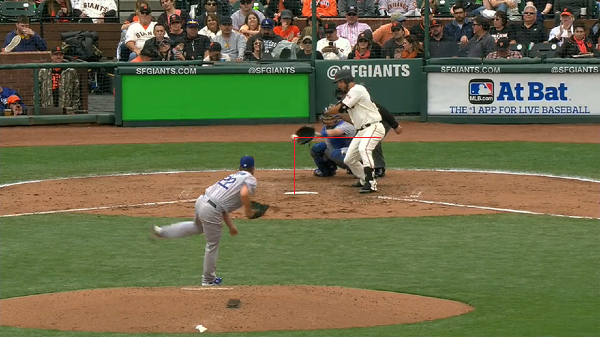
It was a first pitch, so it’s not like the umpire was tightening the zone with two strikes. It was a fastball, so it didn’t have a ton of break, and A.J. Ellis didn’t get crossed up. And, you know, this was Clayton Kershaw, who you’d think would usually get the benefit of the doubt. But when I’ve looked at these events, I’ve seen some commonalities, and this one fits a pattern. Sometimes these calls happen because the catcher immediately tries to throw to a base. Nothing like that here. But look at where Ellis set up. He wanted a fastball down and in. The umpire stood behind Ellis, well inside. The pitch missed up and away, relative to the target. That made it more difficult for Ellis to catch, and the pitch would’ve looked more outside, considering where the umpire stood. This is not to forgive anyone for a called ball on a fastball down the middle, but what’s been true before is true here: these calls generally don’t happen without a missed spot. Kershaw had the right to be annoyed, but it’s not like he wanted that fastball where it went.
Still, I’m surprised. Kershaw didn’t miss horribly, and Ellis didn’t even do a terrible job of receiving. Frequently, catchers drag these pitches out of the zone away. Their glove darts off to the side and they can’t stop its momentum. Ellis, to his credit, did stop this pitch about where it was, and where it was was right down the middle. So I put this one mostly on the umpire. You can examine the body language. When Ellis caught the ball, he was clearly caught off guard by the lack of a strike. And Kershaw didn’t quite know where to look for help:
There wasn’t going to be any help. There was nothing anyone could do to help. Balls and strikes can’t be argued without an ejection, and it’s not like Kershaw is in the business of getting tossed. You just can’t blame him for his visual bewilderment, because for one pitch, everything he’d ever been taught about the strike zone was a lie. There was a tear in the fabric of baseball, and for a fleeting moment, Kershaw looked into the void. For an instant, one and one was three. In all other instances, one and one is two, but there was a little hiccup in the code. I don’t know what that feels like, but I know it would be weird to throw the next pitch. And A.J. Ellis, for his part, had something in store for that one:
It was another questionable called ball, although plenty more defensible than the first. Watch Ellis, though. After the first pitch, Ellis held the ball frozen for 0.4 seconds. After this pitch, Ellis held the ball frozen for 1.4 seconds. A whole extra second of holding the baseball in place, just to make sure the umpire knew where it was. It’s passive-aggressive, but it was a way for Ellis to stand up for himself and for his pitcher without getting the boot. There are surprisingly few ways to do that.
I always enjoy seeing how the various broadcasts respond to these. The Giants’ TV broadcast was right on it:
Kuiper: And the first pitch is wide, one ball and no strikes.
Krukow: Kershaw wants to know why that was wide.
Kuiper: Yeah, that looked like a strike.
Krukow: I think for the most part with Brian O’Nora, the plate umpire, you have to put it between the catcher’s knees. If you go outside the knees, even if it goes across the plate, rare do you get that strike. That last pitch was an example of it.
I don’t know if Krukow is right, but at least it’s a theory. It’s something, to address what the viewers had just seen. There’s observation here, and objectivity, and an attempt at an explanation. Meanwhile, on the Dodgers’ TV broadcast:
“Hunter Pence out of the cleanup spot.”
[pitch]
“…both the cleanup hitters today have struggled against the opposing ace.”
Didn’t just ignore the weirdness of the pitch. Ignored the pitch entirely. Didn’t say a thing. As for radio broadcasts? Giants radio called the pitch outside. Giants Spanish-language radio called the pitch “afuera,” or outside. Dodgers radio called the pitch low and outside. Dodgers Spanish-language radio called the pitch “bajito,” or a little low. Technically, all of them were wrong — the pitch was none of those things, because it was down the middle. But Dodgers English-language radio was the most wrong, because it accused the pitch of having two problems, instead of one. Low and outside? There’s a decent chance the announcer wasn’t looking and decided to just make something up. I guess it isn’t important, outside of these blog posts.
Clayton Kershaw: called ball, right down the middle. If it can happen to him, it can happen to anyone. From start to finish, Kershaw threw 91 pitches, and none of them were closer to the center of the zone than the first pitch to Pence, which put Kershaw behind 1-and-0.
Jeff made Lookout Landing a thing, but he does not still write there about the Mariners. He does write here, sometimes about the Mariners, but usually not.
Interesting. Both pitches look like strikes from here. That first one is inexcusable. Ellis looks like he’s moving and stabbing/reaching a lot though. Plus he’s off center and not square. Seems like a recipe to lose your pitcher some calls.
Not to mention for some reason the ump decided to look over the outside shoulder of Ellis, putting him even further from the strike zone. I’m sure from where he was looking, the ball did look outside, especially when combined with Ellis reaching across to grab it.
Umpires are required to stand over the catcher’s shoulder between the catcher and batter. They made umpire positioning uniform a few years ago to improve consistency and reduce the change of an umpire getting hit with a foul.
Right, but the point is if the catcher is set up off-center, then the umpire is out of his normal uniform position. Ellis stabbing at the pitch and not holding it steady definitely didn’t help. He must have thought it was right down the middle, don’t have to worry about framing this one.
I felt the same way about the first call: in freeze frame the ball is clearly right over the middle of the plate, but watching the video Ellis’ stabbing motion carries the ball out of the zone. I’d have to categorize this one a bad call by the umpire but also a bad framing job by the catcher.
Kershaw’s reaction is priceless.
ROBOT UMPS
But but but… we can’t remove the human aspect from the game. MY GOD, THINK OF THE CHILDREN!
Yeah, I’ve never understood the idea that getting a call wrong is ‘just part of the game’. Some people seem terrified by getting every call right, and I honestly don’t get the resistance. ‘Human element’ just seems to be a euphemism for ‘it’s ok to get it wrong’.
The poor children who would have become umpires will have to grow up to do something else that involves visual acuity and occasional dickishness.
Art critic maybe?
Lol.
Whenever someone tells me they love the human element that umpires bring to the game, I want to ask them, “so tell me, what are some of your favorite missed calls in history?” On some mystical touchy-feely level these people want the human element. But in practice no one likes a blown call.
MLB could devise a pitch-review system that is similar to tennis. Each batter gets x number of reviews. If the batter objects to a call, ask for a review and put the results on the jumbotron for all to see.
It’s all about where the catcher is set up. The catcher’s body is well inside, and he reaches across his body to make the catch, so the pitch looks outside.
While I personally support using robot umpires, the human umpiring errors become a lot less infuriating if you think of them as random and relatively uncommon events, i.e., luck.
From that perspective, having a strike called a ball is like, say, getting your pitch blown sideways by a sudden gust of wind.
Baseball wouldn’t be baseball without the unpredictability element. And, the umpiring controversies are arguably an integral part of some fans’ (and sports writers’) enjoyment of the game.
I think the main issue is many people suspect the umpires may be biased (not random) or think the errors occur too frequently (not uncommon).
We know umpires are biased, just not for or against specific teams or pitchers, so far as we know. One bias we know about, for instance, is that they call a bigger zone on 3-0 than on two-strike counts.
” the umpiring controversies are arguably an integral part of some fans’ (and sports writers’) enjoyment of the game.” Then we should get rid of the best umpires and keep the worst.
Framing is measurable skill. Why would we want to take this out of the game? A better catcher might have sold this better. Though, in this case, it’s hard to see what Ellis could have done different. MLB should regularly review this data and go over it with the ump in question. I like to think that his goal is to call the best game possible and will be open to advice to improve his umpiring.
I’d love to see someone’s team lose the World Series on an awful, obviously wrong call, and still joyfully espouse the benefits of the ‘human element’.
So I gather you’re not a Cardinals fan. Ever heard of Don Denkinger?
In that case, let’s just have a random ball/strike generator. Doesn’t matter where the pitch ends up, it will have, say, a 63% chance of being called a strike.
Why assume its random variation? There’s no time during history that gambling hasn’t been involved in sports, yet fans assume that their time is clean. The subjects of this story are far from unique. Umpiring often radically affects the outcome of a game, yet umpires are graded in such a way that it becomes meaningless. Fans wondering what is going on are insulted by a mumbling Joe Torre citing meaningless measurements. Reporters either don’t dare to write about the subject or are too ignorant.
Prior to robot umps, there could be hard questions and an examination of performance. Without a scandal, I doubt it happens any time soon. All is well is what Manfred and Torre will say no matter what the facts.
“It was a first pitch, so it’s not like the umpire was tightening the zone with two strikes.”
This alone should tell you that umps should be removed from calling balls and strikes.
Ump tightens zone. Ump won’t give call to rookie. Ump widens zone because pitcher is around plate.
These alone should get ump fired.
Yikes. I’m glad one minor mistake or decision that I make over the course of making 100 decisions a day isn’t enough to get me fired.
(Of course the umps can and should do better, and call a more consistent zone regardless of the pitcher, regardless of the count. Still, a call for firing is a tad overdramatic.)
I expected this article to be about Dellin Betances. Betances snapped off a slider on opening day for strike three and the third out straight down the middle of the plate. It was called a ball and the next pitch was hit for a double costing the Yankees the game.
Nobody will ever feel bad for those Yankees when all they do is buy players that other teams had to develop for them. You want a team to feel sorry for, look at those Tampa Bay Rays! They have a top-3 pitcher in baseball in Chris Archer, a top-3 3B in baseball in Evan Longoria, a top-3 OF in baseball in Kevin Kiermaier. They even have Enny Romero for goodness sake! Will somebody give them a championship already?
Yeah, DeMuth definitely blew the call, but I had it as knee-high and practically on the corner. Not so outrageous as to really stand out.
The overhead camera showed it to be well in from the corner. It looked closer to the midline than the corner. It was so egregious, when I saw I immediately thought “this will make one of Sullivan’s posts about the worst called balls.”
Yeah well, Jeremy Giambi was safe and Jeffrey Maier. Bad calls against the Yankees don’t count as they still have a long way to go to achieve karmic balance.
Because over the 100+ year history of the Yankees playing baseball, those 2 calls mean they DEFINITELY are way ahead in terms of bad calls.
I find it especially ironic you bring up those calls, since every view I can find shows Giambi as soundly being out, and Maier’s grab being in the realm of “kinda, possibly”.
I’m far from a Yankees fan, but you can’t put down an entire fanbase and say “yeah, well, you can never complain about bad calls ever.”
I don’t recall the Giambi play being controversial at all. He himself never argued it, so I am sure he knew he was tagged before touching the plate. But by not sliding, he made it easier to be tagged.
As for the Maier play, if you see where Tarasco was set up, it looked like the ball was going to hit much higher up on the wall than where he was planning on, he didn’t even attempt to leap for it, or else his glove would have come close to where Maier’s was. I don’t think the ball had enough downward trajectory that would have caused him to catch it by just standing there. My thought was if Maier wasn’t there, that ball hits off the wall, makes Tarasco look like a fool, and Jeter would be standing on second, maybe third if the ball caromed far enough away. I don’t recall Tarasco as being a particularly good fielder, so a misplay by him is certainly plausible.
For all of you crying for robot umps consider this. The margin of error for robot umps is roughly 1.5 inches, about the same as human umps on average. Sure errors as egregious as the one in this article would be avoided…but other problems could arise. The strike zone changes based upon the hitters height, stance, and location in the box. It is also 3 dimensional while those 2D pitch boxes only show where the ball finishes. Suppose a ball bounces off the back of the plate but barely catches the front edge of the zone? Those foolish boxes would cause cans to cry about it being a ball but it does in fact cross the zone. I think umps can certainly try to improve their consistency, but robot umps may solve one problem and create many more.
Granted, each player has a unique strike zone based on height and stance, but those could easily be set during spring training or when the player first comes up.
But where do you get the bizarre idea that the strike zone changes based upon the hitter’s location in the box? The horizontal element of the strike zone is defined by the plate. The box or the hitter’s position in it has nothing to do with it.
I get the bazaar idea that where a hitter stands in the box changes the zone because while the left and right will not change, the strike height is relative and a hitter up in the box will have different zone vertical zone than in the back of the box relative to the plate. For instance a hitter who was in the back of the box vs the starter moves forward vs a reliever, and therefore a changeup at the knees that is dropping may/may not be a strike depending sice it is with respect to the hitters knees and not some immovable fixed point in space.
Is it a charity bazaar? Or more akin to a crowded Moroccan street scene with rugs and mysterious meats for sale? I need to know more about this bazaar idea.
um byron… you are 100% wrong… home plate defines the pentagonal prism that the ball must cross… the hitters dimensions (knees, belt buckle, whatever) defines the vertical placement of the upper and lower limits of the pentagonal prism defined by the plate… batter placement in the box has ZERO effect on the strike zone (as defined in the rules)… the one that really ticks me off is this… a GOOD 12-6 curveball pitcher can easily bounce a ball off the plate with a pitch that catches the lower front edge of the strike zone… you NEVER see that called… conversely the same pitcher can catch the very back corner of the prism that by rule IS the back corner of the strike zone, that is up in the eyes of the hitter… calling the strike zone PROPERLY would make 12-6 curve-ball pitchers (who can paint the corners) virtually unhittable… but alas we will NEVER see the strike zone called properly (as defined in the rules) by human beings… if we can shoot a satellite into a 10 square mile box from 3 billion miles away, we most certainly have the technology to automate balls & strikes!!!
Consider the bazaar, where shock is standing on the change in the region for some time left and the right has not changed, but the fighters attacked relatively high in a vertical cross-section will have two more on areas related to the matrix. For example, a fighter must remain in the area before moving against anti-knee boots and a presentation to his bullpen, withdrawal may or may not directly address the conference on the occasion Taiku murderer, is not it.
I don’t know if MLB really wants a strike to be called if it nips the pentagonal prism at any point in its flight path. They could just have the robo-umpire call it a strike if it hits anywhere in a rectangular vertical plane that faces the pitcher, in the center of home plate (at the vertex where the slanted edges of home plate begin).
Also, as we learned from Microsoft’s Tay, all robots eventually become racist monsters. Do you want this in baseball?
If MLB switched to an automated strike zone, it would need to be calibrated for players before each game, likely during batting practice and warm-ups. Logistically, that’s not very difficult to do.
As for the accuracy of the system, I’ve always subscribed to the theory that perfect should not be the enemy of good. So, if it represented even a 30% increase in ball/strike accuracy, without disrupting game pace, I say it is worth it.
The rules for the strike zone specify the batter’s “natural stance” and “usual stance when he swings at a pitch.” Presumably, those would not change very often or at all. They could set it once and use that until or unless the player claimed that he had changed his “natural stance”, in which case it could be recalibrated.
When you miss big away from the umpire’s line of sight(Away from LHH vs. in to RHH with catcher sitting away, strikes or stri-balls are often called balls.Also when the catcher loses contact with the umpire by pivoting his shoulders away from the umpire the same is also true.
JW
Ha ha I knew exactly which pitch this article would be about just from the title.
I was watching the Dodgers TV feed and remember them not particularly mentioning this. They may have said something on the next pitch but I can’t be sure.
I sometimes feel a mixture of pride and sadness when my pitch recognition apparently laps the broadcast; in this case, the moment this happened, I said “that was down the middle.” Either they couldn’t tell or they were paying attention to other things.
What would Vin Scully have said if it was a home game?
I was listening to this game (from England) on MLB At Bat via the Giants radio broadcast. They were definitely all over this, commenting that they weren’t sure how that pitch could be called a ball and going so far to say it was right down the middle. I’m not sure I’d heard announcers for the opposing team be so surprised at a missed ball/strike call that went in their favor. I’ve been hoping to see something written about the pitch so I could see what it looked like. Thanks!
I think Krukow was dead-on about O’Nora, seeing how Ellis caught the pitch just outside his right knee.
But I still can’t figure out why O’Nora would be setting up over Ellis’s left shoulder. Was he setting up there the whole game, and simply slid to the left when Ellis set the target inside? I would think he’d get a better view by shifting back over Ellis’s right shoulder so he’d have a straight-on view of the strike zone. (Disclosure – I never umped a game above Little League, so I might be missing something basic about umpire positioning.)
For everyone who wants robot umps — Every player has a different size, shape, and batting stance. You realize there would be an actual person changing the strike zone for every batter, either before or during the game (depending on how the technology works), right? It would likely be an MLB employee, likely an umpire…but would *guaranteed* lead to some controversy about the zones various players are given. Conspiracy theories (right or wrong) would abound..
This could be very, very funny.
Well, Shirtless Bartolo Colon would make the strike zone like 12″, which would cause even more confusion..
do measurements before the season… when their card pictures are taken… every player in spring training… it would literally take 10 seconds… you COULD take “batting stance” into account if you wich, I however would not do it that way, if I were “king” I would do it by “normal standing posture”… no Eddie Goeddel/Ricky Henderson shenanigans… YOU are the batter… it’s YOUR job to defend the strike zone… BATTER UP!!!
Exactly.
What do you mean by normal standing posture? I’d just make it based on a normal batting stance. Otherwise, pitches near head-high would be considered strikes and every game would end 1-0 with 50+ strikeouts.
So are you claiming that all the pitchfx data we’re getting is inaccurate? I mean, how can they measure hitters’ or pitchers’ “in-zone” and “out-of-zone” percentages if it is so difficult to actually measure the zone itself?
This is a serious question and not meant to be snarky. I’ve never read a detailed description of these stats so it is entirely possible these errors are inherent to the system and well known. However, I would have expected to see at least one such disclaimer in one of the articles I’ve read that refer to these numbers.
Kinda sorta…
The real life zone is called based on where the batter is standing in the box. Meaning, you arent going to call the pitch based off of the front of the plate is the batter is in the back corner of the box. The real life pitches need to cross at knee level to be called a strike unless you want the managers to freak out.
With pitch f/x, if youre facing someone who bats in the back of the box, you could hypothetically throw a change up that fades down in the zone as it cross the plate but never really cross that batters knees because he is not standing at the front of the plate, he is further back in the box, closer to the backstop.
And those same general rules apply in various other circumstances.
This isnt to say that pitch f/x is bad or that the data is “wrong”, but that is how the pitches are called in the real world.
So the question really is, if we used pitch f/x to call balls and strikes, would it be more accurate, less accurate, or neutral? Is the ball/strike data actually available in real time?
Where the batter stands in the box should be irrelevant to how balls and strikes are called (left to right, front to back), so if the robo-ump eliminates this aspect, even better still!
I think motion-capture technologies have a lot to offer about being able to properly identify the strike zone on a player-by-player basis. Players would need to affix something to their body/uniform. Yeah, yeah, they could monkey with it, but if there was a baseline taken, any unnatural variance could be quickly identified, probably even in the batter’s box.
Ellis also set up low and inside for the second pitch to Pence, that certainly didn’t help. And it isn’t at all surprising that the Dodgers announcers didn’t notice it, I have the impression with them that the players could start playing basketball and it might take the announcers a while to catch on.
I had to listen to the SportsNet LA broadcast on Friday night. For some reason, the Giants broadcast wasn’t available to me. (I don’t live in the Bay Area, so it wasn’t blacked out due to location).
It was easily the worst broadcast I’ve ever heard, and this is coming from a guy who generally doesn’t care for Kruk and Kuip.
But Hershiser and Garciaparra were other-worldly awful.
They are really bad.
Having been brought up on Scully, I find bad announcing to be really hard to put up with.
God, they’re so terrible. The Dodgers have both the uncontestable best TV broadcast and one of the worst, bottom 5 at least.
it was a terrible framing Job by the catcher but it Counts were the ball crosses the Zone and not how the catcher catches it 5 feet behind the plate.
I realize it is not easy because a ball moves fast and umpires do use where it is caught to help the call, but that is the reason why we should get electronic pitch calling.
I don’t get to see Dodgers games on TV, but when you say “Dodgers broadcast” are you referring to Vin Scully?
No, Vin doesn’t do any of the away games anymore, and this game was in SF.
If Ellis were set up any further inside, he’d be in the third base dugout. I think the call is on him as much as it is the umpire.
If the announcers aren’t going to point this stuff out, they may as well be Ronald Reagan reading a teletype.
Reagan was better than that.
(hires cartoonists to brief Johnston)
I’m surprised no one has actually put any blame on Kershaw on this one.
He missed his intended target by a foot. Granted the pitch ended up over the plate, even though it was accidental.
Sure, it’s a strike. But, I don;t think we can sit here and naively ponder why an umpire would call it a ball. (1) the catcher is sitting way off the plate, (2) the catcher has to reach quite a distance for it, and (3) the ball was a long way from its intended target.
I think pitchers get some balls that are called strikes because they hit the target/mitt perfectly even when the target is a bit off the plate … and this is an obvious case of a pitcher not getting a strike because he missed his target by a long way.
It’s very clear that a ‘catcher’s balk’ should have been called on both pitches by Brian O’Nora. You can’t setup with half of your body outside the catcher’s box, which is a set of imaginary lines that extend from each side of home plane. The camera angle is also nowhere near straight is all you have you do is point a pen straight up at 90 degrees from the pitchers rubber and see that you are nowhere near home plate. Based on the 2nd pitcher, it looks like O’Nora is lined up in the batter’s box behind Hunter Pence. The whole sequence is a joke and so is this article.
When is the last time you saw a “catcher’s balk” called? Certainly it could be called on at least half of the intentional walk pitches I’ve seen, and I can’t recall EVER seeing that call made, although I have heard of the rule.
Evidently, a long time ago, the catcher’s box was defined by an extension of the 1B and 3B lines, so it was shaped like a triangle. I don’t know when that was changed though.
In my MSBL league in Kansas City, about 10 years ago, a team won the championship on a walk-off Catcher’s Balk..last time I heard of it.
Horrible calls like this are why need automated strike and ball calling ASAP.
Sure, MLB umpires suck, but THAT call? That call sucked all the way through a black hole and out the other side.