
What Do Hitters See, and When Do They See It?
One morning, about two weeks ago, a YouTube video made me feel like I was asleep at the wheel. Ethan Moore, a former analyst with the Rockies and the Reds, had posted a video titled “Every Baseball Analyst is Missing Something Important.” I’d like to consider myself a baseball analyst, and it sounded like I might be missing something important. And so I clicked to see what that might be.
Over the span of 36 minutes, Ethan broke down a total of three pitches, all of which were thrown by Nolan McLean to Pete Crow-Armstrong in the second inning of a late September game between the Mets and Cubs. He used this plate appearance to illustrate his central claim: There is so much happening in the handful of milliseconds between the release of the ball and the swing of a bat, and that the psychology of the hitter — conscious thoughts, subconscious expectations, muscle memories — dictates the decision of when to swing, and where, and how hard. As Ethan put it, “When the ball is in the air, on the way to the plate, what is actually happening in the mind and the subconscious brain of the hitter?”
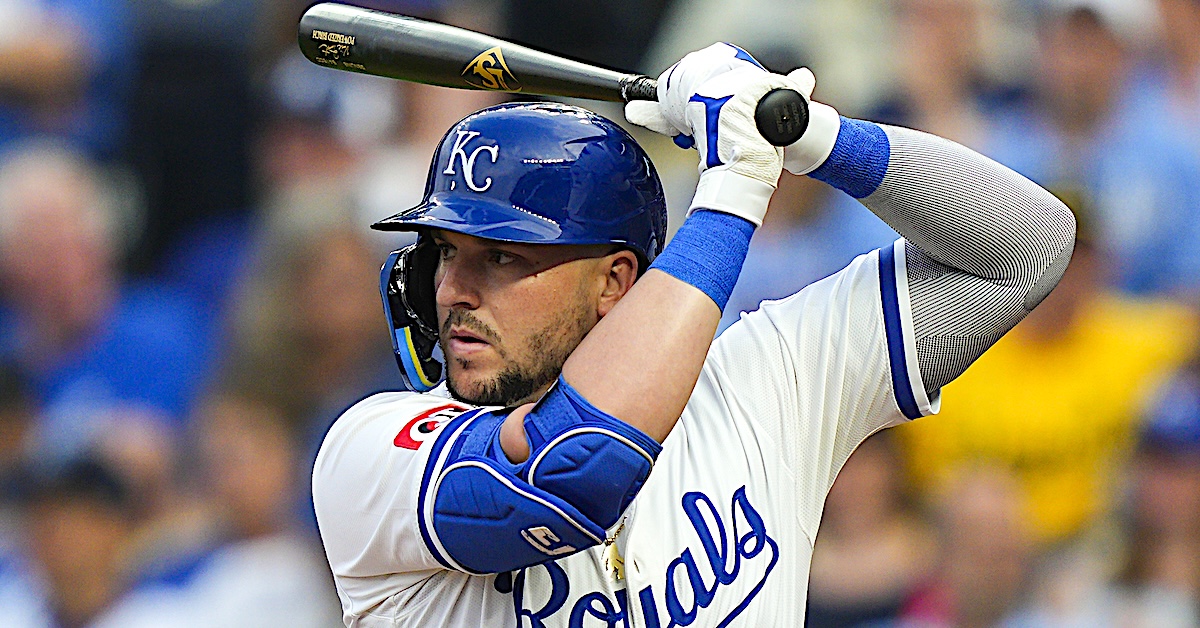
It reminded me of another video I saw a bit earlier in the spring. It featured Vinnie Pasquantino, before he captained Team Italy in the WBC, wearing a microphone during a live batting practice session against his Royals teammate Steven Zobac. It’s meant to be a short and funny clip, and it is both of those things, but I just kept thinking about Pasquantino’s subconscious.
A running bit in the video is that, after a pitch is thrown, Pasquantino leans back and asks the catcher what pitch Zobac threw. “That was a fastball?” he asks. “Cutter,” the catcher responds. Later on, he sounds more sure he’s got it. “Slider?” “No, cutter again.”
Pasquantino hit 32 home runs and struck out 15.7% of the time last year. This suggests that his internal computer can identify in the split of a second what pitch is coming, and where to put his swing. And yet! In this video, he is wildly misjudging pitch types. Maybe it’s a Zobac-specific thing. If his spring pitch data is any indication, he doesn’t even throw a cutter, though it’s possible that he calls the pitch a cutter, even if it looks like a slider and Savant classifies it as such. Maybe the catcher himself is confused about the pitch types. (But also, isn’t the catcher calling the pitches?) But if it’s the case that Pasquantino can’t tell the difference between two pitches, how is he as successful as he’s been?
A new paper perhaps gives some clues. In early March, three authors from the Vision and Image Processing Lab at the University of Waterloo published a paper with the eye-catching title of “Interpretable Pre-Release Baseball Pitch Type Anticipation from Broadcast 3D Kinematics.” Limiting themselves to only pre-ball flight information — in other words, looking only at the movement of the pitcher’s body prior to ball release — the authors attempted to predict the ensuing pitch type for over 100,000 pitches. They were correct over 80% of the time. In more than four out of five cases, they were able to tell what pitch would be thrown while knowing nothing about the actual pitch.
When considering the implications of a study like this, the first thought might go toward pitch tipping, and whether R&D departments might be able to leverage a similar methodology to better prepare their hitters to pick up tells. But there are also the questions it raises about swing decision psychology. When somebody hangs a slider, is Pasquantino having a verbal thought in his brain that goes something like, “That’s a slider,” or does the home run swing start sometime before? As the pitcher proceeds through the windup, and drops his trunk or bends his wrist, does Pasquantino then makes a subsequent adjustment in his setup, in the position of his hands, or in the conviction of his swing?
The next level of analysis might involve answering questions like these: Why do hitters miss, exactly? Where, specifically, do they miss? Over or under the pitch? Early? Late? In a Saberseminar presentation (and a subsequent article for Baseball Prospectus), Stephen Sutton-Brown did some really interesting work along these lines. Using Savant’s new swing tilt data, he found that the swing can be broken down into two phases: The initial 100 milliseconds, when the batter must decide whether to swing using only a two-dimensional version of the pitch, and the remaining handful of milliseconds, where the shape and angle of the swing takes hold. I tried to use some of this new swing tracking information to demystify changeups in an article from last year titled “Changeups Are Weird.” Applying a similar logic as Stephen did in his piece, it’s possible to calculate something like “implied miss distance” for any given pitch, or at least it’s possible for Alex Chamberlain, and then those implied miss distances can be aggregated to see the patterns for a given pitcher.
When Savant — at some point, perhaps not this season, but hopefully next season — starts to provide information about the position of the bat in space, these miss distances will no longer be implied. On any given swing, it will be possible to understand the specific expectation of the batter relative to the pitch that was actually delivered. Same goes with contact points: It will be possible to know how much a hitter was jammed, or how close their contact came to the end of the bat. Hopefully soon, the data will be available to tell a detailed story of the outcome of every swing.
For now, I will keep wondering about what we can’t yet know. What are hitters seeing, exactly? When do they see it? How do hitters know what’s coming, and when do they know it? What are the inputs? How conscious is the process? Can they tell what pitch is coming? When is the decision made? Is the science of hitting always going to be a mystery?
Michael Rosen is a transportation researcher and the author of pitchplots.substack.com. He can be found on Twitter at @bymichaelrosen.
This is somewhat related, and it’s such a good article I plug it whenever I get a chance: Sally Rooney on Ronnie O’Sullivan, the world’s greatest snooker player. She’s asking some very interesting questions about the mental and physical tasks that go into the split-second and extremely fine decisions made by professional athletes. It’s all very mysterious, but fascinating: https://www.nybooks.com/articles/2025/03/27/angles-of-approach-unbreakable-ronnie-osullivan/
(sorry for the paywalled link)
That link is a fantastic read, thank you.
it’s an honor to get essaymogged by sally rooney
This is one of those things that becomes more obvious the more you think about it. It’s not exactly “psychology”–it’s something related to that. It’s cognition.
The vast majority of things that human beings do is not something we are consciously aware of and use a far faster and more automatic level of cognition. For example, when you drive, you are not spending all of your time thinking about where to put your hands, the exact distance to turn the wheel, how hard to push the brakes, or anything like that. You just do it. That’s a form of cognition but it’s not a form of “thinking” like we usually discuss it. It’s way faster than what we usually call “thinking” and it feels almost automatic.
Some people call this “muscle memory” but it’s part of a larger class of cognition called “procedural memory” which allows us to do things without going through all of the steps every single time. A batter is simply not able to use their declarative cognition to literally declare what pitch it is, and if they were able to do that it wouldn’t come fast enough to swing. They’re relying on procedural cognition not only to know how to swing the bat but whether to swing at all and any adjustments to make to the swing along the way. These decision rules of whether (and how) to swing are coming from that procedural level of memory and cognition.
If you want to know why hitters swing and miss at some things rather than others, there’s a couple of reasons. One is that it’s just really hard to hit a baseball, and faster pitches are even harder to hit. It’s a small miracle that anybody can get a hit 25% of the time, much less half the league.
The other is deception. We kind of know this already, because of the research on tunnelling. But you can generalize it further, because there are certain types of visual cues that should trigger the swing decision and how to swing it, and if you can make those visual cues trigger the swing decision when they shouldn’t then the pitcher has usually won.
The problem is that I have no idea how much these swing decisions vary from batter to batter. Are there specific visual cues that fool everyone? Or do they work better for some batter than others?
I think every hitter is going to have to their own set of heuristics based on their training. Very few humans have the same level of ability to discern a pitch that will be a strike from a pitch that will be a ball at the level of a Juan Soto, but you adapt. It’s the reason players watch video of their opponents — it helps prime their brain on the patterns to expect. It’s why you’ll see one hitter explain to another in the dugout the way a pitcher’s pitch moves — especially if it violates their heuristics.
I’m been also thinking about this in the context of hitters aging. We’ll have more data in a few years, but it seems like aging hitters are not losing much bat speed. Stanton still has elite bat speed, but has not been an elite hitter since his 20’s.
It makes me think that some combination of reduction in reaction times, hand-eye coordination, pitch recognition (vision?) are much more responsible for age-related decline.
To argue with myself, maybe bat speed loss is really important if you don’t already have a ton of it.
Joshua Rodrigues at BP looked at this in January. He found that bat speed slowly declines as you age, and hitters compensate by pulling the ball more and attacking the ball at a higher angle.
I’m not sure hitters can even explain how they know whether or not to swing. I was a reasonably good collegiate baseball player, especially when it came to swing decisions and bat to ball skills, and I have absolutely no idea how I recognized pitches. I do viscerally remember the first time I had a pitcher throw me a split-fingered fastball. But I can’t tell you how I recognized it the second time.
This is a great example of what I was talking about previously. Declarative forms of memory / cognition whatever are really only a part of what our brains do. A huge amount of it is stuff that we (or the world) have trained our bodies to do for us. We know so much more than we can ever explain in words.
This is something all great athletes do without realizing it and really great ones (and coaches) take advantage of it.
For instance, NFL defensive linemen will read whether the offensive lineman is setting up a little “light” indicating he is getting ready to backpedal into pass protection. A great offensive lineman can be coached to look that way on, say, a screen pass, encouraging a harder rush that takes the defender out of the play more easily.
Most interestingly, these tricks don’t work as well at lower levels, like High School, because the players aren’t good enough to pick up on subtle cues to be manipulated by false subtlety.
Millions of dollars spent in research and development to get to the conclusion so many old guys will tell you while having a beer:
“Some guys have it, some guys don’t.”
I would love to read a follow-up on this:
“A systematic importance analysis reveals that upper-body mechanics contribute 64.9\% of the predictive signal versus 35.1\% for the lower body, with wrist position (14.8\%) and trunk lateral tilt emerging as the most informative joint group and biomechanical feature, respectively.”
the full paper is free to read! they break this down in some more detail in the results
Some pitchers only have a couple of pitches, often based on their delivery which is the main predictor here, so kind of duh. I’m going to predict that Mariano Rivera is going to throw a cutter. Bang 90%. Using only data from pitchers with a full arsenal might be driving these numbers down quite a bit.