
What’s Eating Francisco Lindor?
Normally, I’d write some cutesy introduction to this article, maybe regale you with a fun anecdote from my life or make a bad joke to keep the mood light. Today, there’s no time. Francisco Lindor is hitting poorly this year, and we need to get to the bottom of it.
When stars slump early in the season, it’s often easy to see a culprit. Maybe they’re swinging out of their shoes and running a huge strikeout rate. Maybe they’re victims of bad batted ball luck. Maybe they’re playing hurt. In Lindor’s case, the problem is power. Now 195 plate appearances into the season, he’s hit five doubles and four home runs. Those are both by far the worst rates of his career, and combined with a .216 BABIP, they’ve resulted in a desultory batting line.
Easy, right? Lindor stopped hitting the ball hard, so now he’s bad. Only, he’s not:
| Year | Hard-Hit% | Avg. EV | Max EV | Barrel% |
|---|---|---|---|---|
| 2015 | 36.7% | 89.9 | 110.4 | 3.5% |
| 2016 | 33.9% | 88.7 | 112.1 | 4.1% |
| 2017 | 35.9% | 89 | 111.7 | 7.1% |
| 2018 | 40.8% | 90.6 | 114.5 | 9.5% |
| 2019 | 41.0% | 91 | 113.5 | 7.5% |
| 2020 | 41.1% | 89.9 | 111.4 | 5.6% |
| 2021 | 41.4% | 89.6 | 112 | 5.0% |
So much for the lazy analysis — and to be clear, using average exit velocity is absolutely lazy. Whatever’s going wrong, it’s more complicated than a simple power outage.
Keep those statistics in mind, because we’ll be coming back to them. For now, let’s talk about how Lindor got to his power when he was at his best. He’s not a strapping presence, particularly in the context of modern shortstops. He stands 5-foot-11 and seems to generate power out of thin air, not through sheer physical might.
One way to get that power is to swing at pitches where you can best do damage, over the heart of the plate. Batters put up gaudy numbers when they swing at pitches over the heart, and Lindor is no exception. Well, until this year at least. Here are some relevant batted ball numbers for heart-of-the-plate swings over his career:
| Year | Swing% | Swing Runs | Barrel% | wOBACON | xwOBACON |
|---|---|---|---|---|---|
| 2015 | 81% | 5 | 5.4% | 0.44 | 0.404 |
| 2016 | 76% | -4 | 7.3% | 0.39 | 0.408 |
| 2017 | 71% | 12 | 11.3% | 0.434 | 0.457 |
| 2018 | 72% | 15 | 13.1% | 0.453 | 0.455 |
| 2019 | 78% | 6 | 12.7% | 0.434 | 0.441 |
| 2020 | 79% | 0 | 6.7% | 0.413 | 0.424 |
| 2021 | 75% | -6 | 7.4% | 0.333 | 0.383 |
As ugly as that looks, it could have been worse. He’s crushed a double and a homer in his last two games, both on middle-middle pitches.
While those numbers show that Lindor isn’t the same power threat that he was from 2017-19, they can’t explain why he’s been so punchless so far this year. After all, from a barrel rate perspective, he’s doing better in 2021 than he was last season. Barrels are the single best batted ball category, and also the most analytically useful. Here, they’re telling a different tale than his overall numbers.
Another problem vexing Lindor this year: a complete lack of line drives, as Neil Greenberg of the Washington Post noted. In fact, simply swapping in Lindor’s groundball, line drive, and fly ball rates from this year with his previous career production on each batted ball type, we’d expect to see a meaningful decline in production. Those extra grounders replacing line drives “cost” him 20 points of wOBA, a sizable decrease. But uh, he’s seen a 55-point decline this year. Hitting the ball into the ground hurts, but it doesn’t hurt this much.
The last piece of the puzzle is, naturally enough, fly balls. Those aren’t an optimal outcome at the plate — you’d prefer to do nothing but smash line drives — but enough of them turn into doubles or home runs that they’re far preferable for grounders. Or, well, that’s the theory. This year, Lindor’s fly ball production has been downright grounder-esque; his fly balls have gone for a .226 wOBA, hardly distinguishable from the league’s .215 mark on grounders.
What’s wrong here? It’s a problem on both ends of the distribution. First, Lindor has done terribly when he doesn’t get all of the ball. He’s hit 33 fly balls below 95 mph, the cutoff Statcast uses to define whether a ball was hit hard. He has precisely one single to show for them, a weakly-hit fly ball that found a hole in center field:
There’s no real talent to that hit. Sometimes, the ball just lands where there aren’t any defenders. But Lindor is accomplishing that trick at a vanishingly low rate this year, and those empty-calorie singles do a great job propping up a batting line. In this case, I think it’s fair to say that Lindor is getting a little bit unlucky — the league is hitting .082 on weakly-hit fly balls, while he’s batting .030. That’s just two singles, though; not nearly enough to explain his rough year.
Not only that, but Lindor is popping the ball up at a career-high rate — though to be fair, his career high matches the league average rate. He’s gone from a hitter who never pops up to simply average in that category. A previous version of Lindor might sneak out another single or two through fewer wasted pop outs, but again, this isn’t enough to explain what’s wrong.
No, to figure out why Lindor’s fly balls, and also overall production, have dipped, we’ll have to come full circle and examine what happens when he hits the ball well. Remember, Lindor’s hard-hit rate is roughly unchanged this year while his barrel rate is down slightly. But not all barrels are created equal. As Alex Chamberlain explained this January, dividing barrels into two categories — “blasts” and “weak barrels” — gives us further insight into contact quality.
Lindor’s blast rate (I know, I know, so many rates) has declined in tandem with everything else. Not only that, but it’s leading the way. There are roughly as many blasts as weak barrels across the league, but Lindor’s diminished barrel rate is overstating his production; he’s been getting to true premium batted ball outcomes less frequently than ever, even when he barrels the ball up:
| Year | Blast% | Barrel% | Blasts per Weak Barrel |
|---|---|---|---|
| 2015 | 0.9% | 3.5% | 0.35 |
| 2016 | 1.3% | 4.1% | 0.46 |
| 2017 | 2.7% | 7.1% | 0.61 |
| 2018 | 4.3% | 9.5% | 0.83 |
| 2019 | 3.2% | 7.5% | 0.74 |
| 2020 | 2.5% | 5.6% | 0.81 |
| 2021 | 1.4% | 5.0% | 0.39 |
Lindor’s struggles can’t be traced to one central category. He’s getting overwhelmed in the heart of the plate, an area where he used to feast. He’s hitting too many grounders, more pop ups than ever, and not enough line drives. He’s barreling the ball up less often, and even when he does, he’s not blasting the ball the way he used to.
I’ll level with you; I can’t figure out why this is all happening at once. Players don’t generally slump this way, via an aggregation of slight underperformance across a broad spectrum of categories. It can’t really be explained by struggles with a particular pitch; though he’s been particularly poor against cutters this year, pitchers are only throwing them 5.4% of the time, and he’s hit sliders, which are often cross-categorizes with cutters, quite well.
Maybe the answer is that Lindor is just a little off his game and a little unlucky at the same time. He’s just not hitting the ball as well as he normally does, period. He hasn’t slumped when it comes to strikeouts and walks — his swinging strike rate is roughly unchanged, and he’s making his customary high amount of contact while walking at a career-high rate.
The dirty little secret about Lindor, if you can call it that, is that even when he was putting up 30-homer seasons, he never did it with overwhelming power. He’s so good at everything non-contact — walking more than average while rarely striking out is really hard — that even slightly above average results on contact produced a star-level line, particularly when combined with his defensive prowess.
Because he puts the ball in play so often — again, average walks and few strikeouts — he gets to his counting stats the same way. When he hit a career-high 38 homers in 2018, he put 560 balls in play, the second-highest total in the majors. Mike Trout bested him by a single home run, but he did so on 351 balls in play. Teammate José Ramírez, a contact-happy hitter himself, turned 504 batted balls into 39 homers. Lindor is a volume hitter, in other words.
Production on contact is far more variable than production on strikeouts and walks. Even more than that, Lindor’s style of production on contact — heavy on balls in play, relatively light on home runs per batted ball — is the noisiest there is. He’s had stretches like this before, though none quite so extended:
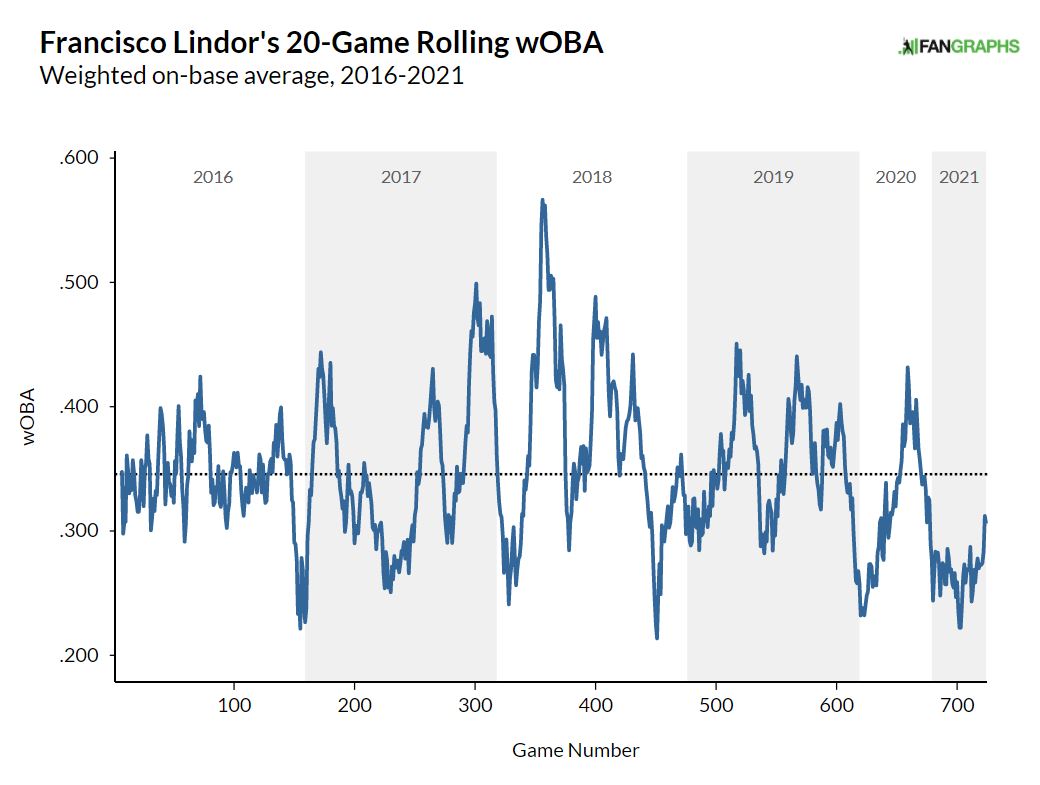
What’s wrong with Francisco Lindor? He’s not hitting the ball well. I’m not all that worried about it yet, though. Lindor’s game is reliant on balls that he hits in the field of play, where a degree or two of launch angle can be the difference between a duck snort single and a running catch.
That’s not to say nothing has changed; those barrel and blast rates really do matter, and a downturn in top-end production makes the normal ebbs and flows of Lindor’s game look worse. But for the most part, Lindor has done what he always does — put a ton of balls in play without overwhelming power — and gotten the short end of the stick. This isn’t a dramatic change in his game, but rather the ugly downside of a volume-based offensive approach combined with a small but real slump in contact quality. That’s small consolation for a ravaged New York roster, but it bodes well for the rest of the season — and the rest of his 10-year contract, to boot.
Ben is a writer at FanGraphs. He can be found on Bluesky @benclemens.
Baseball Savant has a feature that shows histograms of Launch Angle (as well as a few other things). Normally, Lindor has a beautiful normal distribution for LA with low variance centered on 20 to 30 degrees of LA. This season, he’s all over the place with the 20 to 30 LA bucket being 5th-most among batted balls behind -10 to 0, 0 to 10, 10 to 20, and 30 to 40 LA buckets. He’s still swinging the bat hard, but he’s not squaring up with pitches with any kind of control.
Nice addition joe
Great point. I feel like the next important metric for Statcast to add is standard deviation of launch angle. Sweet Spot gets close to this idea, but adding SDLA would help to quickly identify those hitters who aren’t squaring it up.
Part of the story is that his power output was trending down a bit in 2020, which is just one more small problem. But that is so small I don’t think that’s most of what’s going on here. I still think there were some worrying things in 2020 but nothing that could explain this.
If I had to bet, I’d say the most important issue is that guys like Lindor benefit a lot from livelier balls. In 2017, Lindor went from a guy with 15-homer power to one with 30 homer power, which was also around when they ball got livelier. In 2021, they deadened the balls to remove the cheap home runs, and the guy who hit a lot of home runs without showing particularly big power is now not really hitting home runs anymore.
The problem with my theory is that I’m not sure how to define who would fit in that bucket of players. Jose Ramirez, who also had a big power surge around then, is still hitting home runs. Trevor Story, who has always shown quite a bit of power, has also had a bit of a problem hitting home runs. To make this theory work I’d need to find other players who inexplicably gained power in 2017 and then lost it in 2021.
If a guy is swinging the bat the same in 2021 as they were in 2017, this could be a workable theory. But Lindor literally isn’t the same at the plate. He’s slashing and slapping, he’s not finishing his swings, and he generally looks uncomfortable.
One friend who played high-level college ball and knows hitting betting than me said Lindor is swinging like a guy with an injured hip, the way he’s not exactly rotating or finishing… and that’s the best way I can describe it, even if that’s not the actual source of the issue. When he gets a good swing, he still does damage – Thursday’s homer was a prime example. But he’s not getting enough of those good, full swings on a consistent basis.
I would totally buy the injured hip theory except that the thing that worried me–running–doesn’t seem to be a problem for him right now. Although maybe it could be an injury that only hurts on rotation with a swing and not so much for running?
How about an alternative theory that blends both: The guy is not getting the results he expected because of the deadened ball and he’s completely messed up his swing trying to recapture it?
I think that’s entirely plausible.
Fully believe there is an element to the struggles of Lindor, Torres, etc. that absolutely has to do with the ball, but is not yet fully quantifiable. These hitters who used to put up counting stats without blood-red statcast metrics are suffering with the new ball. I also believe the bizarre rash of soft-tissue injuries is partially the result of players having to swing harder to make the ball go as far as it used to.
Jose Ramirez is interesting – he’s been able to overcome the new ball by figuring out how to hit the ball harder *and* with more Barrels.
Torres has been fine. His plate skills have improved A TON and looks like somebody who could have an OBP of .365 with 30 home runs. He already almost halfway there to setting a career-high in walks. I don’t like the Yankees, but Torres is a beast.
@kid – whereas the Mets, in spite of recent changes, are still not one of the better teams in helping their players figure out this kind of thing.
It wouldn’t surprise me at all if we eventually learned that CLE did significantly more to help Ramirez cope with the new ball while the NYM left Lindor largely to founder.
Funny that you mention Jose Ramirez since this feels like Ramirez cerca 2018-2019, where he slumped for about the last 40 games of 2018 and the first 80 or so of 2019. Similar to Lindor, there were a myriad of articles trying to diagnose what was wrong with him. But no one could ever really say exactly what the problem/issue was.
At the end of the day, this is a reminder that hitting a baseball is arguably the most difficult task is any sport. And you have to do it against pitchers with different arm slots, speed, pitch mix, etc. And with a umpires with different strike zones. And 30 different ballpark configurations. And different weather and lighting. And different fielding configurations. And sometimes, if you’re not paying attention, they may just throw is a completely new ball….
Lindors issues is the same as Ramirez’s was: they were too passive, over-focusing on walking or getting the perfect pitch to hit. That meant that they were letting lots of very hittable pitches go by, and often late on the ones they did swing at. That’s why they both had so many pop-ups.
@Left of Centerfield “At the end of the day, this is a reminder that hitting a baseball is arguably the most difficult task is any sport.”
—-it really isn’t. One word: Polo.
@sadtrombone You’ve probably thought of it, but shouldn’t fly ball distances help a lot here? If a guy is clearing the fence by 10-20′, or by a couple of degrees, presumably any move to a deader ball will cost him more than it would, say, Pete Alonso, who rarely gets cheap HR.
Mark DeRosa had a nice segment on MLB network awhile back about how Lindor’s mechanics are all off. Basically his legs and torso were out of sync, leading to a lot of weak swings. Obviously biomechanical analysis goes a bit beyond the usual fangraphs work, but the blast to weak barrel ratio seems to at least support the notion that he’s unable to really make the best kind of powerful contact at the moment.
Interestingly, BP’s DRC+ has Lindor at 97, which obviously is not up to his usually standard, but it is not nearly as bad as his wRC+.
As someone who watches way too many Mets games, what I see is a hitter trying to pull everything (or be a little late trying) rather than using all fields, and often pulling with lazier slash-type swings than fully-loaded swings. What has surprised me is that he hasn’t always been swinging through the ball; some of his swings remind me more of Luis Castillo than they do Francisco Lindor.
The good news is he’s taking bad pitches while he struggles, rather than expanding the zone to try to hit his way out of it. The walk rate is not only a career high but, at >11%, an elevation into the double-digit range.
Some of it also has to come back to realistic expectations, which I believe to be a 110-115 wRC+ hitter who will play Gold Glove-caliber defense and be a leader on the field and in the clubhouse. Right now he’s all of those things except one; he’s a 74 wRC+ hitter who fans are now expecting to be a 130 wRC+ hitter. When his line settles in where it “should” be, a lot of New York shouters will be disappointed in the result they should have expected all along.
It also bears noting that he’s given us Mets fans something that we’re not used to – accountability and a positive attitude amidst his struggles. I’m grateful for that.
i would be very upset if my team spent 330 m on 115+ wrc with gold glove defense
Uh….that’s a 4-6 win player. Just looking at Lindor’s own history, he was worth:
5.5 wins at a 109 wRC+ in 2016,
5.7 wins at a 116 wRC+ in 2017, and
4.5 wins at a 115 wRC+ in 143 games in 2019.
@Jason B It’s also a 4-6 win player coming off two 4.5 fWAR seasons (or a 4.5rWAR and a 3.0 rWAR season, by BR, which is suggestive) who peaked in 2018 and will be entering his decline phase in the second year of this huge contract, a contract the Mets entered into despite having every means to know they’re likely out of it in 2023 and 2024, after which Lindor will be well past prime, by age.
It wasn’t a good signing at a position the team had covered, and that’s even if Lindor was having a season more in line with what was expected.
I am going to steer away from the data for a second and do amateur scouting. He has long been my favorite non Mets player because he is one of those keepers I hit on really cheap and have enjoyed the profits for years, so I watch him a ton. Now he’s my real team’s SS besides so I watch him plenty in person (season ticket holder) or on TV daily.
His swing and approach are messed up. I have seen many times, where he takes defensive slap swings, including in hitters’ counts, or lately he has been flat out bunting with runners on base. He, for whatever reason is not swinging regularly for “blasts” but for soft contact.
Now 2 days ago, he was quoted as saying he is trying to fix his swing to “imitate his 2017 self” but he “can’t remember how it felt”. So now hes trying to hit more flies, but he is all messed up. Sometimes these things just start to click because it is sucha mental game. But I don’t believe his days of being a star level hitter are gone.
Yes. Bingo. (Or confirmation bias 🙂 )
I haven’t looked for a few days, but when I looked a few days ago he was struggling mightily left handed and about normal right handed. At the time it was 123wrc rh, and 45 lh. Looking now it has changed slightly (101 vs 65) so maybe he has made an adjustment, or a couple hits fell. His walk and k rate remain similar. For his career he has always been better right than left, and it isn’t completely unusual for a switch hitter to suddenly have prolonged struggles a certain way. For Lindor unfortunately it is lh. It also matches with the with the eye test. His swing left handed is off… Sometimes his lower body is falling out of the box and his bat is dragging and he ends up hitting tons of opposite field weak grounders, whereas his batted ball profile remains the same right handed. In a way it reminds me of what happened with Jram a couple years ago, where all of a sudden he forgot how to pull the ball. Fortunately he was able to fix it. With that said he only has a career 116wrc and hasn’t been that high for three seasons. His glove is his carrying tool, which gives a high baseline, but even once he turns it around he isn’t likely to be much better than an average hitter who likely benefited from the juiced baseball prior.
One thing I’m curious about is if there is a type of player than benefitted from the juiced ball. Is there some sort of league-wide regression in all the rate/power output metrics?
He’ll probably never put up a .200+ ISO again, but he’ll be fine.
He put up 3 consecutive seasons with a .230+ ISO, most recently in 2019. He’s healthy (from what we know) and he’s only 27. His swing may have changed, his approach may have changed, and the ball may have changed, but none of that is irreversible- it’s possible that he never puts up another .200+ ISO, but I don’t think I would bet on that.
@gvanlue “He’s only 27.” –Only? He’s at peak age.
All that and you didn’t mention the elephant in the room: Lindor’s hitting has been going down for a few years, now. Consider his wRC+ from 2018-21: 132, 115, 102, 74.
I realize that the nature of these articles is to go super granular with the stats, but in the process sometimes the more obvious is passed over.
This is not to say that Lindor is in decline, but he could be. Some players seem to peak in the 24-25 range and then decline after. Of course what is so surprising about Lindor is that he’s fallen this far, so some bounceback should be expected. But it might be time to look at the overall trends and consider that the best of Lindor is behind us (namely, 2018), and he’s not the superstar we thought he was. Not good news for the Mets.
This is pretty much my read as well. Plenty of guys peak early (though isn’t the groupthink these days that peak usually is around 24-25, not 27 as previously believed?). We should expect some bounce back because this is probably unsustainably bad, but I wouldn’t bet much money that he has another 30-HR season in him.
Yep. We could call it the “Cesar Cedeno Career Path,” although CC peaked at 21-22, so is in the extreme. Hanley Ramirez is another that comes to mind.
Andruw Jones says hello! (And was up way early, maybe 19?)
Yes, although I see Andruw being more in the Griffey/Pujols category – early collapse. Jones actually maintained his peak through his 20s, then crashed at age 30-31.
Edgardo Alfonzo?
“but in the process sometimes the more obvious is passed over.” That line really hit me. That really hits home for lots of topics.
It does. I also spent the offseason warning the Mets about this, specifically, and can’t recall a single upvote.
Hmm many of these early collapse players seem to be from countries were it’s not that hard to get a fake birth certificate.
@Nats Fan something we’re routinely admonished over for even mentioning, but it’s surely possible to consider without being any sort of racist.
For example, “are birth certificates easier to fake outside the US, than inside?”
“Yes.”
Ergo, a working hypothesis.
@Angelsjunky I remember saying that repeatedly this offseason once the Mets’ interest became known. Given the Mets appeared nicely covered at SS, especially at what they were paying. getting Lindor at SS when they had far greater positions of need to fill seemed foolish, even without this precipitous decline.
As for paying Lindor during the 2020-21 offseason as if it was a year later and he had just posted 2018 numbers for the 2021 season… that seemed absurd on its face at the time.
The last time the Mets got an in-his-prime all-star middle infielder from Cleveland, he turned into Carlos Baerga.
Yes, I know the situations are much different, but that’s not how PTSD works.
Actually it was Roberto Alomar… which also didn’t work out well (although, perhaps you’re noting that Alomar was past his prime by that point)… and I am still baseball-traumatized by both.
How much of this could be explained by a new ball that deadens power? If Lindor didn’t have oodles of extra power to begin with, and now that power is reduced slightly but noticeably, could that have an effect on weakening his overall game? Especially given the way he’s still doing peripheral stuff well enough, I think the idea that he’s just getting less oomph for his effort could be worth exploring.
Checkout his stretch from May 2017 into July – 252 PA, .221/.277/.377 for a .281 wOBA, He finished that year with a .353 wOBA.
A lot like a 29-year-old Derek Jeter through the end of May in 2004 – 234 PA , .220/.277/.336 for a .271 wOBA. He finished the 2004 season with a .356 wOBA.
Lmfao…. fangraphs has become a parody of itself. I remember about 4 weeks ago when they posted an article about how historically bad Baez was. There’s a reason they get on average ge 12 comments per article. Its because they have made themselves irrelevant. Please notify me when you can click on an article that isn’t begging for a donation. No serious fan takes this site seriously ,and they haven’t since 2018. Rightfully so.
Thanks for your keen insight! We’ll miss you
How should we notify you? Please leave your contact information
I never saw this kind of analysis for Andrew McCutchen’s disastrous—and portentous—2016, but I feel like it was a similar story: a guy who’d gotten MVP power out of a slight frame through overall excellence at the plate slipping in all facets.
For a Pirates fan, it’s a depressing reminder; for a Mets fan, it’s terrifying.
McCutchen’s ISO only ever cracked .200 twice from 2009-2015- most of those years it was in the .160-.200 range. Since 2016, it hasn’t dropped below .169, and has been .200+ twice. So, his power doesn’t seem to have diminished- his average has just dropped significantly, and his K% has gone up some. And he was still a good hitter from 2017-2019- just not MVP level. Lindor’s slump looks different, in that his power has been down this season and in last season’s small sample. He has also definitely been a victim of low BABIP this year, in a way that McCutchen wasn’t when his AVG started to decline.
@jroth All the moreso because it’s a continuation of the FO ineptitude that has long plagued the Mets FO. How Alderson is still here and making decisions is testimony to Cohen’s administrative ineptitude.
Maybe he is away from the only baseball home he has known, which is a big deal to someone who came to a new country to follow their dream, all the while struggling over his sister’s cancer diagnosis. When this kind of pressure is conjoined with the pressure to perform over a massive contract in a massive market, a player can press and underperform psychologically. This description is not mutually exclusive to statistical analysis or a subtle but chronic decline. But treating a person statistically is often foolishly conflated with treating their performance statistically.
Did MLB / Baseball Savant adjust barrel rate for the higher exit velos this year? I thought an update to the “x” stats was coming, but don’t remember if they were going to adjust the thresholds for barrels.
IIRC, early exit velos were up 1-2 mph off the bat due to the new ball (but flying shorter distances because of the lighter weight, higher seams). If you’re using hard-hit rate (95+ mph) YoY, no change would actually mean a drop in performance (i.e. Lindor’s 41.1% HH rate to 41.4% this year).
Great piece, Ben, your writing is superb and I always look for you on the home page. Keep up the good work.
Also worth looking into is whether the season that made him as a superstar, 2018, had more than its share of luck, thereby creating unrealistic expectations. Granted every player’s best season typically involves a happy share of good luck, but without it we’re talking about a 4-5 WAR player–which is terrific, but not someone you want to pay $341m to–or even $300m to, given Lindor’s age.
His current performance also suggests a window through which to look at other, similar players going into FA (to the extent there are players similar enough to Lindor to matter). Whose numbers are… delicate, in the sense of being more prone to collapse. Was Lindor’s current collapse more likely than we thought? Should more attention have been paid to the substantial drop off in his hitting between 2018, and 2019-2020?