
What’s Going On With Ian Anderson?
Ian Anderson was one of the better stories of the 2020 season. Entering the year as the No. 3 prospect in the Braves’ system and the No. 44 prospect in all of baseball, he was seen as a future mid-rotation starter who could help quickly. He did just that and more: Added to the rotation in late August, Anderson finished seventh in the NL Rookie of the Year voting despite making just six starts. He put up a 1.95 ERA in those outings, and while the supporting data said he wasn’t the Cy Young-level pitcher that number might suggest, he was still awfully good. He was even better in the postseason, allowing just two runs over 18 innings, striking out 24 and giving up just 11 hits.
Anderson maintained his rookie eligibility entering 2021 and earned the No. 2 ranking in Atlanta’s system (Eric Longenhagen and I discussed putting him at No. 1 ahead of Cristian Pache) and the No. 13 spot in this year’s Top 100 list. He looked like the cornerstone of a young Braves rotation that would help lead them to National League East title contention.
His first start of the year was vintage Anderson (or at least as vintage as you can get for a guy who is still a rookie), as he gave up one run over five innings and struck out seven. His next two were far from it: 11 hits and seven runs allowed over 10.1 innings. Game score is far from a perfect measure, but it’s a simple and quick look at a start, and Anderson’s game scores of 47 and 45 in his last two outings represent the two worst marks of his career. This could be a blip, or there could be some tough luck in there. But a closer look at the data shows that this is more than just a randomly-generated bad run.
When asked to evaluate a pitcher not living up to expectations, these are the first three questions I try to answer.
- Without knowing anything internally, is there anything to worry about in terms of health?
- Has the pitcher changed anything in terms of usage and location?
- Has the pitcher seen his pitch shapes change due to alterations in his mechanics or spin rate?
The Health Question
It’s impossible to know how a player is feeling without direct access to both the individual as well as the training staff. The good news here is that there is nothing in the data to suggest Anderson might be dealing with arm issues. As an outsider, the best analogue to pitcher arm health is velocity, and he is in-line with his 2020 data.
| AVG FB Velo | AVG CB Velo | |
|---|---|---|
| 2020 | 94.1 | 80.1 |
| 2021 | 94.3 | 80.2 |
Usage and Location
Anderson has never been knows for his precision, but his walk rate of 10.4% through his first three starts is a near match for his 10.1% mark from 2020. His stuff really moves, and the combination of big movement and plus command is for unicorns like Gerrit Cole. Anderson’s command is far from ideal, but there’s nothing in the data showing a decline from what we are used to. His usage remains roughly the same as well.
| FB% | CB% | CH% | |
|---|---|---|---|
| 2020 | 48.3% | 20.8% | 30.8% |
| 2021 | 46.9% | 22.5% | 30.5% |
It’s a slight uptick in offspeed usage, but that should be a good thing; those are this pitches that perform the best. There’s nothing to see here, which leaves us with just one more option.
Changes to Shape and Spin Rate
There is where we actually find something. Anderson’s high release point serves him well in terms of pitch shape, allowing him to generate a classic rising four-seamer and contributing to his ability to get plus depth on his curveball despite below-average spin rates. But something has happened to his release point in 2021, and it’s not something we normally see in pitchers: He has gotten both higher and wider with it. You can see the difference in this animated GIF that shows the contrast between last year and now.
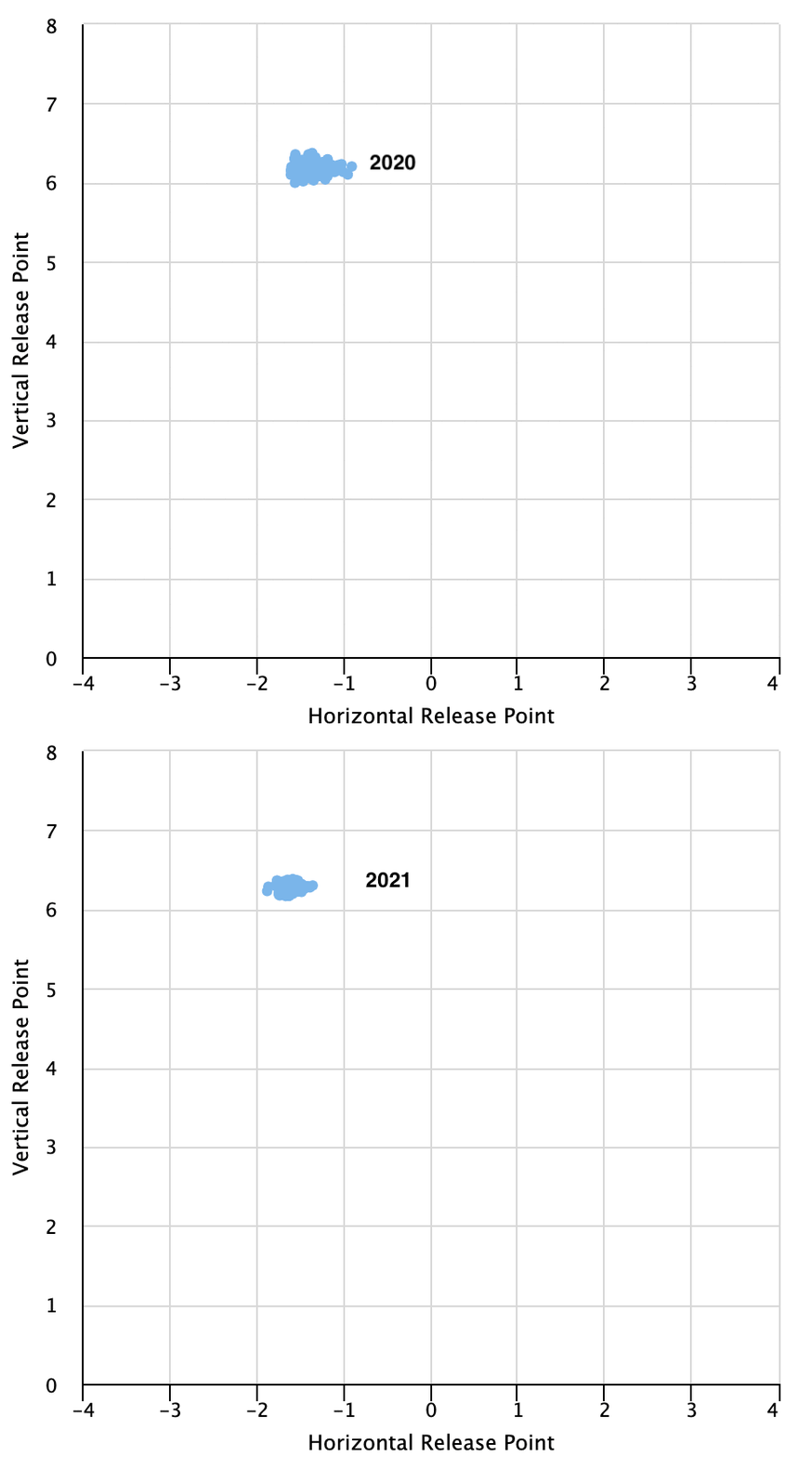
This is not an easy combination to achieve. Grab a baseball off your desk (or a coffee cup or anything roughly baseball sized). Slowly mimic your natural throwing motion and stop at your release point. Now widen your release point. The most obvious way to do that is to lower the angle, which creates more distance from your frame.
Without ultra high-speed video available to the common person, it’s hard to say how exactly Anderson is achieving both a higher and wider release point. It could be in his wrist load, or his body position, as he’s always relied on a body lean to create his angles. Or it could be greater extension of the elbow joint to create a longer fulcrum.
That should be a good thing. As I discussed in my piece on pitch shapes, the shapes pitchers generate are greatly dependent on arm angles. Anderson’s fastball already has plus shape, and adding both rise and run to the pitch should make it even better, but that’s not what’s happening.
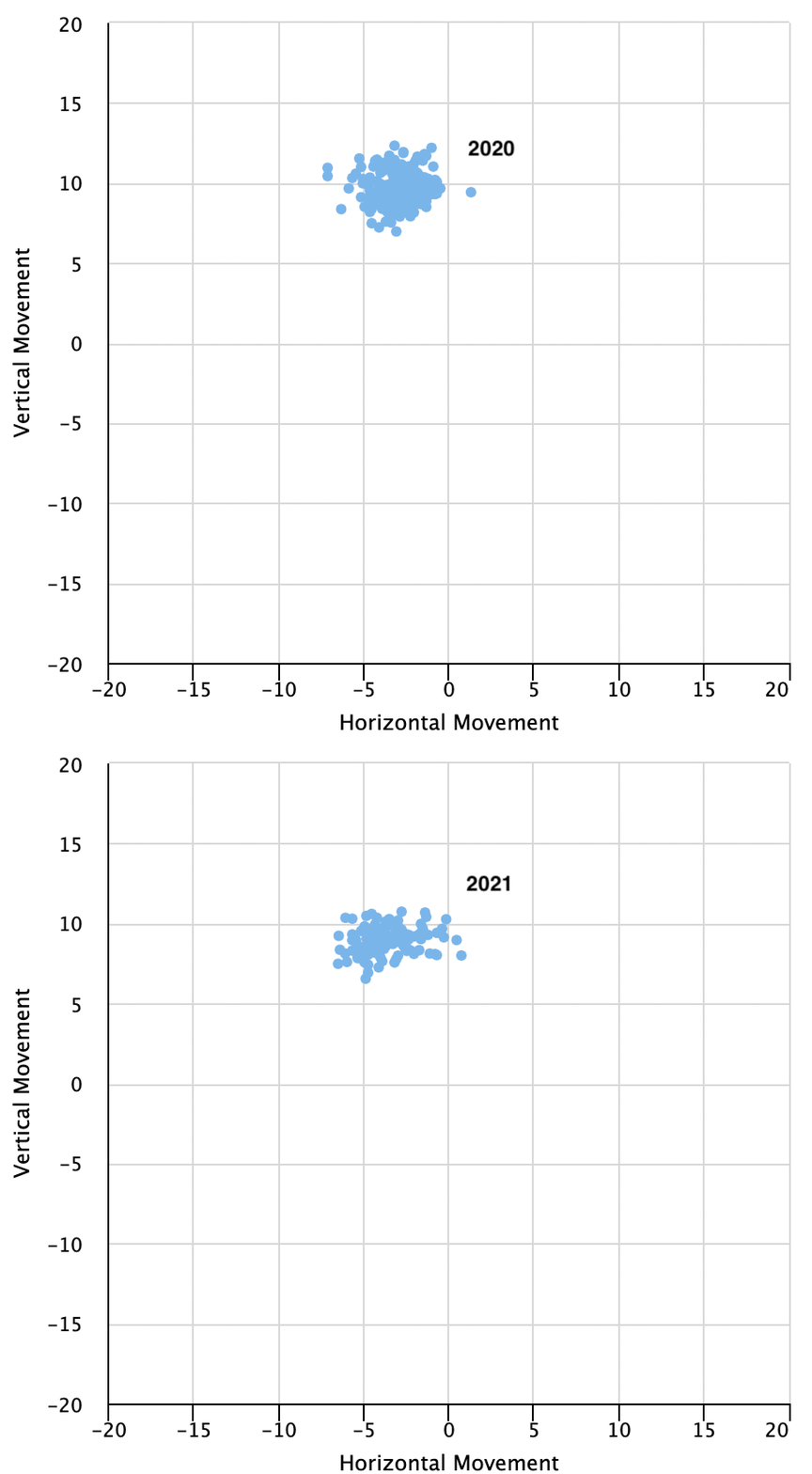
As you can see, Anderson’s fastball does have a bit of extra run to it from what we’ve seen in the past, but more importantly, and more troubling, is that the pitch flattened out a bit in terms of verticality. What was once 12% more vertical movement than average for pitchers with similar velocity, release point and extension is now 1% less. Less rise means more hard contact, and Anderson’s barrel rate has gone from a minuscule 1.2% in 2020 to 12.2% this year.
So what’s going on here? My theory is that the wider release point is affecting Anderson’s grip on the baseball and impeding his ability to stay on top of the ball, keeping him from producing the kind of spin shapes that are necessary for his signature vertical attack. It’s hard to corroborate this without the kind of high-speed video that only teams have access to, but that belief is buoyed by Anderson’s curveball, which has lost about an inch of depth and more than 100 rpm, or roughly 7%.
Throwing a baseball with the kind of velocity and spin we see from major league pitchers requires remarkable mechanical consistency. Anderson’s recent performances are not the result of bad dice rolls, but of a small yet significant mechanical difference that has made him a less effective pitcher. This is far from some kind of nightmare scenario or forecast for doom, but it is something that needs to be addressed if he is to return to his 2020 form, as well as the future projected for him.
Kevin Goldstein is a National Writer at FanGraphs.
This is great analysis. Love it. I assume that this is exactly the kind of thing that pitchers and coaches work on between starts? Finding the source of issues and trying to correct it. I can’t imagine maintaining big league mechanics where any small change can throw everything off. I think my release was a little different every single time I shot a basketball in high school, which is one of reason (of many) that my career stopped right there haha.
This feels like Chris Paddack all over again. It’s not that they’re the same pitchers, but they seemingly are plagued by very similar issues.
Awesome analysis – hope Rick Kranitz is a Fangraphs reader…
cool stuff KG!
Not sure if this makes me more or less optimistic about Anderson. If it’s something obvious like “change your arm slot”, it seems like pitchers do that fairly frequently and it would be just a matter of working on it during side sessions. If it’s something subtle and hard to ID or address, you could see this being the beginning of an entire season of attempting to experiment with tweaks.
Either way, excellent analysis. I had kind of written off his struggles to his known issues with command/control but that doesn’t seem to be the case.
I think the thing is that while this analysis is not often found in public because few people writing there have KG’s analysis chops, the reality is that players are making these kinds of adjustments all the time. Human beings aren’t fixed objects or points in time: Every player, both pitcher and hitter, is changing like this constantly, sometimes intentionally and sometimes not. Baseball is first and foremost a game of adjustments, where players are constantly trying to make tweaks to compensate for how they’re currently being attacked, adjusting batting stances to handle the pitches they’re currently making outs on better, trying to improve their command or pitch performance, etc
While having data like this is a relatively new phenomenon, the improvement process isn’t. It’s just something that’s much easier to do now that there is empirical data to guide it, and not eye test / game results to rely on. KG – or an analyst for the Braves – could put this analysis together in a matter of hours, instead of it taking days or weeks or even months for Anderson to recognize he was doing something different if he’s not doing it intentionally, or to arrive at adjusting the correct element if the change was unintentional and he didn’t know what had gone wrong.
But this isn’t some sort of notable aberration – it’s extremely typical. The scale of the changes may not be (in terms of the resulting loss of spin here being fairly large), but this kind of stuff is the rule, not the exception.
It’s easy to mis-judge that because you get to see it analyzed or hear it discussed when, 99% of the time, we don’t have either of those luxuries. But that doesn’t change the reality that it’s happening all the time.
Not worried about Anderson at all. He’s a bulldog and I believe he’s talented enough to make an adjustment on the fly. The rest of the rotation though..
Maybe he stopped using sticky stuff.
The Braves need a new pitching coach.
Do you interpret the horizontal/vertical release point chart by imagining you are the pitcher and are throwing the ball away from you or that you are the batter and the ball is coming toward you? I have always kind of assumed it was the former (since this is a chart for use mostly by pitchers and they would naturally gravitate to using their own vantage point), but Kevin’s use of “wider” to describe Anderson’s release point in 2021 vis a vis 2020 would suggest it is the latter (since Anderson is right-handed and the release point moves to the left on the chart (from an average of about -1.3 in 2020 to about -1.7 in 2021). It would be nice to include something on these charts that makes it clear one way or the other for those of us who do not look at them every day.
These are batter perspective, which you can see by looking at where the 0 falls on the x axis; a LHP would be mirrored
It doesn’t actually matter, though, because you could mirror the chart on the Y axis and it would be identical for both sides.
Maybe he just needs to drop some vinyl possibly The Ballad of Jethro Tull to get in sync
I hadn’t looked at Anderson’s release points or pitch movement much yet, but interestingly I noticed something similar with Max Fried. His release was higher and his stuff had also “flattened”. The slider had less velocity adjusted downward movement (and considerably less horizontal), and the fastball had greater “rise”, which given the fact that it was probably better as a weird, groundball inducing 4-seamer (ie, it used to have among the greatest amount of drop of any 4-seamer in the majors, and is now merely displaying a below average amount of “drop”), actually seems to be a bad thing.
This is cool info., but I think I’d wait for a few more games before declaring his new release point bad news.
He had an insane 0.28 HR/9 last season, vs. 1.76 this season. Three HR allowed in total this season.
What does the y2y correl. for pitcher barrel rate look like, by the way?
Is raising the release point maybe a Braves thing? I know it was mentioned in a recent scouting notebook by KG and EL that the Braves raised Ynoa’s release point. That has worked out for him for the most part so far, but maybe it’s not a one size fits all adjustment?
Its a common thing in many organizations because, as KG mentions here and in his piece on pitch shapes, pitch pairings that are based around vertical movement (4 seam fb / curveball) generally improve as the arm slot moves up from 3/4 towards over the top. It’s one way of helping guys improve their spin efficiency on those pitches, and 4 seam fastballs are very popular in most organizations.
Well well well. Look who just shoved.
He was sharp tonight, and to my eye, his release point looked a bit higher. I was probably confirming my own bias though.
This is a great article, thanks for writing such a clear exploration of possible reasons for Anderson’s decline in performance. Like others, I noticed his outing vs NYY had much better results. Is it easy for you to add in one start’s worth of release point data to see if he made a tweak? Thanks!
Hoping to get a followup to this article examining what, if any, adjustments Anderson has made to get back on track.