
When Do Players Retire?

Most players grow up, not out.
When I wrote about Julio Rodríguez a few weeks ago, one of the points I made was that he has a “not-so-distant” shot at being the best player of Generation Z. My wording was intentional, a careful hedge illustrated by this plot:
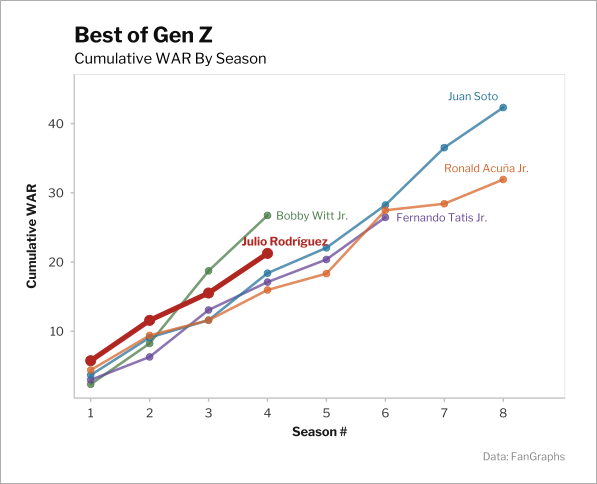
The plot shows Rodríguez was the best player among Gen Z through his first two seasons and the second best through four seasons, behind only Bobby Witt Jr. This is a lie of omission. Rodríguez debuted when he was 21, and Witt debuted when he was 22; the plot compares them to Ronald Acuña Jr. and Fernando Tatis Jr., who each debuted when they were 20, and Juan Soto, who debuted at 19.
If we instead look at WAR by age, the plot looks like this:

You can see one reason why I chose the first plot: It’s more readable. I’d also argue, lie or not, it’s a noteworthy point of view, illustrating how quickly each player defined their generational relevance.
But I also wondered at the time whether this view might be the “correct” perspective. My thinking was maybe careers last for a certain number of years, rather than being capped at a specific age. Perhaps the game only holds a player’s interest for so long, or the wear and tear on their body is tied to time on the field, rather than time on the Earth.
So for this post, I asked the question: How long do players stick around?
I found all players who debuted and retired between 1989 and 2019. I started with 1989 because that’s roughly when the average age of the league stabilized, and I cut it off at 2019 because I wanted to avoid decisions on who is or isn’t retired. This creates a sample of all players who started and stopped their careers over a span of 30 years.

I binned players by debut age. The next table shows the median seasons played, retirement age, and career WAR for each bin.
We can see that, in general, those who debuted earlier played more seasons than those who debuted later. We can also see that most players retired between 28 and 29 years old regardless of when they debuted. Young batters played longer (and better) than young pitchers, but the gap largely disappeared once debut age reached 25.
| Age | Batters | Seasons | Retire Age | Career WAR |
|---|---|---|---|---|
| ≤20 | 49 | 13 | 33 | 10.80 |
| 21-22 | 388 | 8 | 30 | 1.85 |
| 23-24 | 860 | 5 | 29 | 0.07 |
| 25-26 | 671 | 3 | 28 | -0.03 |
| 27-28 | 261 | 2 | 29 | -0.05 |
| 29-30 | 86 | 2 | 30 | -0.07 |
| 31+ | 30 | 1 | 32 | -0.06 |
| All | 2345 | 4 | 29 | 0.02 |
| Age | Pitchers | Seasons | Retire Age | Career WAR |
| ≤20 | 44 | 9 | 30 | 4.59 |
| 21-22 | 464 | 6 | 28 | 0.99 |
| 23-24 | 984 | 4 | 27 | 0.12 |
| 25-26 | 872 | 3 | 27 | -0.02 |
| 27-28 | 341 | 2 | 29 | -0.04 |
| 29-30 | 85 | 2 | 31 | 0.00 |
| 31+ | 52 | 2 | 35 | 0.11 |
| All | 2842 | 3 | 28 | 0.06 |
Let’s start to zoom in on relevant examples for our Zoomer cohort. I filtered the data to include only those who played at least five seasons in the majors. This view shows us the length of careers for players who were at least good enough to establish themselves in the league.
The trend becomes more clear from this perspective. The median player who debuted at age 24 or younger retired at age 32. The median retirement age was the same for all players in that range, meaning those who debuted at 19 and those debuted at 24 still retired at 32. There’s a small difference between batters and pitchers, with established batters hanging on slightly longer than established pitchers. There’s also some additional nuance for players who debuted older. (It’s hard to retire at 32 for a player who debuted at 33.)
But for the most part, my theory that careers are tied to total seasons played regardless of when those careers begin is mostly wrong. Players want to stick around as long as possible, and “as long as possible” tends to be capped at about 32-33 years old. Those who start younger simply get a head start on this universal clock, and in turn, play more seasons.
We can see this in the following plot, which shows total seasons played relative to debut age for all players who made it at least five seasons. Players who debuted at 20 or younger played about 12 seasons. Those debuted at 21-22 played about 10 seasons, and those who debuted at 23-24 played about eight seasons. It trickles off from there.

We can zoom in even further. I found 30 players who posted at least 20 WAR through their first five seasons. All but six stuck around at least 13 seasons, and most retired between 35 and 40 years old. I continued to find that players who debuted younger tended to play longer, though this analysis approaches “meaningless sample” territory.
| Name | Position | Debut Year | Retire Year | Debut Age | Retire Age | Seasons | First 5 WAR | Career WAR |
|---|---|---|---|---|---|---|---|---|
| Alex Rodriguez | Batter | 1994 | 2016 | 18 | 40 | 22 | 20.8 | 113.6 |
| Ken Griffey Jr. | Batter | 1989 | 2010 | 19 | 40 | 22 | 28.1 | 77.7 |
| Andruw Jones | Batter | 1996 | 2012 | 19 | 35 | 17 | 25.4 | 67.0 |
| Chipper Jones | Batter | 1993 | 2012 | 21 | 40 | 19 | 20.1 | 84.6 |
| Scott Rolen | Batter | 1996 | 2012 | 21 | 37 | 17 | 20.4 | 69.9 |
| Joe Mauer | Batter | 2004 | 2018 | 21 | 35 | 15 | 20.3 | 53.5 |
| Grady Sizemore | Batter | 2004 | 2015 | 21 | 32 | 10 | 28.3 | 29.7 |
| David Wright | Batter | 2004 | 2018 | 21 | 35 | 14 | 28.1 | 51.3 |
| Hanley Ramirez | Batter | 2005 | 2019 | 21 | 35 | 15 | 24.0 | 41.8 |
| Brian McCann | Batter | 2005 | 2019 | 21 | 35 | 15 | 20.6 | 52.2 |
| Bobby Abreu | Batter | 1996 | 2014 | 22 | 40 | 18 | 20.3 | 59.7 |
| Nomar Garciaparra | Batter | 1996 | 2009 | 22 | 35 | 14 | 27.5 | 41.4 |
| Frank Thomas | Batter | 1990 | 2008 | 22 | 40 | 19 | 30.0 | 72.1 |
| Ben Sheets | Pitcher | 2001 | 2012 | 22 | 33 | 10 | 20.6 | 29.9 |
| Jeff Bagwell | Batter | 1991 | 2005 | 23 | 37 | 15 | 26.6 | 80.2 |
| Todd Helton | Batter | 1997 | 2013 | 23 | 39 | 17 | 21.1 | 54.9 |
| Andy Pettitte | Pitcher | 1995 | 2013 | 23 | 41 | 18 | 20.9 | 67.9 |
| Mike Piazza | Batter | 1992 | 2007 | 23 | 38 | 16 | 23.8 | 62.5 |
| Lance Berkman | Batter | 1999 | 2013 | 23 | 37 | 15 | 21.6 | 55.9 |
| Tim Hudson | Pitcher | 1999 | 2015 | 23 | 39 | 17 | 23.0 | 50.4 |
| Roy Oswalt | Pitcher | 2001 | 2013 | 23 | 35 | 13 | 25.7 | 52.3 |
| Russell Martin | Batter | 2006 | 2019 | 23 | 36 | 14 | 21.9 | 54.6 |
| Tim Lincecum | Pitcher | 2007 | 2016 | 23 | 32 | 10 | 25.5 | 27.0 |
| Kenny Lofton | Batter | 1991 | 2007 | 24 | 40 | 17 | 23.1 | 62.4 |
| Chase Utley | Batter | 2003 | 2018 | 24 | 39 | 16 | 23.8 | 61.5 |
| Matt Holliday | Batter | 2004 | 2018 | 24 | 38 | 15 | 20.2 | 49.5 |
| Brandon Webb | Pitcher | 2003 | 2009 | 24 | 30 | 7 | 24.4 | 27.7 |
| John Valentin | Batter | 1992 | 2002 | 25 | 35 | 11 | 21.1 | 31.4 |
| Josh Hamilton | Batter | 2007 | 2015 | 26 | 34 | 9 | 20.2 | 27.9 |
| Ichiro Suzuki | Batter | 2001 | 2019 | 27 | 45 | 19 | 27.0 | 57.6 |
What does this all mean for our great Zoomers?
My first takeaway is I think this is good news for all of them. Obviously, I am kind of sidestepping the question of aging curves, as it’s a topic that’s been thoroughly explored by us. If you’re interested in how player performance ages, I highly recommend this FanGraphs Community Research post from YeonWoo Oh, which proposes a method for adjusting aging curves based on much of what I’ve discussed today (that players begin and end careers at different times).
Regardless of aging models, however, it’s clear that players who are very successful in their early 20s typically have long, excellent careers. Yes, Rodríguez and Witt are indeed a bit behind their peers for status of Best Zoomer, but they’re still well positioned to be among the most prominent names of their generation.
More than anything, this analysis makes me appreciate Soto even more. “Juan Soto is underrated” might be a tough point to make, given he signed a 15-year, $765 million less than 18 months ago. But there were several times while writing this post where I had to triple check that, yup, Soto is still just 27 years old, and he’s just now starting his ninth season in the majors. He’s one of the 25 best players ever by WAR at his age, and there’s no sign of him slowing down. If he were to finish out his contract, he’ll retire in 2039 at age 40, after a 22-year career.
That’s not say nobody in Gen Z could catch Soto. Rodríguez, Witt, and Tatis are each strong defenders and can theoretically reach seasonal WAR totals that Soto likely cannot. Witt’s 10.5 WAR season in 2024, for instance, is more than two wins clear of Soto’s best of 8.3 from 2024. And one could envision Rodríguez or Tatis (or even Witt again) posting a similar mark, helping them to claw back into the race. Plus, Gen Z stretches from 1997 to 2012, meaning we’re only just starting to see players born in the mid-aughts make their way to the majors. Konnor Griffin is the first player born in 2006 to debut, and only a handful of 2004-2005 babies have made it.
But Soto’s annual excellence has become a matter of clockwork. He played 150 games in the last six non-COVID seasons, posting a 146 wRC+ or better in each and setting a floor as a four-win player. He’s on the injured list with a calf strain to begin 2026, and he’s already forfeited the possibility of getting to 150 games again. But he should be back soon and is sure to keep setting the bar higher and higher for his generation.
I guess the long-delayed lede here is, wow, Juan Soto, what a career. It’s only just begun.
| Name | Position | Debut Year | Debut Age | Seasons | First 5 WAR | Career WAR |
|---|---|---|---|---|---|---|
| Mike Trout | Batter | 2011 | 19 | 15 | 38.5 | 87.2 |
| Francisco Lindor | Batter | 2015 | 21 | 11 | 28.8 | 60.5 |
| Mookie Betts | Batter | 2014 | 21 | 12 | 28.8 | 62.6 |
| Kris Bryant | Batter | 2015 | 23 | 11 | 27.8 | 29.2 |
| Andrew McCutchen | Batter | 2009 | 22 | 17 | 27.7 | 52.4 |
| Bobby Witt Jr. | Batter | 2022 | 22 | 4 | 26.7 | 26.7 |
| Jacob deGrom | Pitcher | 2014 | 26 | 12 | 24.5 | 49.1 |
| Alex Bregman | Batter | 2016 | 22 | 10 | 23.5 | 43.1 |
| Cal Raleigh | Batter | 2021 | 24 | 5 | 22.9 | 22.9 |
| Juan Soto | Batter | 2018 | 19 | 8 | 22.1 | 42.3 |
| Giancarlo Stanton | Batter | 2010 | 20 | 16 | 21.7 | 44.6 |
| Bryce Harper | Batter | 2012 | 19 | 14 | 21.3 | 55.6 |
| Julio Rodríguez | Batter | 2022 | 21 | 4 | 21.2 | 21.2 |
| Paul Goldschmidt | Batter | 2011 | 23 | 15 | 20.9 | 57.3 |
| Manny Machado | Batter | 2012 | 19 | 14 | 20.8 | 57.3 |
| Nolan Arenado | Batter | 2013 | 22 | 13 | 20.7 | 51.6 |
| Fernando Tatis Jr. | Batter | 2019 | 20 | 6 | 20.4 | 26.5 |
| Carlos Correa | Batter | 2015 | 20 | 11 | 20.0 | 40.5 |
| Yu Darvish | Pitcher | 2012 | 25 | 13 | 19.3 | 35.6 |
| Jose Quintana | Pitcher | 2012 | 23 | 14 | 19.2 | 35.2 |
| Matt Chapman | Batter | 2017 | 24 | 9 | 18.9 | 34.8 |
| Aaron Judge | Batter | 2016 | 24 | 10 | 18.8 | 61.5 |
| Shane Bieber | Pitcher | 2018 | 23 | 8 | 18.6 | 21.8 |
| Ronald Acuña Jr. | Batter | 2018 | 20 | 8 | 18.3 | 31.9 |
| Justin Verlander | Pitcher | 2005 | 22 | 20 | 18.2 | 83.9 |
Ryan Blake is a contributor for FanGraphs and Lookout Landing.
The thing that sticks out to me is that Aaron Judge didn’t debut until age 24; is 22nd on the list of active players in WAR through the first five MLB seasons; and is 4th in overal WAR on this list.
Sure didn’t retire at age 33
People often want to attribute it to one or the other, but it’s clearly both a longer development and injuries (along with 2020 shortened season) with him. Ronald Acuña Jr. has torn his ACL twice and already has more than 2x Judge’s PAs through his age 28 season.
The other part is that he is a much better hitter since turning 30. Again, it is clearly two things: he’s been healthier for sure but outside of his rookie year, he was more of a “great” or “really, really good” hitter as compared to his status now as generational to say the least since turning 30.
To be fair, Judge was still on 7.7 bWAR/162 pace in 2018-2021. Granted, since 2022, he’s a 10.1 bWAR/162 pace…so.
(This, of course, is also the reason most Yankee fans refuse to let the Spencer Jones dream die…)
According to a Reddit post, only seven players since 1960 have debuted at age 24 or older and still made the Hall of Fame. Even Lou Gehrig, who went to Columbia, made his Yankees debut at 19. It’s sort of inuitive that players with advanced skill sets would debut at a young age and therefore have more years to accrue stats. But that may change as teams are drafting more college players like Judge who reach the majors later but with more maturity. Interesting to see the retirement age has leveled off around 30 which shows no matter when you start, you’re bucking the trend if you’re still productive into your 30s.
Wow Mookie has a huuuuge bwar/fwar gap. By fWAR Judge has basically caught him and will pass him soon, but bWAR has him ahead by like 18.
The defensive numbers appear to be the gap there. Bref thinks much more highly of Betts’ defense over his whole career than FG.
Ahhh, Brandon Webb. When he came out of his Opening Day start in 2009 with an injury, I just assumed he’d be back at some point, even if it meant surgery. Some small part of me is still waiting for him to come back. . . .
He was so good then gone. Ot was really unfortunate.
How about Pujols? He’s in no-man’s-land, neither active nor “retired” by your 2019 cutoff. But it would be fun to see how he slots in on the Generational Debuts chart.
I quickly tried to add it up mentally and his first 5 years he had 36.6 fWAR so he would be second on the list
To me the real takeaway from that final table is that Witt is 6th in first 5 seasons WAR but has only played 4 full seasons. Unlikely that he catches Trout but he’ll be 2nd by a wide margin by the end of this season.
I’m surprised the multiple mentions of Soto didn’t cite the fact that the 2020 COVID season cut over the games from the schedule, limiting his (and others’) WAR total for that year. His 2018 + 2020 games played total is 163, only slightly more than a full season.