
White Sox Ride the Catching Carousel

Kyle Teel has some catching up to do.
Teel is set to begin the season on the injured list. He pulled his hamstring while legging out a double for Team Italy last week at the World Baseball Classic. The diagnosis is a Grade 2 strain, which could keep him out for most of April. It’s an unfortunate start to what was meant to be his first full big league season.
In some ways, this answers a crucial question for the White Sox: Who will start at catcher on Opening Day? Teel, 23, would have been the obvious choice for most rebuilding organizations. He was a top 100 prospect last year before his debut in June, and he then posted a 125 wRC+ in 297 plate appearances. He’s at the forefront of Chicago’s burgeoning prospect pipeline and a key figure as the organization searches for its next core.
But the same can also be said for Edgar Quero, a similarly rated prospect who debuted last year at just 22 years old. Quero is now set for the starting job right out of camp, and he’ll have the first chance to showcase his development in 2026.
The Jam
It’s rare for a major league team to have two catchers this young. Teel and Quero were the first catcher teammates to have at least 250 plate appearances at age 23 or younger since 1975, when two tandems accomplished the feat: Gary Carter and Barry Foote for Montreal, and Darrell Porter and Charlie Moore for Milwaukee. Before them, it was Frank Snyder and Ivey Wingo in 1914 for St. Louis, and before them it was a bunch of dudes in the 1800s.
Now, these are somewhat aggressive cutoffs. I was able to find a few teams each season who gave semi-regular playing time to multiple catchers under 25. But the only teams in the divisional era with a younger average catcher age than last year’s White Sox are the 2007 Braves and 1996 Pirates.
| Year | Team | Age | Catchers |
|---|---|---|---|
| 2007 | ATL | 23.2 | Brian McCann & Jarrod Saltalamacchia |
| 1996 | PIT | 23.4 | Jason Kendall & Keith Osik |
| 2025 | CHW | 23.7 | Edgar Quero & Kyle Teel |
| 1997 | PIT | 23.9 | Jason Kendall & Keith Osik |
| 2022 | WSN | 24.0 | Keibert Ruiz & Riley Adams |
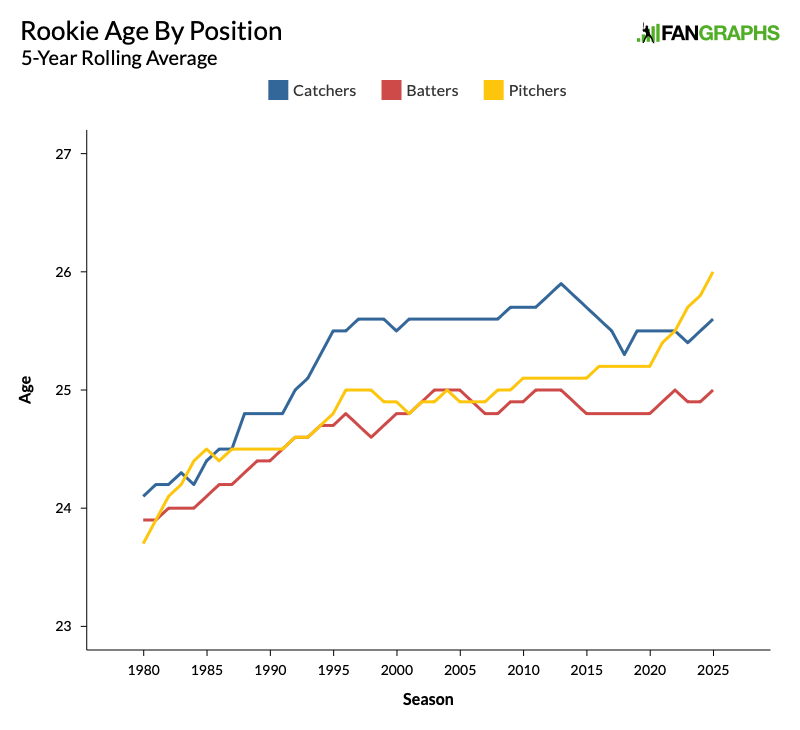
Catchers take awhile to develop through the minors. Not only must they learn how to hit pitches, they also must learn how to frame pitches, block pitches, and call pitches for dozens of their teammates. And because catching is a physically demanding job that requires more days off (unless you’re Cal Raleigh), they develop these skills a touch slower than their peers. Analysis from 2012 shows catchers tend to peak two years later than players at other positions. Teams have responded by delaying their debut:
Catcher is also unique in that the skill set isn’t parallel to other positions. A team with a pair of starling right fielders might move one to left to get both of their bats in the lineup. But a catcher’s value is generally tied to catching itself, and very few hit well enough to where a position switch (or significant DH duty) might be justified. If a team finds itself with multiple catchers of value, it is often inclined to trade one.
Or at least, that’s my theory to explain this: 25 of the 66 catching prospects graded 45 FV or higher between 2021 and 2025 have been traded. If we pretend reliever prospects don’t exist for a moment, that’s the highest rate of prospect trades at any position.
| Pos | Total Prospects | Total Traded | Trade Rate |
|---|---|---|---|
| RP | 61 | 28 | .459 |
| C | 66 | 25 | .379 |
| 2B | 58 | 21 | .362 |
| SP | 290 | 102 | .352 |
| 3B | 52 | 18 | .346 |
| RF | 47 | 16 | .340 |
| LF | 29 | 9 | .310 |
| CF | 97 | 30 | .309 |
| 1B | 26 | 6 | .231 |
| SS | 102 | 18 | .176 |
| DH | 1 | 0 | .000 |
This analysis is a little tricky. Prospect lists are cyclical, while transacting is near constant, and positions and grades can change. The total prospect count includes any player who ever received a 45 grade or better on any of our preseason lists from 2021 to 2025; players who received such a grade multiple times are included just once for each position. The trade count includes any prospect who also appeared in the trade log from RosterResource; players traded multiple times are included just once for each position. The result is a broader slice that may miss a few players at the edges, but I think the picture is clear: Catcher prospects get traded a lot.
In fact, the catching prospect carousel is how the White Sox created this log jam in the first place. Teel and Quero (and even third stringer Korey Lee) are each former top prospects traded from teams not quite in a position to use them.
Quero signed with the Angels out of Cuba in February 2021. They advanced him quickly, as they’re known to do, and he seemed to respond, working onto our 2023 Top 100 Prospects list at the age of 19. “Quero is a bat-first catching prospect far away from the big leagues,” wrote Eric Longenhagen and Tess Taruskin in their evaluation of him at the time. The issue for the Angels was they already had Logan O’Hoppe, who ranked even higher on the same list and found immediate success upon his debut. At the trade deadline, perhaps in denial of their standing ahead of Shohei Ohtani’s looming free agency, the Angels shipped Quero to the White Sox for Lucas Giolito.
Teel was drafted by the Red Sox out of the University of Virginia in 2023. He, too, advanced quickly, and found himself on our 2024 Top 100 Prospects list at the age of 22. “Teel is a decorated college catcher with a fabulous offensive résumé,” Eric Longenhagen and Tess Taruskin wrote in their prospect report on him two years ago. While the Red Sox didn’t have a system-wide catching log jam, they were in the market for a frontline starting pitcher with big league experience. Teel was an attractive trade chip worthy of headlining a deal to get Garrett Crochet.
The logic of this for the White Sox — making two crucial, franchise-altering deals for players at the same position — raised more than a few questions. But as Ben Clemens noted at the time, for a rebuilding team with nothing lose, it’s often wise to attack prospect attrition head on. Log jams exist in theory more often than in reality.
The Jelly
This strategy looks quite prescient now, with Teel set to miss the first several weeks of the season.
Quero will get the first shot at full-time catching duties, just as he did in 2025. He held is own in 403 plate appearances after an April call-up, with a 95 wRC+, a 17.6% strikeout rate, and a 7.9% walk rate. He had some great months and some terrible months, and that all worked out to an OK year at the plate.
His is the type of offensive profile I tend to describe as “interesting” more than “exciting.” He swings very slow — the 10th-slowest swing of 2025 — but he also tends to swing accurately, squaring up 43.3% of his contact (fifth overall) and rarely whiffing. He also tends to swing at good pitches: His chase rate was 10th best in 2025, and he was one of only two players not to swing at a single pitch in the waste region. (Why this didn’t result in more walks is analysis for another day.)
Still, the lack of bat speed does put Quero in an awkward tweener space. Yes, he topped 95 mph on 46.3% of his batted balls last year, but he rarely went above and beyond that mark. His .451 xwOBA on hard-hit balls was fifth lowest in the majors. He also ran one of the 10 lowest pull rates of 2025. It’s a profile that leads to lots of groundballs to middle infielders, and fly balls to the gaps at middle depth, rarely challenging outfielders at the wall. A step forward in 2026 would include increasing the top range of his exit velocity, or pulling the ball in the air more often.
Unfortunately, his future in the majors likely relies on that step forward at the plate. Quero was the worst pitch framer of 2025, finishing with -13 catcher framing runs. His other defensive metrics (blocking and throwing) were effectively neutral. It’s possible he improves his receiving skills (once again emphasizing his age), but defense has always been his limit, and it’s tough to find playing time for a catcher who can’t catch.
Teel will start a bit later once his hammy is healed, looking to build off an excellent rookie performance. He posted a 125 wRC+, a 25.9% strikeout rate, and a 12.5% walk rate in 297 plate appearances following his June debut. He simply hit and hit and hit and only improved as the season wore on.
Again, it’s an “interesting” profile. Like Quero, Teel doesn’t swing particularly hard, but unlike Quero, he doesn’t swing accurately, rarely squaring up the ball and whiffing often. His carrying contact trait is a near-flawless launch angle distribution, posting a 47.8% sweet-spot rate in 2025, a mark that would have led the league had he qualified.
The contact styles paint an interesting contrast. Quero makes up for his light swing by maximizing his exit velocity and spraying moderately hard contact all over the field, hoping enough of it finds grass. Teel, on the other hand, simply lofts the ball, often to the pull side, hoping a few plop over the fence.
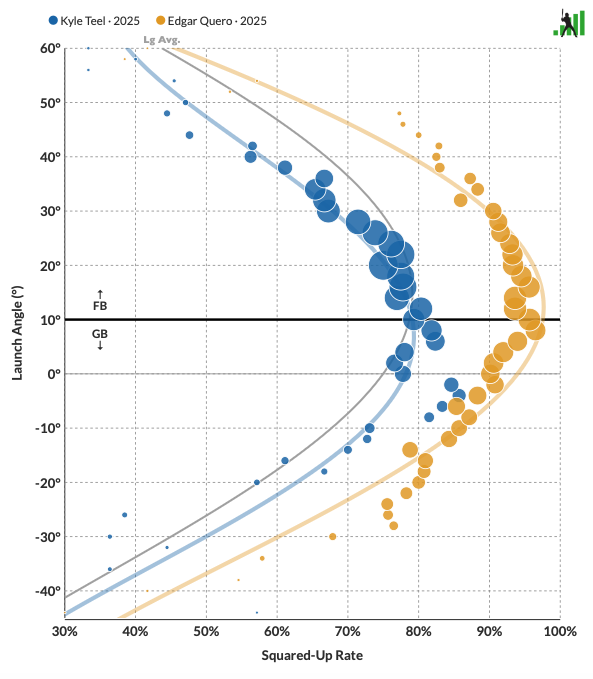
I tend to prefer Teel’s approach to the bat-speed dilemma. His pinpoint launch angle makes even his weak contact competitive. When he does make good contact, it’s likely to be traveling in the air toward the shallowest part of the park. Teel also looked significantly better than Quero by the various x-metrics, despite a much worse hard-hit rate; launch angle, it’s important! Now, Teel’s eye for the zone was not quite as sharp as Quero’s, but it was still very good, and Teel (again, for reasons unclear to me) seemed to translate his approach into an impressive number of walks. A step forward at the plate in 2026 would likely include cutting back on the strikeouts, and if we’re being greedy, finding the barrel more often.
As far as defense, however, Teel wasn’t quite as sharp as one would’ve hoped. His framing was essentially neutral, and his blocking was among the league’s worst. The scouting reports are a bit friendlier, and I do put some stock into the fact that the White Sox gave him a greater share of the catching duties near the end of the season. I’m willing to chalk this up to small samples and assume he’ll improve with more playing time.
That’s all to say, both Teel and Quero posted strong rookie seasons for their age and position, and both showed signs of their future value, but neither catcher has done enough to force the team to move on from the other one. For what it’s worth, the White Sox came in at just 26th on our positional power rankings. But even that ordinal ranking might not be telling us all that much, considering there is only marginal separation between their projected value at catcher and the expected production at the position for each of the six teams ahead of them.
How will this work once Teel returns? Before the injury, manager Will Venable suggested the plan is to have Teel catch when facing right-handed starting pitchers, with Quero at DH. Against lefties, Quero will catch and Teel will sit. It’s a platoon, in other words. Quero is a switch-hitter who’s stronger against lefties; Teel is a lefty batter who’s stronger against righties. Both are primed for plenty of playing time.
How will this work long-term? That’s less clear. It’s possible one of them runs away with the job, or that neither of them does. But it’s also possible both wind up as reasonably good options when the White Sox are competitive again. What happens from there is a problem I’m sure they’d each like to have.
Ryan Blake is a contributor for FanGraphs and Lookout Landing.
I really like the white sox moves this offseason. I thought they sort of crushed it for what they had to work with. That being said…..Guessing they will struggle on the mound since these guys are young. Shouldve signed 1 veteran catcher that can teach them how to call and handle a staff. How to garner respect from all the different personalities on the mound. I’ve seen this episode too many times to know whats going to happen this season for them.
Appreciate the article but a little weird to only mention Korey Lee in passing. He’s a third stringer because of Teel & Quero, not because he’s a total bum. Lee’s 27, was a decent prospect in his own right, he’s probably the best defender of the trio right now, and he’s flashed some gains in K% that could make him a low-end starter quality C overall. Not inconceivable the answer is trading Quero and rolling with a Teel/Lee platoon.
As a White Sox fan, I hope you’re right about Lee, but I don’t see any evidence from AAA in 2025 that he’s any better than he was at AAA in 2023, or the majors in 2024 for that matter. His K rates are the same for the two AAA seasons.
Not obvious at surface level, but he seriously improved under the hood: 86.4% in-zone contact rate at Charlotte last year vs 75.2% in Chicago in ’24 and 77.4% at AAA in ’23. That largely carried over in his limited ’25 big-league work (83.7%). That brought his overall contact rate meaningfully: 67.4% ’23, 66.7% in ’24, 75.1% (AAA)/72.2% (MLB) in ’25.
If he gets to his plus raw pop in-game even a little like he has this spring (caveat emptor), his bat is totally viable for a competent defensive catcher.
Maybe he winds up as the platoon partner for Teel then. It feels like it is a lot more likely that Quero hits better than he learns to catch.
Apparently Quero does a great job gameplanning and pitch calling.
Quero went to Driveline in the off-season, specifically to address the bat speed and launch angle issues discussed here. Something to monitor with his burgeoning opportunity.
This is a small sample size but I can remember sitting behind home plate at a Trash Panda game looking forward to watching Quero play. He was lazy during warm ups between innings and I thought he would never be a MLB catcher.
That’s not a sample size issue, that’s just an anecdote