
Willians Astudillo and Shooting for History
Some of you might not realize that, if you hover over the search bar up there, you’ll see which player pages have recently been the most popular. Let’s give it a spin, shall we?
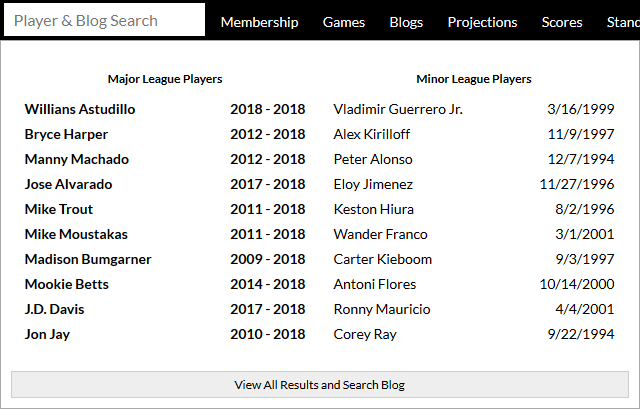
Willians Astudillo. Between Astudillo and Vlad, I don’t know which has been more popular, but I strongly suspect it’s the former, and it’s definitely the former among major-league players. People have been losing their minds over Astudillo of late. Now, I did write about him last week. Playing winter ball down in Venezuela, Astudillo has performed like a deserving MVP candidate. But also, there’s a clip that’s been making the rounds. Willians Astudillo hit a home run.
Willians Astudillo may have broken every single one of baseball's unwritten rules on one home run ? pic.twitter.com/LD6e73C1Eh
— ESPN (@espn) January 9, 2019
Much has been made of Astudillo’s behavior. Within the span of a couple of seconds, you’ve got the Adrian Beltre follow-through:
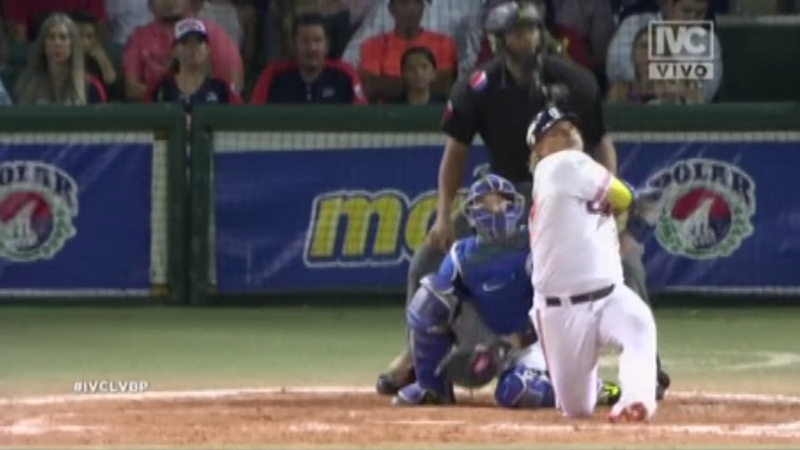
The kneel and stare:
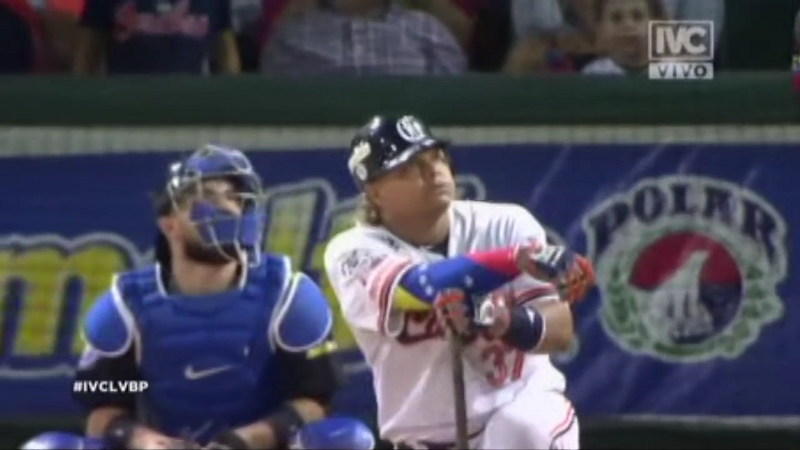
And the celebration at his own dugout:
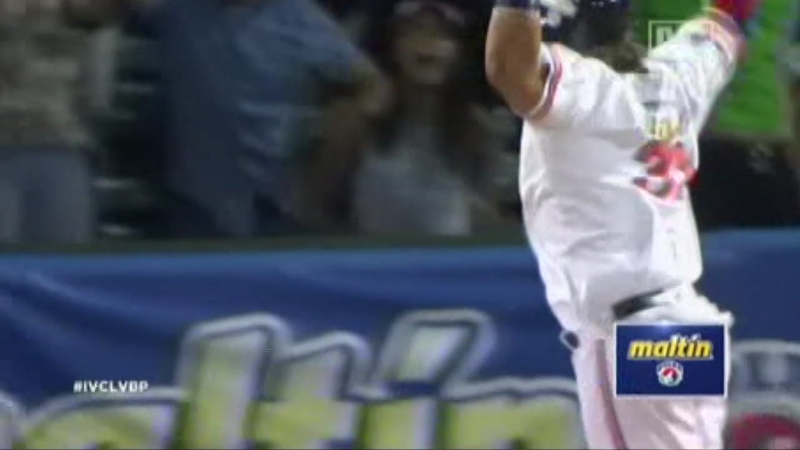
Astudillo pimped that thing. Astudillo pimped that home run like few home runs have ever been pimped. Many people have looked upon him favorably for that, while there’s also been the usual, predictable group of people who think he deserves a fastball to the ribs, if not worse. I should hope we’re moving beyond this debate — it’s inconceivable to me that anyone would prefer a brand of baseball played without passion. But anyway, I want to at least lay out some context. Why did Astudillo respond like he did? Because he didn’t hit just any home run.
That’s a playoff home run. The Venezuelan winter league has entered the playoffs. That’s a playoff home run, in Game 5 of a best-of-seven series between Astudillo’s Caribes de Anzoátegui and Navegantes del Magallanes. Astudillo’s team lost the first two games, before rallying to win the next two. The home run up there snapped a 1-1 tie in the bottom of the eighth. Astudillo went deep against big-league pitcher Deolis Guerra, after Guerra had gotten the first two batters out. The game ended 2-1, and Game 6 of the series is tomorrow. After posting a big regular season, Astudillo has gone 8-for-20 in the playoffs. He has one home run and, of course, zero strikeouts.
It’s a good time to be Willians Astudillo. It’s a good time to be searching for Willians Astudillo content. And because Astudillo has gotten so popular, he’s been on the mind of our Alex Chamberlain. Alex pitched a topic to me. Full credit to him for the idea. I’ll blockquote the heart of the matter:
ok, here goes: willians astudillo is our best and final hope for breaking dimaggio’s hit streak record
There’s no need to dig too deep. No one is going to break Joe DiMaggio’s hit-streak record. But who, right now, might actually have the best odds? The best odds that are still impossible, since a 56-game hitting streak is essentially impossible. (Slightly less impossible than a 57-game hitting streak.) If you know anything about Astudillo, you know that he just about never strikes out. That’s the first statistical trait that ever made him so charming. But, related to that, Astudillo also seldom walks. Here’s a table of Steamer projections for 2019, among players who are expected to get at least a pinch of major-league service:
| Player | AB/PA% |
|---|---|
| Hanser Alberto | 94.8% |
| Dawel Lugo | 94.3% |
| Willians Astudillo | 94.2% |
| Yonathan Daza | 94.0% |
| Ronny Rodriguez | 94.0% |
| Josh Fuentes | 93.8% |
| Dustin Fowler | 93.8% |
| Tim Anderson | 93.8% |
| Dee Gordon | 93.8% |
| Victor Reyes | 93.8% |
AB/PA% is a weird thing to look at, but it makes sense when you’re worried about a hitting streak, because key to any hitting streak is maximizing at-bats. A walk doesn’t do you any good. A hit-by-pitch doesn’t do you any good. If you bat four times, and go 0-for-1 with three walks, any existing hitting streak is over. This is something Astudillo has going for him. This is presumably what Chamberlain had in mind. What’s critical, then, isn’t so much batting average as it is hits per plate appearance. Here are the big-league leaders over the past three years:
| Player | H/PA% |
|---|---|
| Jose Altuve | 29.8% |
| Daniel Murphy | 29.6% |
| Jean Segura | 28.3% |
| Charlie Blackmon | 28.2% |
| DJ LeMahieu | 27.8% |
| J.D. Martinez | 27.7% |
| Wilson Ramos | 27.3% |
| Yuli Gurriel | 27.3% |
| Michael Brantley | 27.3% |
| Eduardo Nunez | 27.2% |
There are some top candidates right there. The higher one’s rate of hits per plate appearance, the higher one’s odds of an extended hitting streak. But then, for this prompt, we’re not trying to look backward. We’re trying to look forward. Full ZiPS hitter projections don’t yet exist, but we do have all the Steamer data. Here are the highest projected rates of hits per plate appearance:
| Player | H/PA% |
|---|---|
| Yonathan Daza | 28.3% |
| Daniel Murphy | 27.8% |
| Willians Astudillo | 27.3% |
| Vladimir Guerrero Jr. | 27.3% |
| Josh Fuentes | 27.2% |
| Jose Altuve | 27.0% |
| Eloy Jimenez | 26.8% |
| Eduardo Nunez | 26.7% |
| Yuli Gurriel | 26.5% |
| Raimel Tapia | 26.3% |
Daza is a…curious leader, but he rarely walks, and he’s posted high averages in the lower minors. At the same time, he’s played only a half-season in Double-A, so you’d be forgiven if you didn’t think 2019 will be his year. Behind Daza, we have Murphy. Murphy makes sense because he’s a line-drive, contact hitter, and, like Daza, he’ll play in Colorado, where hit rates are inflated. And then, after Murphy, there’s Astudillo. Astudillo is basically tied here with Vlad. I should note that, in his time in Triple-A, Astudillo’s rate of hits per plate appearance has been 27.6%, which is awfully similar. Astudillo doesn’t have speed, but he has that relentless ability to hit the ball *somewhere* almost every time. It makes a hitless game pretty unlikely, at least if Astudillo were to start, and every hitting streak starts with one. The more likely a player is to turn any given plate appearance into a hit, the more likely that player is to have a long hitting streak.
It’s a little more complicated than that, even ignoring one’s place in the batting order. For example, if someone bats four times and draws four walks, any existing hitting streak is still alive. The same goes for a pinch-hit appearance that leads to a walk. The hitting streak would continue. But we’ve covered what’s most important. On a per-PA basis, Astudillo projects as a premier hit machine. ZiPS is more bearish, putting Astudillo’s H/PA% for 2019 at 26.5%. Yet that would still be one of the very highest rates. I think that we’ve answered the question.
No one in 2019 is likely to threaten Joe DiMaggio’s all-time-record hitting streak. The chances are far too slim. Yet they can still be individually calculated, and if one were to go through the math, one of the five or ten leading candidates to make an attempt would be Willians Astudillo. He might not have Jose Altuve’s speed, and he might not have Daniel Murphy’s home-field favorability. But he does have the incredible bat control. The biggest question might just be how often he plays.
Jeff made Lookout Landing a thing, but he does not still write there about the Mariners. He does write here, sometimes about the Mariners, but usually not.
Astudillo will win the Rookie of the Year, and maybe even MVP.
ay EB
I can think of no better outcome for 2019 than Willians Astudillo breaking DiMaggio’s hit streak.
I am trying hard to come up with something else, and all of the other contenders also involve Astudillo. This guy is gonna save baseball.
I want him to hit what should be a double to the gap for game #57, and then I want him to recreate this home run celebration. I want him to do exactly the same thing to such a degree that he is only halfway to first base as the ball caroms off the wall, and when he rounds to go to second he is thrown out by 35 feet. I want him to keep making his way around the bases and celebrating with this same degree of gusto as he returns, having recorded an out, to his dugout.
My only potential counter is that Juan Soto might save it first.
Roughly one in one hundred and eight million, for a specific 56 game stretch. There are 106 such stretches in the regular season. So about one in a million that it will happen in 2019. If we give him a 20 year career, about one in fifty thousand he will achieve it *at some point*.
Those aren’t actually impossible odds. Multiply that by the number of contact-heavy hitters in the majors in any given year, and it seems likely we will eventually see the record broken.
Strikeout rates are climbing and contact rates overall are trending down. I’d argue the opposite.
Baseball is going to be around for a long long time. Lowering contact rates make a difference, certainly, but odds are still in favor of us seeing the record broken at some point. Given the tables above, let’s say there are 20 contact heavy hitters who play as regulars in a given year. That means on any given year, we have about a 1:50,000 chance to see the record fall. So if we assume at least another century of baseball, it’s a 1:500 chance that the record will be broken somewhere in that time.
That’s definitely far from a guarantee. It’s still relatively long odds. But it’s also far from a statistical impossibility.
With todays bullpen usage, shifting, scouting reports and balls in play becoming less and less in todays game with many, many more obstacles to list- IDK. Too many variables (working against/or would need to be met) for the likelihood of that ever happening.
Although, don’t get me wrong, i’m not arguing it’s IMPOSSIBLE, but…
What do we see first? .400 or 56 games? What does the math say?
Hmm..I’m getting the odds at approximate 1 in 5 million. Here are my assumptions – can you correct my math?
30% chance of a hit per PA
4 PA/game
P( >=1 hit in a game) = 1 – P(0 hits) = 1 – .7^4 = .76
P(>=1 hit in n games) = .76^n
P(56-game hit streak) = .76^56 = ~2.1 x 10^-7 –> 1 in ~4.7M
I’m not sure about the following: since there are about 106 such stretches, that becomes 1 in 44k.
If we make the (obviously wrong assumptions) that each hitter has the same H/PA chances and that AL team plays the same 9 hitters each day (8 for NL), then we have 8.5 * 30 = 255 players trying it, so the odds that *someone* would do it are down to about 1 in 172 in any given season.
So the probability of nobody doing it for, say, 50 years is (1-1/172)^50 or about 75%.
So if every hitter in MLB was Astudillo, there’d be about a 25% chance of someone doing it in the next 50 years.
Your maths is right. kbn’s is way off.
Where by way off, I think kbn used a 27.2% H/PA rather than 30. Which means a 71.91% chance of a hit in a game rather than 75.99. And that’s literally the difference between 1 in 4.76 million and 1 in 104.53 million for 56 games. Between 1 in 174 and 1 in 3,800 for a given season. Between the next 50 years being a 25% chance and a 1.3% chance.
Umm … that’s not how statistics work. You started alright: The one in 108m is about right. But you lost your way after that. If you try something with a one in 108m chance 106 times, the result is not 1 in a million that it happens once. If that were the case, if you tried 108m times you’d be guaranteed that it would happen once, which of course isn’t true (same reason if you flip a coin twice your chances of getting one head is not 100%). You have to think about it backwards. The chances of him accomplishing the feat at least once is the opposite of him never doing it at all. Meaning those two probabilities add to 1. And the chances of him doing it never in his career is pretty easy to compute. The chances of him not doing it in any given 56 game stretch is 107999999/108000000. He has about 3000 such stretches in a 20 year career, so the chances of him never pulling it off is that very-closet-1.0 number raised to the 3000th power. And the chances of him doing it at least once is 1 minus the resulting number. The correct answer for his entire career is about 1 in 35000 (I used 1 in 106m rather than 1 in 108m). So actually more likely than you calculated.
“If you try something with a one in 106m chance 106 times, the result is not 1 in a million that it happens once.”
In fact, it is, when rounded to the nearest whole number. It’s 1 in 1,000,000.495.
You’re right that simply taking 106 million and dividing by 106 is incorrect methodology. But when the chance of something happening is so small, it’s a reasonable way to approximate quickly. Because the only difference is the approximation gives double credit for the chance of the thing happening twice (triple credit for chance of 3, etc) in the sample, and the correct method doesn’t. When the chance of multiple occurrences in the sample size is so tiny, that difference is negligible.
It’s when the chance of success gets bigger, or the sample gets bigger, that the approximation doesn’t work so well. If it’s a 1 in a million chance of happening for a given player season, and we look at the next 1 million player seasons, roughly the next 4000 years with 250 players each year, it doesn’t mean there’s a 1 in 1 chance. The approximation breaks down, the actual answer is 63.2% chance of it happening, not 100%.
You’re all wrong. It’s 50%/50%. He either does it, or he doesn’t.
“if someone bats four times and draws four walks, any existing hitting streak is still alive”… It’s weird to me that a) that’s the rule, and b) there’s a rule written down somewhere that governs what counts as a hit streak.
Dear Willians,
When you make your acceptance speech at Cooperstown, please remember that it was I, tz, who posted the first comment about your reaching the top of the FanGraphs search bar above Harper, Machado, and Trout.
Thanks in advance,
tz
re: that home run:
1) the initial pause seems to be him waiting to see if it was fair or not
2) it seems to be a GW HR. I don’t think the celebration is out of line. Not that winning this game is necessarily comparable to winning the World Series, but I don’t recall too many people complaining about Joe Carter’s celebration.
It was a go-ahead homer, not a game-winning homer.
Ah, ok – I should be done a little more research. In that case, yes – I agree the celebration was a little excessive. I did notice though that Todd Frazier replied on Twitter and said that he loved everything about it!
I am clearing out all the unnecessary stuff I have on my Genie, like all the post-season games that the Sox played in 2018, so I can catch every AB of Willians Astudillo in 2019. Absolute must-see TV!
All that maths, and no mention of the actual chance of a 57 game hitting streak? If you get 4 PAs in a game, and your chance of a hit is 30% per PA, then your chance of at least 1 hit in a game is 75.99%
If your chance of at least 1 hit in a game is 75.99%, then your chance of a 57 game streak for a given 57 games is roughly 1 in 6 million. Of course, if you’ve got approximately 100 different 57 game blocks in a season, that’s now 1 in 60,000. If you’re in a league where the batters consist of 300 Astudillos, that means you should expect a 57 game hitting streak once every 200 years.
The Twins have to play him. They would be mad not too.
They’re not the only ones who would be mad.
There is no home at the inn: I would bet that the Twins do Not have Willans on their projected 25 man roster: They have Castro, at Catcher, Sano 3rd, Polanco at SS, Schoop at 2b, Cron at 1b; Outfield Buxton, Rosario, Kepler, with Cruz at DH Bench Garver, Adrianza, Cave (and Maybe Austin) with 13 pitchers being the most likely scenario, baring injury. He isn’t supplanting Cruz and doesn’t have a defensive position. He is an atypical player who doesn’t fit the statistical mold in an age of statistical molds being the way teams are operating.
There is a lot of weight to a fan favorite. Buxton and Cruz would get me to watch them but not a lot else as an average fan watching what will be a very average team. The team is a product and he is the Cherry on top of a pretty dull sponge cake
I agree that it appears challenging for the Twins to find room. And at the same time, I’m optimistic that Falvey / Levine will find a way – perhaps even at the expense of trading Castro.
Ignoring the fun factor, Astudillo would also be a much more efficient use of a roster spot than Garver. Astudillo can catch competently enough to do it once or twice a week, while also filling in at 3rd, 2nd, and corner OF. Plus he’s much more likely to have value as a pinch hitter when not starting (and ESPECIALLY in scenarios like runner on 3rd, 1 out, where you really want a ball in play.)
This is not a knock on Garver. I think he has proven himself a capable backup with the potential to be an average starter, but he’s limited to one position, which is much less valuable on the bench.
What sets Astudillo above the rest (the way I envisioned it) is, aside from maximizing AB/PA, he also maximizes (AB – K)/PA — that is, BIP/PA (approximately). So, if it were to come down to the final PA of the game, he’d have the highest probability of putting the ball in play. I hadn’t considered how drawing a walk in this instance might be beneficial, though.
No matter; I am so giddy
(I guess the walk wouldn’t matter, on second thought. In fact it would make the last PA a failure, for the purpose of this exercise. So, right: even though Murphy and Altuve are more efficacious per BIP, they have a lower probability of a BIP outright.)
Go Willians!
“Many people have looked upon him favorably for that, while there’s also been the usual, predictable group of people who think he deserves a fastball to the ribs”
Why not both? That celebration was so excellent he deserves an extra base!
“it’s inconceivable to me that anyone would prefer a brand of baseball played without passion.”
I believe that you can play the game with passion while still showing respect for the opposing pitcher and team. The two aren’t mutually exclusive.
Sportsmanship has a different meaning today than it used to, in that it actually no longer exists, which is actually really funny to me. In a world that is becoming so increasingly sensitive, we, for some reason, no longer feel that “losers” deserve the common decency of not having their noses further rubbed in. Engaging in sportsmanship doesn’t mean that individuals or teams shouldn’t be allowed to celebrate, but they can still spare their opponents the public indignation that comes with those celebrations’ excessiveness.
Take, for example, the 2018 SI Sportsman of the Year. Set aside that it went to a team, the Golden State Warriors, not to an individual, and it was still awarded to a group that:
1. Celebrates marginal achievements with hand gestures and dances.
2. Calls out and insult opposing players.
3. Experiences infighting.
4. Engages in public name calling.
5. Refer to themselves as the greatest.
All of which go directly against the definition of “sportsmanship”.
I don’t mean to deride Willians Astudillo, Baseball Hero, for his actions here. Context is important, and emotions can sometimes take over. As someone pointed out above, no one said a peep regarding Joe Carter’s HR trot. Or Kirk Gibson’s fist pump.
However, I do think that we as a society have reached a crossroads regarding how we view the importance of sportsmanship. Some, such as the editors at SI, may want to redefine the word. Maybe that’s just out of convenience. Many may want to disregard it entirely.
I, for one, don’t appreciate the transformation we’re seeing in professional sports, and I accept that I’m in the minority. But, hey, if you enjoy pre-choreographed dances after touch downs, “team pictures” in the end zone after every turnover, shimmies after every basket and bat flips after every home run, good for you. There’s plenty more where that came from!
I do enjoy that stuff!
And that’s okay too!
It seems to me like the players are more accepting of it, even when on the receiving end, since they’re all engaging in the behavior anyway. If they aren’t offended by it, I don’t see why we as fans should be.
That doesn’t mean that I like it, advocate it or would teach my kids that they should behave that way though.
Right on it oozy.
Heck, I’d settle for the mere acknowledgement that valuing dignity and restraint over emotionalism is a valid personal preference. Instead, it’s the recurrent “if you don’t share my tastes you suck” cheap shot.
“The chances are far too slim.”
First time the word “slim” has been used to describe anything about Astudillo?
The crazy thing about that Steamer table, Vladdy Jr, who never played in MLB, is not a free-swinger by any means and he draws plenty of walks, yet is still predicted in the leaderboard in H/PA%…
I mean, I read the article, and I see the math. But if we’re betting on who is the most likeliest to break DiMaggio’s hit streak record, Altuve is the favorite by a mile right?
There are a lot of people in here smarter than me at math! To those people, I pose the question, what’s more statistically improbable, Dan Uggla’s 2011, 33 game hit streak, or Astudillo going for 57? Thanks in advance!
Of note, Uggla ran a .233 batting average on the back of a .253 BABIP, a 9.2% walk rate, a 23.2% K rate, and a 73.4% contact rate…
Baseball!
More fun: Before the streak started, Uggla was hitting .173/.241/.327 (55 wRC+). And his season surrounding the hit streak (removing the 33 games) looked like this: .194/.276/.368 (78 wRC+).
The question you are posing really is “What is more surprising, some player like Uggla with a pretty bad batting line, getting a 33 game streak at any point in say the last 10 years? Or Astudillo getting 57 at any point in his career?”
Chance of a given 56 games all having hits is anywhere from 1 in ~5 million (at 30% hit/PA) to 1 in ~100 million (at 27.2% H/PA). For Uggla’s career, his hit/PA was just under 21%, and was 17.3% that season outside the streak. If we use 20%, we get his chance of a hit in a given game being 59%. His chance of a given 33 games all having hits is 0.5904^33, or 1 in 36 million. If we use 17.3%, it’s 1 in 1 billion.
So 2011 Uggla producing a 33 game hit streak might be even more unlikely than someone like Astudillo going 56. Or they’re about the same, depending on your starting assumptions.
Now waiting for Yonathan Daza’s name to appear on the most-searched-for players list.
It’s going to take a really long time to break that record since Fangraphs has him down for 120 at bats this year.
Give him one in the ribs…the last thing we need is baseball turning into the self-aggrandizement shows of football and basketball. How about setting a good example for young kids watching?
Throwing solid objects at high velocity at people is a good example for kids?
Just for fun and context …
Astudillo had 33 hits in 97 PAs in his debut, just over 34%.
The last modern seasons of 30+ hits and at least 34% H/PA came in:
— 2007, among all players (Timo Perez?!?, 35/96)
— 1973, among debuts (Ken Griffey, Sr., 33/92)
— Never, among those with a BAbip of .350 or less (Astudillo was .341)
I am as excited about Astudillo’s freak-outlier potential as I was about Ryan Schimpf’s.
Of course, Schimpf was last seen batting .178/.643 in Salt Lake City.
But the offseason is for dreaming.
Since I’m not equipped for the probabilistic model, I did a simple study of the 44 hit streaks of 30+ games since 1908 (including those spanning seasons; data from B-Ref).
The medians:
— AB/PA* 92.7%
— H/PA* 36.2%
— SO% and BB% both about 7%
— SO+BB% 14.4%
— 4.47 PA*/game
— 4.16 AB/game
— BA .395
— BAbip .381
(* My “PA” in these measures is simply AB+BB, since the streak finder doesn’t give actual PAs nor HBP, SF, etc.)
My quick take: Although extremely high SO+BB% is quite detrimental to batting streaks, extremely low rates are not necessarily a big plus. Just one of these 44 streaks had a SO+BB% below 8%, while 11 were over 20%. Even the 11 streaks of 35+ games had a median 11.5% SO+BB. Astudillo’s debut rate of just 5% SO+BB probably doesn’t mean much for these purposes.