
ZiPS Time Warp: Joe Mauer
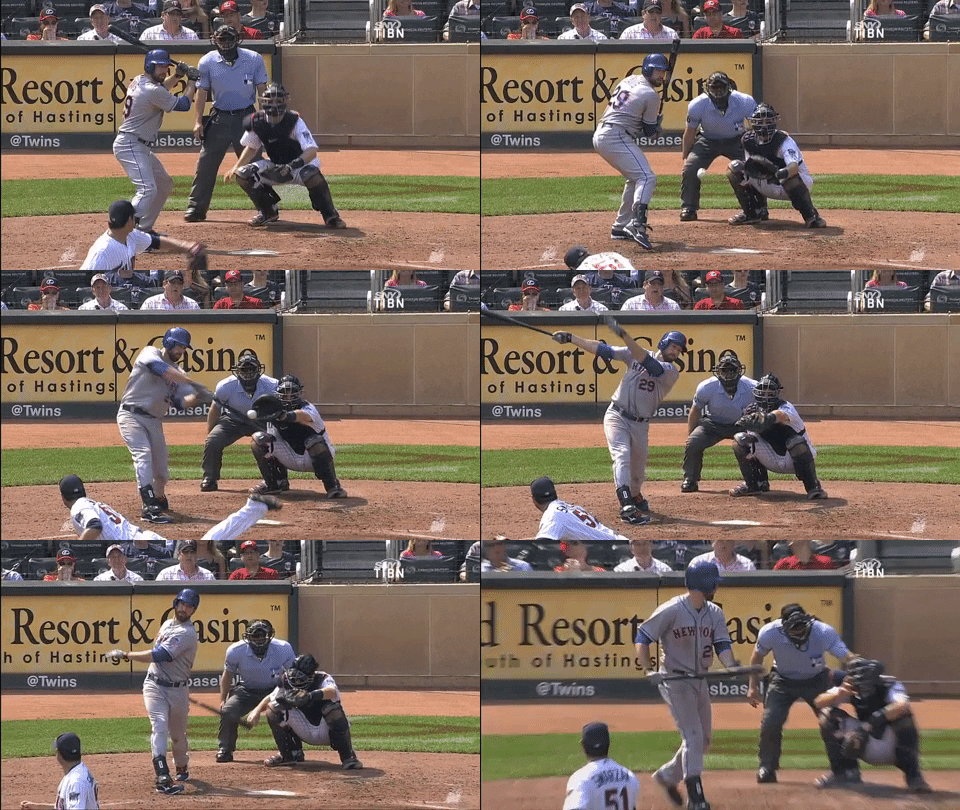
If we didn’t know it was real, Joe Mauer’s career with the Minnesota Twins might strike us as being more like a fairy tale than an actual story. That is, until August 19, 2013. That was when Mets first baseman Ike Davis hit a foul tip that hit Mauer square in his helmet.
The moribund Twins, coming off a 69-93 season, had the first overall draft pick in 2001 for the second time in franchise history. The first time the Twins had the No. 1 pick, they drafted Tim Belcher, who didn’t sign when the team wouldn’t pay the going rate for a top selection. Minnesota also failed to sign their second round pick, Bill Swift; none of the players they actually did sign ever played a game in the majors.
The Carl Pohlad-owned Twins were not known for aggressively investing in their team. In 2000, the Twins drafted Adam Johnson with the No. 2 pick, largely because he was willing to sign for a $2.5 million bonus, a smaller sum than the next five players drafted. The consensus top pick, Mark Prior, wasn’t going to be cheap (he ended up signing for a $4 million bonus and a $10.5 million major league contract). But the Twins had the chance to not spend money and get a top prospect who was a local boy, and they took it, signing Joe Mauer to a $5.15 million bonus and no guaranteed major league deal.
Mauer was far less of a reach than Johnson had been the previous year; indeed, he may very well have been the mock draft darling if it hadn’t been for the presence of Prior and Mark Teixeira, who were both considered to be as complete a prospect coming out of college as one could ever find. Mauer was already a hitting machine at a young age — he only struck out once in his entire high school career — but there’s always a risk with a high school catcher.
The concerns turned out to be unwarranted. Mauer went from a St. Paul high school to hitting .400 in rookie ball almost immediately after signing. Three years later, he was already in the majors. By his age-30 season in 2013, Mauer could boast six All-Star appearances, an MVP trophy, three Gold Gloves, and four Silver Sluggers, and was widely considered an elite catcher. With six weeks to go in the 2013 season, Mauer was having his best year since before his injury-shortened 2011, hitting .323/.404/.476 for a 143 wRC+ and 5.2 WAR. His case for Hall of Fame induction was proceeding quite nicely. The post-Pohlad Twins opened their wallets for their best player, signing Mauer to an eight-year, $184 million extension in 2010.
| Name | G | AVG | OBP | SLG | wRC+ | WAR |
|---|---|---|---|---|---|---|
| Johnny Bench | 1633 | .268 | .343 | .484 | 128 | 64.1 |
| Gary Carter | 1407 | .272 | .345 | .461 | 123 | 53.3 |
| Joe Torre | 1518 | .305 | .369 | .475 | 136 | 51.1 |
| Ivan Rodriguez | 1479 | .305 | .342 | .489 | 110 | 49.5 |
| Ted Simmons | 1564 | .298 | .366 | .459 | 126 | 49.2 |
| Joe Mauer | 1178 | .323 | .405 | .468 | 134 | 46.1 |
| Mike Piazza | 981 | .328 | .391 | .575 | 154 | 44.0 |
| Brian McCann | 1105 | .277 | .350 | .473 | 117 | 42.5 |
| Yogi Berra | 1200 | .293 | .353 | .493 | 128 | 40.3 |
| Mickey Cochrane | 1167 | .321 | .412 | .490 | 132 | 39.8 |
But as we know, the foul tip to his head ended up being the major turning point in his career. Placed on the seven-day concussion disabled list, Mauer didn’t play for the rest of the 2013 season. Until the last game of his career, Mauer didn’t play another game at catcher, as the Twins moved him permanently to first base to protect his health. Entering 2014 with a career wRC+ of 134, Mauer didn’t put up that number in a single season as a first baseman. And it wasn’t a coincidence; Mauer dealt with blurred vision for years. From a star to a league-average player at best after a single pitch, Mauer continued to play for Minnesota until his retirement after the 2018 season.
Finishing with nearly 2000 games in the majors, and collecting 2,123 hits, a .306 average, and 52.5 WAR, Mauer finished with career numbers that the vast majority of players would be elated to have accumulated. He may even still make the Hall of Fame, depending on how the electorate considers the concussion. When contrasting Johan Santana and Kirby Puckett, there’s a lot of inconsistency regarding how the voters treat peak value and injury-shortened careers. If considered a catcher, Mauer would rank ninth all-time in hits at the position. It would be hard to argue the event that led to his move to first resulted in Mauer’s career numbers ballooning as the typical move from catcher to an easier defensive position might. And while I will still be just-short of having my Hall of Fame vote when Mauer becomes eligible for induction, I absolutely will vote for him should I have the opportunity a couple years later.
Let’s construct an alternate history for Mauer’s career using 2013 as the jumping-off point. Using the ZiPS projection system, I ran the rest of Mauer’s career as-of the concussion. The foul tip misses Mauer this time, he collects 38 more hits and a .311/.391/.451 line for the rest of 2013, and then experiences a normal decline phase as a catcher:
| Year | BA | OBP | SLG | AB | R | H | 2B | 3B | HR | RBI | BB | SO | SB | OPS+ | WAR |
|---|---|---|---|---|---|---|---|---|---|---|---|---|---|---|---|
| 2004 | .308 | .369 | .570 | 107 | 18 | 33 | 8 | 1 | 6 | 17 | 11 | 14 | 1 | 138 | 1.2 |
| 2005 | .294 | .372 | .411 | 489 | 61 | 144 | 26 | 2 | 9 | 55 | 61 | 64 | 13 | 107 | 3.4 |
| 2006 | .347 | .429 | .507 | 521 | 86 | 181 | 36 | 4 | 13 | 84 | 79 | 54 | 8 | 144 | 5.8 |
| 2007 | .293 | .382 | .426 | 406 | 62 | 119 | 27 | 3 | 7 | 60 | 57 | 51 | 7 | 118 | 3.3 |
| 2008 | .328 | .413 | .451 | 536 | 98 | 176 | 31 | 4 | 9 | 85 | 84 | 50 | 1 | 134 | 6.4 |
| 2009 | .365 | .444 | .587 | 523 | 94 | 191 | 30 | 1 | 28 | 96 | 76 | 63 | 4 | 171 | 8.4 |
| 2010 | .327 | .402 | .469 | 510 | 88 | 167 | 43 | 1 | 9 | 75 | 65 | 53 | 1 | 140 | 5.7 |
| 2011 | .287 | .360 | .368 | 296 | 38 | 85 | 15 | 0 | 3 | 30 | 32 | 38 | 0 | 102 | 2.1 |
| 2012 | .319 | .416 | .446 | 545 | 81 | 174 | 31 | 4 | 10 | 85 | 90 | 88 | 8 | 140 | 4.6 |
| 2013 | .320 | .401 | .470 | 568 | 80 | 182 | 43 | 0 | 14 | 62 | 77 | 107 | 0 | 140 | 5.9 |
| 2014 | .302 | .388 | .427 | 539 | 74 | 163 | 35 | 1 | 10 | 73 | 75 | 96 | 2 | 130 | 6.1 |
| 2015 | .305 | .386 | .446 | 511 | 68 | 156 | 34 | 1 | 12 | 67 | 67 | 92 | 2 | 126 | 5.2 |
| 2016 | .301 | .385 | .444 | 491 | 67 | 148 | 32 | 1 | 12 | 66 | 67 | 95 | 2 | 127 | 4.4 |
| 2017 | .298 | .385 | .436 | 466 | 66 | 139 | 29 | 1 | 11 | 66 | 66 | 89 | 2 | 121 | 3.7 |
| 2018 | .284 | .365 | .400 | 437 | 54 | 124 | 25 | 1 | 8 | 54 | 56 | 80 | 1 | 109 | 2.7 |
| 2019 | .279 | .354 | .397 | 408 | 55 | 114 | 22 | 1 | 8 | 54 | 48 | 73 | 1 | 100 | 1.6 |
| 2020 | .277 | .346 | .375 | 376 | 45 | 104 | 17 | 1 | 6 | 45 | 40 | 59 | 1 | 94 | 1.0 |
| 2021 | .272 | .333 | .353 | 346 | 39 | 94 | 14 | 1 | 4 | 39 | 32 | 49 | 1 | 85 | 0.2 |
| 2022 | .266 | .323 | .332 | 289 | 31 | 77 | 10 | 0 | 3 | 31 | 24 | 36 | 1 | 77 | -0.4 |
| ZiPS Proj. ROC | .290 | .367 | .408 | 3863 | 499 | 1119 | 218 | 8 | 74 | 495 | 475 | 669 | 13 | 111 | 24.5 |
| Actual ROC | .278 | .359 | .388 | 2552 | 330 | 709 | 146 | 10 | 38 | 289 | 323 | 470 | 9 | 105 | 6.4 |
| ZiPS Proj. Career | .307 | .388 | .440 | 8364 | 1205 | 2571 | 508 | 28 | 182 | 1144 | 1107 | 1251 | 56 | 124 | 71.3 |
| Actual Career | .306 | .388 | .439 | 6930 | 1018 | 2123 | 428 | 30 | 143 | 923 | 939 | 1034 | 52 | 124 | 52.5 |
I think Mauer has a clear-cut case for induction as a modern Mickey Cochrane — another legendary catcher struck down by injury — but the normal Mauer decline phase makes the case for his enshrinement overwhelming. ZiPS projects Mauer to fall short on his quest to become the first catcher to collect 3,000 hits, but he passes the 2,500-hit line and still retains the .300 batting average he actually finished with, though this time with 1,500 more at-bats. 71.3 wins would leave Mauer looking up at only Johnny Bench among catchers, but even for voters who aren’t interested in WAR, the old-fangled stats amply make his case.
Joe Mauer had the kind of career any player should have been proud to call his own. It would be a shame if an errant foul ball cost him the chance to make a summer speech in upstate New York.
Dan Szymborski is a senior writer for FanGraphs and the developer of the ZiPS projection system. He was a writer for ESPN.com from 2010-2018, a regular guest on a number of radio shows and podcasts, and a voting BBWAA member. He also maintains a terrible Twitter account at @DSzymborski.
Thanks for the great article. Hopefully there will be more. Mauer, unfortunately, is part of a star-crossed cohort of elder millennials: David Wright, Pedrioa, Sizemore, Baldelli, Lincecum, and more who saw promising careers derailed by injuries.
Seems even those in that age group who reached the top were not immune to the shit luck of their micro generation
Or they didn’t have the late-career regenerative powers their counterparts from the previous generation had.
Sad if true that steroid hysteria has robbed us of the latter half of great players’ careers.
it sounds as though you are suggesting that we should all agree to turn a blind eye to steroid use so that these players can extend their careers. I hope I have misunderstood you.
Could not agree more with this sentiment. The phony sanctimony, a ’21st century post-9/11 ‘Merican speciality, dedicated to things like steroids and sign stealing in sport was all to cover for way more sinister happenings btw
Great. Now we have conspiracy theory loonies haunting Fangraphs, too.
Go back to Breitbart, dude.
I NEED A HAIR CUT
I can’t keep up with who is who and for which side…which one is Breitbart?
Rereading that I have to admit to maybe coming in a little hot. It’s true but also a little extra
Genuinely have no idea what David Wright’s injury has to do with 9/11 but you do you.
Prince Fielder anybody?
Nice article and hopefully Mauer makes it to the Hall.
Was not expecting to find Joe Torre #3 on that list. Makes a good trivia question…
Mauer belongs anyway. 7th all-time by JAWS.
Big fan of this series….The 2002 draft was the first one I really followed but no way that doesn’t happen without Mauer, Prior, and Teix in 2001…He and yadier are far and away the best two catchers I’ve ever seen for different yet sameish reasons, HOF them both please
The way its looking, Mauer should be a good HOF test case for Gerald Posey.
Mauer through 30 | 135 OPS+ | 44.6 WAR
Mauer after 30 | 105 OPS+ | 10.7 WAR
Posey through 30 | 135 OPS+ | 37.8 WAR
Posey after 30 (so far) | 96 OPS+ | 3.9 WAR
Really hope Adley Rutschman ends up being the real deal. The no-doubt Hall of Fame catcher seems to have been extinct for a while now.
I believe without question that Mauer is Hall of Famer and that the head injuries took their toll on his late career performance. However, another factor that probably should have been mentioned is the increasing use of the shift, which IRC, had a big impact on Joe, according to Joe himself.
If this is Joe’s actual opinion, I’m skeptical. Joe was a left-hander who never pulled even a third of his batted balls and consistently put about 50% on the ground. Was a lefty who largely drove the ball on the ground to all fields really a major victim of the shift?
After the injury, his K% went up, his ISO and SLG went down. His always-high BABIP dropped but not by very much. His Soft% as a share of all batted balls went up, also not very much.
It feels more like someone who stopped making crisp contact, not someone who went from hitting into space to hitting into the teeth of the defense.
Right. He was never a pull hitter and struggled during a period when they tried to get him to change in that regard. The shift took away more of his ability to go up the middle and opposite field. That said, it looks like the numbers don’t really support the idea that shift/better defensive positioning hurt him all that much.
https://www.startribune.com/joe-mauer-has-seen-evolution-of-shifting-in-twins-career/490168401/
The sad part is that although he was a solid first baseman, Cooperstown is for the elite, and he never quite matched the legendary production. He’s still going to go down as a top 5 all-time Twins player and all-time great catcher most likely, and it was great to see him play.
I’m not sure Torre belongs on that list of pre-30 catchers. He always split time between the dish and the corners, and by his late 20s had moved nearly entirely to being a corner infielder.
Mauer’s longtime teammate Corey Koskie had a similar occurence, although he was unlikely to be on a hof track. A concussion suffered playing for the Jays almost immediately ended his career. Never the healthiest guy to begin with, he couldn’t keep going past age 32.
Justin Morneau is probably the better example. He was on pace for another MVP season until he got a concussion and was never the same after.
Koskie played just before his skills would have been really valued. He put up 16 WAR between ’01 and ’03 and finished with more career WAR than Morneau.
That’s incorrect. Mourneau had more War than Koskie according to Baseball-Reference. Both were very good players with careers cut short by concussions.
As this is FanGraphs, I cited Fangraphs WAR. Whatever, not an important distinction.
I had never noticed what kind of pace he was on in 2010 pre injury. 5.1 war in 81 games is an all-time 1b season pace.
3 lefty hitting infielder, teammates for a few years, who were all cut short or limited by concussions. Hope they are all ok these days.
HOF for me. Multiple years as the best at his position while also staying completely out of any controversies.
Thanks for the ZIPS projection. Joe belongs anyway, but let’s leave no stone unturned.
Just to add: he wasn’t just MVP, he was one of only three catchers in the AL to be thus recognised. (The other two being Pudge R and Thurman.) I think we can all guess the sole NL catcher with that distinction. (Clue: see top of lists, above.)
I mean, that should count for something, shouldn’t it?
Did Yogi Berra suddenly get wiped from the history books? Elston Howard and Mickey Cochrane (twice, including once when there was only one award given) did too. In the NL, before Posey Bench was the last NL MVP catcher, but before him was Campanella (three times), Lombardi and Hartnett.
The problem with this projection, is Mauer was declining before the concussion. 2013 stat’s were given a lift by his career high BABIP (.380). In 2014, he dropped back to his career average BABIP of .340 and was a .280 hitter. Dropping back to his 10 year career average isn’t a result of an injury.
His decline started a few year earlier when his strike out percentage started to increase. Either his swing was getting slower or his approach of taking too many strike resulting in his increased strikes outs,
If you are going to do a projection, it’s not really reasonable to just 2013 only as the baseline. If you adjusted 2013 stats to reduce the high BABIP, he would have been a sub-.300 hitter.
His high BABIP in 2013 does account for some excess value in *that year* but beyond that I don’t think most of this scans to me.
First, the projections didn’t just pick one year and project from that. If you assume a healthy 2013, his last five healthy years were 2008, 2009, 2010, 2012, and 2013. His WAR in those years was 6.4 8.4 5.7 4.6 5.9. Yes, some of the 5.9 in 2013 was the result of that high BABIP, but we’re really talking about 15 hits and maybe 18 bases. That’s the gap between his BABIP that year and his career BABIP. It’s real, but it’s only a couple ticks in his WAR for the year. So while 6.1 sounds a *little* high off the top of my head, it doesn’t seem crazy with those four numbers leading up to it.
And if we’re gonna talk about career BABIP patterns, it’s worth saying that in those same non-injured years he ran .342 .373 .348 .363 .383. That’s a lot of years in a row above his career average! He seemed to have been at a new level of batted ball authority starting in 2008; his career average is dragged down by his first four years and his last four years. That doesn’t seem like random variance, it seems like someone who was a better player in that middle phase.
Second, it’s not clear if you mean “taking too many strikes” is a long-term pattern or a new one after the injury. I think you’re right that he was taking too many pitches at the end of his career; his F-Strike% from 2014 on is 57-60% every year, whereas it was 51-55% for every year from 2005-2013. But that’s definitely a new pattern.
The other new pattern is that pitch value metrics show he stopped hitting fastballs and changeups in 2014. He just crushed fastballs and consistently produced positive value on changeups through 2013. After 2014 he was a middling fastball hitter and a below average changeup hitter. (His dropoff on sliders came much earlier, not sure what that’s about but would be interesting to explore; other pitch types have more variance in the results but he didn’t see nearly as many of those as he did FB, CH, and SL.)
All that could definitely be about a slower bat and not vision. And maybe it was a natural decline that was always coming, just a guy with more wear on his body than we’d realized. But there does seem to be a real breaking point in how he hit the ball from 2014 on. The 2013 season was legit great like the ones before it.
Here’s his strike out rate:
2010 9.1%
2010 11.4%
2012 13.7%
2013 17.5%
2014 18.5%
2015 16.8%
As a contact hitter, a doubling of his strike out rate is going to have a major impact on his batting average. If you have 500 ab’s and increase the strike out rate by 9%, you reduce your hits by 13, which takes a .300 hitter down to .270.
The basis for the article is that the concussion resulted in Mauer downward decline. It’s only clear that his production started to decline in 2014, if you only look at his basic stats. His career BABIP was .341, his BABIP in 2014 was .342. In 2014 he hit .277. In order to get him to a .300 average, you have to either be expecting him to exceed his career BABIP or somehow reverse this strike out trend. If either was assume in the projections, it should have been explained.
The concussion in 2013, was the cause of moving Mauer from behind the plate, but saying it caused the drop off in production isn’t a clear cut case. He played in 158 games in 2015. It’s hard to believe that was done with on-going concussion problems. His career as a catcher probably did reduce his career and production, but you could see the production was going to drop prior to the 2013 concussion. If he stayed behind he plate, his production probably would have dropped even faster than is actual stats, not got better.
In my mind Joe Mauer is the catcher version of Dale Murphy. There’s a case to be made. They were both the best in the world for a short time. They both were, seemingly, the truly nice, team leaders that Kirby Puckett and Steve Garvey only pretended to be. Catching is such a. minefield that Mauer is closer to the HOF, but I don’t know… seems like a veteran’s committee pick to me.