
Adam Wainwright’s Recent Resurgence
Adam Wainwright wasn’t supposed to be pitching this season. After a 13-year run that had become increasingly injury-plagued since 2015, he was contemplating retiring at the end of 2018. His five-year contract extension, which had been paying him almost $20 million annually, was expiring at the end of the year and he had spent the majority of the season on the injured list with elbow inflammation. At 37 years old with a very successful and storied career under his belt, no one would have questioned him if he had hung up his spikes.
Wainwright returned to the mound for four starts in September and rediscovered his feel for pitching, even if his results didn’t exactly match. He allowed 12 runs in just over 22 innings in the final month of the season despite posting a 3.21 FIP during that stretch. Instead of a last-minute retirement tour, those four games became the building blocks for his resurgence this year.
It turns out the Cardinals weren’t ready to part with Wainwright either. They re-signed him to a one-year, incentive-laden contract with a $2 million base salary. With Carlos Martinez injured and then sent to the bullpen, Michael Wacha ineffective and also relegated to relief, and Alex Reyes not yet ready for prime time, the Cardinals have had to rely on Wainwright a little more than they were supposed to.
His season started off inauspiciously, as he posted a 4.82 ERA and a 5.18 FIP through his first 10 starts of the year. But his last seven starts, beginning with his outing on May 28, have been a return to form for Wainwright. He’s dropped his ERA and FIP to 2.98 and 3.31, respectively, during this stretch, backed by some real improvements to his peripherals. He’s struck out 27.8% of the batters he’s faced during these seven starts, accumulating six or more strikeouts in each of them save one (an outing he was removed from with hamstring tightness). A lone start against the Cubs in which he walked seven — but still held them scoreless over eight innings — is inflating up his walk rate. Ignore those seven free passes and his walk rate drops from an okay 8.1% to an excellent 4.9%. His first start after the All-Star break was his best of the season, as he held the D-backs scoreless over seven innings, allowing just five baserunners while striking out seven.
As you might expect, much of Wainwright’s recent success has been driven by his signature pitch, his curveball. Throughout his career, he would throw his big breaker just over a quarter of the time. But last year, he took a page out of the Rich Hill handbook and started throwing his curveball 37% of the time.
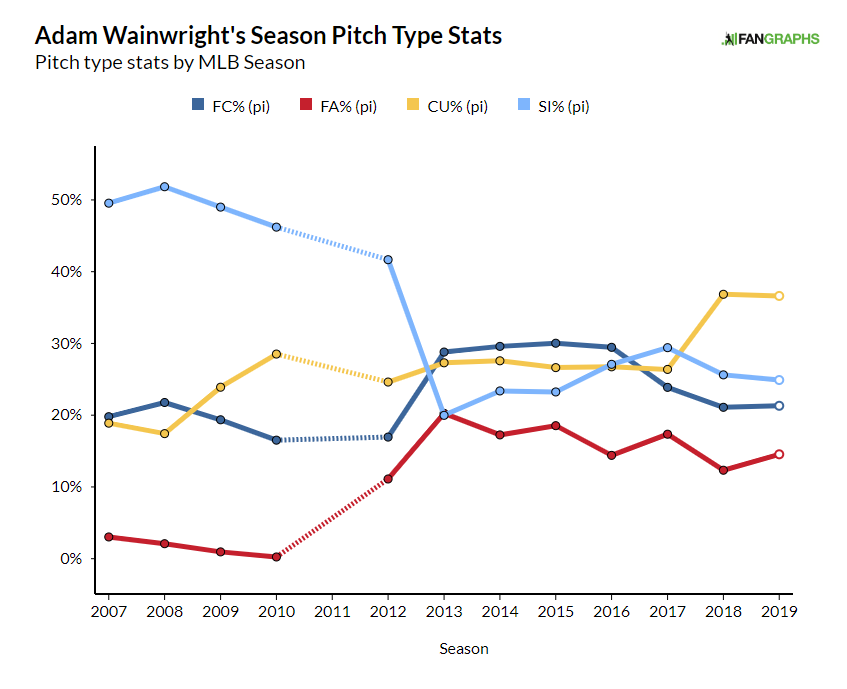
Rather than a traditional 12-6 curveball, Wainwright’s has a ton of horizontal movement — the second-most in the majors according to the Baseball Savant pitch movement leaderboards. That’s allowed him to generate plenty of whiffs with the pitch while still inducing groundball contact more than half the time when a batter puts it in play. With a fastball averaging just under 90 mph nowadays, leaning on his curveball more often seems like a great plan to leverage his best pitch for all its worth.
After a two-year dip in velocity, his curveball is back to averaging 75 mph again. And because he’s throwing it more often, he’s had to locate it in the zone to earn strikes. He’s generating a swinging strike or a called strike on 34.6% of his curveballs thrown this year, a rate much closer to his heyday and an above-average rate for a major league curveball.
But his surge over the last month and a half has as much to do with his curveball as it does one of his other secondary pitches, his cutter. He dropped the usage of his cutter (along with his other two fastballs) when he started throwing his bender more often, but it’s still an important pitch for him and he’s finally leaning on it again. Between 2013 and 2016, Wainwright was throwing his cutter almost 30% of the time. His usage of the pitch has dropped since then to just over 20%. He started off the year with a similar usage pattern but it quickly dropped out of his repertoire as he struggled through the first part of the season.
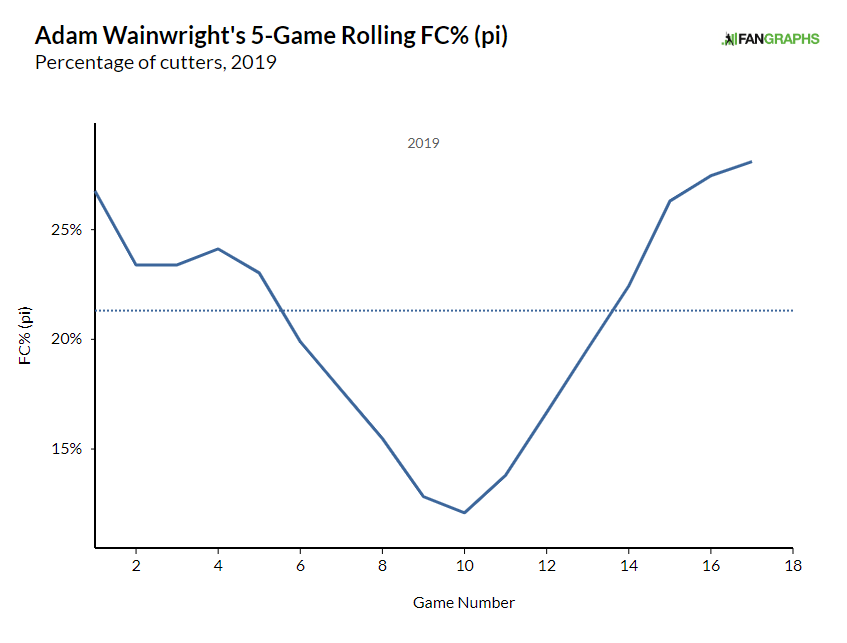
But on May 28, he threw it 20.7% of the time in his start against the Phillies, which marked the beginning of a renewed reliance on the pitch. Prior to that game, he was throwing it in even counts, or when the batter was ahead around 80% of the time. That usage pattern wasn’t very effective at all. From May 5 to May 22, a period encompassing four starts, he accumulated just three whiffs total with his cutter, an ugly 7.1% swinging strike rate. Since May 28, he’s run an 11.2% swinging strike rate with the pitch. That uptick in whiffs is likely due to him using it more often in counts where he’s ahead and looking for a swinging strike.
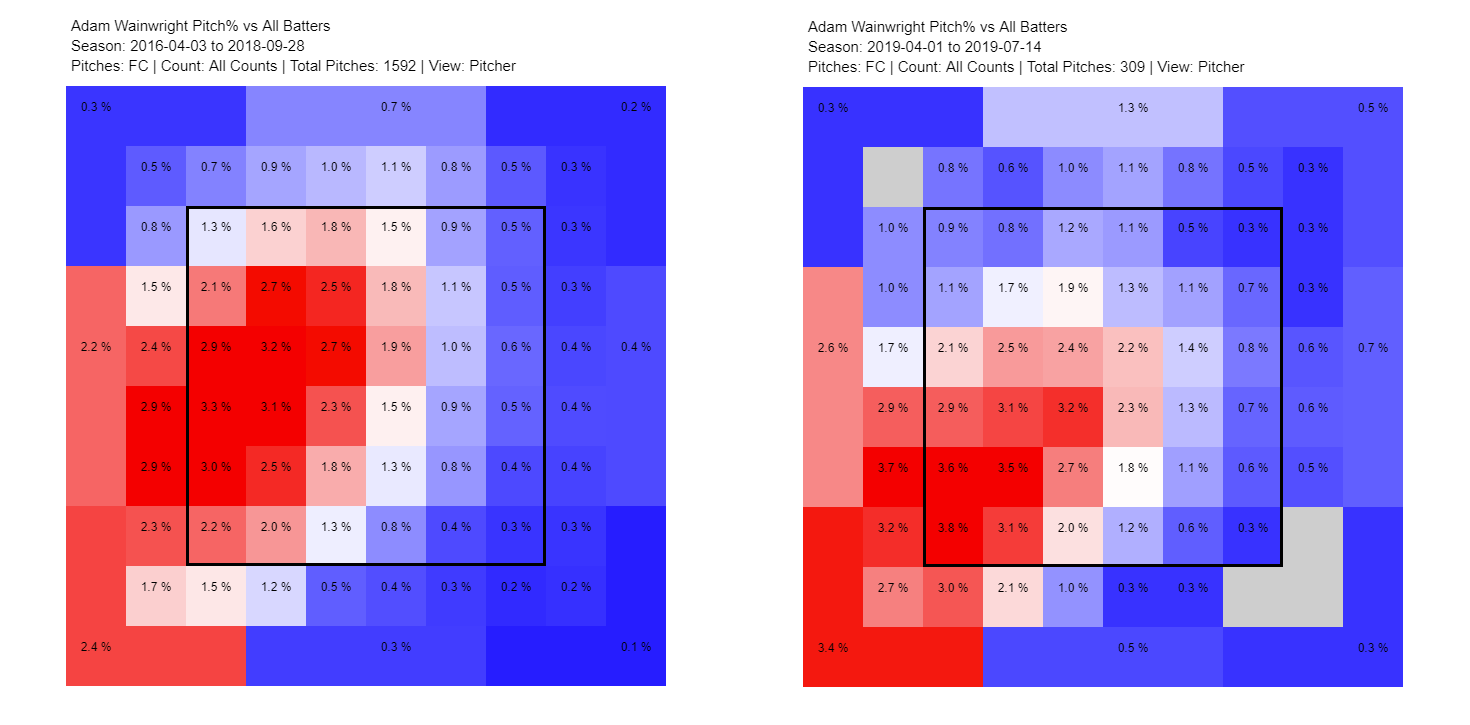
He’s also locating his cutter in more advantageous locations. The average vertical location of his cutter is at its lowest point since 2012, and it’s a significant change from last year. This heatmap shows his cutter locations between 2016 and 2018 on the right and this season on the left.
Since the NL Central is the most hotly contested division in baseball, and the two Wild Card spots are basically a toss-up between six or seven teams, the Cardinals need all the help they can get. Leaning on Wainwright to anchor their starting rotation probably wasn’t in the preseason plan, but then, nothing goes according to plan in baseball. Wainwright’s last seven starts have shown that he still has a little bit left in the tank, and he now has this summer and fall to write another exciting final chapter in his great career for St. Louis.
Jake Mailhot is a contributor to FanGraphs. A long-suffering Mariners fan, he also writes about them for Lookout Landing. Follow him on BlueSky @jakemailhot.
As a Cardinals fan I love that Waino is having a good stretch here. But this needs to be his last lap in his Cards career. I don’t envision he’ll keep playing, but if he does — and someone pays him something of significance — bully for him. He’ll always be a Cardinal and that won’t change.
The amount of dollars the Cardinals have “invested” in guys well over 30 (or even 32) is immense and continuing to do so isn’t going to result in a 95+ win team anytime soon. Keeping Waino around for sentiments sake isn’t a wise decision.
Why would you say that? It is not like Wainwright does not deserve to start and is keeping some good player out. Nor is he getting overpaid. You do need to let him go if he sucks but he seems to be doing perfectly fine.
This is totally silly. He isn’t keeping any deserving player from the rotation, and he’s pretty clearly one of the Cardinals’ best options. He’s making, at most, $10m this season, which is very cheap for a healthy starter.
Other older players might be weighing the Cardinals down, but it’s ridiculous to penalize Wainwright for the Cardinals’ poor judgement elsewhere.
You love the Cards and Wainright yet don’t want him to be back, when all he is doing is pitching well on a very team friendly deal. Makes tons of sense! Keep it up Waino. And I hope he continues this success and returns to the Cards on a similar deal next year. So far, he’s earned it.
Depends what you mean by “something of significance”.
As older pitcher, Wainwright isn’t going to command a monster contract from anyone. And if he and the Cards want to remain together, it’s a situation tailor made for a 20/2 or 30/3-ish deal. Maybe even a handshake agreement for one year renewing deals in perpetuity so long as he’s effective and wants to keep pitching.
Waino isn’t getting any more than 1 year deals from anyone at this point, nor is he getting $10M/year guaranteed. As such, there’s no problem for the Cardinals to continue to bring him back on similar deals to this season as long as he remains decently effective.
“A lone start against the Cubs in which he walked seven — but still held them scoreless over eight innings — is inflating up his walk rate. Ignore those seven free passes and his walk rate drops from an okay 8.1% to an excellent 4.9%.”
This technique of simply excluding a poor performance by some metric – which in this case is one out of only seven starts, no less – is intellectually flawed and disingenuous. A lot of players look a lot better on many metrics if we simply decide to exclude their worst performances for arbitrary reasons.
It’s particularly annoying from Fangraphs, which positions itself as one of the best sites for statistically-based analysis of baseball (and is typically justified in doing so). I would have thought that Fangraphs, after so many years of operation, would have some sort of “don’t do this” list as a simple reminder for writers and editors to avoid some common but fallacious (mis)uses of numbers. I’d expect this particular mistake to fall somewhere within the top ten on that list.
I don’t completely disagree with you, but I think the purpose of the “exclude one start technique” is to point out an outlying data point. Wainwrights real walk rate is 8.1%, but aside from the one start that looks like an outlier it has been 4.9%. I think that is a fair observation to make. When you look at a data set and all of the points seem to follow a trend except for one or two, I think it is perfectly ok to look at the data with and without them to better understand your results. You obviously can’t completely exclude/ignore the outlying data points, but I think it is totally ok to question them and see how they impact your overall results.
It really depends on why the outlier exists.
If it was a rain delayed game in Coors on his return from injury, for example, then you certainly could justify ignoring that particular game.
But without some valid external reason, throwing out one game out of seven simply because he issued a lot of walks, is bad practice.
Nobody throws away a hitter’s three home run game simply because it is an outlier.
I agree with tung_twista. If there’s a logical underlying rationale – e.g., a starter is rocked in two innings then goes on the IL the next day – then this could be fair. AFAIK, no such rationale exists in this case. It’s certainly not in the article if it does.
I wasn’t saying that we should completely disregard the outlier, I’m just meant that I think it is ok to say, “outside of one start Wainwright’s walk rate has actually been really good” That doesn’t change the fact that he did in fact give up a ton of walks in one start, and so his actual walk rate is 8.1%, but when all the other data points point in one direction, I think that it is ok to point out that one start might just be an outlier. Wainwright didn’t go on the IL/there wasn’t a rain delay or anything, but since the start is an outlying data point that has a large impact on the overall results, I think it is fair to at least add an asterisk to the 8.1%. You don’t discount the 3HR from a player’s counting stats, but if all of a player’s home runs came within a week of the season, it would be a lot more likely that it was a fluke than an indicator of his production moving forward. Last year Matt Carpenter had a Ruthian middle of the season that was capped by an absolutely horrendous beginning and end. I think it is fair to look at Marp’s 5fWar last season and say, “most of that was due to a crazy hot streak, I don’t know how likely he is to repeat those numbers”. I don’t think the author was saying we should disregard Waino’s 8.1% walk percentage, I think he was just trying to point out that the one number doesn’t tell the whole story.
Disagree
Sequencing can be wacky, but it doesn’t justify throwing out bunched data points.
Wainwright used to have a stellar walk rate (i.e. around 2 BB/9)- but for the past 3 seasons he’s has consistently worse control (3.3, 4.0, 3.4 BB/9). Its a fan-take to throw out inconvenient data so as to argue that Wainwright has turned back into his old self.
Yea, poor article really, reads a bit more like a StL fan piece: notably poor use of data, mixed with narrative, producing a lack of insights.
Notable that Wainwright got healthy I guess, but his last 3 years don’t show any resurgence apart from maybe pitching closer to a full year this year.
17: 123 IP, 4.29 FIP (4.40 xFIP)
18: 40 IP, 4.28 FIP (4.26 xFIP)
19: 98 IP, 4.37 FIP (4.23 xFIP)