Author Archive

Daily Graphing – Mike Cameron

Yesterday it was reported that the Mets will trade Mike Cameron to the Padres for Xavier Nady. The trade is contingent on Mike Cameron successfully passing a vision test since his 2005 season ended prematurely after butting heads (literally) with Carlos Beltran. Let's take a look at how he might fare with a change of scenery.

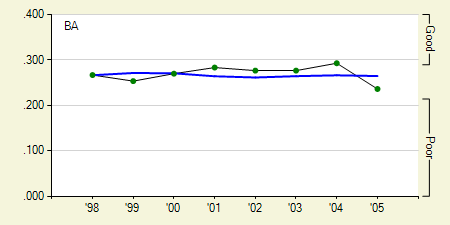
BA

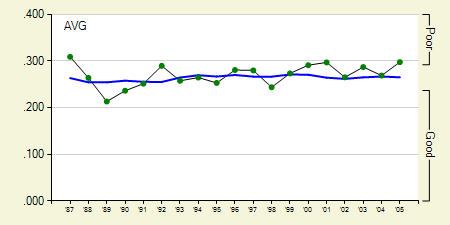
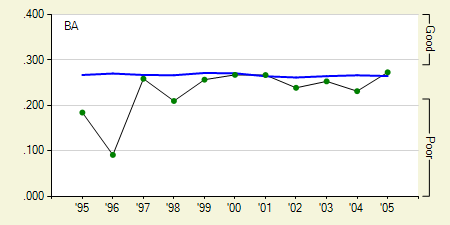
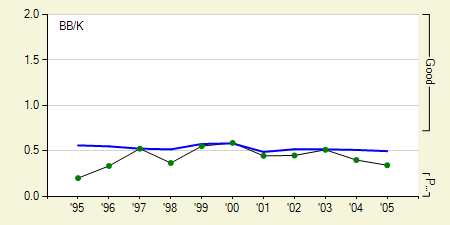
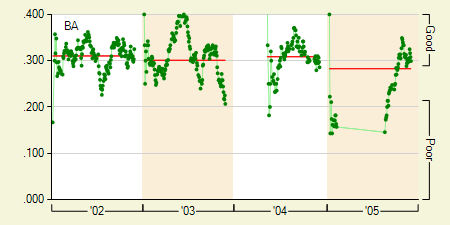
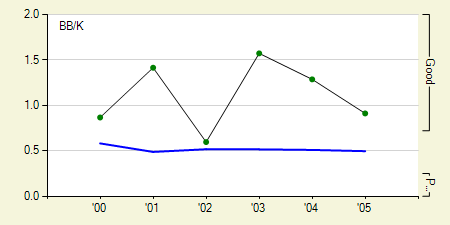
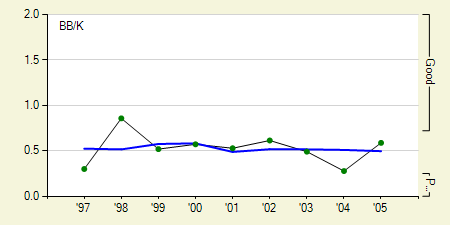
The two nice things about Mike Cameron are that he has both power and speed. He's been a 25 Home Run / 30 Stolen Base guy on a few occasions. Unfortunately, as you can see from the graph above, he doesn't hit for average. He did however hit for a career high .273 last season, despite his falling walk to strikeout ratio (BB/K).

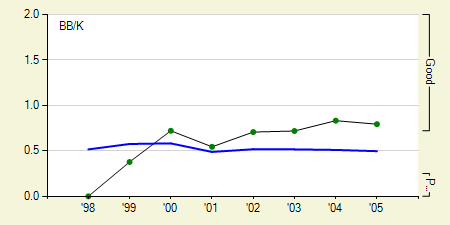
BBK

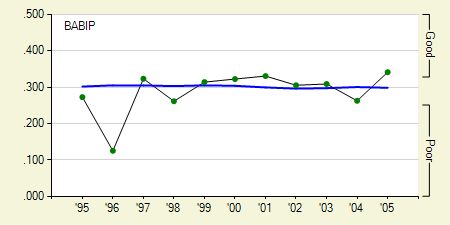
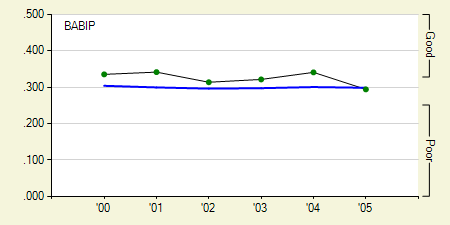
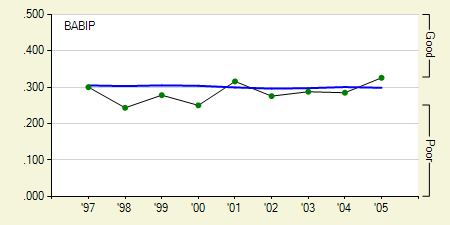
I do find this downward trend in his BB/K rather disturbing as it is nearing unacceptable levels. This decline was masked by a very high Batting Average on Balls in Play (BABIP), which explains the career high batting average. Assuming his BABIP returns to a normal level next year, he'll probably hit closer to .240 than .270.

BABIP

As for his power numbers, a move to PETCO Park certainly won't help him as it's the most difficult park to hit home runs in. Yet, I honestly don't see much of a decrease since he's played in Safeco Field and Shea Stadium the past 6 years which are also difficult parks to hit home runs in for right handed batters. Also, the Padres like to steal as much as any team, so I don't see him stealing any fewer bases. All in all, he should have a very typical Mike Cameron year; decent power and speed, with no consistency to get on base.


Daily Graphing – Nomar Garciaparra

Nomar Garciaparra has had a rough couple of years. He went from being one of the premiere shortstops in the baseball, to an oft injured scapegoat. He didn't even get to celebrate a World Series championship with the team he spent so many years with. He's played only143 games the past two seasons, but how did a healthy Nomar Garciappara perform when he returned for the final two months of this past season?

BA

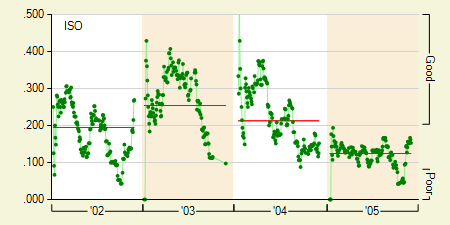
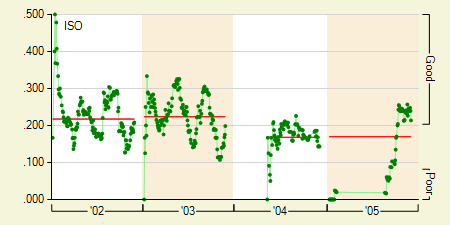
Surprisingly it looks like he was back to his old self, as far as batting average goes. After he returned from his groin injury, he batted a very old-Nomar like .318. Not only was he hitting for average, but he was also hitting for power. In August and September he hit all of his 9 home runs.

ISO

If Nomar Garciappara can remain healthy for an entire season (and that's a big if), it looks like he still has the ability to be one of the best offensive shortstops in baseball. When he finally does play an entire season, I'm sure there will be a comeback player of the year award waiting for him.


Daily Graphing – Scott Eyre

Scott Eyre did something incredible today. He received one 10th place MVP vote to become the first relief pitcher to receive a vote without recording a single save. Please feel free to use this gem of trivia to stump everyone you know. Someone in the Baseball Writers' Association of America is a huge Scott Eyre fan. He actually had a nice season, going 2-2 with a 2.63 ERA in 68 plus innings of work. Let's see if he has any hope of receiving a vote next year.

BB9

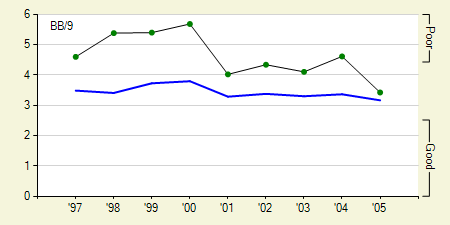
Last season, Scott Eyre was able to get his walks per 9 innings (BB/9) down to a career low 3.4. While this is not a spectacular number, when coupled with his solid strikeout rate of 8.6, it makes him a successful pitcher.

HR9

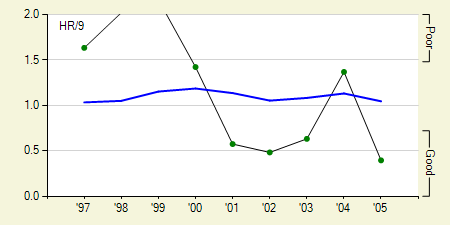
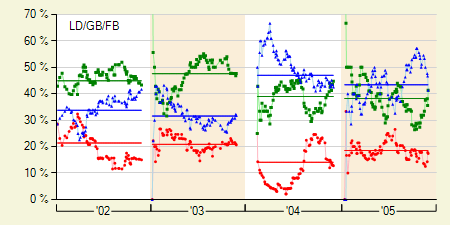
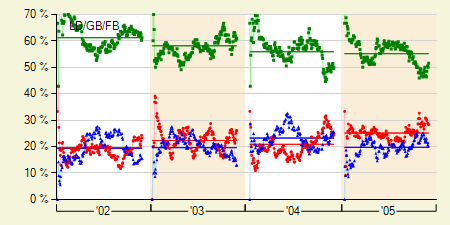
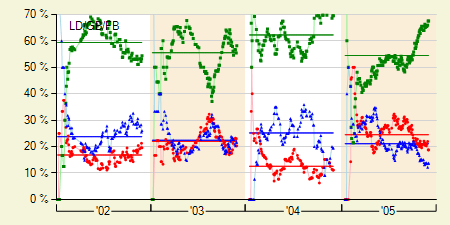
He was also able to get his home runs per 9 innings (HR/9) down to a career low. He only gave up 3 home runs the entire season. This is where I see danger flags. Over the past couple season, Scott Eyre has transformed himself from a groundball pitcher to a flyball pitcher.

LDFBGB

I think it's highly unlikely that he will be able to allow as few home runs as he did last season, especially with his increased fly ball tendencies. Even though this will lead to an increase in his ERA, I think he'll still be able to have a solid season. Unfortunately, I'd say the chances of Scott Eyre getting another MVP vote are just about zero.


Daily Graphing – Juan Pierre

Rumor has it that the Cubs are close to trading for the Marlins' center fielder Juan Pierre. We all know about Juan Pierre's speed. He was second in the National League in stolen bases and over the past four years he led the majors in them. In 2004 he hit for an excellent .326, but this past year he had his worst season, hitting only .276. Should Juan Pierre be expected to rebound next season?

BBK

Despite the downward trend in his walk to strikeout ratio (BB/K), he's still in the top 20% of all batters. If it starts to dip any lower then we can start to worry. For now it looks like he just had an off year, much like the one he had in 2002.

BABIP

The area he dropped off the most was his batting average on balls in play (BABIP). Just like his batting average, his BABIP was the worst of his career. What I find most odd about this is that 25% of his balls in play were line drives. That's a pretty high line drive percentage.

LDGBFB

While it's not unusual for a batter to hit for a high line drive percentage and a lower batting average, I would consider it “unlucky”. Taking that into account and his lower than usual BABIP, I'd say Juan Pierre had a fairly unlucky season altogether. I'd expect Juan Pierre to rebound nicely in 2006.


Daily Graphing – Abraham Nunez

MLB.com asks this about free agent Abraham Nunez: “Nunez is one of the harder-to-read players on the market. Did he reach a new level in 2005, or was it a fluke?” Good question MLB.com. In Abraham Nunez's first season with over 400 at bats, he had a career high batting average of .285. That's a huge improvement over his previous career average of .238.

BBK

There's nothing special about his walk to strikeout ratio (BB/K). He had a terrible 2004 season, but rebounded to career averages in 2005. This doesn't account for the increase in his batting average.

BABIP

His Batting Average on Balls in Play (BABIP) was the best best of his career. It was also way out of line with his career average. Furthermore, 25% of the balls he hit were line drives; once again, way out of line. Both of these do account for the rise in batting average.

LDGBFB

I think it's highly unlikely Abraham Nunez will repeat his .285 batting average next season. He probably won't hit for a dismal .238, like he did in 2004 either. Teams looking for a versatile infielder or utility man could do a lot worse, but they should think of him more as a .250-.260 batter.


Daily Graphing – Kenji Jojima

There's been a lot of talk recently about the Mariners potentially signing the Japanese catcher Kenji Jojima. I was able to track down some of his statistics.

Year	AB	R	H	2B	HR	RBI	SB
1995	12	2	2	0	0	1	0
1996	58	5	14	2	4	9	1
1997	432	49	133	24	15	68	6
1998	395	53	99	19	16	58	5
1999	493	65	151	33	17	77	6
2000	303	38	94	22	9	50	10
2001	534	63	138	18	25	95	9
2002	416	60	122	18	25	74	8
2003	551	101	182	39	34	119	9
2004	426	91	144	25	36	91	6
2005	411	70	127	22	24	57	3

I wasn't able to obtain his fielding statistics, but he won 7 straight gold gloves at the catcher position. Not too shabby.

SLG

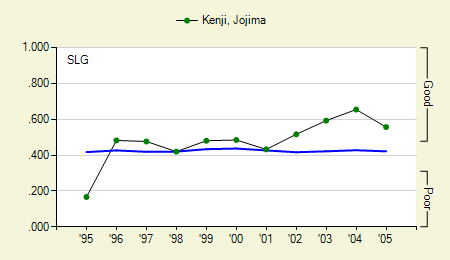
Taking a look at his slugging percentage (SLG) graph, you can see he is well above the MLB average using his Japanese statistics. This probably isn't the fairest comparison, but I think it still gives you a good idea of where he stands.

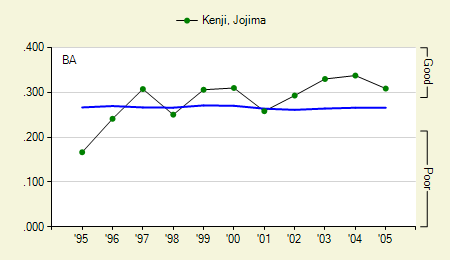
BA

In addition to hitting for power, he can also hit for average. I wish I was able to obtain his walk and strikeout totals for 2005, but in 2003-2004 he showed an excellent walk to strikeout ratio (BB/K) of 1.07. There's bound to be some drop off as he learns to adjust to new pitching, but it appears that Kenji Jojima should be capable of being one of the better offensive catchers in the Major Leagues.


Daily Graphing – Todd Jones

Todd Jones really pissed me off last year. See, I had Guillermo Mota in my fantasy league and when he got injured, Todd Jones pitched so well that Guillermo Mota never got his closer job back. Now that Todd Jones is a free agent, should teams expect him to be the lights out pitcher he was last year?

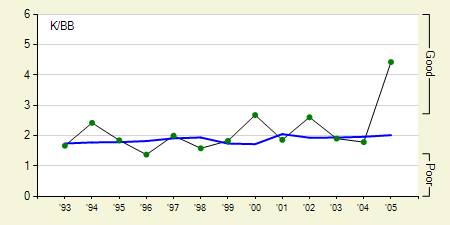
BBK

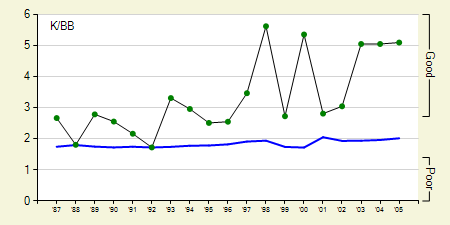
Can you say career year? His 2005 strikeout to walk ratio (K/BB) was way out of whack with the rest of his career. It's not because he learned to strike batters out, it's because he learned how not to walk them.

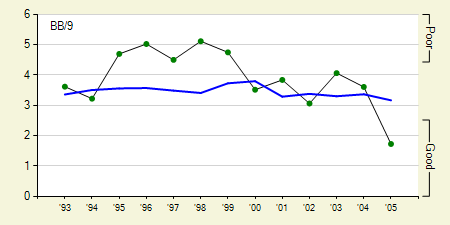
BB9

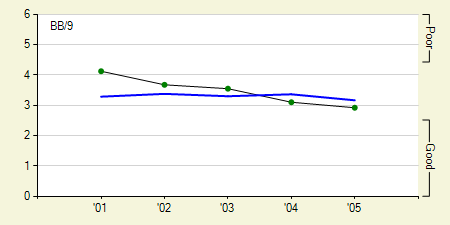
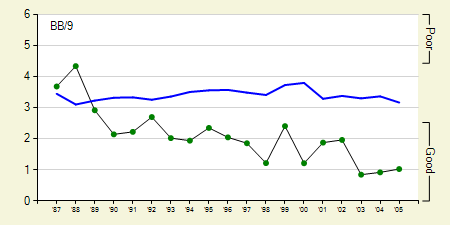
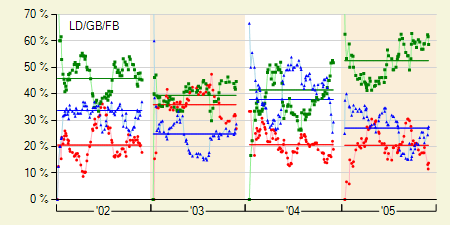
His walks per 9 innings (BB/9) were nearly 2 points lower than it was at any other point in his career. That's a drastic improvement for a veteran pitcher. In addition, he only allowed 2 home runs the entire season. This can be somewhat attributed to an increase in his ground balls induced. Even for an extreme ground ball pitcher, 2 home runs sounds more like an anomaly to me.

FBGBLD

While it seems like Todd Jones was an entirely different pitcher this year, I would approach him with extreme caution next year. A large spike after years of consistency seems extremely fluky to me. Even if his improvement was for real, there's little doubt in my mind that he'll never be quite as good as he was in 2005.


Daily Graphing – Chris Carpenter

Today my faith in the Baseball Writers' Association of America was restored after they voted to give Chris Carpenter his first Cy Young award. Despite Dontrelle Willis' MLB high 22 wins, and Roger Clemens' MLB low 1.87 ERA, Chris Carpenter was actually the superior pitcher in 2005.

KBB

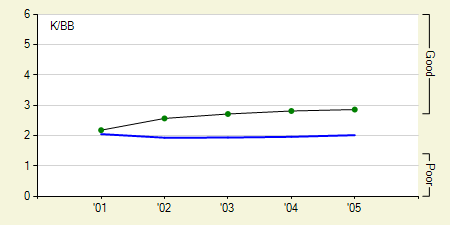
If you compare their strikeout to walk ratio (K/BB) you'll see that Chris Carpenter was a good deal more effective than his counterparts. He led the majors with 27 quality starts and for 4 months in the middle of the season he had 22 consecutive quality starts where he compiled a stellar record of 16-2.

K9

Oddly enough, he was not the same pitcher in the second half of the season as he was in the first half. As you can see, his strikeouts per 9 innings (K/9) took a large dip in the middle of the season and never recovered. He went from a K/9 of 8.9 in the first half to a K/9 of 6.8 in the second half. His walks per 9 innings (BB/9) followed nearly the same pattern.

BB9

The dip in strikeouts is definitely something to keep an eye on early next season, but long as he can keep his walks low, there's no reason he can't continue his success. Chris Carpenter can live with striking out a few less people, as he's one of the top groundball pitchers in the league.


Daily Graphing – Danys Baez

If you remember, the Mets did not pick up Braden Looper's contract leaving the team without a closer. I wrote about that here if you need a refresher on how mediocre Braden Looper really is. The Mets Plan “A” is to acquire Billy Wagner who is one of the best closers in baseball. Plan “B” seems to be to acquire Danys Baez. Would Danys Baez really be an improvement over Braden Looper?

K9

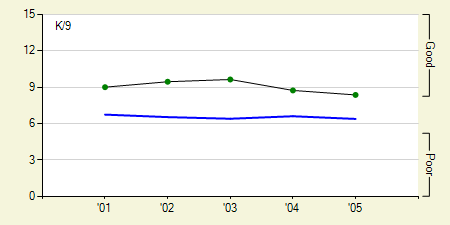
If you compare their strikeouts per 9 innings (K/9), you'll see that Danys Baez was a good deal better than Braden Looper last year. Unfortunately, a K/9 of 6.3 for a closer isn't very appealing. Take a look at the list of closers who over the past 4 years had a K/9 under 8.

Name		K/9	BB/9	SV	BS	S%
Danny Graves	4.3	2.4	85	18	83%
Jose Jimenez	4.8	2.4	69	12	85%
Danny Kolb	5.7	4.1	72	17	81%
Braden Looper	5.8	2.8	98	22	82%
Mike Williams	5.9	4.5	74	11	87%
D. Hermanson	6.0	3.0	52	14	79%
Jose Mesa 	6.3	4.0	139	25	85%
Rocky Biddle	6.7	4.4	46	13	78%
Danys Baez	7.1	3.9	102	23	82%
Tim Worrell	7.2	3.0	58	19	75%
Bob Wickman	7.4	2.9	78	8	91%
Todd Jones	7.4	3.1	43	18	70%
Jorge Julio	7.8	4.1	83	20	81%
Mike DeJean	7.9	4.5	46	14	77%

11 of the other 13 were ejected from closer position for poor performance. If I were the Mets, I'd seriously consider a different plan “B”. I don't think Danys Baez is the right person to fill their empty closer position.


Daily Graphing – Colon vs. Santana

Today Bartolo Colon was named the 2005 American League Cy Young award winner. He won 21 games with a 3.48 ERA. Not too shabby, but I think Johan Santana should have won his second consecutive Cy Young award instead. Here's why.

ERA

Johan Santana had a better ERA than Bartolo Colon.

WHIP

He had a better WHIP.

KBB

He had a better strikeout to walk ratio (K/BB).

Bartolo Colon did win one category besides wins and that was run support. The Angels gave Bartolo Colon 149 runs, while the Twins gave Johan Santana only 121 runs, a difference of 28. Furthermore, Johan Santana left the game with the lead 19 times and had the bullpen blow his lead 3 of those times. On the other hand Bartolo Colon never lost when leaving the game with the lead. Johan Santana also had 24 quality starts compared to Bartolo Colon's 21 quality starts.

So here's the list of things Johan Santana did better: ERA, WHIP, Strikeouts, Walks, Runs, Innings Pitched, Hits, Home Runs, Losses, Complete Games, Shutouts, Quality Starts, and Pitches thrown per inning. The Cy Young award is supposed to be given to the best pitcher in the league, not the pitcher with the best bullpen and offense. Johan Santana was clearly the best American League pitcher in 2005.