Author Archive

Daily Graphing – Kyle Farnsworth

Reports are that free agent Kyle Fransworth will likely be signed by the Yankees to a three year contract somewhere in the neighborhood of 17 million dollars. This past year he had his best season ever by posting an ERA of 2.19 and striking out 87 batters in just 70 innings of work. He was traded to the Braves in early August and took over the closers role by the end of that month where he went 10 for 10 in saves. The last time Kyle Fransworth pitched nearly this well was 2001 and he's never had back to back seasons with an ERA under 4. Will he be able break that trend and repeat his 2005 season next year?

K9

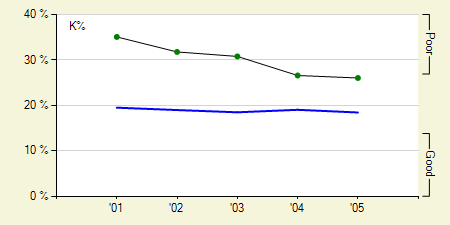
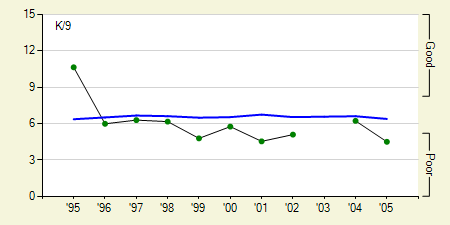
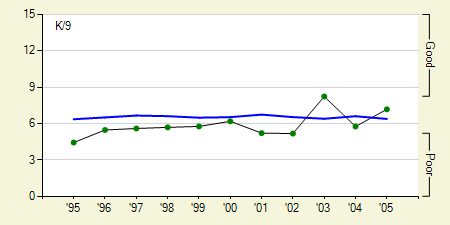
If his strikeouts per 9 innings (K/9) are any indication of how well a reliever does (which they are), then I'd say he's a pretty attractive relief pitcher. He had the sixth highest K/9 of any relief pitcher in 2005. Unfortunately, he has been periodically wild and that has kept him from consistently being one of the best relievers in baseball.

BB9

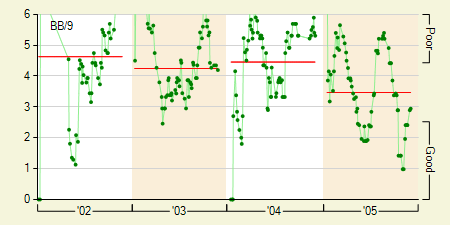
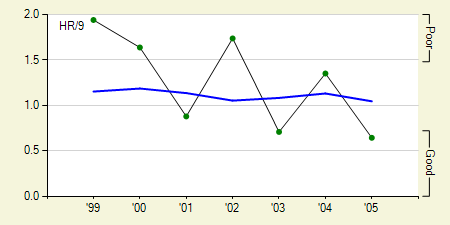
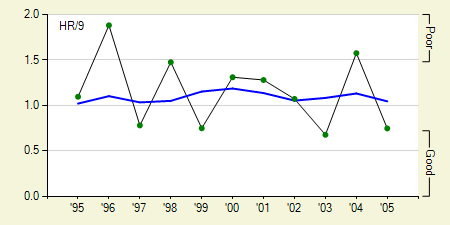
The two other things he had going for him in 2005 were the small number of home runs he allowed and his Batting Average on Balls in Play (BABIP). He only gave up 5 home runs the entire season making his home runs per 9 innings (HR/9) the lowest of his career. Likewise, his .261 BABIP was also the lowest of his career.

HR9

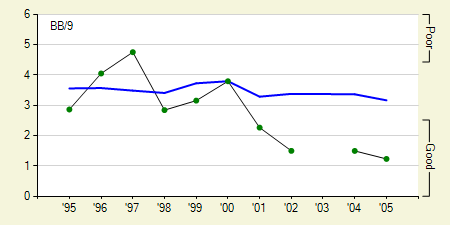
I think Kyle Farnsworth was definitely a little lucky last year, but that's no reason to think he can't be a dominant pitcher in 2006. His K/9 is exactly where you want it to be for a relief pitcher and while an increase in his home runs and BABIP are likely, there is still plenty of room to improve the the number of walks he issues. I think we'll see a similar Kyle Farnsworth next year, and for the first time he'll keep his ERA well under 4 for two consecutive season.


Research – Pitchers, Home Runs, & Fly Balls

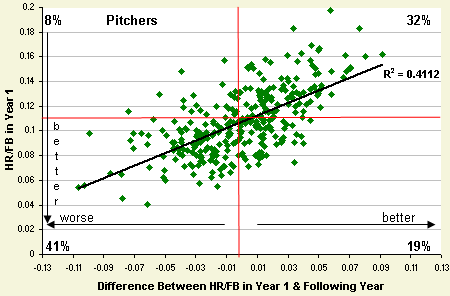
Stemming from the Home Runs & Fly Balls research, there is some question about how much control a pitcher has over the amount of home runs he allows. In an attempt to answer this question, I made a scatter plot of a pitchers Home Runs per Fly Ball (HR/FB) and the change in his HR/FB the following year using data from 2002-2005.

HRFBD

The horizontal red line is the average HR/FB, and the vertical red line indicates the place where zero change would be from year to year. This divides the chart into four quadrants. The percentages in each corner show the percentage of data points in each quadrant. For instance, 41% of the pitchers sampled had a below average HR/FB that increased the following year. Likewise, 32% of the sampled pitchers had an above average HR/FB which decreased the next year. That means that 73% reverted their home run fortunes the following year and only 27% continued their current trend.

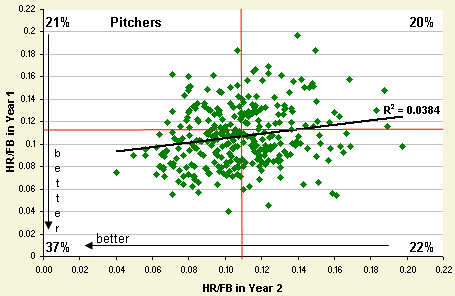
Careful though, just because a player reverted their HR/FB doesn't mean they're doomed or saved from home runs. Here is another scatter plot that compares the first year's HR/FB directly with the next years.

HRFBA

As you can see there is pretty much no correlation between a player's actual HR/FB from year to year. This tells me that while a player is likely revert their HR/FB the following year, it's unclear how much of a change there will be. One thing to note is it seems that below average players are slightly more likely to continue having a low HR/FB. However, this may just be a result of the pitchers sampled in this study.

I believe this data shows that pitchers generally do not have control over their HR/FB from year to year. This would mean that the number of home runs a pitcher allows is based on both chance and the number of fly balls a pitcher allows.


Research – Home Runs & Fly Balls

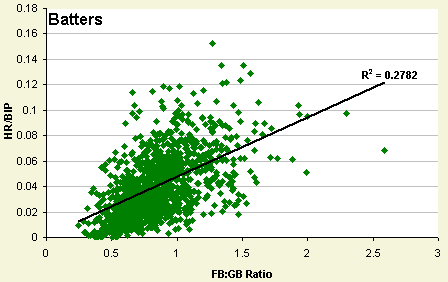
I thought I'd try something a little different today and write about some research I've been doing on home runs and fly balls. Most of this research was spurred by a good discussion that's ongoing in our forums section between Russ, Mike and me. The first question posed was, “How much of a batter's power is related to his Fly Ball/Ground Ball ratio?” Knowing that most home runs are the result of fly balls (a few are line drive), it seemed to make sense that if a player hit more fly balls he'd be rewarded with more home runs. For a quick answer to that question I put together a scatter plot of each player's Home Runs per Balls Hit into Play (HR/BIP) and his FB/GB ratio using 2002-2005 data.

BHRBIP

As you can see, the trend would indicate there is some correlation between how often a player hits fly balls and his home run production, but unfortunately it's not all that strong a correlation. One thing to note is that players who hit an extremely high number of ground balls don't hit a lot of home runs, but once you exit the extreme groundball category the less conclusions you can make about a batters power based on his FB/GB ratio.

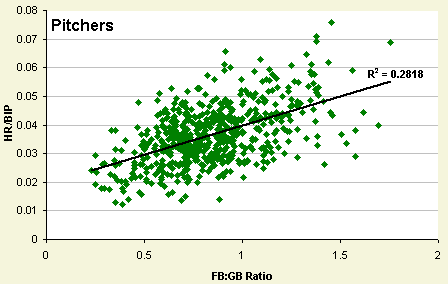
What about pitchers? Does their FB/GB ratio dictate how many home runs they give up? Here's the same scatter plot for pitchers.

PHRBIP

There is definitely a different shape here, but essentially it shows a similar correlation (but slightly stronger) to what the batter's graph showed. Either way, I think it's safe to say that just because a batter hits or a pitcher allows a lot of fly balls doesn't mean they'll be exiting the park. However, it does seem like the more fly balls a player hits/allows, the more susceptible to home runs he becomes.

Tomorrow (or later today), I'll be writing about how much control a pitcher has over his home runs allowed.


Daily Graphing – Esteban Loaiza

Yesterday, free agent Esteban Loaiza was signed by the Oakland Athletics to a 3 year deal worth slightly over 21 million dollars. Esteban Loaiza has been quite the enigma the past three years. After being consistently average for the first 8 years of his career, he shocked everyone in 2003 by winning 21 games with a 2.90 ERA and finished second in the AL Cy Young balloting. Then in 2004 he had one of the worst seasons of his career by posting a 5.71 ERA. Last year, determined to prove that his 2003 season was not entirely a fluke, he went 12-10 with an ERA of 3.77. Don't let that 12-10 record fool you either. He had 24 quality starts, the 6th best in the majors and some very poor run support. So, the big question is, who is the real Esteban Loaiza?

BB9

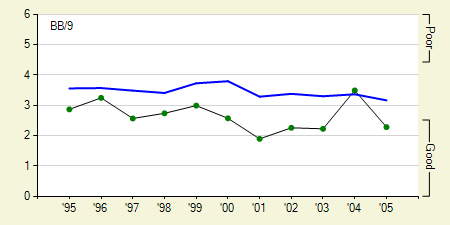
He's certainly not someone who walks a lot of batters. As you can see he's done a very good job limiting free bases over the course of his career. The one exception was 2004 and most of his trouble came after he was traded to the Yankees. Before being traded to the Yankees he had a walks per 9 innings (BB/9) of 2.9. With the Yankees it jumped to an abysmal 5.5 BB/9. I think it's safe to say that was a fluke. Since he has his walks under control, strikeouts will be one of the major keys to his success.

K9

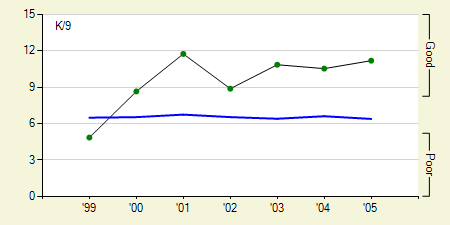
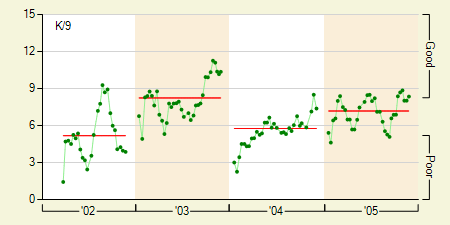
As you can see, in 2003 his strikeouts per 9 innings (K/9) took a major jump mostly due to an improved cut fastball and changeup. In 2004 in dropped back down to his career levels and then in 2005 it was up again. What the graph above doesn't show you is that in 2004 his K/9 was creeping back up to 2003 levels the entire year. In the first half of 2004 his K/9 was 5.1 where in the second half it was 6.9.

K9D

The other key to his success in 2003 and 2005 was limiting the number of home runs he allowed. He's actually been all over the map in home runs per 9 innings (HR/9) and I wouldn't be too surprised if he allowed more home runs next year.

HR9

I think Esteban Loaiza is one of these overvalued/undervalued players where some people can't get past his 8 years of mediocrity and others are still hung up on his 21 win season. I have to admit, I've been on the mediocrity side for quite some time, but as long as he doesn't allow too many home runs I think he'll be a quality pitcher. He's never had a problem with walks and it looks like his increased strikeouts are for real.


Daily Graphing – Jim Thome

For the first time in 7 years, Jim Thome failed play in over 140 games after having season ending elbow surgery in mid August. Before his decision to shut things down, he was easily having the worst season of his career by batting only .207 with a mere 7 home runs in 193 at bats. Jim Thome insists he'll be fully recovered from shoulder surgery next season and ready to play for his new team, the White Sox. While a rebound for the slugger is almost a certainty, how much of an improvement over last year should be expected?

BABIP

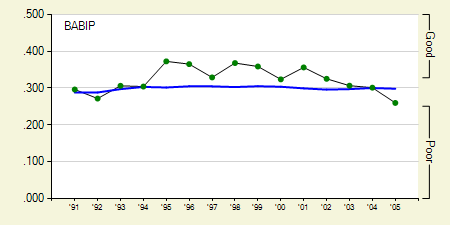
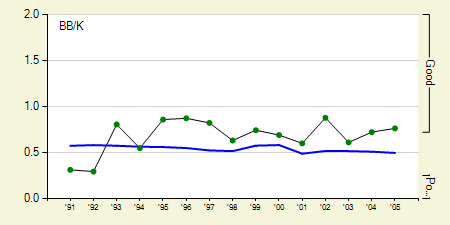
First let's address his poor batting average. Besides injuries, some of his .207 batting average can be attributed to a very low Batting Average on Balls in Play (BABIP). As you can see his 2005 BABIP of .260 is way out of line with his career averages and should revert to at least the .300 mark next year. In addition to his low BABIP, his walk to strikeout ratio remains above average which only bolsters evidence that his batting average will rebound.

BBK

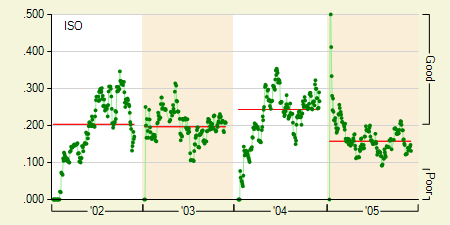
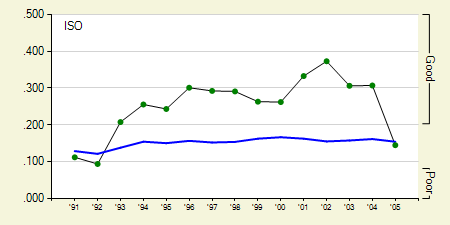
However, the area where he experienced the most severe decline was not his batting average but his Isolated Power (ISO). Much of this decline is likely due to injuries, but he'll be 36 years old next season and I'd be surprised if his age wasn't slightly responsible for the decrease in power.

ISO

If Jim Thome can remain healthy next season, I don't see any reason why he won't have a significant rebound. His batting average should return to around his career averages, but I'd be surprised if he had another 40 home run season. Considering his health and age, I think 30 home runs is more within reason.


Daily Graphing – Bob Howry

The Cubs have signed Bob Howry to a three year, 12 million dollar contract. For the past two years, Bob Howry has been one of the better relievers in the American League by posting back to back sub-3 ERA seasons. Let's see if there's any chance he can make his sub-3 ERA, a three year occurrence.

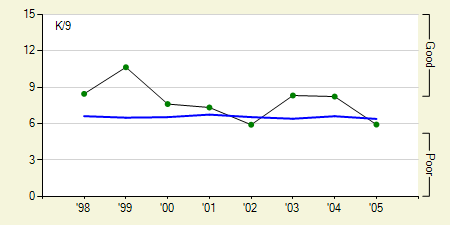
K9

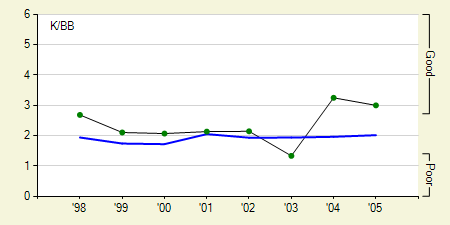
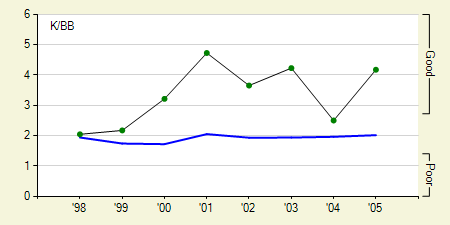
His strikeouts per 9 innings (K/9) have been fairly inconsistent. In 2004 he had an excellent K/9 of 8.2, but in 2005 it dropped to a below average 5.9. Despite the drop in his K/9 he was able to keep a high strikeout to walk ratio (K/BB) by decreasing the number of walks he allowed.

KBB

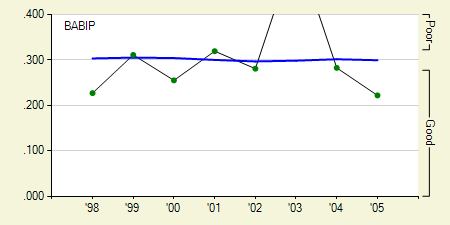
The one area where I see a real problem is his Batting Average on Balls in Play (BABIP). In 2005 he had a BABIP of .222, which is incredibly low. It was so low that it puts him in the 99th percentile of all pitchers. Considering the league average is right around .300, I'd say there is absolutely no chance of him repeating his .222 BABIP.

BABIP

I can't say I'm too optimistic that Bob Howry will have another sub-3 ERA season. The decrease in his strikeout rate is somewhat troubling as it means he'll have to be extra careful not to walk batters. Then there's the unsustainable BABIP which I wouldn't be too surprised to see above .300 next season considering how lucky he was in 2005. Don't think that a move to the National League will help him either as NL relievers actually had a higher ERA than American League relievers last year. Yeah, I'd say the chances of Bob Howry having another sub-3 ERA season are pretty slim.


Daily Graphing – Javier Vazquez

A couple of weeks ago, Javier Vazquez formally requested to be traded. If the Diamondbacks don't trade him by March 15th, he will have the option to become a free agent. Up until being traded to the Yankees in 2004, he spent six years in Montreal where he was one of the better pitchers in the National League. After spending one devastating year with the Yankees, he was sent to the Diamondbacks where he showed vast improvement, but failed to completely recapture his pre-Yankee days. Will Javier Vazquez ever return to being the dominant pitcher he was in Montreal?

KBB

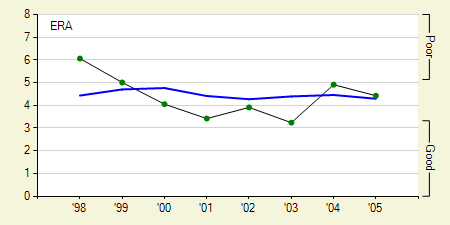
If you look at his strikeout to walk ratio (K/BB), it actually looks like he already returned to his pre-Yankee days. However, the same cannot be said for his ERA.

ERA

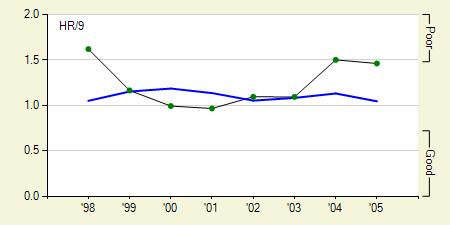
The main reason for his failure to post such a high ERA despite his very high K/BB is that he gave up 35 home runs, the second most in baseball.

HR9

For Javier Vazquez to completely recover from his year as a Yankee, he'll have to reduce the number of home runs he allows. A move to a pitcher friendly park would certainly help him in this area. Other than his home runs, it looks like he's back on track to be a dominant pitcher.


Daily Graphing – Mike Lowell

Peter Gammons is reporting that the Marlins' Josh Beckett will be heading to Boston along with Mike Lowell in exchange for Hanley Ramirez, Anibal Sanchez and a player to be named. Yesterday I talked about Josh Beckett's considerable upside, but Mike Lowell is coming off the worst year of his career. What should Red Sox fans expect from Mike Lowell next season?

BA

As you can see, Mike Lowell had an extremely low batting average (BA) last season which was way out of line with his career averages. Most likely this was the result of an equally low Batting Average on Balls in Play (BABIP) of .256. So, was he just incredibly unlucky last season, or was this indicative of something else?

BBK

I'm leaning strongly towards unlucky. His walk to strikeout ratio (BB/K) remained a very good 0.79. Actually, the last time someone hit for such a low batting average with such a high BB/K was Paul Konerko in 2003, and he just had back to back 40 home run seasons. However, unlike Paul Konerko in 2003, Mike Lowell's Isolated Power (ISO) never reached previous levels at any point during the season.

ISO

I suspect that Mike Lowell's batting average will bounce back next year in a big way. As for his power numbers, I think he'll definitely hit more than his 8 home runs in 2005, but I'm hesitant to say he'll completely revert to 2004 form. Moving to Fenway Park may also give his power numbers a boost. Either way, there's no doubt in my mind that in 2005, Mike Lowell was just unlucky.


Daily Graphing – Josh Beckett

Apparently the Marlins are trying to move 2003 World Series hero Josh Beckett in an attempt to cut their payroll. The two possible trades would be Josh Beckett and Mike Lowell to the Rangers for Hank Blalock and John Denks, or Peter Gammons suggests he could be sent to the Red Sox for Hanley Ramirez and either Jon Lester or Anibal Sanchez.

Josh Beckett has at times been compared to a young Roger Clemens. Unfortunately, much of his young career has been marred with blister problems. In 2005 he pitched in 29 games, the most of his career, and posted a 15-8 record with a 3.37 ERA. How much more can be expected of him?

K9

Josh Beckett's strikeouts per 9 innings (K/9) have been on a slight decline the past two years, but it still remains an excellent 8.4. That's good enough to rank him among the top 10 of all starting pitchers in 2005.

BB9

Fortunately, any decrease in his K/9 has been offset by a greater decrease in his walks per 9 innings (BB/9). There is still a lot of room for improvement here and he's heading in the right direction. If you take a look at his strikeout to walk ratio (K/BB) graph below, you can see every year he has made slight improvements.

KBB

Josh Beckett will only be 26 years old next season. The only thing stopping him thus far has been his blisters and he was only bothered by them once last year. Each year of his young career he has taken small steps forward and I expect that next year he'll take yet another step forward.


Daily Graphing – David Wells

Apparently the Padres are interested in re-acquiring David Wells from the Red Sox. Over the past four years David Wells is tied for the 8th most wins in baseball with a record of 61-29. Over that same time period, he has had the most run support of any player in baseball with 605 runs, a whopping 4.94 runs per start. What I'm trying to infer is that he's been the benefit of some pretty gaudy run support and maybe he hasn't pitched quite as well as his record indicates.

BB9

You certainly can't accuse David Wells of giving up many free passes. Over the past three years he's walked 61 batters in 91 starts. He only struck out 5.2 batters per 9 innings last year, but when you're walking only 1 batter every 9 innings, you can live with a lower strikeout rate. As you can see in the graph below, his strikeout to walk ratio (K/BB) is extremely high.

KBB

David Wells will be 43 years old next season, which is getting up there for a baseball player. It's hard to pinpoint any specific areas of decline on his graphs, but if I had to point to one thing it would be his opponent's batting average (AVG). It looks like he might be starting to become a more hittable than he used to be. This worries me for a pitcher that relies on keeping the ball in the strike zone.

AVG

While David Wells may be exceptional at limiting walks, he's pretty average at everything else. A move to PETCO Park would certainly help him give up less home runs, but I doubt we'll see another 15 win season from him next year.