Each offseason, we fill up these pages with transaction analysis. We dive into trades and free agent signings, qualifying offers, DFAs, non-tenders, Rule 5 selections, and minor league deals, and we even spare some time for manager hirings and firings. Rarely do we devote much space to the comings and goings of coaches. Even the most-prominent, big-name hitting coaches, pitching coaches, and bench coaches do their work almost entirely out of the spotlight. It’s nearly impossible to know what effect they have, if any, and because their heads are the first to roll when things aren’t going right, they come and go with alarming frequency. So when the Mets let Antoan Richardson, their acclaimed first base coach, walk to the division rival Braves in November, I never wrote anything about it. I had thoughts about the development, but not enough analysis to fill a thousand-word article. I settled for a 10-word skeet, and I wrote about Salvador Perez’s contract extension instead. Now that the Mets have been without Richardson, and the Braves have been with him, for half a season, let’s remedy that oversight.
In 2025, the Mets were successful on 89% of their stolen base attempts. That wasn’t just the best mark in baseball. The difference between the Mets in first place and the Cubs in second place was bigger than the difference between the Cubs and the Astros, who finished in 25th. Four teams racked up more than New York’s 147 steals, but because the Mets almost never got caught, Baseball Prospectus still credits them with putting up more base-stealing value than any team in the game. Read the rest of this entry »
Hello. While on paternity leave, I kept a journal about baseball and my daughter, who is not named Derek Jr., but who will henceforth be referred to as Derek Jr. You can read all of the entries here.
May 15
Derek Jr. has another evening of gas trouble. She wakes up after my wife and I eat dinner, then spends 90 minutes alternately docile and racked by quick bouts of intense, outwardly inexplicable pain. It’s gone by 10 PM, and as I finish feeding her, we catch the end of the Phillies-Pirates game, then switch over to Giants-A’s. We are lucky enough to witness a rare sighting: Luis Arraez hitting a home run. Jeffrey Springs leaves an 81-mph changeup belt high on the inner half, and Arraez abandons his usual stay-back-as-long-as-possible-and-slap-it-the-other-way approach. He turns on the ball with a ferocious uppercut:
Usually, this is one of my very favorite things to witness: Arraez realizing mid-pitch that there is a ball he can absolutely pummel, and turning into a ferocious slugger all of a sudden. His hands are lightning quick. I wish I had a millisecond-by-millisecond breakdown of exactly what is going through his head leading up to this swing decision. What is it exactly that he sees, and what is it exactly that tells him, “Hey man, you know how you go up to the plate and look to do the exact same thing every single time? Well, we’re throwing that out the window right now. Friggin’ rip it.” I’ll always wonder what kind of hitter he’d be if he came up to the plate intending to do damage. Could he make it work? Might he be even better?
She just tooted. I’m gonna try to go to sleep. [So, uh, I was dictating this entry on my phone and my wife walked in, and I guess I forgot to turn off the speech-to-text function. Let’s just get back to Arraez.]
This time, however, I’m a little bit bummed. Last year, I started tracking something I call homerless qualifiers. A homerless qualifier is a player who qualifies for the batting title, but doesn’t hit a single home run all season long. It’s a really tough needle to thread, being good enough to merit 500 plate appearances without even a single homer, and it’s increasingly rare. However, with Arraez playing in San Francisco, I thought we had a great chance to see it. Power isn’t a part of his game anyway, and he should be able to pile up singles in that big park. His homers only ever come on balls like this one, where he turns and rips it down the line, and Oracle Park doesn’t reward that kind of behavior for all but the strongest left-handed sluggers. I figured it might discourage Arraez from turning on the ball entirely. But Sacramento is a different story, apparently. I guess now we’ll have to pin our hopes for a homerless qualifier on… Fernando Tatis Jr.?
May 15
Derek Jr. only woke up once last night. My wife and I got something like seven hours of sleep. Seven hours! We are refreshed. We are renewed. We are reborn. Once Derek Jr. finishes her breakfast, we throw her into the stroller and head out to have a morning. It’s a beautiful sunny day. We pick up coffees and hit the park. It turns out the Brooklyn Half marathon is today. It’s in full swing, and as we approach the park, we can hear the cheers of the spectators from across Bartel-Pritchard Square (which is, in fact, a traffic circle and not a square at all). The jogging loop that circles the park is jam-packed with runners. In order to actually enter the main part of the park, we have to wait on the sidewalk for a few minutes along with all the spectators cheering on their half-marathoning friends. Finally, I see an opening. I turn to my wife and tell her to follow very close, then I charge through the gap, pushing the stroller ahead of me like a fullback on Supermarket Sweep.
We rattle the stroller down the walking path and settle on some benches with a good view of the morning’s Little League action. It turns out it’s picture day. Team after team masses on our right, poses for their photos, then disperses. I can only imagine the chaos all these hundreds of little kids caused as they tried to weave through the packed half marathon traffic.
On the grass right in front of us is a team of six- or seven-year-olds in green uniforms. Their game today must be scheduled awkwardly in relation to their team photo, too close to leave and then meet back at the field later, but too far off to do anything other than sit around waiting. With time to kill, their coach gets a drill going. The players line up in single file, he rolls the one in front an unbelievably slow grounder, and the player fields it and throws it back to the coach. But again, these are six- or seven-year-olds. Not one of them actually fields the ball cleanly. Not one of them throws a catchable ball back to the coach. He is completely unperturbed, waiting patiently as each player chases down their ball and then not minding a bit when it’s his turn to chase down each wild throw. I’m antsy just watching it, but he has the patience of a saint.
The real action is on Field 1, to our left. It’s a game between 10-year-olds, the Red team against the Blue team. As Derek Jr. snoozes and my wife and I chat, I keep a loose eye on the game. The first ball in play is a routine fly to left field, but again, these are 10-year-olds. The Blue left fielder warbles unsteadily toward the approximate landing spot of the ball, his glove hand already reaching up to the sky. The hang time can’t be more than two and a half seconds, but it stretches out for an eternity. You can feel every single person at the field — players, coaches, parents, even the bored siblings — holding their breath and wondering whether this kid can actually do the impossible and catch a baseball. It’s high drama at 8:45 AM on a Saturday, and he nails it. He nails it! The ball smacks into his mitt and sticks, and the crowd goes wild. F7.
We only see two more balls that even make it into the outfield, both off the bat of some enormous kid on the Blue team. Because the ball rarely even makes it out there, the outfielders are only stationed a few feet onto the outfield grass, but twice, this kid smacks the ball a good 40 feet over the head of the Red left fielder. Both times, it rolls directly into a picnic, and both times, this poor kid has to navigate snacks and blankets in order to retrieve it. By the time the world’s slowest relay begins, the giant Blue kid has already scored and is back on his bench panting.
We have a great time on the benches. Derek Jr. wakes up happy, and we feed her and play with her and snap a million pictures.
We need to change a couple diapers on the park benches. It’s the first time we’ve done so in public, and it turns out that they’re angled more steeply than we realized, but once we figure out how to keep our baby from rolling off the back, it goes just fine. And as it turns out, her poopy diapers aren’t even the most disgusting thing in the vicinity. After a while, an old man takes a seat on the last bench in the row, two down from us. He’s wearing a bucket hat, a button-up, khaki shorts, and sandals. Have I painted the picture? He looks exactly how you’d expect a kindly older gentleman who spends his Saturdays enjoying the fresh air in the park to look. Then he removes the sandals and starts clipping his toenails.
It is so loud. It is so weird. And it takes him so, so long. I have lived here for my entire adult life and I assure you that I have seen some stuff, but I’m ready to call it. This is the grossest thing I have seen in New York City. The other gross things I’ve seen have always been, at least to some extent, accidents. Sometimes nature calls at an inopportune moment. Sometimes nature causes a gigantic rat to drop dead on the sidewalk directly in front of your front door. But this man left the house with clippers in his pocket. This is a premeditated act of domestic terrorism, on picture day of all days. We move all the way down to the farthest bench. It is still loud.
Back home, Derek Jr. goes down for a nap, and I flip on the Orioles-Nationals game. The first thing I notice is that the billboards behind home plate at Nationals Park are advertising a dumpster company. Given the way the Nats have played over the past five seasons, it’s maybe a tad on the nose:
Then the billboards get weirder. Adley Rutschman’s gold catching helmet perfectly matches the Bet MGM ad that’s behind home plate in the bottom of the seventh inning. Actually, the Bet MGM ad isn’t behind the plate. It’s digitally superimposed over the physical ad behind the plate, which is for a new motion sickness drug. Also, it’s digitally superimposed very shoddily.
The ball blinks and glitches the whole way to the plate. Also blinking on and off the screen are the bat, the sliding mitt in the batter’s back pocket, and even the pitcher’s face. It’s disorienting to watch, but I suppose it’s impressive that someone found a way to make gambling ads even less palatable. Maybe this is all just an elaborate ploy to sell more of that anti-nausea medication. I miss the dumpster ads:
Bryce Harper started out as a catcher. By the time he was old enough to drive, though, everyone knew his catching days were numbered. When the Nationals drafted him in 2010, they stamped that nonsense out, because no one who can mash like Bryce Harper is allowed to waste their energy and their knees behind the dish. Harper moved to the outfield, and those of us who were there in 2012 will recall that for a short while, he was fantastic out there. He played with his hair on fire, he had a rifle arm that slotted in nicely alongside Rick Ankiel’s cannon, and in those first couple years before Statcast appeared, he was downright fast. It didn’t last too long, though. Harper decided to beef up, arriving in Florida each spring with more and more muscle mass and less and less footspeed. Also, he ran into walls a lot. For most of his career, Harper was a poor outfielder, and then in 2023, he returned from Tommy John surgery as a first baseman, initially on a temporary basis. He has not played in the outfield since.
So far this season, according to Statcast’s Fielding Runs Value, Harper has been the fourth-worst fielder in baseball. He’s at -7 FRV, ahead of only Willy Adames and Logan O’Hoppe at -10, and Owen Caissie at -8. According to our defensive numbers, which include a positional adjustment, Harper has been worth -12.3 runs, making him the worst defender in baseball by a substantial margin. So that’s bad. Nobody wants to be at the very bottom of the leaderboard. I mean, I suppose once you sort the leaderboard upside down, it shouldn’t be called a leaderboard anymore. It should really be called a trailerboard. Or maybe the shame list. I’m spitballing here. The point is that’s not where Harper wants to be. And it gets worse.
Statcast has FRV values dating back to 2016. Here’s the single-season trailerboard for that entire 11-year period:
So the worst total ever recorded is -9 FRV. Harper is already at -7, and he’s still got half a season left to move beyond 1,250th place. He’s on pace for -13 FRV and -23.2 defensive runs, which would absolutely boat race the worst defensive seasons of the Statcast era. On the bright side, he’s no longer running into walls.
So is Harper one of the worst defensive first basemen in recent history? The other defensive metrics don’t think so. (As a matter of fact, they’re formulas, so they don’t think at all, but you get the point.) Harper is at -1 Defensive Runs Saved this season, an improvement over the -3 he put up in 2025. Deserved Runs Prevented, the flagship defensive metric of Baseball Prospectus, is much more conservative than the others, so Harper’s -0.3 mark makes him the fourth-worst first baseman this season. That’s very bad, but it’s not historic or anything. Last season, he was at a positive 0.3 DRP. In other words, we’re seeing a sudden drop-off according to two metrics, while the other metric thinks Harper has gotten very slightly better.
Harper also graded out fantastically at first base as recently as 2024. That was his first full season at the position, and he nailed it. He was worth 5 DRS, 5 FRV, 0.9 DRP. You can take my word for it (along with the absence of minus signs) that all of those numbers are good. Two years ago, Harper was a good first baseman and all the computers thought so. This season, one of them thinks he’s meh, one thinks he’s terrible, and one thinks he’s bordering on the worst ever to do it.
Now it’s time for the big caveat you’ve been waiting for. Defensive metrics are far from perfect, and they take a long time to stabilize. In fact, when I started writing this article yesterday, Harper was at -8 FRV. Then last night, he made a couple great plays — one of which you can watch below — and knocked it down to -7. That’s the thing about small sample sizes.
Half a season of an ugly FRV does not the worst defender ever make. Still, numbers this extreme definitely mean something, and the nice thing about Statcast is that it gets very specific. Here’s why the fancy cameras dislike Harper:
Bryce Harper’s Directional OAA
Year
In
To Right
To Left
Back
2024
0
5
3
0
2025
3
-4
2
0
2026
2
-8
-2
1
First basemen don’t really go back on the ball too much, so we can mostly ignore that last column. Charging the ball isn’t Harper’s problem either. Hit the ball right at him, and he’ll probably be just fine. The problem is on the sides. In 2024, Statcast says Harper was great going both to his right (toward second base) and to his left (toward first base). In 2025, he stopped being good to his right side. This year, he stopped being good to his left side, too. He has now officially run out of sides.
With this data in hand, I hit the tape. Here’s another big caveat: Every player is going to look bad if you’re going into your film session looking for the things they’re doing wrong. It’s just human nature. However, I did my best to look at every single ball hit Harper’s way, not just the ones that got by him. Moreover, I’m here to help. I did notice a few clear issues, and I’ve prescribed some simple fixes.
The first problem is that Harper isn’t great at diving for the ball. That’s unfortunate, because although first base isn’t the hot corner, the position is still awfully close to home plate and involves a lot of plays that don’t provide much in the way of reaction time. Harper has had a lot of plays this year where he only has time for a step and a dive. I suspect that a fielder with better instincts and a quicker first step wouldn’t have to dive quite as often, but there’s only so much I can do to quantify that. That’s what Statcast is particularly good at, because it knows every player’s starting point and how much time they have to make each play. For right now, what I noticed is that Harper rarely seems to come up with the ball when he dives for a grounder. On nearly every play in the supercut below, he is within range of the ball, but he doesn’t get his glove down in time, or he dives too late, or the ball deflects off him, or he just doesn’t get extended.
All of these clips are just from the first half of this season, so this is happening pretty regularly. I don’t really know how you fix that. Harper didn’t grow up playing the infield. He spent almost no time on the dirt until he turned 30. It might just be too late for him to develop that particular skill, and it would be lunacy to risk an injury to such a valuable hitter by making him practice hurling himself to the ground over and over again. So that part’s going to be tough. Just to make Phillies fans feel better about this one, here’s a video of Harper making a diving play:
There, that’s nice. Now, I don’t mean to say there’s nothing Harper can do to fix this problem. I don’t know how you get him better specifically at making the play once he’s diving for the ball, but I do think there are a few things he could do to avoid having to dive in the first place. I’m sure that working on his instincts and his first step is already a part of his daily infield routine, but beyond that, there are a couple of ways for him to get in a position to make a few more plays.
I would argue that Harper should play a bit deeper to buy himself more time. This season, when lefties are at the plate with no one on, the league’s first basemen have average depths ranging 120 feet and 130 feet. Harper is right in the middle at 125. When righties are up, he averages 111 feet, a bit shallower than average. If you recall the table at the top of this article, Harper has always been good, maybe even great, at coming in on the ball, so why not push him back just a couple feet? He still wouldn’t be the deepest first baseman out there, but he would get a little bit more of the reaction time that he needs.
The next issue I noticed also has a pretty simple fix. As I watched ball after ball sneak past a diving Harper, I noticed something simple. When he’s holding a runner on first base, he tends not to get back into a good fielding position. When you’re holding the runner on first, you’re all the way on the edge of the field, which drastically reduces your range, since all of the area to your left is foul territory. Once the pitcher commits to home, first basemen usually shuffle toward their right in order to get back into a more useful fielding position. Harper is not great at that. In fact, he sometimes seems to forget to do it altogether.
According to the Statcast data, Harper actually grades out in the middle of the pack in terms of positioning when there’s a runner on first. His average angle is 41 degrees, and some players are as high as 43 (standing directly on the foul line would be a 45 degree angle). However, that data gets measured when the pitcher releases the ball, not when it crosses the plate, and at that point, most first basemen would only be a step or two into their shuffle. Harper often doesn’t seem to shuffle at all, and ball after ball leaks by his right side, even balls that are within the cutout of the infield grass. Believe me when I tell you that the video above could have been longer. At a certain point, I stopped pulling videos, because there were just too many, so here’s a sample of screenshots that show just how close he is to the bag:
He’s flat-footed in all of these shots. No wonder the numbers say that he doesn’t have good range going to his right. He’s starting as far to the left as it’s possible to get, and he doesn’t seem particularly interested in correcting that. Again, the Statcast numbers say that Harper is not the most egregious offender on this particular count, but he is a player whose range could really use some help, and making sure he remembers to take a shuffle or two in order to get into a better position seems like it would be pretty easy.
The last issue I noticed specifically about balls to Harper’s right is that he has a tendency to get greedy. You can’t run into that many walls as a first baseman, but you can go steal grounders away from your second baseman. I love that Harper is aggressive. You want your first baseman to go get the ball. And sometimes, like on these plays, it works out just fine.
Those ended up as outs. That’s great. But we all saw the second baseman behind Harper, ready to field the ball, right? Sometimes it doesn’t work out that great.
The good news is that this should be at least somewhat fixable. I’m sure every infield coach has a drill where they hit tweeners toward their first basemen in order to help them practice making the split-second decision to go after the ball or cover the bag. Let’s make that a regular part of Harper’s pregame warmups.
I have one last complaint. I think Harper is genuinely great at starting the 3-6-1 double play and the 3-6 double play where the first baseman steps on the bag and the shortstop tags the lead runner. His turns are smooth and his throws are strong and accurate. That’s why Statcast thinks he’s great coming in on the ball. Those are often balls where he has to charge and make a good throw, and he’s excellent at it. However, I think Harper doesn’t charge the ball hard enough, specifically on routine plays. He’s often happy to wait back even on softly hit balls, which means that he won’t have time to step on first base himself, which means his pitcher has to cover and catch a flip. Now, Harper’s good at making that flip, but you’d still much rather have your first baseman make that play himself. A lot of things can go wrong on those flips plays: errors, sprained ankles, collisions. Here’s a glaring example:
This ball was an easy grounder hit at 49 mph, but Harper still chose to wait back and field it 15 feet behind the bag. Even then, he still had plenty of time to make the play himself. The runner wasn’t even halfway to first when he flipped the ball to the pitcher. This was a low stakes play, and about as easy a flip play as you’ll see, but it was also a play that did not necessitate a flip at all. Harper just decided early on that he was going to flip it; that’s why he didn’t charge the ball, and that’s why he didn’t keep it even after the runner gave up on the play. Here’s a higher stakes example:
This is a very easy play that Harper turned into a hard one. That’s Cy Young candidate Cristopher Sánchez on the mound. The Phillies should be protecting his ankles at all costs! Not only was Harper the closest player to first base when he fielded this ball, but also, look at where everybody else was when he fielded it.
The batter is barely out of the box. Sánchez is still on the mound, and he has to bust it over to first. Watch that clip again and look how hard he hits the bag. This is egregious. It hasn’t really come back to bite Harper just yet, but turning easy plays into hard ones is not a great habit.
So that’s my critique of Harper’s first base defense. Just a quick 2,400 words. I should once again close by noting that we’re talking about small sample sizes, and that Harper is probably not quite as bad as Statcast makes him out to be, if for no other reason than the fact that no first baseman has ever graded out as badly for a whole season as he has in the first half of this one. However, I need to bring up one more thing.
Just a few days ago, Tom Tango wrote a blog post revealing that Statcast will soon be incorporating data about how first basemen handle throws. It’s an exciting development, and I recommend reading the whole post, but we’re interested in one specific part. Naturally, Tango mentioned a couple players who stand out: “For the 2021-present (thru June 27, 2026), Matt Olson and Freddie Freeman are tied at +25 receiving outs above average. Yuli Gurriel is at +12 at half the playing time. On the flip side is Bryce Harper at -13.” Harper is the worst at this stat even though he’s only been playing first base since late 2023. As Tango was quick to mention, Harper is a converted first baseman. Because we don’t have a year-by-year breakdown, it’s entirely possible that he’s fine at this particular skill now, and that he racked up all that negative value when he was a newbie at the position. I asked a couple smart Phillies fans (though I left Michael Baumann alone because he’s on vacation) what they thought of Harper’s receiving. One said they hadn’t noticed it much one way or another, and one said they thought he’s pretty good at it. So maybe this is merely old news or nothing at all. Or maybe Statcast is about to hate Bryce Harper even more.
The Nationals aren’t the biggest story of the 2026 season – not yet, anyway. Their record sits at 43-43, which leaves them 2 1/2 games out of the final Wild Card spot. That’s a pleasant surprise for a team we projected to finish 26 games below .500, but it has not changed the opinion of the Playoff Odds. Our odds project the Nationals to run the second-worst record in the National League the rest of the way, and give them just a 4% chance of snagging that spot. Until yesterday’s loss to the Red Sox, the computers had begrudgingly had to bump Washington’s probability of winning the World Series from 0.0% on Opening Day all the way up to 0.1%. After the loss, the Nats are back down to double zeroes. Regardless of how much regression comes their way in the second half, the Nationals have been one of the most interesting teams in baseball so far.
You’ve almost certainly heard someone say in the last several weeks that the Nationals have the best offense in baseball and the worst pitching. In fact, our dear friend Leo Morgenstern wrote an article for MLB Trade Rumors titled “A Closer Look At The Best Offense In Baseball.” That was six weeks ago now, and although the Nationals have cooled off some, you can still make the argument that they have the best offense. At the time, Leo pointed out that the Nationals were averaging 5.46 runs per game, the highest mark in baseball this year, and ahead of the franchise record of 5.39 set by the 2019 World Series champions. Since that article came out, the Nationals are tied for the sixth-most runs in baseball, dropping their season mark to 5.26 per game. They still had the best mark in baseball until yesterday, when the Dodgers hung nine runs on the A’s. Both teams have now scored 452 runs, but the Dodgers have played 85 games to the Nationals’ 86, bumping them up to 5.32 runs per game. I wrote this article before yesterday’s games, when the Nationals were still first, so please don’t yell at me too much for the anachronisms in the ensuing paragraphs. Read the rest of this entry »
Hello. While on paternity leave, I kept a journal about baseball and my daughter, who is not named Derek Jr., but who will henceforth be referred to as Derek Jr. You can read all of the entries here.
May 12
Today was the first time I left my wife to put Derek Jr. down to sleep on her own. My friend Michael Clair had an event for his book about the Czech national baseball team, and after watching him pour everything into this book for years, there was no way I could miss it. It was a great time. Jay Jaffe hosted, so I got to chat with him, Mike and his family, and a couple other cool baseball people I’d never met before. But it was also a disorienting experience.
It started with a tactical error on my part. On my way from the subway station to the bookstore, I passed an old Polish bakery and couldn’t help ordering one of the poppy seed buns in the window. When the clerk reached for the display, I realized that the buns were way, way bigger than they looked from the outside. I was now a block and a half away from the event, holding a bun the size of my face inside a crisp paper bag. Because I am a fool for baked goods, and because I didn’t want to distract everyone by crinkling the bag for the entire event, I did what had to be done. I stuffed the entire face-sized bun into my face during the three-minute walk to the bookstore.
I sat up front next to Mike’s wife, and as the event got going, I felt my baseline exhaustion combine with a massive carbohydrate crash. It was not ideal. It also felt so strange to just sit there without having anything else to do. Nobody needed me. There were no chores to do, no way I could help out. It was probably the first time in a month I’d worn jeans rather than basketball shorts. My wife had encouraged me to go out and have fun without worrying about her and Derek Jr. I suppose it should have been a relaxing feeling, but I just wasn’t ready for it. Once the Q&A ended and I’d gotten in a few minutes of small talk, I fairly ran out of the bookstore and back to the subway. Read the rest of this entry »
Kirthmon F. Dozier via Imagn Content Services, LLC
Hello. While on paternity leave, I kept a journal about baseball and my daughter, who is not named Derek Jr., but who will henceforth be referred to as Derek Jr. You can read all of the entries here.
May 11
Yesterday was Mother’s Day, and I thought that would be the theme of my entry. I wasn’t actually planning on writing about my wife, though. I was planning on writing about her friends.
This isn’t my story to tell, but my wife has had a really difficult life. She’s had to overcome more than anyone I’ve ever known, and she’s had to work very hard to get where she is. Part of the reason she’s made it so far is that she has built an amazing collection of friends stretching all the way back to preschool. She is kind and outgoing and selfless. She is an incredibly supportive friend, and now that she could use some help herself, she’s got an army behind her. One friend was waiting at our apartment to help out when we got home from the hospital. One checked an enormous suitcase of hand-me-downs the last time she visited. One had a baby nine months before us, and when we visited her over the winter, she sent us home with a bag of clothes and a trunk full of fancy baby gadgets we never would have thought to get ourselves. Another made a mobile for Derek Jr. by hand and is scouring the Buy Nothing app for free diapers and baby supplies. Another is visiting town — from Europe — for two weeks and coming over most days to cook for us and do laundry. Those who can’t visit have sent gifts and FaceTimed the baby.
I have been really moved by the support I’ve gotten from my own friends, but this is something else entirely. My wife has put so much good into the world, and the world is taking this opportunity to show how much it is appreciated. It’s overwhelming evidence of a life lived right. Anyway, that’s what I thought I was going to write about. Or maybe this onesie that my wife has been saving for Mother’s Day. Instead we’re going to talk about the injured list. Read the rest of this entry »
I ended up here by accident. I was writing about Steven Kwan yesterday, and I found myself on a leaderboard that contained all 3,658 qualified seasons for batters since 2002. That’s the first year Sports Info Solutions started tracking its reams and reams of granular data, so I spend a lot of time with the leaderboards set to that particular date range. If somebody is at the top or bottom of a column on that leaderboard, then they have earned a superlative. For example, in 2003, SIS credited Tony Batista with a 63.4% pull rate — the highest pull rate ever recorded! I have to believe it’s the highest of all time, too. How is it even possible to pull the ball 63% of the time? It certainly sounds impossible, but I believe the number to be true both because the second and eighth spots also belong to Batista, and because, well, do you remember Tony Batista’s batting stance?
Yeah, that’s what you’d expect a guy with a 63% pull rate to look like. Batista’s offensive approach made him look like a guy who had time traveled from an age long before right field was even discovered.
Today, we’re talking about a different former Oriole who, at least as of right now, can lay claim to one of the most extreme seasons of all time. Here’s the top of the fly ball rate leaderboard. Once again, we’re looking only at qualified seasons. Read the rest of this entry »
Last week, a reader named Kevin submitted a particularly pithy mailbag question. I have reproduced it here in its entirety. This won’t take long:
Dear FanGraphs team,
Steven Kwan is broken. Should us Guardians fans have any hope that he can be fixed?
Kevin
In honor of Kevin’s brevity, I suppose my answer should have consisted of a single word, but Kwan has been one of the most interesting players in baseball for years. It’s worth taking a full look at what’s going on with him right now. Read the rest of this entry »
Hello. While on paternity leave, I kept a journal about baseball and my daughter, who is not named Derek Jr., but who will henceforth be referred to as Derek Jr. You can read all of the entries here.
May 9
We have a delightful new tradition in our apartment called Family Nap. When Derek Jr. goes down to sleep in the middle of the day, my wife and I do the same. The whole family naps. It’s a Family Nap. We really need it today. I didn’t get much sleep during the early shift, then at 6:30 AM, I handed Derek Jr. off to my wife, who didn’t get all that much more sleep than I did because she was up twice pumping. Something in your body rebels at going to bed — not as a nap, but as a regular part of your sleep — as the sun is rising. I wake up three hours later and Derek Jr. is already down for her first nap of the day, so my wife encourages me to try for a little more sleep. I give it my best shot, but when I get back into bed, something is wrong with my equilibrium. Every time I close my eyes, it feels like I’m rocking in the rocking chair. It strikes me as a worrisome development.
In the afternoon, Derek Jr. blows out two diapers as violently as anyone has ever blown out a diaper — she’s a hurricane; they’re the roof of the Trop. At some point in the last couple weeks, I wrote down a note for this journal that says, “Blowing out a diaper is like a ringing double.” However, after checking with some friends, it turns out that I didn’t actually know what the definition of a ringing double was. Maybe I’ll write about that later and leave the shredded diapers out of it.
Maxar Technologies USA Today Network via Imagn Images
The blowouts have depleted our supply of onesies. We’re down to our last one, a tie-dye number of indeterminate origin. Hurricane Derek Jr. doesn’t seem to mind it, and after all her hard work, she decides she’s earned some sleep. As she drifts off in my arms, my wife and I make the momentous decision to follow suit. It’s a genuinely exciting prospect. When I said earlier that Family Nap was a tradition, I may have been overstating things a bit. It’s more of a vision at this point. It’s a dream of a better future.
When you have a baby, people tell you all the time that you have to sleep when the baby sleeps. That’s what they say: “You have to sleep when the baby sleeps.” And they’re right. You have to sleep when the baby sleeps. But you also have to do the laundry. And the dishes. And you have to boil water for formula and sterilize the baby bottles and pacifiers. You have to cook and eat and shower and go to the pharmacy and get groceries, and wow, we’re way behind on thank-you notes, and pay the bills, when’s the last time you shaved, and get on the phone to dispute another denial from Goddamned UnitedHealthcare, and try to do at least a bare minimum of tidying up if only so that you don’t feel like you live in a Babies “R” Us that just got hit by a tornado, and then, after all that, maybe, just maybe, you can unwind by taking a nice, calming, deep breat – nope, the baby is awake and crying. Deep breaths will have to wait.
Today, though, we’re doing it. I transfer Derek Jr. to the crib, we get a load of laundry going, and, whispering so as not to wake the baby, my wife starts a chant: “Fam-ly Nap! Fam-ly Nap! Fam-ly Nap!” I suppose this one shouldn’t technically count because we’re not all going to sleep in the same room, but the spirit of Family Nap blazes in our hearts. I sleep in Derek Jr.’s room so that if she wakes up early and needs attention, my wife can keep sleeping. It’s a good call. Derek Jr. got around 20 minutes of sleep in my arms, but she only gets about 20 or 30 more in the crib, so the family portion of Family Nap is very short. I lift her out of the crib, rock her back to sleep, and pull up the Angels-Blue Jays game on my phone with the volume turned all the way down.
It’s the bottom of the second inning, and I’m just in time to catch a rarity: back-to-back infield singles very nearly hit to the same spot. I tend to think infield singles don’t get enough credit for all the excitement they provide. During an infield single, the entire infield buzzes with action. The batter is sprinting to first as hard as they can, the fielder is getting everything they possibly can on the throw, and the first baseman is stretching as far as their meaty legs will allow. But those are just the main characters. The action around them spins on: The catcher hauls it up the line in full gear to back up the play, the other fielders rotate over to cover their own bags, the umpire gets in position to make the call, the outfielders (occasionally) back up the play. And with the whole infield awhirl, it usually comes down to a bang-bang play at first, at which point the stadium explodes with opinions because everybody is 100% sure they know whether the runner was safe or out.
The first infield single does not exactly prove my point. Daulton Varsho chops one up the middle, about 10 feet to the right of second base. Second baseman Vaughn Grissom is shifted over towards first base for the pull-happy Varsho, so he has to race to his right. Varsho isn’t a burner, but he’s fast enough and he has a head start by virtue of his left-handed swing, so Grissom has to attempt a more difficult play, a sliding catch that will allow him to pop up, plant hard, and fire toward first with a lot on the throw. But he botches the catch part, and as it turns out, that was a load-bearing part of the plan. I don’t mean to make it sound like Grissom really messed up here. He didn’t have the luxury of reading the ball and picking a convenient intercept point; he just had to run to the spot, and he got stuck with a tricky in-between hop. That makes the play more difficult than it looks. Still, in an earlier time, the play probably would’ve gone down as an error.
Righty Ernie Clement is up next, so Grissom is playing about 15 feet farther over toward his right than he was for Varsho. Unfortunately for him, Clement hits a worm-burner about 15 feet farther to Grissom’s right than Varsho’s ball was. This one skids off the third base side of the mound, and once again Grissom races over for a sliding stop. He gloves the ball and glances toward second base to force Varsho out, but shortstop Zach Neto was playing deep in the hole and Varsho is going to beat him to the bag. Playing to pull has really hurt the Angels this inning. Grissom gets his left knee under him, pops up, and digs deep, turning his body into a trebuchet in order to get as much as he can on the long throw to first, but it’s not enough. Clement stomps on the bag with the ball still a yard away – I’m sorry; as we’re playing in Rogers Centre, I should have said a meter – his arms spread wide. He’s not all that sure that he actually beat the throw, though. As he chops his steps to slow down, he looks toward the umpire and lowers the angle of his arms slightly. It’s the body language version of replacing the exclamation point after his original “Safe!” signal with a question mark:
More importantly, Dylan Cease is still letting the hair grow. He’s no longer Drabecking. Comparisons are honestly failing me. He’s got so much hair and his mustache is so very thick. I can’t decide whether he looks more like he’s in some sort of 1970s disguise, like he’s an extra from the fight scene in Anchorman, or like he’s one of Alexandre Dumas’ musketeers:
I missed the first inning, when Trey Yesavage struck out Mike Trout on a splitter. But I get to see him whiff Trout again in the third, and it’s cold-blooded. Trout came into the game ranked in the top 10 in WAR and wRC+, but Yesavage has him in a blender. The first pitch is a splitter on the outside edge for a called strike. The second is a fastball six inches lower, right on the corner of the zone, and Trout fouls it off for strike two. The third pitch is a slider six inches below that one, dropping down and out of the zone for a swinging strike three. Called strike, foul, whiff. Three perfect pitches in three perfect spots. It’s ruthlessly efficient, maybe the most impressive thing I’ve seen this season (aside from Cease’s hair):
At that point, Derek Jr. has been asleep for awhile, so I figure maybe I can deposit her back in the crib. She’ll get some more sleep, and I’ll head into the family room and watch the game on an actual television screen for once. We’re taking big swings today. My read of the situation is that her sleep is in a tenuous place. I don’t think I’ll be able to keep her asleep during re-swaddling and resettlement in the crib, so I try something I’ve never tried before: I just put her in the crib with no swaddle. I don’t even pull the tie-dyed onesie back down over her belly. I just get her in the crib, still asleep, her limbs splayed willy-nilly. I don’t think she’s going to sleep that much longer anyway, so what’s the worst that could happen?
Approximately two seconds after I get the game up on the TV, I find out. I glance over at the monitor, and her crib looks like it’s full of thrashing eels. Her pacifier has fallen out, waking her up, and with no swaddle to keep her calm and motionless, she’s kicking her legs and waving her arms at warp speed. She looks like she has about eight limbs and they’re moving so fast you could make a smoothie in the crib. I’ve never seen anything like it. It would be mesmerizing if it weren’t my job to keep her from turning into a tiny human blender. I pick her up and soothe her, then bring her out to watch the game. We take in a couple more minutes before my wife wakes up. Family Nap is officially dead, and it’s time to feed Derek Jr. and start the cycle all over again.
Mark Hoffman/Milwaukee Journal Sentinel/USA Today Network via Imagn Images
Hello. While on paternity leave, I kept a journal about baseball and my daughter, who is not named Derek Jr., but who will henceforth be referred to as Derek Jr. You can read all of the entries here.
May 8
I’ve spent so much time writing about burping here that I feel I owe some context to anyone who hasn’t spent much time feeding babies. I’m sure you know the basics of the exercise. You raise the baby to your shoulder and pat them on the back until they burp or spit up. Voilà: You have burped a baby. That’s not wrong, but I never really understood the whys and wherefores until the last couple weeks.
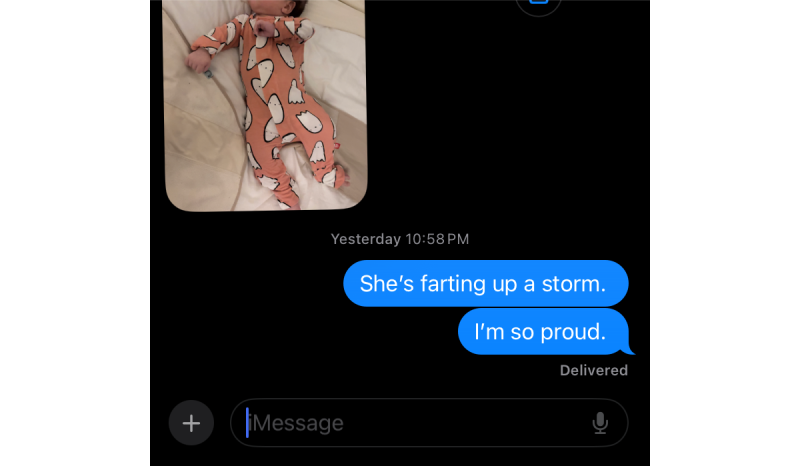
Before I get into it, I feel like I should apologize. I’ve always been staunchly opposed to public discourse about bodily functions. When I was a kid, I tended to define myself in opposition to my older brother, and that was his thing. I was a voracious reader; he could burp the alphabet. I mimicked Ken Griffey Jr.’s stance and Cal Ripken Jr.’s sidearm throwing motion; he learned to spit like a big leaguer. Now, of course, my life is sometimes exclusively focused on bodily fluids and diaper drama and coaxing monster burps out of the sweetest little baby you ever saw, then exclaiming “Oh-ho-ho!” and congratulating her on their grandeur. Somehow, I have turned into the guy who texts this to his wife:
So. Babies are born with immature digestive systems. Everything is difficult. They choke easily, things often don’t sit right in their stomachs, they get the hiccups constantly, and they tend to go to the bathroom while they’re eating. All of these issues are distracting and uncomfortable. In order to avoid pouring more milk on those already dicey situations, evolution developed a simple fail-safe: If something’s wrong, the baby just won’t swallow the milk. Sometimes they’ll stop pulling it into their mouth in the first place, but even if they’re ravenous and they’re sucking aggressively, they’ll then just let it pour right out of their mouths and down their round faces.
When you’re feeding a baby, you have to listen carefully for the adorable little piglet grunts that indicate that they’re swallowing. You learn to appreciate the nuances of those teeny-tiny gasps and grunts and harrumphs, all of which tell you whether and how well they’re getting the milk down. When a baby is eating successfully, it should sound a bit like a Rich Hill start — wait, no, that’s way too intense — rather, it should sound like Rich Hill having a gentle game of catch. Here’s an audio recording of Derek Jr. during a particularly aggressive mealtime. It’s…a lot:
You can hear her grunting and swallowing and gulping for air. You can hear the wind whistling through the vent in the bottle. At one point, you can hear the milk tumbling down into her stomach. And if you listen really closely, you can hear my wife and me trying not to giggle so loudly at her ferocity that we ruin the recording.
When you’re feeding a baby, you’re listening and you’re constantly keeping an eye out for milk pooling at the corner of their mouth or dribbling down their chin. Whenever you sense that the milk is no longer flowing into the tummy, it’s burp time. A nice, big burp will resolve whatever buildup of gas is causing their distress, or at the very least, give them some time to reset themselves and get ready to resume the meal. Essentially, there’s something in the way, and your job is to shake it loose.
You put the bottle down, lift the baby by the armpits and sling them over your shoulder, and pound them on their tiny back as hard as your conscience will allow. (No matter how hard that may be, it’s be a butterfly kiss compared to the thwacks of the nurses at the hospital, who could slap a burp out of a cinder block.) You rock back and forth, because aligning the alimentary canal so that it’s leaning slightly forward can encourage a burp. You alternate between patting on the back and rubbing firmly from the lumbar region up toward the shoulders. (It’s unclear to me whether this actually induces a burp, but it seems like it would feel nice, and that makes you feel better about all the back whacking.) You walk around and bounce the baby on your shoulder as you go. I sometimes do a little shuttle run across the apartment, or put on a song and dance around just for fun.
As you do all this, you can’t help but verbally encourage the baby to burp. Often, the baby is very hungry and therefore very upset that you’re interrupting their (unsuccessful) alimentation, so you end up simultaneously whacking them on the back, explaining why you’re denying them food, and pleading for a burp. I often find myself emphasizing the transactional nature of the relationship like a kid attempting to prize away a friend’s prize rookie card. “Look, you and I both know what you want, and we both know there’s only one way to get it,” I’ll cajole. “If you can think of another way to get food in your belly, by all means, have at it. You scratch my back, I’ll stop whaling on yours.”
Eventually you’re rewarded with a big burp, which is your signal that the baby is ready to eat again. The burps always come suddenly, which means they often elicit from you a cry of surprise and joy, at which point you congratulate the baby like she just won the Super Bowl. I used to despise the very idea of wasting my precious attention on something as crass as burping. Now here I am 30 years later, telling my daughter how proud I am every time she emits a window-rattling burp.
Bottle feeding tends to require much more burping than breastfeeding. [Note from the future: We have also discovered that Derek Jr. needs significantly fewer burps if we feed her bottles that are closer to room temperature rather than from the fridge. She doesn’t mind the cold bottles, but she has a lot more trouble with them. We’re still learning here.] As a result, I’ve spent more time burping Derek Jr. than my wife has. I’m more comfortable with it. Compounding that is the fact that burping can be more challenging when you’re breastfeeding. My wife likes to have a whole pillow situation set up around her, along with her water bottle (because breastfeeding dehydrates you) and her phone to track how long Derek Jr. is eating. That’s no big deal for standard issue burps, but if you need to stand up and dance around the apartment to dislodge a particularly stubborn one, you have to reconfigure the whole nest when you sit back down. I’m desperate to find ways to lighten the huge load my wife is bearing as she recovers from the physical trauma of the birth, deals with massive postpartum hormone shifts, and gives over so much of her time to nursing and pumping, so I often volunteer to jump in and do the burping in order to preserve the nest. I’m now the designated burper.
Once the baby is finished eating, she’s usually adorably drowsy, but you can’t put her down to sleep right away. She needs time to process all the milk she just ingested, which means staying at least somewhat upright. If you put her on her back right away, she’ll be extremely uncomfortable. Even if she does fall asleep that way, she’ll likely get the hiccups or spit up, which is both scary and uncomfortable. The spit-up will run down her cheek and spread in a wet circle on the sheets beneath her face.
When things go well, burping leads right into this upright period, and she’s sleepy putty in your hands. She’s adorable and calm, and your job is to sit there and admire this warm little bundle who has dropped into your life. It’s a special time, and I feel certain that it’s what I will remember most about these last several weeks. It’s also the time when I’ve done most of the writing in this journal and the reason that so much of what I’ve written has been so lovey-dovey. If you were sitting with your drowsy baby’s warm body pressed against your chest and your cheek, you’d be mawkish too.
I tend to give Derek Jr. 20 or 25 minutes to digest, during which time I sing or play music or hold my phone out of her line of sight and watch baseball. It’s nearly four in the morning right now, long after all the games are over, so in between songs, I’m watching highlights of Jacob Misiorowski mowing down the Yankees. He struck out 11 while throwing harder than any starter has ever thrown. I wish I’d seen the whole game, because I’m genuinely curious about how Les Miz is progressing as a pitcher. PitcherList gave his location a B- tonight and Stuff+ gave it a 141, both the best grades he’s gotten all year. That’s exciting. When you’re sitting 101 mph with the fastball and — good Lord — 96 with the slider, B- command should work out just fine. The curveball is the pitch that jumps out the most, because there’s just no way for a hitter to be ready for such an extreme change of pace:
The most important thing I glean from the highlights, though, is that Misiorowski is still locked in a fierce battle against his own hat. The topic for today is shaking things loose, and it definitely applies to him. Watch him closely and you’ll notice that he has to adjust his hat after every single pitch. Clad in the new Brewers City Connects — with “Wisco” across the chest in script, they look more than anything like a product placement for a chain of off-brand gas stations — he still sports the stiffest brim in the league. I swear you could use that thing as a ruler.
Speaking of rulers, the 6-foot-7 Misiorowski is long and narrow everywhere, including his head. The hat doesn’t quite reach his ears. No wonder the thing never gets broken in; he’s barely even wearing it! This is actually something I noticed last year, when Eric Longenhagen posted slow motion footage of Misiorowski’s delivery. Combine a significant head whack with the fact that the stiff hat is basically resting atop his dome like a yarmulke, and you’ve got a recipe for a hat that bounces all over the place every time Misiorowski throws: