Philadelphia Phillies Top 34 Prospects

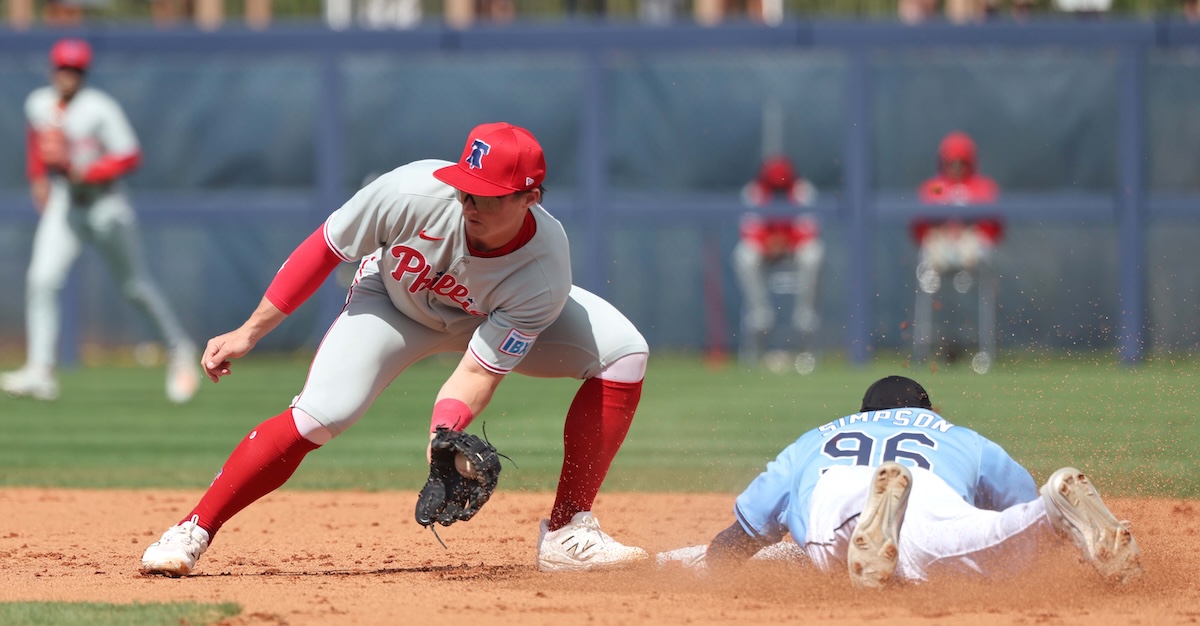
Aidan Miller Photo: Kim Klement Neitzel-Imagn Images

Below is an analysis of the prospects in the farm system of the Philadelphia Phillies. Scouting reports were compiled with information provided by industry sources as well as my own observations. This is the sixth year we’re delineating between two anticipated relief roles, the abbreviations for which you’ll see in the “position” column below: MIRP for multi-inning relief pitchers, and SIRP for single-inning relief pitchers. The ETAs listed generally correspond to the year a player has to be added to the 40-man roster to avoid being made eligible for the Rule 5 draft. Manual adjustments are made where they seem appropriate, but we use that as a rule of thumb.

A quick overview of what FV (Future Value) means can be found here. A much deeper overview can be found here.

All of the ranked prospects below also appear on The Board, a resource the site offers featuring sortable scouting information for every organization. It has more details (and updated TrackMan data from various sources) than this article and integrates every team’s list so readers can compare prospects across farm systems. It can be found here.

Phillies Top Prospects
Rk Name Age Highest Level Position ETA FV
1 Aidan Miller 21.6 AAA SS 2026 55
2 Andrew Painter 22.8 AAA SP 2026 55
3 Justin Crawford 22.0 AAA CF 2026 45+
4 Aroon Escobar 21.1 AA 2B 2028 45
5 Gage Wood 22.1 A SP 2026 45
6 Moisés Chace 22.6 AA SP 2026 45
7 Jean Cabrera 24.3 AA SP 2026 45
8 Gabriel Rincones Jr. 24.9 AAA LF 2026 45
9 Francisco Renteria 17.1 R LF 2031 45
10 Matthew Fisher 19.9 R SP 2031 45
11 Romeli Espinosa 17.6 R SS 2031 40+
12 Cade Obermueller 22.5 R SP 2027 40+
13 Dante Nori 21.3 AA CF 2028 40+
14 Alex McFarlane 24.6 AA SIRP 2026 40+
15 Cody Bowker 22.1 R MIRP 2027 40
16 Keaton Anthony 24.6 AAA 1B 2027 40
17 Gabe Craig 24.6 A SIRP 2027 40
18 Ramon Marquez 20.4 A SIRP 2028 40
19 Dylan Campbell 23.6 AA RF 2027 40
20 Alirio Ferrebus 20.4 A C 2030 40
21 Anderson Araujo 17.8 R C 2031 40
22 Dayber Cruceta 17.9 R CF 2030 40
23 Kehden Hettiger 21.7 AA C 2029 40
24 Seth Johnson 27.4 MLB SIRP 2026 40
25 Zach McCambley 26.7 AAA SIRP 2026 40
26 Brad Pacheco 20.6 R SIRP 2029 40
27 Wen-Hui Pan 23.4 A+ SIRP 2027 40
28 Bryan Rincon 22.0 A+ SS 2028 35+
29 Devin Saltiban 21.0 A+ CF 2029 35+
30 Griffin Burkholder 20.4 A CF 2029 35+
31 Michael Mercado 26.8 MLB MIRP 2026 35+
32 Yoniel Curet 23.2 AAA SIRP 2026 35+
33 Cristhian Tortosa 27.2 AA SIRP 2026 35+
34 Titan Kennedy-Hayes 24.2 A+ SIRP 2028 35+
Reading Options
Detail Level
Data Only
Full
Position Filter
All

55 FV Prospects

1. Aidan Miller, SS

Drafted: 1st Round, 2023 from JW Mitchell HS (FL) (PHI)
Age 21.6 Height 6′ 2″ Weight 210 Bat / Thr R / R FV 55
Tool Grades (Present/Future)
Hit Raw Power Game Power Run Fielding Throw
40/50 55/60 45/60 55/55 30/40 45

Miller became scouting famous as a high school underclassman, in part because he was old for his class (a little over 19 on draft day) and developed a bit earlier. His age and a broken wrist during his senior year contributed to his slide to the back of the first round, where the Phillies drafted him 27th overall and gave Miller just over $3 million to turn pro rather than go to Arkansas. He had a monster first full season in 2024, as he slashed .261/.366/.446 across both A-ball levels and got a shot of espresso at Reading to cap the year. His second full season started more slowly, and Miller struggled to hit for power during the first half, but he exploded after the All-Star Break and posted a .955 OPS en route to a September promotion to Lehigh Valley. He ended up slashing .264/.392/.433 on the season, hit 14 homers and 27 doubles, and stole a whopping 59 bases in 74 attempts.

Miller’s swing has been on time to pull pro pitching. His hands work in a lovely loop that create pull-side loft through the middle-in portion of the zone; it’s one of the cooler looking righty swings in the minors. This is a high-ball hitter who covers the inner half and top third of the zone with a potent contact and power blend. His hard-hit rate and peak exit velocities were both above the big league average in 2025, and Miller is a broad-shouldered kid in his early-20s and might add another half grade of power or so if he keeps getting stronger. Because he’s so geared to pull, Miller pulls off of a lot of sliders, including many that finish on the plate. His selectivity (all of his chase data, no matter the pitch type and count, was excellent in 2025) helps him hunt pitches he can pull until he’s forced to protect the outer third of the zone later in the count. Miller has been able to make an above-average rate of contact so far, but the way to beat him (locate breaking balls away from him) is clear enough that his grade here anticipates a little bit of a dip in this regard at the big league level, though his OBP skills and power are still very exciting for a potential shortstop. Fans should expect offensive output similar to what Zach Neto has been able to muster in Anaheim as Miller gets big league traction.

Miller still has some technical details to polish on the defensive end (his hands and throwing accuracy are still inconsistent), but he’s a great athlete who’ll do some acrobatic things to make tough plays around the bag or on the run. The Phillies have only ever played Miller at shortstop since signing him, and it’s the position at which he’d be the most valuable, but with Trea Turner entrenched ahead of him, it might behoove them to expand his defensive horizons in 2026 in case, be it via trade or injury, it turns out he’s needed at either second or third. Should he turn out to be a more comfortable, consistent defender at either of those positions, then a permanent move should be considered. Miller is going to be good enough at shortstop to play there, but only just so. If he can be a plus glove at second or third, that might be a better long-term fit.

You Aren't a FanGraphs Member
It looks like you aren't yet a FanGraphs Member (or aren't logged in). We aren't mad, just disappointed.
We get it. You want to read this article. But before we let you get back to it, we'd like to point out a few of the good reasons why you should become a Member.
1. Ad Free viewing! We won't bug you with this ad, or any other.
2. Unlimited articles! Non-Members only get to read 10 free articles a month. Members never get cut off.
3. Dark mode and Classic mode!
4. Custom player page dashboards! Choose the player cards you want, in the order you want them.
5. One-click data exports! Export our projections and leaderboards for your personal projects.
6. Remove the photos on the home page! (Honestly, this doesn't sound so great to us, but some people wanted it, and we like to give our Members what they want.)
7. Even more Steamer projections! We have handedness, percentile, and context neutral projections available for Members only.
8. Get FanGraphs Walk-Off, a customized year end review! Find out exactly how you used FanGraphs this year, and how that compares to other Members. Don't be a victim of FOMO.
9. A weekly mailbag column, exclusively for Members.
10. Help support FanGraphs and our entire staff! Our Members provide us with critical resources to improve the site and deliver new features!
We hope you'll consider a Membership today, for yourself or as a gift! And we realize this has been an awfully long sales pitch, so we've also removed all the other ads in this article. We didn't want to overdo it.
Drafted: 1st Round, 2021 from Calvary Christian HS (PHI)
Age 22.8 Height 6′ 7″ Weight 225 Bat / Thr R / R FV 55
Tool Grades (Present/Future)
Fastball Slider Curveball Changeup Command Sits/Tops
40/50 55/55 55/60 45/55 45/60 94-98 / 100

Painter became one of baseball’s best pitching prospects throughout 2022 and entered 2023 seemingly poised to complete a meteoric rise akin to Josh Beckett‘s and aid Philadelphia’s rotation at some point during the season. Instead he tore his UCL during spring training, though he didn’t immediately undergo surgery. Painter received a PRP injection on the off chance that it, along with rest and rehab, would allow him to return by the end of the season, potentially during a pennant race. Unfortunately, he and the Phillies rolled snake eyes; Painter didn’t heal enough to avoid surgery, which he had late enough in 2023 that it cost him basically all of 2024 as well. He returned to action in the fall of 2024, including an Arizona Fall League stint in which Painter’s stuff looked intact. In 2025, after some A-ball tuneup starts in April, the Phillies sent him to Triple-A Lehigh Valley and he struggled badly enough there — a 5.40 ERA and 18 homers allowed across 22 starts and 106.2 innings — that by the middle of the season it was clear that, rather than be justified by his own performance, it would take multiple injuries ahead of him for Painter to debut in Philly.

So, what happened here? Painter’s arm slot lowered throughout the season and changed the direction of his fastball’s movement, which had less vertical life than the dominant 2022 model. The dip in results was staggering: a 29% miss rate and .645 opponent OPS in 2022 versus a 17% miss rate and a 1.006 OPS against it in 2025. Whether Painter’s fastball quality can be reconstituted through mechanical work we just won’t know until the start of 2026. For him to be a dominant, top-of-the-rotation power pitcher, he needs a dominant, power-pitcher’s fastball. If Painter can’t get back to that, his overall projection is still favorable, but no longer very special.

That said, this is still a spindly 6-foot-7 youngster who was sent straight to Triple-A after two years off, and after only 13 combined starts above Low-A. He is built and moves like a durable and consistently effective big league starter. His breaking pitches (and his feel for locating them) are both impressive for an athlete his age and size, and have utility against both left- and right-handed hitters as strike-getting and finishing pitches. Painter’s changeup also improved a lot in 2025, and his usage of it tripled late in the season as it performed like a plus pitch. Whether this improvement will stick might be dependent on whether Painter’s arm slot is back to its original orientation in 2026. Player development doesn’t often take a linear path, and so while Painter took a step back in 2025, it was at least for identifiable reasons that could feasibly be remedied and return him to dominant form in short order. If not, he’s more likely to be a secondary-oriented mid-rotation guy.

45+ FV Prospects

Drafted: 1st Round, 2022 from Bishop Gorman HS (NV) (PHI)
Age 22.0 Height 6′ 1″ Weight 175 Bat / Thr L / R FV 45+
Tool Grades (Present/Future)
Hit Raw Power Game Power Run Fielding Throw
40/50 45/55 20/30 70/70 40/50 50

There’s a sizeable gap between the player Crawford is right now and the one that his numbers and visually identifiable talent and athleticism suggest he could be. Though he was drafted as more of a developmental project, Crawford has yet to experience an on-field speed bump and is a career .322/.385/.446 hitter. He’s fresh off a .334/.411/.452 line at Triple-A Lehigh Valley in his age-21 season, and is in position to help the Phillies’ big league outfield in 2026, maybe even when camp breaks. Why then is his FV grade still a little south of the threshold associated with the Top 100 list or an average everyday big leaguer? Because the top 20 center fielders across a multi-year sample almost always hit for power, and unless Crawford’s swing and batted ball profile evolve as he gets stronger, he doesn’t lift the ball enough to do that. Most of Crawford’s underlying data supports his baseball card stats. His contact rates (both overall and inside the strike zone) are plus on the big league scale, and he is hitting the ball pretty hard (46% hard-hit rate, 110 mph max) for anyone, let alone a projectable 21-year-old. Crawford’s body rotates with beautiful verve, and his ability to bend his lower body throughout his swing to adjust the depth of his barrel takes both physical talent and technical skill to execute.

But Crawford’s long levers take a while to get going, and he’s often too late to the contact point to pull and/or lift the baseball, especially fastballs. The results — a 2.7 degree average launch angle and 60% groundball rate — are unlike all but a couple of big league hitters who have played regularly during the last half decade. Raimel Tapia is the only major leaguer with a meaningful sample (900 PA) during that window to have a groundball rate of 60% or more, and of the hitters with an average launch angle under five degrees, only Christian Yelich has an above-average batting line. Especially as he faces better fastball velocity, Crawford’s current swing will probably keep his SLG% under .400, and unless you’re a Kevin Kiermaier type of defender, such production is more typically associated with second-division everyday center fielders or luxury timeshare outfielders.

Whether mechanical intervention will improve Crawford’s output, or whether it will happen naturally as he gets stronger, we just won’t know until he’s allowed to face and adjust to big league pitching over a long period of time. His groundball rate has at least been trending in the right direction since he turned pro. He was way up in the 70% range when he first debuted, and his spray chart looked like the most cartoonish slash-and-dash hitter. Zac Veen is a recent prospect whose underlying data contained similar warning signs (Crawford is also fairly chase prone), but his on-field performance began to dip once he reached the upper levels, while Crawford’s has not. Make no mistake; Crawford’s tools are going to help a big league club in some capacity, just probably as an action-pressing nine hole hitter who bunts and slashes his way on base.

The son of former Devil Rays outfielder Carl Crawford, who led the league in triples and stolen bases four times, Justin’s blazing speed is the most resonant trait inherited from Carl. If there’s another, it’s that his speed plays down on defense a bit. Carl struggled to read the ball off the bat and was relegated to left field; Justin’s reads are a bit crude, and he can be tentative at that catch point, especially around the wall, but he’s only 22 and has double-robbing gap-to-gap speed. He’ll eventually be a fine defensive center fielder, and he’s already the second-best outfield defender on the Phils’ 40-man after Johan Rojas. Crawford is probably going to play major league baseball for a long time, and this grade leaves room for him to have a star-caliber peak season or two during his six years of team control, but it mostly soberly assumes Crawford will struggle to get to power during a lot of his pre-free agency time and settle into the back half of the everyday center fielders in the league during that window.

45 FV Prospects

4. Aroon Escobar, 2B

Signed: International Signing Period, 2022 from Venezuela (PHI)
Age 21.1 Height 5′ 10″ Weight 210 Bat / Thr R / R FV 45
Tool Grades (Present/Future)
Hit Raw Power Game Power Run Fielding Throw
40/50 50/50 30/45 45/40 30/40 50

Escobar spent two years in the DSL and then had something of a breakout during a 2024 Florida Complex League season shortened by shin splints; he walked twice as often as he struck out and posted exciting underlying power metrics. He entered 2025 as a Pick to Click and arguably did, as he slashed .270/.361/.413 split between both A-ball levels and reached Double-A as a 20-year-old at the very end of the year. But Escobar’s performance dipped as the season went on, and after a white-hot start in Clearwater, he slugged just .369 in Lakewood and his season-long K% was double his 2024 mark.

Escobar is still a well-rounded hitting prospect with a shot to be an everyday second or third baseman. We learned more about his defensive abilities in 2025, as he was actually healthy and playing almost solely second base, where he’s slick around the bag but not great when he needs to run around and collect grounders near the edge of his range. Escobar is listed at 180 pounds but is probably closer to 220 and is built like White Sox era Juan Uribe. He might merit more time at third base to make him more versatile (2026 is his 40-man platform year, after all), or to see if, like Uribe, it turns out to be a better fit for him.

Regardless of where Escobar ends up on defense, it’s going to be important for him to hit and hit for power to profile as an everyday player. After he looked like a special contact bat on paper in 2024, he was more average in 2025 when challenged by better pitching; his 76% contact rate and 110-mph airborne max exit velo are right in line with the big league mean. That’s still good for a hitter this age (albeit one with less physical projection than is typical), and Escobar certainly looks like an explosive and talented hitter to the eye in many ways. He’s adept at using the ground to generate pull power, he moves the barrel around the zone fairly well (especially the top of it), and he can spray hard contact from pole to pole. If he has an underlying issue it’s that, despite looking like a short-levered guy, Escobar’s bat enters the hitting zone too late to pull any fastballs. When a hitter’s spray chart looks like Escobar’s does against A-ball fastballs, we should be cautious about assuming his power output will hold against big league heat. This FV grade represents a modest upgrade compared to where Escobar ranked last year, but still has him positioned as more of a second-division regular or good part-time player who could use some defensive versatility to ensure he can play the latter role in Philly starting in 2027 or 2028.

5. Gage Wood, SP

Drafted: 1st Round, 2025 from Arkansas (PHI)
Age 22.1 Height 6′ 0″ Weight 205 Bat / Thr R / R FV 45
Tool Grades (Present/Future)
Fastball Curveball Command Sits/Tops
70/70 60/60 30/45 94-97 / 98

Wood was a power reliever during his first two years in Fayetteville and then moved into the rotation as a junior, only to be shut down pretty quickly with a shoulder injury that limited him to 10 starts and 37.2 regular season innings. To say Wood looked healthy when he returned would be an understatement. At the 2025 College World Series, Gage did his best Kerry Wood impression and ripped riding fastballs and knee-buckling curveballs past Murray State hitters in a 19-strikeout no-hitter.

Wood is small, he’s had injury issues, and he really only has two pitches at the moment, but he was still a late first round prospect because his fastball’s velo/ride/angle cocktail is deadly, and his curveball’s vertical snap plays beautifully off of it. Are there echoes of Ty Floyd here? Wood is similar in terms of his stature, repertoire, and collegiate postseason heroics. His ability to spin the baseball should yield at least one other good breaking ball. He threw something like 50 cutter/sliders and 15 changeups in all of 2025; those pitches are raw. Adding to Wood’s relief risk is that he can only consistently throw his fastball for strikes, but even that is a developmental win considering he was in the bullpen a year ago, and recall that there are many big league starters who feast off of heavy fastball usage when it rides like Wood’s does. He’s risky, but he could be a good no. 4 starter.

6. Moisés Chace, SP

Signed: July 2nd Period, 2019 from Venezuela (BAL)
Age 22.6 Height 6′ 1″ Weight 215 Bat / Thr R / R FV 45
Tool Grades (Present/Future)
Fastball Slider Changeup Command Sits/Tops
70/70 45/50 30/45 30/45 93-96 / 97

Acquired with Seth Johnson from Baltimore in 2024 in exchange for Gregory Soto, Chace entered 2025 as a Top 100 prospect thanks to a dominant riding fastball. He was sitting in the mid-90s throughout 2024, and his heater benefitted from basically every positive secondary trait a fastball can have beyond its pure velocity. It looked like a harder version of Joe Ryan‘s heater, albeit in an overall package that featured more significant relief risk than Ryan. It seemed plausible that Chace, who was put on the 40-man after the 2024 season, could play a very important role in Philly in 2025, even if that was as the team’s setup man or closer. Instead, Chace’s velocity tanked into the low 90s, his walk rate regressed to his problematic, early-career levels, and after six starts, he was shut down and needed Tommy John toward the end of May. The injury not only casts doubt on how Chace’s stuff might look when he returns, but also robs him of valuable reps needed to develop the durability, control, and secondary pitches of a starting pitcher.

Chace’s slider flashes late, hitter-freezing, two-plane bend, but it doesn’t do so consistently. At times, his changeup has ridiculous tailing action and can steal strikes running back over the glove-side corner of the plate, but again, this is rare. His release is pretty inconsistent generally, which is totally normal for a young pitcher with this kind of arm speed, but now that large chunks of two of Chace’s option years (barring the Phillies being granted an exemption due to his injury) have been spent on the shelf, it’s more likely that he ends up in relief, though with a fastball like this, we’re still looking at a potential late-inning weapon. I’m told by sources within the organization that the Phillies plan on deploying Chace as a starter when he’s back.

Signed: July 2nd Period, 2019 from Venezuela (PHI)
Age 24.3 Height 6′ 4″ Weight 185 Bat / Thr R / R FV 45
Tool Grades (Present/Future)
Fastball Slider Changeup Command Sits/Tops
40/40 50/50 55/60 45/55 92-95 / 97

After two consecutive years of excellent strike-throwing, Cabrera spent his first season on the Phillies’ 40-man roster entirely at Double-A Reading, where he posted a career-low strikeout rate (22.2% K%) and nibbled a bit more than he has otherwise tended to (10.6% BB). Still, his projection hasn’t changed. Cabrera’s two hiccup seasons have come when he skipped the domestic complex level and went straight to Low-A in 2022, and then when he had his first prolonged exposure to upper-level competition in 2025; these are pretty natural places to stumble a bit.

Cabrera still does the things one looks for in a steady, back-of-the-rotation starter. He’s limber and athletic, he repeats his delivery well and with little violence, he has demonstrated that he has season-long big league starter stamina (he worked 137 innings last season), and he has the toolkit to thwart both left- and right-handed hitters. Issues with his fastball’s shape and playability forced Cabrera to lean more heavily on his slider as a strike-getting pitch in 2025, and subsequently use his changeup (which played like a plus pitch for the second consecutive year) more as a finisher. These are firm, one-seam sinker style changeups in the 85-88 mph range. Cabrera can work east/west with his slider and changeup, while his fastball’s movement is less dynamic; that’s the piece of his profile that really caps his ceiling. Cabrera is a more reliable strike-thrower than the other Phillies starters likely to begin the 2026 season in the minors, putting him in the no. 6 or 7 starter spot on the depth chart and making him likely to debut in 2027 and exhaust rookie eligibility.

Drafted: 3rd Round, 2022 from Florida Atlantic (PHI)
Age 24.9 Height 6′ 3″ Weight 225 Bat / Thr L / R FV 45
Tool Grades (Present/Future)
Hit Raw Power Game Power Run Fielding Throw
30/35 70/70 50/60 40/40 45/50 45

Rincones’ father pitched briefly in the Mariners system before an injury derailed his career. His family moved to Venezuela and then later to Scotland for his dad’s new job in the oil industry. Rincones would eventually find his way to the prospect factory that is Plant High School in Florida (the alma mater of Tuckers Preston and Kyle), where he would initially struggle to make the team before establishing himself as a junior college prospect. He then spent two seasons at St. Petersburg College before transferring to FAU, where in just one season he slashed .346/.451/.658, hit 19 homers, and elevated his draft stock into the third round thanks to his big lefty power.

In three pro seasons, Rincones is a career .246/.357/.434 hitter. He spent 2025 at Triple-A Lehigh Valley, where he posted a .799 OPS and set career highs in homers (18) and extra-base hits (41). A shoulder injury (2022), torn thumb ligament (2024), and sprained ankle (2025) have cost him big chunks of his pro career and, odd amateur arc included, he’s played far fewer high-level baseball games than most prospects his age. But when he’s been healthy (including right after returning from that nasty thumb injury), Rincones has destroyed righties. He’s career .256/.362/.476 hitter versus them (.164/.257/.224 vs LHP) and has some of the best raw power in the organization, even when you include Philly’s big league roster. A strapping 6-foot-3, 225 pounds, Rincones will flash plus-plus pull-side juice against pitches in the middle-in portion of the plate, but doesn’t access it all over the zone.

His lever length leaves him vulnerable to elevated fastballs away from him, and overall Rincones’ whiff tendencies put him toward the bottom third of the big league scale (Trevor Larnach, Will Benson, Seth Brown and Josh Lowe are all fair comps) but they aren’t so bad as to worry he’ll bust entirely. This includes his splits against righties, against whom he has a career 71% contact rate. When you have big power like Rincones does, you can whiff this much and still play a meaningful part-time role. Now that he’s on the Phillies’ 40-man roster, Rincones should get the opportunity to do that as part of a timeshare with Adolis García and/or Nick Castellanos at some point in 2026.

9. Francisco Renteria, LF

Signed: International Signing Period, 2026 from Venezuela (PHI)
Age 17.1 Height 6′ 4″ Weight 210 Bat / Thr R / R FV 45
Tool Grades (Present/Future)
Hit Raw Power Game Power Run Fielding Throw
20/40 55/70 20/60 55/45 40/50 50

Renteria has arguably the best raw power projection among the 2026 international signees, as his enormous 6-foot-4 frame has a ton of room left for strength and mass. He’s already putting on impressive shows in a BP setting and hit 18 bombs in Venezuela’s LMBP Home Run Derby during the winter of 2025. Renteria’s hit tool projection is more difficult. Though he participated in many events — some in the U.S. with Perfect Game, others as part of Venezuela’s national team, with some summer league ball against older pros in VZ — Renteria’s bat-to-ball data is mixed despite his short swing. He hits with a high front side that might leave him vulnerable to softer stuff at the bottom of the zone. When Renteria first agreed to a deal, it seemed like he’d have a shot to develop in center field, but he’s just kept getting taller and now is a nearly certain to end up in a corner, where he’ll likely have the power to profile in an everyday role if he hits enough.

10. Matthew Fisher, SP

Drafted: 7th Round, 2025 from Evansville Memorial HS (IN) (PHI)
Age 19.9 Height 6′ 3″ Weight 200 Bat / Thr R / R FV 45
Tool Grades (Present/Future)
Fastball Slider Curveball Changeup Cutter Command Sits/Tops
45/55 50/60 55/60 20/50 20/50 20/45 92-94 / 95

Fisher, who is from the same part of Indiana as the Mattingly family, ranked 32nd on the 2025 Draft Board but signed for $1.25 million (the slot value of pick 68) in the seventh round, the highest bonus ever given to a seventh rounder. He was 19 on draft day and is a bigger, heavier athlete than most high school pitchers, but Fisher is very limber and athletic, and has a gorgeous arm action, with the cut/ride fastball/curveball combo that lots of modern scouting departments covet.

Though Fisher’s body lacks the usual projection, his fastball still experienced a velo bump late in high school. He was more 88-92 mph during his showcase summer, then was 92-95 in his pre-draft spring. Fisher’s fastball is the kind that thrives when located at the top of the zone, spinning in at 2,500 rpm and averaging 17 inches of induced vertical break, with natural cut at times. He’s a natural supinator with a big two-planed curveball in the 78-82 mph range that spins at roughly 2,900 rpm, giving him the foundation to be able to add multiple breaking balls and maybe a kick change as he develops. He’ll be 20 years old before he throws his first pro pitch at an affiliate and the cement on Fisher’s arm talent is almost certainly a bit drier than that of his debutant peers, but his stuff is exciting and he has the same sort of mid-rotation potential as any high school pitching prospect with this kind of fastball/curveball starting point.

40+ FV Prospects

11. Romeli Espinosa, SS

Signed: International Signing Period, 2025 from Dominican Republic (PHI)
Age 17.6 Height 6′ 4″ Weight 170 Bat / Thr R / R FV 40+
Tool Grades (Present/Future)
Hit Raw Power Game Power Run Fielding Throw
20/40 40/60 20/55 60/55 30/50 55

This is an aggressive evaluation of Espinosa meant to illustrate his ceiling. He presents a rare combination of present contact feel and long-term power projection for an up-the-middle prospect. Espinosa’s build comps to Elly De La Cruz at the same age: endless limbs on a broad-shouldered 6-foot-4 frame, with the room to add big strength while remaining sufficiently lithe and agile for shortstop. The 2025 DSL season began a few days before Espinosa’s 17th birthday, and he managed to slash .282/.363/.430 there while posting a 77% contact rate (a shade better than the big league average). That’s a very positive contact-hitting origin point for a shortstop prospect built like this, as long-levered hitters like Espinosa are often still uncoordinated at this age.

The very wobbly Jenga block in Espinosa’s early-career prospectdom is his current inability to identify breaking pitches. His chase and whiff tendencies against breaking stuff is in a red flag area right now, and that’s against crude DSL pitching. This issue will be severe enough to destabilize Espinosa’s offensive output as he climbs if it doesn’t improve. Past studies indicate a player’s plate discipline tends to be a pretty static aspect of his skill set, but those were all conducted before technology allowed for contemporary methods of development, and last year Espinosa was playing pro ball at the age of a high school underclassman. Let’s see how his chase rate trends in year two. He’s one of the more exciting and tumultuous prospects in all of rookie ball.

Drafted: 2nd Round, 2025 from Iowa (PHI)
Age 22.5 Height 5′ 11″ Weight 160 Bat / Thr L / L FV 40+
Tool Grades (Present/Future)
Fastball Slider Changeup Command Sits/Tops
50/55 45/50 30/50 30/45 91-95 / 98

Obermueller entered his junior year with a reliever’s profile, coming off two straight seasons of walking six or more batters per nine and wielding only two pitches. In his draft spring, he cut his walk rate down to a respectable 9% and was maybe the best pitcher in the Big Ten; he led the conference in strikeouts and was in the top five in ERA and FIP. He signed for just under $1.2 million in the second round and did not pitch at an affiliate after the draft.

Obermueller has relief risk because he’s smaller, he throws just two pitches, and he doesn’t have great command of either of them. But he’s a special athlete with a beautiful delivery, which arguably allows for mold-breaking command and changeup projection. Obermueller is an incredibly loose, explosive athlete with bendy, whippy limbs and a powerful lower body. His delivery adds deception to his stuff in basically every way. He’s able to hide the ball for a long time because of how far back his arm lays before release. He takes a cross-bodied stride and has a lower arm slot, but he still manages to power down the mound and generate plus extension despite an indirect line to the plate. Plus, Obermueller gets to a more vertical hand position on release than is typical of someone with his arm slot. All of this creates huge uphill angle on his fastball, which averages 91-95 mph. That’s up a tick from his sophomore year, and he’ll peak in the 97-98 mph range.

Obermueller’s slider has huge sweeping action, but it starts breaking really early and is easier to spot out of hand. He generally lives in and around the zone with it, and he doesn’t have precise or focused usage of it right now, but it moves enough that college hitters couldn’t handle it. In pro ball, he’s going to need to dot it more precisely, and find a third pitch. Obermueller threw his changeup 30 times in 2025, 2% of his usage, and just 19 times in front of a Trackman unit. It often sails on him and it isn’t a good pitch right now, but he has all the athletic and mechanical markers of a guy whose changeup will get better thanks to his arm speed and deception. The Phillies could move Obermueller through the minors quickly as a nasty lefty specialist, but his long-term ceiling is as a fourth starter.

13. Dante Nori, CF

Drafted: 1st Round, 2024 from Northville HS (MI) (PHI)
Age 21.3 Height 5′ 10″ Weight 190 Bat / Thr L / L FV 40+
Tool Grades (Present/Future)
Hit Raw Power Game Power Run Fielding Throw
30/45 40/40 20/30 70/70 45/60 40

Nori, whose father is an assistant coach for the Minnesota Timberwolves, was one of the older high schoolers in the 2024 draft and turned 20 a couple of months after signing. The Phillies skipped him over rookie ball and he slashed .262/.363/.381 at Clearwater in 2025, then was promoted to Jersey Shore and Reading in short succession at the end of the season before Nori had a stellar Arizona Fall League stint.

Nori can really run, and while he needs to improve on reading balls hit over his head, he is otherwise a very promising center field defender. He goes full tilt into both gaps to rob doubles, and he has slick ball skills as he goes to the ground sliding or diving to snatch would-be singles in front of him. His defense is going to carry him to a big league role, but his offense is going to dictate what kind. Though he posted an above-average contact rate in 2025, Nori’s bat is pretty slow and he tends to push contact the opposite way. Built like Sal Frelick, his body is maxed out, so it’s tough to project on his bat speed and power based on physical maturation. His hit tool is going to have to be very special for him to profile as an average everyday center fielder, and it’s much more likely that his lack of power will cause his hit tool to play down a bit and that Nori will wind up as a luxury model fifth outfielder.

14. Alex McFarlane, SIRP

Drafted: 4th Round, 2022 from Miami (PHI)
Age 24.6 Height 6′ 4″ Weight 215 Bat / Thr R / R FV 40+
Tool Grades (Present/Future)
Fastball Slider Splitter Command Sits/Tops
65/65 50/60 40/40 30/40 95-99 / 101

I considered McFarlane to be a pure relief prospect when he was at Miami, but the Phillies decided to try to develop him as a starter, and for the first two months of 2023, it looked as though they really had something. He punched out 50 hitters in his first 37 innings and worked efficiently enough to pitch into the fifth and sixth inning during several starts, a rarity for him at Miami. About halfway through the 2023 season, however, the team began to drastically limit the length of McFarlane’s outings, his stuff waned, and he was ultimately shut down at the end of August and had Tommy John that September, which put him out for all of 2024. He returned in 2025 with his arm strength intact, shifted from the rotation to the bullpen in August, and then was promoted to Reading. Though he didn’t dominate after the role shift, McFarlane’s fastball leapt two ticks after he was ‘penned; Synergy Sports has him averaging 97 mph and touching 101 during that span. He’ll enter 2026 as a pure reliever and could play a meaningful late- or multi-inning role in the big leagues this year, provided McFarlane throws strikes in Reading and Allentown.

McFarlane is a little undersized (not that it matters as much in relief), but he’s got a body built for longevity and is a fabulous on-mound athlete, with huge arm speed and plus-plus raw spin on his slider. His fastball has tailing life and some uphill angle created by his lower arm slot, and it’s best when it’s shattering bats around the hands of righty batters. Even when he was working as a starter, McFarlane barely threw his splitter and was a fastball/slider guy 92% of the time. Though in some respects his slider performed like a 70-grade offering in 2025 (it’s swinging strike rate was up over 20%), McFarlane is much better at locating it in the zone than he is at dotting it on the corner, and he needs to do the latter more consistently for his slider to play like a plus or better pitch in the big leagues. Honing this skill is the key to him reaching his high-leverage relief ceiling.

40 FV Prospects

15. Cody Bowker, MIRP

Drafted: 3rd Round, 2025 from Vanderbilt (PHI)
Age 22.1 Height 6′ 1″ Weight 212 Bat / Thr R / R FV 40
Tool Grades (Present/Future)
Fastball Slider Changeup Cutter Command Sits/Tops
50/55 40/45 40/50 50/55 30/45 91-94 / 95

Bowker was on the fancy school express, transferring from Georgetown to Vanderbilt for his junior year. There he successfully transitioned into a starter-only role and had a career year in 2025, with a 31.6% strikeout rate and 8.9% walk rate in 72 innings. He signed for $700,000 and didn’t pitch after the draft.

Bowker has an extreme drop-and-drive, low-slot delivery. His right shin is practically scraping the ground as he delivers, creating extreme uphill angle on his pitches. Bowker sat in the 91-94 mph range all year even as he blew through his career innings high, and he throws fastballs for strikes (70% strike rate with plus-plus miss and chase) despite mechanical funk. Though his secondary pitch feel is not as crisp, Bowker has a bunch of them. He changes speeds on two breakers — a mid-80s cutter and low-80s slider — that play nicely off his fastball near the top of the zone, and he can turn over a changeup in the low 80s if he wants something to finish low. It’s a starter’s pitch mix in a mechanical package more commonly seen in the bullpen, which is why Bowker is projected to slot into multi-inning big league role.

16. Keaton Anthony, 1B

Undrafted Free Agent, 2023 (PHI)
Age 24.6 Height 6′ 2″ Weight 220 Bat / Thr R / R FV 40
Tool Grades (Present/Future)
Hit Raw Power Game Power Run Fielding Throw
45/50 50/50 40/45 30/30 40/45 40

Anthony was a third-team All-American in 2023 but went undrafted in part because he was one of several athletes at Iowa and Iowa State ruled ineligible after a gambling sting conducted by the Iowa DCI. Some of the athletes were charged with misdemeanors, while others reached plea deals; Anthony faced no criminal charges and wasn’t accused of betting on his own team, but he was one of the athletes whom the NCAA deemed ineligible.

In pro ball, Anthony quickly moved to the upper levels of the minors and has hit above .300 at every stop, with a .323/.378/.484 line split between Double- and Triple-A in 2025. Indeed, he has fantastic hand-eye coordination and plate coverage, but his approach and manner of swinging (which is very similar to Nick Castellanos) is geared toward the opposite field in the extreme, and Anthony (in part due to injury) has yet to have a double-digit homer season as a pro. It’s fun to watch him put on a clinic for “staying inside” the baseball to hit oppo singles and doubles, but he lacks great pure bat speed and it takes him a while to get to the contact point. He has had trouble elevating velocity (he posted a 65% groundball rate against pitches 92 mph and above last year), as well as diagnosing balls and strikes against fastballs (30% chase, the big league average is 24%), and both of these issues are obstacles threatening an already brittle righty-hitting first base profile. Anthony’s skillful hitting should allow him to be a big leaguer, but it looks like there’s an obvious way to attack him in order to limit his power.

17. Gabe Craig, SIRP

Drafted: 5th Round, 2025 from Baylor (PHI)
Age 24.6 Height 6′ 5″ Weight 210 Bat / Thr R / R FV 40
Tool Grades (Present/Future)
Fastball Slider Command Sits/Tops
50/50 60/70 30/40 93-96 / 97

Craig pitched in six college seasons with two stints at Tyler JC sandwiched around a season at Texas A&M, followed by three at Baylor. He was utterly dominant in his final season in Waco, as he carried a 0.56 ERA and allowed just 19 baserunners in a career-high 32 innings, earning All-American honors as a dominant reliever. Craig’s slider is a beast. It has absurd lateral action and can look like a ball out of hand, then like a strike mid-flight, then a ball again as it continues bending off the corner. It “only” generated a plus miss rate in college, but that’s because Craig leans on it to throw strikes as well as finish hitters. His fastball is a standard 93-96 mph heater, the kind you see on a slider-heavy bullpen piece. Craig is likely to rocket through the minors in 2026, and there are folks who think he could debut before the end of the season. Because he has just one outstanding pitch, he’s more likely to slide into a standard middle relief role than a late-inning one, but if there’s more gas in the tank, or if Craig finds a third pitch, then he has more upside.

18. Ramon Marquez, SIRP

Signed: International Signing Period, 2025 from Mexico (PHI)
Age 20.4 Height 6′ 2″ Weight 185 Bat / Thr R / R FV 40
Tool Grades (Present/Future)
Fastball Slider Changeup Cutter Command Sits/Tops
45/50 40/45 60/70 40/50 30/45 92-95 / 96

Marquez signed out of Mexico for $10,000 and raced to full-season ball six months after he signed while becoming one of the better pitching prospects in the Phillies system. He dominated complex ball in Florida for 10 outings and was elevated to the full-season roster in Clearwater for the season’s final month, altogether posting a 1.25 WHIP and striking out 72 batters in 55 innings.

Marquez throws hard for his age, albeit with downhill plane and movement that makes it vulnerable to contact. His best pitch, and maybe the best individual pitch in the system, is a Bugs Bunny changeup that generated an elite miss rate (just over 60%!) last season. It has an absurd amount of sinking and tailing action, and is absolutely the kind of pitch that could spearhead a relief profile on its own. Marquez also has a fringy slider that sometimes has a cutter look and velo, and he might be suited to have an explicit cutter rather than the hybrid look of his current breaker.

Though Marquez threw a starter’s rate of strikes in 2025 and looked comfortable as he was stretched out to work four and five innings per outing later in the season, his delivery has a head whack so grotesque that David Cronenberg would consider it excessive. It’s rare for pitchers whose deliveries look like this to remain starters, and perhaps Marquez’s fastball will need the boost from shorter-outing deployment to be effective. Even if these issues prove meaningful, Marquez would still be a great pickup for his price tag as a changeup-merchant reliever.

19. Dylan Campbell, RF

Drafted: 4th Round, 2023 from Texas (LAD)
Age 23.6 Height 5′ 11″ Weight 205 Bat / Thr R / R FV 40
Tool Grades (Present/Future)
Hit Raw Power Game Power Run Fielding Throw
30/45 50/50 30/45 50/50 30/45 60

Campbell was a high school infielder who ended up settling into right field during his college career at Texas, where he had a bit of a power breakout as a junior. Drafted by the Dodgers, he slashed .251/.331/.372 in the chilly Midwest League in 2024 and stole 42 bases in 49 attempts, before he was traded to the Phillies for some of the pool space required to sign Roki Sasaki. Campbell had a pedestrian first season as a Phillie split between High- and Double-A (a .215/.298/.367 line, good for a 95 wRC+), then got white hot in the Arizona Fall League, where he carried a 1.044 OPS. Campbell’s regular season performance was more in line with a player who gets a cursory mention at the end of these lists, but his Fall League look and the Phillies’ willingness to experiment with him on defense has kept the pulse of his prospectdom alive.

Short levers and strong wrists give Campbell notable hitterish traits, and he told MLB Pipeline’s Sam Dykstra that he was working with a new swing in the AFL (for what it’s worth, it looked the same to me). Though he has kept his infielder’s mitt handy for occasional second base duty in pro ball, Campbell was introduced to first and third base for the first time in the AFL. A stocky athlete whose meaty torso and trunk taper down to toothpick ankles, Campbell runs well in a straight line but isn’t the best lateral mover. Defensive versatility is going to be important to his rosterability, but he played the corner infield so infrequently in Arizona that seeing him enough to satisfactorily evaluate his prospects there was difficult. Campbell is back on the radar as a potential bat-first utilityman who plays the outfield corners and hopefully at least one infield position.

Signed: International Signing Period, 2023 from Venezuela (PHI)
Age 20.4 Height 6′ 2″ Weight 174 Bat / Thr R / R FV 40
Tool Grades (Present/Future)
Hit Raw Power Game Power Run Fielding Throw
30/50 35/50 30/40 40/30 30/45 50

Ferrebus has hit well enough each of the last two years (he’s a career .275/.357/.404 hitter) to receive mid-season promotions, from the DSL to FCL in 2024 and then from the FCL to Low-A in 2025. He is a long-levered C/1B prospect with precocious oppo contact feel who struggles some with selectivity and receiving.

Ferrebus is really projectable for a young catcher, but he needs to be stronger and quieter at the catch point. His hands are better picking balls in the dirt than they are at squeezing pitches around the edges of the zone, though too often he relies on his hands to pick the ball rather than move his body to block it. His lean, sinewy build might be part of why, and added strength might make it easier for him to wear one when he needs to. Throwing accuracy helps Ferrebus’ average arm play up when he gets a clean throw away, but too often messy or slow footwork prevents him from doing so. There’s enough here that Ferrebus should absolutely continue to develop behind the dish even though he isn’t a lock to stay back there, and even if things work out, it’s probably going to take a while.

Added strength over time should aid Ferrebus on both sides of the ball, as he probably needs to shorten up a bit to hit big league fastballs. Of the young, 17-to-20-year-old, deep-projection position players in the Phillies system, Ferrebus is the one who has most demonstrated proficient contact feel, so he sits atop that group.

Signed: International Signing Period, 2025 from Venezuela (PHI)
Age 17.8 Height 5′ 11″ Weight 177 Bat / Thr R / R FV 40
Tool Grades (Present/Future)
Hit Raw Power Game Power Run Fielding Throw
25/50 40/50 20/50 40/30 30/40 45

Araujo is a bat-first catching prospect who had an awesome 2025 DSL debut during which he slashed .289/.377/.528 with 21 extra-base hits in 45 games. He’s a medium-framed, short-levered hitter whose top hand drives the explosion of his swing, facilitating lots of loud pull-side contact. Araujo can flatten his bat path to cover the top of the zone or use a more uphill angle to scoop low pitches.

Because of his youth and inexperience, Araujo is currently a very raw defensive catcher and is not a lock to stay back there. He played a lot of first base in 2025, too, though that was due as much to Philly’s DSL catching depth as it was Araujo’s own shortcomings. If he doesn’t develop as a catcher, then Araujo’s modest size (think Ty France’s body) would likely cap his power and, it follows, his ceiling as a first baseman. For now, he’s a talented young hitter who’ll be tested by Florida complex arms as an 18-year-old in 2026.

22. Dayber Cruceta, CF

Signed: International Signing Period, 2025 from Dominican Republic (PHI)
Age 17.9 Height 6′ 1″ Weight 155 Bat / Thr L / L FV 40
Tool Grades (Present/Future)
Hit Raw Power Game Power Run Fielding Throw
25/50 20/40 20/40 60/60 40/55 55

Cruceta is a well-rounded young center field prospect with exciting physical projection and present contact skill. He slashed .291/.438/.373 in his DSL debut and managed a 77% contact rate. That low slugging percentage is indicative of Cruceta’s strength and bat speed right now — he lacks both. But his hands work in an aesthetically pleasing way, he’s a good athlete, and he runs well, and at a statuesque 6-foot-1, he could mature into that center field Goldilocks Zone where he adds power but stays rangy on defense. Cruceta looks a lot like the domestic high schoolers who get a $1 million bonus, give or take, and he has a non-zero shot to be an everyday player eventually.

Drafted: 11th Round, 2023 from Sierra Canyon HS (CA) (PHI)
Age 21.7 Height 6′ 1″ Weight 205 Bat / Thr L / R FV 40
Tool Grades (Present/Future)
Hit Raw Power Game Power Run Fielding Throw
20/35 50/55 35/45 40/40 20/40 45

An Oregon commit from the northwestern part of Los Angeles, Hettiger signed for just shy of $400,000 in 2023 and hit .195 at Clearwater in his first full pro season. In 2025, he gave up switch-hitting and slashed .232/.330/.389 in Lakewood, good for a 117 wRC+ in the South Atlantic League.

The hitting environment in the Sally masked Hettiger’s power, his carrying tool. This guy can really swing it. His hands are explosive and generate blood-thirsty pull-side launch, with Hettiger showing average big league power as a college-aged prospect with room on his frame for more strength. Hettiger also has a real approach and tends to target high pitches, the ones he’s suited to crush. He’s probably going to strike out a bunch (he K’d at a 29.1% clip in 2025) because he runs deep counts and sells out for power when he swings, but his feel for contact also might improve some as he focuses solely on hitting left-handed.

Lefty-hitting catchers with this kind of bat speed are uncommon, and that’s what is giving Hettiger some prospect value here. Though the Phillies gave him a shot of espresso at Double-A in September, Hettiger is still very much a developmental prospect, especially as a defender. His receiving and pitch framing are sushi raw, and some of the pitchers in Reading were visibly frustrated by his struggles at the very end of the season. Hettiger has also played a lot of first base; it wasn’t until the last month of 2025 that the Phillies really dedicated Hettiger solely to catching. He’s athletic enough to have a shot of sticking back there, though it’s probably going to take several years before he’s good enough to handle the duties of a big league job.

24. Seth Johnson, SIRP

Drafted: 1st Round, 2019 from Campbell (TBR)
Age 27.4 Height 6′ 0″ Weight 200 Bat / Thr R / R FV 40
Tool Grades (Present/Future)
Fastball Slider Curveball Splitter Command Sits/Tops
50/50 55/55 50/50 50/60 30/30 93-97 / 100

Johnson was a converted middle infielder who seemed like he was scratching the surface of his abilities at Campbell and could plausibly make substantial improvements with pro development. The Rays selected him with the 40th overall pick, then watched Johnson’s stuff take a leap as he posted a strikeout rate of nearly 30% in his 2021 full-season debut. He was traded to Baltimore as part of the 2022 Trey Mancini swap, then had TJ and missed most of 2023, was traded to Philly in the Gregory Soto deal in 2024, and moved to the bullpen in a 2025 season spent mostly at Lehigh Valley, with a dusting of big league action. Johnson’s command not only plateaued in a way that forced him to the bullpen, but made it so that his stuff plays down a bit. He sits 96 and touches 100, but his heater played like an average pitch in 2025. He’s at his best when he’s mixing in all four of his pitches in an unpredictable fashion, which includes him using his upper-80s slider to get ahead of hitters. His secondary stuff is good enough for Johnson to be an inefficient middle reliever.

25. Zach McCambley, SIRP

Drafted: 3rd Round, 2020 from Coastal Carolina (MIA)
Age 26.7 Height 6′ 2″ Weight 225 Bat / Thr R / R FV 40
Tool Grades (Present/Future)
Fastball Slider Cutter Command Sits/Tops
40/40 60/60 55/55 40/40 93-96 / 97

McCambley progressed slowly through the Marlins system after reaching Double-A as a starter in 2022. He has average arm strength and can touch 97, but the round-down shape traits on his heater(s) has pushed him to rely more on his cutter and slider. He took a step forward as a strike-thrower in 2025 and had a good year pitching in relief at Miami’s upper-level affiliates before the Phillies popped him in the Rule 5 Draft during the offseason. His feel for spin, particularly pronounced on the slider, helped him miss quite a few bats last season, and it’s a little surprising the Marlins never gave him a shot. On the strength of his plus breaking stuff, he projects as a low-to-mid-leverage reliever.

26. Brad Pacheco, SIRP

Signed: International Signing Period, 2023 from Venezuela (PHI)
Age 20.6 Height 6′ 0″ Weight 185 Bat / Thr R / R FV 40
Tool Grades (Present/Future)
Fastball Slider Curveball Changeup Command Sits/Tops
50/60 20/45 40/40 45/60 35/50 93-96 / 97

Pacheco has had early-career success as a rookie ball starter, with 1.19 WHIP in 62.1 career innings. He throws hard, with his fastball residing in the 93-96 mph range through most of 2025 as he worked four to five innings per start. Pacheco’s arm action is explosive, and he generates six-and-a-half feet of extension even though he’s only six feet tall. He’s been able to throw strikes despite his delivery featuring a good bit of effort, and he’s walked just 6.5% of opposing hitters since signing. His arm action (and ability to kill spin) allows for lots of projection on his power changeup, which currently lives in the 86-90 mph range. His breaking ball is a blunt 80-mph curveball that might morph into a harder slider/cutter with time. It’d be easier to project Pacheco as a starter if he were a bigger athlete; it’s rare for righties this size to wind up in a big league rotation. But he throws hard, throws strikes, and should have at least one viable secondary weapon at peak (the changeup), which would allow him to be a reliable middle reliever.

27. Wen-Hui Pan, SIRP

Signed: International Signing Period, 2023 from Taiwan (PHI)
Age 23.4 Height 6′ 3″ Weight 230 Bat / Thr R / R FV 40
Tool Grades (Present/Future)
Fastball Slider Splitter Command Sits/Tops
55/60 45/50 45/60 30/40 94-98 / 99

Signed for $350,000 in January of 2023, Pan became the talk of that year’s minor league spring camp because he arrived throwing very hard. Pan sat 92-94 mph during amateur international competition, but was sitting 96-98 during his first spring with the Phils while topping out at 99 mph. He quickly moved to the bullpen and held the velo bump throughout a 2024 campaign that saw him time early in the year with a broken pinkie finger before ascending to the closer role at Jersey Shore by the end of the season. Unfortunately, Pan needed Tommy John in November and missed all of 2025.

Pan looks like a potential higher-leverage reliever when he’s really humming. In addition to the premium velocity, he has a firm slider that averages about 85 mph and he’ll flash a plus-plus splitter. Though his slider is more consistent, Pan’s best splitters are easily his nastiest pitches. An invisible parachute pops out of the back of his splits and opposing hitters flail at them helplessly. The 2026 season is Pan’s 40-man platform year, and he should be pushed to the upper minors pretty aggressively to put him in position to prove he deserves a roster spot.

35+ FV Prospects

28. Bryan Rincon, SS

Drafted: 14th Round, 2022 from Shaler HS (PA) (PHI)
Age 22.0 Height 5′ 10″ Weight 185 Bat / Thr S / R FV 35+
Tool Grades (Present/Future)
Hit Raw Power Game Power Run Fielding Throw
20/30 45/50 30/35 50/50 50/60 60

Rincon had something of a breakout in 2023 when he managed an 88% in-zone contact rate, and 81% rate overall, in A-ball while playing a good shortstop. In the following two seasons, he has hit under .200 while dealing with some pretty serious injuries: a severe hamstring injury in 2024 and a broken hamate in 2025. His carrying tool is his shortstop defense, which should allow Rincon to wear a big league uniform for fits and starts of his physical prime. He has average range but plus hands and arm strength, and he’s an above-average defender overall at short, with the physical ability to be plus at the other infield spots, though the Phillies haven’t deployed him anywhere else just yet. Rincon is entering his 40-man platform year, and it would take an unforeseen offensive surge to net him a roster spot after this season. He’s squarely on the 40-man fringe and will likely be on and off various orgs’ rosters during his peak as a glove-first mercenary.

29. Devin Saltiban, CF

Drafted: 3rd Round, 2023 from Hilo HS (HI) (PHI)
Age 21.0 Height 5′ 10″ Weight 180 Bat / Thr R / R FV 35+
Tool Grades (Present/Future)
Hit Raw Power Game Power Run Fielding Throw
20/30 45/55 25/50 60/60 20/50 40

A $602,500 signee out of the third round in 2023, Saltiban hit 17 homers at Clearwater in 2024 but was still held down in the 35+ FV tier last list cycle because of sketchy infield defense and underlying contact issues. In 2025, his looming strikeout woes bubbled to the surface; he K’d 31.2% of the time and hit .190 in 66 games at Jersey Shore during a season shortened by a ruptured testicle. The Phillies sent him to play winter ball in Australia, where Saltiban out-tooled everyone and had a .899 OPS for Adelaide.

He’s a plus runner and packs a powerful pull-side punch for a smaller guy, but Saltiban remains a high-risk prospect because of his strikeout issues, which stem from a lack of breaking ball recognition. Saltiban played second base in 2024, then a mix of second and center field in 2025. He is a flub-prone infielder and was still struggling to read the ball off the bat in center at the end of last season, but the timeshare and injury limited him to just 37 games out there. He only played center field in Australia and nearly doubled his career start total at the position. It’s imperative for his defense to improve out there; Saltiban needs to be able to make an impact in the field to give his strikeouts room to breath. This is a toolsy, slow-burning prospect who turns 21 in February.

Drafted: 2nd Round, 2024 from Freedom HS (VA) (PHI)
Age 20.4 Height 6′ 2″ Weight 195 Bat / Thr R / R FV 35+
Tool Grades (Present/Future)
Hit Raw Power Game Power Run Fielding Throw
20/30 40/55 25/45 70/70 40/55 55

Burkholder was ranked 70th (early third round) on the 2024 Draft Board and was signed away from a West Virginia commitment for $2.5 million (more like a late first round bonus) as a speedy, long-levered center fielder with some hit tool risk. Burkholder has really struggled in pro ball; sliders are his nemesis. He was striking out 30.9% of the time in Clearwater before he was put the IL in June, and then hit .190 during a month-long rehab stint on the complex afterward before he was shut down in mid-July. Burkholder was a 70% contact guy on the high school showcase circuit, a rate that cratered to 60% in 2025, too low to be a prospect. Still, because he barely played due to injury, and because Burkholder has real tools — plus-plus speed, wristy gap power with projection — his prospectdom still has a heartbeat.

31. Michael Mercado, MIRP

Drafted: 2nd Round, 2017 from Westview HS (CA) (TBR)
Age 26.8 Height 6′ 4″ Weight 200 Bat / Thr R / R FV 35+
Tool Grades (Present/Future)
Fastball Curveball Changeup Cutter Command Sits/Tops
50/50 55/55 60/60 55/55 30/30 93-97 / 98

Mercado entered pro ball as a high-profile high schooler with a good curveball who was coaxed away from Stanford with a bonus just over $2 million. He developed a meaningfully good cutter in 2022 and was largely deployed as a starter until 2023, when the Rays tried him in the bullpen and Mercado’s bat-missing ability took off. Crowded out by Tampa’s depth, he was then traded to the Phillies ahead of the 2023 roster deadline and was added to their 40-man. He has since debuted, but hasn’t pitched well enough to root into the active roster; he was non-tendered this offseason and brought back on a minor league deal. Mercado has improved his changeup throughout the last two seasons but hasn’t been able to polish his strike-throwing, which keeps him in up/down relief territory.

32. Yoniel Curet, SIRP

Signed: July 2nd Period, 2019 from Dominican Republic (TBR)
Age 23.2 Height 6′ 2″ Weight 230 Bat / Thr R / R FV 35+
Tool Grades (Present/Future)
Fastball Slider Changeup Command Sits/Tops
65/65 50/55 30/40 20/30 95-98 / 99

Curet led the minors in strikeouts across the 2023 and 2024 seasons combined, with 303 tickets punched in just 223 innings. Though he struggled with walks some during that time, his massive size and ability to sustain big velo across a starter’s load of innings gave his profile starter-y elements, and his changeup seemed to improve late in 2024, which gave him a more suitable starter’s mix of pitches. He entered 2025 (his second season on the Rays’ 40-man roster) as a Top 100 prospect with a mid-rotation ceiling and late-inning relief floor. Then Curet’s tenure in Tampa Bay was unmoored by a shoulder injury that cost him roughly half of the season. When Curet returned, so too had his arm strength, but his delivery looked out of whack and he struggled very badly to throw strikes in games. He had several starts late in 2025 where he couldn’t get past the third or fourth inning because he was walking so many guys.

With just one option year remaining, the Rays DFA’d Curet after the season and then traded him to Philly for 26-year-old reliever Tommy McCollum. Curet pitched a couple of times in the Dominican Winter League and was still throwing hard, but he had very little feel, especially for his upper-80s slider. He’s an interesting change-of-scenery pickup by the Phils, as a little over a year ago, he seemed talented enough to pitch in the eighth or ninth inning even if things didn’t work out for him as a starter. Still, at this point, he’s purely a bounce-back candidate whose lack of option years puts extreme pressure on him to throw more strikes during 2026 spring training or else be on Philly’s roster bubble.

33. Cristhian Tortosa, SIRP

Signed: July 2nd Period, 2016 from Venezuela (DET)
Age 27.2 Height 6′ 2″ Weight 225 Bat / Thr L / L FV 35+
Tool Grades (Present/Future)
Fastball Slider Command Sits/Tops
60/60 60/60 20/30 94-97 / 100

Tortosa was originally a Tiger and became a six-year minor league free agent after the 2023 season, but he didn’t sign or pitch at an affiliate in 2024 and only popped up pitching in Puerto Rico after the season. He signed with the Schaumburg Boomers of the Frontier League to start 2025 and was signed by the Phillies in May after just three innings in Indy ball, as he was in the midst of a pretty serious velo spike. Tortosa touched 100 a few times at Jersey Shore the rest of the year, and has continued throwing hard in Venezuela this winter. This is a lefty with rare arm strength and a slider that has performed like a plus pitch thanks to the depth created by Tortosa’s arm slot rather than pure spin. He has poor control, maybe bad enough to prevent him from holding down a role even though he has slam dunk seventh inning stuff.

Drafted: 11th Round, 2024 from Austin Peay (PHI)
Age 24.2 Height 6′ 2″ Weight 220 Bat / Thr R / R FV 35+
Tool Grades (Present/Future)
Fastball Slider Command Sits/Tops
60/60 60/60 20/30 95-98 / 100

Kennedy-Hayes is a Rec Spec-sporting, multiple-chain-wearing, hard-throwing relief righty whose fastball peaks in the 99-100 mph range. He spent time at three different junior colleges before landing at Austin Peay, where TKH worked just 20.2 innings in relief in his redshirt junior draft year. Titan’s name aptly evokes his arm strength, and after his velo was down a little bit early in 2025, it rebounded and he was his usual 95-plus later in the season as he struck out 31% of his foes and reached High-A. He has a slider that he throws so hard that it tends to be auto-classified as a cutter. It’s 87-90 mph, but has the big lateral wipe of a slider, and could be a deadly pitch if only Kennedy-Hayes could control it. He can’t right now, walking 30 guys in 45.2 innings last year. Here, inconsistency is forecast to limit Kennedy-Hayes’ role to that of an up/down reliever.

Other Prospects of Note

Grouped by type and listed in order of preference within each category.

Shot to Start
Sean Youngerman, RHP
Enyel Garcia, RHP
Ryan Dromboski, RHP
Juan Amarante, LHP
Zuher Yousuf, LHP
Angel Liranzo, LHP

Youngerman, a 2025 fourth rounder out of Oklahoma State, has a cut/ride fastball that sits 93. He also locates two below-average secondary pitches. Garcia, 18, is a broad-shouldered, 6-foot-4 Dominican righty with a loose arm action and good breaking ball depth. He’s someone to monitor for increased velo in 2026, as he certainly has the build and mechanical look of a guy who’s going to bring it in the mid-90s or better at peak. Dromboski was a 2024 undrafted free agent out of Penn who performed well enough early in 2025 to move into Clearwater’s rotation and then get promoted to Jersey Shore. He doesn’t throw very hard and is a below-average athlete, but his slider and changeup are both good and give him a depth starter look. Amarante originally signed with the Pirates but never threw a pitch for their org; about six months later, he was cut loose and signed with Philly. He spent two years in the DSL and the last couple in Clearwater, where he’s pitched like a strike-throwing depth starter with an above-average changeup. Yousuf, 19, is a smaller Venezuelan lefty with a gorgeous delivery and feel for an average changeup and slider. His fastball averages 90 mph. Liranzo is a physical 19-year-old lefty with a great looking delivery. He only sits 90 mph, but his slider and changeup have played like average pitches and Liranzo throws strikes.

Less Stick Than the Position Demands
Carson DeMartini, 3B
Felix Reyes, OF
Manolfi Jimenez, OF
Raylin Heredia, OF
Jaeden Calderon, 1B/LF
Nikau Pouaka-Grego, 2B
John Spikerman, OF

DeMartini was Philly’s 2024 fourth rounder out of Virginia Tech and slugged his way to Reading in 2025. He generates roughly average low-ball power with a high-effort swing that has left him vulnerable to strikeouts. Though the Phillies have tried DeMartini at shortstop, he’s only a third base fit right now. He needs to demonstrate proficiency at at least one other position to be rostered as a utility guy with a 30 hit/50 power mix. Reyes is a gargantuan 24-year-old Dominican outfielder who crushed in Reading in 2025, where he slugged .572 and ran a plus contact rate for the third consecutive season. At roughly 6-foot-5, 260 pounds, he is in the Franmil Reyes mold both in terms of his size and tendency to chase. This guy could catch fire for a little while and have a big league season with 20-plus homers, but it’s tough to project sustained success for a lumbering left fielder who expands the zone this often. KBO teams should be all over him. Jimenez is a fairly projectable 21-year-old Dominican outfielder with good power for his age. He posted a 46% hard-hit rate in 2025, but he’s spent most of his four pro seasons in rookie ball and struggled at Clearwater when he was finally elevated there last year.

Heredia is a 22-year-old Dominican outfielder who has sported a .281/.344/.461 career line through High-A. His underlying data, as well as the visual evaluation of his tools, has both his hit tool and power in the 40/45 grade area. Calderon, 19, had two years with an .870-ish OPS in the DSL and then only played 12 FCL games last year. He has good bat control but pretty vanilla physical tools for a 1B/LF, and is a healthy rebound candidate for 2026. Pouaka-Grego, 22, is a little Kiwi second baseman who has above-average bat-to-ball skill but 30 power, and he’s had trouble staying healthy enough to play a whole season since signing. Spikerman was once a center field prospect with strikeout issues and is now a corner outfield prospect with strikeout issues after spending the majority of his 2025 time in right. The 22-year-old former third rounder K’d at a 30% clip.

Arm Strength Scratch-Off Tickets
James Tallon, LHP
Orlando Gonzalez, RHP
Danyony Pulido, RHP
Eligio Arias, RHP

Tallon is a 6-foot-5 lefty built like an Andean condor who generated plus miss on a 92 mph fastball in 2025 thanks to the arms-and-legs deception of his delivery. He’s wild and needs a second pitch, but he looks like a Jake Diekman starter kit in the uniform. Gonzalez is as 23-year-old Mexican righty from Jalisco who was playing summer ball for Saltilla when he signed with the Phillies in 2023. A low-level pitcher to this point, Gonzalez enjoyed a velo spike this offseason in Mexico, pitching winter ball for Hermosillo. He’s sitting 94-96 from a funky cross-bodied angle. If he can sustain that and throw strikes in 2026, he’ll be promoted aggressively. Pulido is a high-tension athlete with little feel for location. He’ll bump 98 and K’d 30.1% of opponents in 2025, albeit as a 22-year-old in the low minors. Arias, 22, is a 6-foot-7, 260-plus pound righty generating huge extension and touching 97. He’s wild and has a below-average slider.

Catching Depth
Paul McIntosh, C
Caleb Ricketts, C

McIntosh, 27, became a notable bat-first catching prospect during nearly a half decade in the Marlins system, then was traded to the Phillies as part of the Jesús Luzardo deal last offseason. He’s a physical, short-levered hitter who posted a 121 wRC+ during a 2025 season spent mostly at Reading, but McIntosh doesn’t throw well, and it’s a big enough issue that it’d be tough for him to catch in the bigs consistently. Ricketts is the lefty-hitting version of this profile. He has a nice swing and above-average contact feel, but he struggles to control the run game, allowing 72 steals (20 CS%) in 52 Double-A games last season.

Guys With a Good Breaking Ball
Christian McGowan, RHP
Brian Walters, RHP
Andrew Baker, RHP
Mavis Graves, LHP
Yordanis Guerra, LHP
Jake Eddington, RHP
Jose Pena Jr., RHP
Kevin Warunek, LHP
Giussepe Velasquez, RHP

McGowan had his second TJ in 2025 and will return as a reliever, which has always been the most likely outcome for him. He could be a mid-90s sinker/slider single-inning guy if his stuff comes back after surgery number two. Walters, a 2025 sixth rounder out of Miami, is the brother of Cleveland reliever Andrew Walters and a dead ringer for Craig Kimbrel, ginger beard and all. He sits 94-95, has a plus-flashing slider, and is exiting a program that hasn’t developed pitching well. He might have an extra gear, even if it just comes from elevating his fastball. Baker, nearly 26, sits 96-98 and has a plus slider, but his fastball plays way down due to a lack of movement and control. Graves is a lefty with a good slider who has struggled to throw strikes while being developed as a starter. If his 90ish-mph fastball ticks up in relief, he’ll be a solid second bullpen lefty. Guerra is a 19-year-old DSL lefty whose fastball sat in the upper 80s during the 2025 season and then was peaking more around 92 during Dominican instructs. He hides the ball well and has a dandy breaking ball. His raw breaker quality and perhaps growing velo make him a name to follow in 2026. Lefties with this kind of slider tend to at least play a relief role.

Eddington, a 2023 seventh rounder out of Missouri State, has a gorgeous arm action and an explosive, somewhat out-of-control delivery that produces some 96 mph fastballs. Each of Eddington’s pitches is very firm; this isn’t a guy who can change speeds. He has scattershot command that impacts his secondary pitch quality, but he looks like a potential reliever. Pena was drafted out of a Tampa high school in 2021 and only in 2025 did he leave the area, as he spent years on the complex and Low-A rosters before reaching Jersey Shore in 2025. He has two good breaking balls, but his 93-mph fastball plays down due to its angle. Warunek is an ultra-deceptive 23-year-old lefty who dominated the Florida State League in 2025 thanks to his super loose, deceptive delivery. He could be a specialist in the Sam Long mold. Velasquez, 22, has a good curveball and sits 92 as a starter. He started struggling with walks later in 2025 as his innings count grew. His best shot might be airing it out an inning at a time.

System Overview

Dave Dombrowski’s style as an executive has been to collect excellent big leaguers via trade or free agency more than it has been to home brew impact talent. In 2026, the Phillies won’t have a choice, as some of the guys on this list are going to have to emerge as integral contributors at key positions if the team is going to do more than just win the NL East again. Chief among those will be Justin Crawford in center field, a position at which Odúbel Herrera is the franchise WAR leader during the last decade. It’s too much to expect Crawford to be an impact player immediately, but if he’s given an opportunity early, he can naturally adjust to big league pitching and get a feel for making higher-quality contact as the season rolls along. If Crawford is “fine” this year, that should be enough.

It’s more imperative for the Phillies to get meaningful contributions from at least one rookie pitcher due to the injury to Zack Wheeler and the departure of Ranger Suárez in free agency. If Andrew Painter returns to form, he’ll provide it. If not, or more likely if other Phillies arms get hurt during the year, then focus will shift to the rehab of Moisés Chace (whose pre-injury fastball looked like an elite weapon) and the promotion pace of Gage Wood; both could be lights out for five-ish innings at a time and make an impact in September and October. Lots of viable relief depth is lurking in this system, either right on the Triple-A surface or charging hard from the mid-minors if the Phils are motivated to push their 2025 college draft arms, with Gabe Craig the relief-only prospect most likely to hit Reading quickly. Though they might have a pitching ceiling problem when it counts, they certainly don’t have a depth issue.

The Phillies continue to have a fruitful international program even though some of their high-dollar signees from the recent past have struggled. They maintain two DSL rosters most years and always have a couple of low-dollar prospects pop out of nowhere, and projectable athletic catchers are a common sight on both of their complexes. In the domestic draft, the Phillies have been chasing vertical, low-release fastballs more frequently during the last couple of years, and they’ve been taking lots of old-for-the-class high schoolers, with mixed results. Aidan Miller is one of those, and so far has progressed swimmingly. I’m not sure targeting older high schoolers is a great strategy in itself, but I agree that it’s worth zagging to take the occasional shot on a player who zigging clubs might be undervaluing just because of his age.

This is a slightly above-average system thanks to the impact of the top two guys and the depth of 45-FV prospects, which includes a balanced collection of high-upside young guys and ripe upper-level role players. That said, it will probably trend down considerably throughout 2026 because many of the top guys are likely to graduate and the Phillies tend to be deadline buyers.


Eric Longenhagen is from Catasauqua, PA and currently lives in Tempe, AZ. He spent four years working for the Phillies Triple-A affiliate, two with Baseball Info Solutions and two contributing to prospect coverage at ESPN.com. Previous work can also be found at Sports On Earth, CrashburnAlley and Prospect Insider.

40 Comments
Oldest
Newest Most Voted
mattMember since 2023
6 months ago

I’m just going to say, the added injury risk, the decent but nothing special performance in 2025 and the slight downtick in stuff all has me leaning towards Painter deserving merely a 50 FV.

Last edited 6 months ago by matt
Ivan_GrushenkoMember since 2016
6 months ago
Reply to  matt

Yes the grade doesn’t match the write up. He could even be 45+ with that write up

dbannonMember since 2022
6 months ago
Reply to  Ivan_Grushenko

I’d disagree with the 45+ comment.

“Player development doesn’t often take a linear path, and so while Painter took a step back in 2025, it was at least for identifiable reasons that could feasibly be remedied and return him to dominant form in short order. If not, he’s more likely to be a secondary-oriented mid-rotation guy.”

Mid-rotation guy, according to the FV primer (https://blogs.fangraphs.com/the-new-fangraphs-scouting-primer/), is 50-55, and Eric is suggesting that’s his low-end outcome. Feels safely at 50+, with lots of reason to believe he can climb back toward his previous heights

drewsylvaniaMember since 2019
6 months ago
Reply to  dbannon

It’s interesting that 50+ is not a grade–I wonder why?

Cool Lester SmoothMember since 2020
6 months ago
Reply to  drewsylvania

Presumably the previous track record of looking like a 65, with the observed issues looking like rust/fatigue rather than systemic.

drewsylvaniaMember since 2019
6 months ago

What I mean is that we’ve never seen anyone graded as a 50+. 35+, 40+, 45+, but no 50+.

Cool Lester SmoothMember since 2020
6 months ago
Reply to  drewsylvania

Ahhh, gotcha – I’d guess it’s because 50s all end up on the Top Prospects list, so we have the ordinal ranking to distinguish them.

dbannonMember since 2022
6 months ago
Reply to  drewsylvania

I believe he covers this question in his book, but I don’t remember exactly what his reasoning was. Maybe it’s because there are more players who live below 50 (I.e., tons of prospects are replacement level, but very few are comfortably above), so it’s worth distinguishing? That feels like a familiar reason, but don’t want to misquote him.

Ivan_GrushenkoMember since 2016
6 months ago
Reply to  dbannon

I see how one could read it that way. It’s just that he spent the first 3/4 of the blurb on all the problems before throwing that in.

mattMember since 2023
6 months ago

The headline suggests this is a slightly above average farm but I don’t see it. Regardless of the $ scores I will show below, this looks to me like a back half farm that probably belongs around 20 range. Also based on FG grading system that too does not back it up

MIL: 303.5 (yes this includes Jett/Sproat)
CLE: 267
SEA: 263
LAD: 246
CHWS: 190.5
TOR: 179.5
AZ: 171
CIN: 170
PHI: 158.5

And just for fun my personal rankings of the farms

  1. Milwaukee (by a significant margin)
  2. SEA
  3. LAD
  4. Tor (well behind SEA/LAD)
  5. CHW
  6. Cle
  7. PHI
  8. AZ
  9. CIN

IMO zero bottom 5 farms yet to be revealed

sadtromboneMember since 2020
6 months ago
Reply to  matt

Before the Freddy Peralta trade I would have put the Brewers first of that group too, with only the Mets and Tigers being in the same tier. But with Sproat and Williams it’s almost certainly the best farm system right now. One consensus top 3 prospect, five prospects in the FV50 to FV55 range, and another 8-10 prospects in the FV45 to 45+ range. It’s not as loaded as Boston’s farm system was last year at this time or as Baltimore’s system the 3 years before that but it slots in nicely after that.

Mitchell MooreMember since 2020
6 months ago
Reply to  matt

I appreciate these updates. Keep up the good work.

baseballfan115Member since 2020
6 months ago

I’m using my question of Crawford’s grades to ask a process question more broadly

Considering he has hit nearly 20 hrs over the last couple years (though how many were over the fence is relevant), I find it hard to believe his present power is bottom of the scale. Even with his extreme ground ball tendency, that seems like an 30 or 35 present power. And that’s before getting to his exit velo numbers (average and max) which are strong. find it hard to believe his future power is only a 30.

Do you use future grades as a 50th percentile future grade? Or a most-likely grade?
If so, how would you rate Crawford’s 90th percentile power?

TIA

mattMember since 2023
6 months ago
Reply to  baseballfan115

He doesn’t even hit fly balls hard, among 452 players to hit 25+ flyballs in AAA, his average exit velo is 355th. Of his 49 flyballs, only 1 went 105+ and only 6 went 100+. He also had a below average pull rate only pulling 11 of his flyballs. IMO it is likely he’ll slug sub 400 in the majors

sadtromboneMember since 2020
6 months ago
Reply to  baseballfan115

Do you remember Dylan Cozens? Of course you don’t, he only has 45 MLB plate appearances in his career. That’s only a little more than the forty homers he hit in a single season playing his home games at AA Reading. Rhys Hoskins also hit 38 homers that year in AA, and Jake Fox (career wRC+: 85) hit 23.

Here are some other players who have hit more than 20 homers in a single season playing for the AA Reading affiliate: Mike Costanzo (27), Tagg Bozied (27), Mitch Walding (25), Matt Rizzott (24), Jim Murphy (23), Jake Fox (a second time, with 22), Kyle Martin (22), Deivy Grullon (21), Greg Jacobs (21). How many of those players do you remember? I don’t remember any of them.

This is the place that Bryson Stott called home when he smashed 10 homers in about 350 PAs. He now plays his MLB home games in maybe the most homer-friendly stadium in MLB and has consistently hit 10-15 homers in 550-650 PAs. This should give you a sense of how the power translates.

Justin Crawford hit a mere 3 homers in 180 PAs when he was in AA.

Last edited 6 months ago by sadtrombone
baseballfan115Member since 2020
6 months ago
Reply to  sadtrombone

That’ll do it!
Although I would argue future value would theoretically take that into account. It’s clear to me based on those numbers (and more importantly the scouting report) that’s his swing is geared for low contact. Fly balls are usually mis hits. I would think this is an example of someone with a dramatic difference in possibilities. Some guys never stop hitting grounders, but some guys hit enough of them in the air (without being mis hits) that they can be dangerous. I would not consider it likely but would not be surprised if a swing change unlocks more dangerous flyballs and his power performs like a 40 or 50.

And yes I remember Cozens because of that big year. Ironically I made the argument that he shouldn’t be seen as a top prospect because 40 hrs there isnt the same as 40 hrs elsewhere.

padraic
6 months ago
Reply to  sadtrombone

“Do you remember Dylan Cozens?”

My guess would be that the answer for anyone reading a prospect report for the Phillies is: duh, of course we remember Cozens. And people understand Reading man.

sadtromboneMember since 2020
6 months ago
Reply to  padraic

Apparently not!

johansantana17Member since 2026
6 months ago
Reply to  sadtrombone

I remember Dylan Cozens! In fact, I thought of him earlier tonight watching Avalanche @ Senators because apparently he shares a name with a Senators skater.

Cool Lester SmoothMember since 2020
6 months ago
Reply to  sadtrombone

I remember Dylan Cozens!

RF only guy, struck out 30+% of the time and drastically fell off in AAA, while Crawford actually improved year on year (although ABS surely plays a role in the improved plate discipline).

Anyway, would be interesting to see a breakdown of Crawford’s Pull/Oppo batted ball data – there’s not a damn thing wrong with a 70 running lefty slashing grounders to the left side of the infield.

PC1970Member since 2024
6 months ago

That’s kind of where I’m at. I understand the best offense is to pull the ball in the air, but, if he ends up at the Zips projection of .286/.337/.390 in 2026 while playing a good CF & good baserunning that is still a darn good player. & at only 22 years old, there is room to grow into more power.

Would be better with more power? Of course, but, swing changes are funny. You don’t want him chasing power & end up hitting .230/.285/.400 or something with a bunch of lazy flyballs.

& as a fan, it’s fun having guys with different skill sets.

sadtromboneMember since 2020
6 months ago

I don’t think we have ever seen someone with that plus exit velocity, 70 speed, and a 60% ground ball rate before. The closest I can think of is Alek Thomas and that isn’t comforting. But there are a ton of cases where a player had two of those three things and were functional if unexciting hitters, and you would expect he would be better than them. There’s probably a pretty hard floor on Alek Thomas at the bottom and a hard ceiling as pre-breakout Christian Yelich at the top but I would guess the median outcome (a 45+, which I agree with) isn’t dramatically more likely than either of those. He’s an unusual prospect.

Cool Lester SmoothMember since 2020
6 months ago
Reply to  sadtrombone

I would rate Crawford’s Oppo% as a legitimate differentiator from Thomas – was playing around on Statcast Search, and Crawford’s got a 38.7 Hard Hit% and a 88.5 EV to the opposite field.

Makes him look like a genuine “Hit it where it’s pitched” type, lancing balls to the left side rather than a “Lift and rip” guy who struggles to do the former.

InsertWittyNameHereMember since 2025
6 months ago

Boss makes a dollar, I make a dime, that’s why I read this on company time!

Thelongball24Member since 2016
6 months ago

No Pedro Leon? Still rookie qualified, has a great arm… am I wrong in thinking he could make an impact in 2026?

wallyworld2199
6 months ago

On one hand as a Phillies fan, if Aidan Miller becomes Zach Neto, that would be wonderful. If he wants to do that pre trade deadline, that would be great too.

On the other hand…as a Phillies fan seeing our door closing (if it isn’t already shut), this is not an overly exciting pool. With the history of teams post Dombrowski and overall the Phillies lack of development in the minors it doesn’t paint an overly pretty picture. Still waiting on the Scott Kingery breakout, heard he’s a future Chase Utley.

Really have to hope 2 of the 3 between Miller/Painter/Crawford are 1st division starters or some of 45s develop/become high leverage inning relievers.

Was hoping Renteria would have a bit more of a glowing eval as I have seen others talk him up a bit more. However, he can still barely drive so I suppose he has some growth.

sadtromboneMember since 2020
6 months ago
Reply to  wallyworld2199

With seven prospects here listed with a 60 fastball or better I think you’ll find a high leverage reliever. Chace is the most likely candidate since he’s got an outstanding fastball but has already been on the 40-man for year, is hurt, and looks no closer to being a starter. But Curet looks like he could be that guy too–the Phillies seem to have had some success with wild pitchers with arm strength.

Cool Lester SmoothMember since 2020
6 months ago
Reply to  wallyworld2199

Dombrowski had multiple contention windows with the Tigers…and he acquired the entire young core of that 2003 Marlins team, as well.

John Henry just wanted someone desperate enough for a GM job that he’d salary dump Mookie, which isn’t Dave’s style.

PC1970Member since 2024
6 months ago

That’s what’s forgotten- Detroit was good for close to 10 years.

Made the WS in 2006, got destroyed by injuries in 2007 & still won 88 games, similar in 2008, but, worse record. Tied for the AL Central in 2009, decent in 2010, 2011-2014 won the AL Central, fell apart in 2015 after Scherzer left & Miggy got hurt so they sold off.

& the end in Detroit with quickened because of a bunch of win now moves to try & win before Mike Ilitch passed away.

DD spends $$, but, he also knows talent & knows who to trade & who to keep.

Cool Lester SmoothMember since 2020
6 months ago
Reply to  PC1970

DD is just a legitimate Top 5 GM.

Like, a key part of what’s allowed Friedman to build the Death Star is realizing that Dombo’s approach has always been correct…and then building a system that can replicate and double-check it.

sadtromboneMember since 2020
6 months ago

I had it in my memory that Andrew Painter was listed as the top pitching prospect one year. I don’t think he was at Fangraphs, at least. But I learned some interesting things anyway.

Top ranked pitching prospects in The Board era, excluding Japanese players:
2024: Paul Skenes
2023: Eury Perez
2022: Shane Baz
2021: Nate Pearson
2020: MacKenzie Gore
2019: Forrest Whitley
2017: Alex Reyes

Here are the other FV60 or higher pitching prospects: Anderson Espinoza, Yadier Alvarez, Francis Martes, Lucas Giolito, Brent Honeywell, Sixto Sanchez, Michael Kopech, Brendan McKay, Mitch Keller, Dustin May, Casey Mize, Jesus Luzardo, Matt Manning, Luis Patino, Ian Anderson, Tarik Skubal, Daniel Espino, Grayson Rodriguez, Jackson Jobe, and Andrew Painter.

That’s 27 names. We have the two best pitchers in baseball (Skubal and Skenes), three guys who have had real MLB success and looked awesome at times but it hasn’t been smooth at all (Mackenzie Gore, Lucas Giolito, Jesus Luzardo), three guys where general injury and inconsistency has made them change of scenery candidates (Shane Baz, Grayson Rodriguez, Dustin May), two boring #4 starters (Keller, Mize), two guys who had initial success but who have struggled since then (Anderson, Kopech) one where it is too soon to tell but it looks promising (Eury Perez) and another two where it is too soon to tell but it doesn’t look promising (Jobe, Painter).

And twelve busts. And aside from Espinoza and Alvarez, pretty much all of them had an FV60 or higher when they were in the upper minors.

scotth855Member since 2020
6 months ago
Reply to  sadtrombone

I know it’s gets talked about all the time, but there really is no such thing as a pitching prospect!

sadtromboneMember since 2020
6 months ago
Reply to  scotth855

Yes, although the moral of that story isn’t that you should give up entirely on pitching prospects, it’s that you need more pitching prospects.

sadtromboneMember since 2020
6 months ago
Reply to  scotth855

And also that college pitching prospects are a better bet than high school because they’ve got a couple fewer years under their belt and they didn’t blow up yet.

I might be wrong about with my counting, but this is what I think the breakdown is of the names I listed:
College: 3
JC: 1
HS: 15
International: 8

This mostly makes sense, the players most likely to get an FV60 grade or higher are the ones who are young for the level.

gettwobrute79Member since 2026
6 months ago
Reply to  sadtrombone

One thing that always fascinated me was how successful prep arms are from the draft. And you can’t really look at where they’re drafted because prep arms drop due to demand in every draft. I took a look at prep arms ranked by Pipeline in the top 50 from 2017:

2017: Hunter Greene, MacKenzie Gore, Shane Baz, DL Hall, Sam Carlson, Trevor Rogers, Matt Sauer, Blayne Enlow, Hans Crouse, Tanner Burns, Hagen Danner, Jacob Heatherly, and Steven Jennings. 6 of these 13 (Greene, Gore, Baz, Hall, Rogers, and Jennings) were drafted in that top 50. This probably the best class and best outcome in this exercise. Greene looks like a #2 and so does Gore on his good days. Baz and Rogers reached the majors with some success.

2018: Matthew Liberatore, Carter Stewart, Cole Winn, Ryan Weathers, Cole Wilcox, Ethan Hankins, Grayson Rodriguez, Kumar Rocker, Mason Denaburg, JT Ginn, Adam Kloffenstein, and Lenny Torres. All but Wilcox, Rocker, and Kloffenstein were drafted in the top 50. Wilcox, Rocker, Ginn, and Stewart didn’t sign and went to college or overseas.

2019: Matt Allan, Quinn Priester, Brennan Malone, Daniel Espino, JJ Goss, Jack Leiter, Hunter Barco, and Josh Wolf. Several outlets panning this one of the worst prep pitching classes ever-naturally my Buccos leaned into it by drafting or acquiring 3 of the 8 names here. Allan, Malone, and Espino were ravaged by injuries, Leiter and Barco went to school.

2020: Mick Abel, Jared Kelley, Nick Bitsko, Carson Montgomery, Dax Fulton. Hard to make much of this draft as a trend, but the inability to throw strikes really seems to be a theme in this class.

2021: Jackson Jobe, Anthony Solometo, Andrew Painter, Bubba Chandler, Chase Petty, Frank Mozzicato, Gage Jump, Ben Kudrna, Chase Burns, Josh Hartle, Maddux Bruns. Probably the best group since 2017. Jobe has navigated injury issues before being waylaid by the Tommy John. Chandler is close to the best prospect in the game, and Painter was there shortly before him.

Over these five drafts, there are 49 pitchers ranked in the top 50. Eleven didn’t sign with their pro team. So you’re looking at 38 arms who entered the pros of which nearly all the value is tied up in that 2017 class. While some of that is undoubtedly due to that class having the most time to accrue value, the three classes in the middle have provided very little, although Libby may change that a bit.

The lesson may be that if the prep arm makes it through the injury minefield AND maintains (or better yet, enhances) his stuff, you may have something special. Those are two big ifs though.

Last edited 6 months ago by gettwobrute79
sadtromboneMember since 2020
6 months ago
Reply to  gettwobrute79

I looked at something similar a few years ago and came to two conclusions which are not so different than yours

1) High school pitching prospects are risky enough that they should basically be dropped two full grades below their talent level. Eric does this, while the MLB.com guys typically only drop them one full grade. Teams have also mostly internalized this, I think because Tyler Kolek and Riley Pint have scared them. Seth Hernandez went at 9 but Dylan Lesko, Andrew Painter, and Nick Bitsko all went about 10 spots higher than expected. If you’re taking a high school pitcher with your first round draft pick there should be flashing lights warning you of this.

2) There are almost no hitting prospects that are worth taking after round 2 but a huge number of pitchers taken after round 2 become stars. Skubal is the most recent example of this, but you don’t have to go far to find others (Corey Kluber was another one). It’s pretty clear that teams have no idea what will make for a successful pitcher, especially at the high school level. So you might as well take as many as you want later on!

Jeremy FoxMember since 2026
6 months ago

As a Phillies fan, man, sure feels like there’s a lot riding on fixing Painter this year. Wish I was more optimistic about that. I mean, I’m sure the Phillies knew by the start of last season, if not earlier, that Painter’s arm slot had dropped significantly and that it had significantly degraded the movement on his fastball.

Also a lot riding on Crawford not being “Ben Revere with worse routes”, or “Johan Rojas with with much harder ground balls but much worse defense.” I wish I was more optimistic about that too.

Cool Lester SmoothMember since 2020
6 months ago
Reply to  Jeremy Fox

Ben Revere is a genuinely bizarre comp, mate – Crawford had 20 fewer hard hit balls this past year than Revere did in 1300 Statcast-era PA.

casey jMember since 2026
6 months ago

I don’t see any reason why Chandler Simpson would be a 50 last year, and Crawford is a 45+.

I think I’d give Crawford a 55

Consistent hitter, very likely to hit .300, some pop in there, defensive value, baserunning value. That’s a lot of things.

It’s also fun to see a player who can really use bunting for a hit as a weapon

Cool Lester SmoothMember since 2020
6 months ago
Reply to  casey j

I think Crawford’s a 50 – he’s definitely a 55 if he hits .300, but you can never bet on a prospect to hit .300 in the majors.