
Call Him Medium Leverage Ben
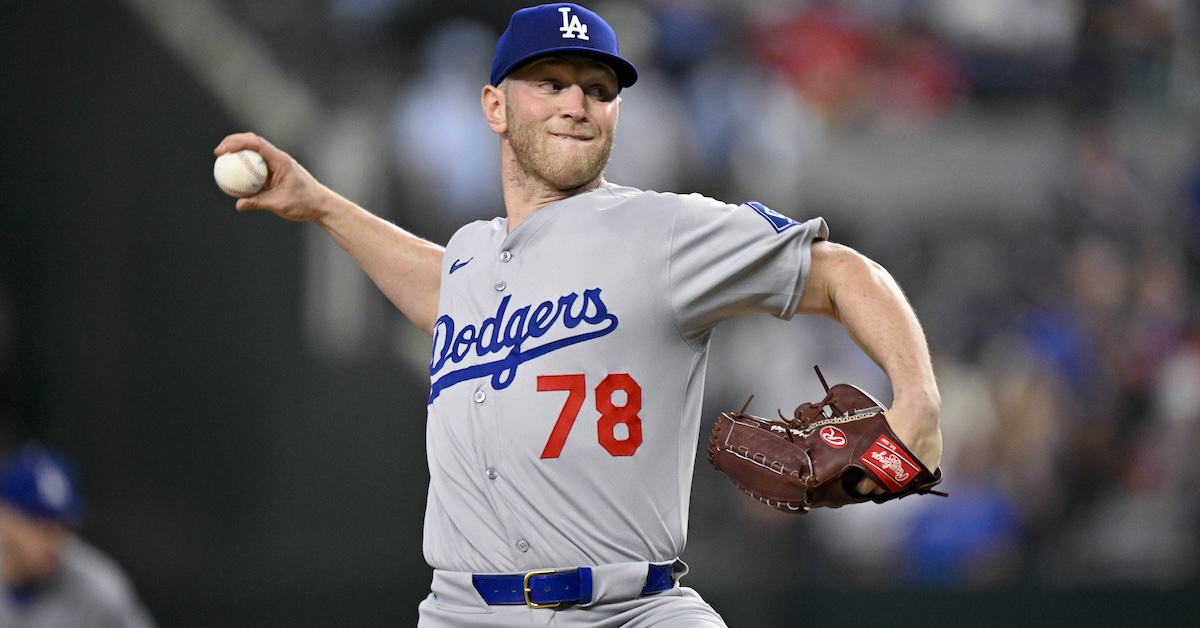
About six weeks ago, Eric Longenhagen published his Dodgers Top Prospects list. It ran 51 players deep, and was headlined by some of the trendiest names in prospect circles: Roki Sasaki, Dalton Rushing, Zyhir Hope. Down at no. 24, headlining the 40 FV group, was a blurb that started with the following phrase: “Low Leverage Ben.”
Ben Casparius is a bulk reliever. He is now what the fifth starter in a four-man rotation was 40 years ago. Most baseball fans know him as the rookie who got called on to make a spot start in Game 4 of last year’s World Series. He’s the guy you call on when Yoshinobu Yamamoto, Jack Flaherty, and Walker Buehler have all taken their turns in the rotation, and Clayton Kershaw is hurt. And so is Tyler Glasnow. And Tony Gonsolin. And Bobby Miller. And River Ryan. And Gavin Stone. And Emmet Sheehan. And (ironically) Kyle Hurt. And Shohei Ohtani, or half of him, anyway.
I guess when you’re in the double digits on the Dodgers’ starting pitcher pecking order, getting “Low Leverage” as a nickname is an occupational hazard. But I don’t like it. Mostly because it’s one short of the three-beat alliteration that made “Late Night LaMonte” roll off the tongue so felicitously. (My condolences to LaMonte Wade Jr. on his recent DFA.)
But also because it’s not true.
Before Wednesday’s games, there were 187 qualified relievers in major league baseball. Casparius is 129th in pLI (average leverage index), but 74th in gmLI (leverage index when entering the game). All due respect, that’s medium leverage. And despite having a short stick to push with, Casparius is 16th among relievers in WPA, two spots ahead of Ryan Helsley.
That’s because Casparius has been really good this year. Out of those 187 qualified relievers, he’s 29th in K-BB%, third in FIP, and second — SECOND — in WAR. WAR comes in such small increments that it doesn’t always (or even all that frequently) paint a comprehensive picture of reliever performance. But the top of this year’s leaderboard is a list of closers and elite one-inning setup men having great years. Plus the Dodgers’ no. 12 starting pitcher.
| Name | Team | WAR | Notes |
|---|---|---|---|
| Robert Suarez | SDP | 1.4 | League leader in saves with 19 |
| Ben Casparius | LAD | 1.2 | Some guy |
| Cade Smith | CLE | 1.1 | Hipster choice to displace Emmanuel Clase |
| Randy Rodríguez | SFG | 1.1 | K-BB% of 36.5; best in baseball by a mile |
| Josh Hader | HOU | 1.0 | Top five in K%, opp. AVG, WHIP, WPA, saves |
| Andrés Muñoz | SEA | 0.9 | League leader in WPA and gmLI |
If I needed three outs in the ninth inning of a World Series game, I don’t know that Casparius would show up near Muñoz or Hader or Suarez on my list of guys to call. But in 39 innings this year, Casparius has struck out 44 batters and walked just seven. He’s allowed an opponent batting average of .193 and just a solitary home run. His ERA (2.54) is right in line with his xERA (2.53) and actually almost a run worse than his FIP (1.69).
I won’t bore you with a granular rundown of Casparius’ advanced numbers — you all know how to find Baseball Savant — but he’s missing bats, he’s getting opponents to chase, he’s avoiding hard contact… I don’t know what more you’d want from a reliever. I feel pretty comfortable saying he’s more than bullpen filler.
Apart from Casparius’ unexpectedly good statistical record, two things about him are of interest to me: First, how he’s doing it. Second, how the Dodgers are using him.
Casparius throws from a high three-quarters arm slot, with a downward arm stab that keeps the ball behind his body. With nobody on base, he also takes a big step toward first base and drags his foot all the way across the rubber over the course of his windup. It’s an odd motion that gives him the sense of pitching in 3/4. I’ll show you what I mean here.
If I couldn’t show you that video, I would’ve said that Casparius’ pitching motion is one part Tommy Hanson and two parts Viennese waltz. (Feel free to disagree on that comparison; I only watched one season of So You Think You Can Dance.)
After all that rigmarole come four pitches: a four-seamer, a cutter, a sweeper, and a curveball. Both breaking balls have above-average movement in both directions; righties see more of the sweeper than all other pitches combined, while lefties see a mix of all four of Casparius’ offerings, with more curveballs than sweepers.
The sweeper is devastatingly effective, and it’s helped Casparius hold same-handed hitters to a .145/.163/.205 batting line this year. I was intrigued that Casparius can get lefties out without a changeup or a splitter — or even a sinker, or any pitch with significant arm-side movement — and if there’s a weakness for Casparius, that’s it. Nevertheless, left-handed hitters are hitting .262/.318/.344 against the righty, so it’s not a fatal weakness yet.
As good as the sweeper is, Casparius is dining out on his two-fastball pairing. He’s one of only three pitchers in baseball who has thrown two fastball types 100 or more times this year, with an opponent wOBA under .250 for both.
That’s because each pitch is a little weird. The four-seamer has top-of-the-scale rise, but almost no arm-side run. The cutter, meanwhile, has poor vertical movement but four extra inches of glove-side movement compared to cutters of similar velocity. In other words, when a hitter faces Casparius, the cutter goes right when it’s supposed to go up, and the four-seamer goes up when it’s supposed to go left.
It seems like the most obvious thing in the world for someone in the Dodgers organization to show Casparius how to throw a changeup, and stretch him out into a starter. He’s on pace to throw about 100 innings this year, with a FIP of 1.73. If he could do that over 180 innings, he’d win the Cy Young Award.
Instead, Casparius has made just one start this year, with his other 36 2/3 innings coming across 19 relief appearances. Only A’s righty Mitch Spence has thrown more innings out of the bullpen this year; only Spence has more relief appearances of four or more outs, and only Spence and White Sox righty Mike Vasil have more relief appearances of at least six outs.
The Dodgers need the innings. They currently have seven starting pitchers and eight relievers on the IL, including six starters on the 60-day IL. That doesn’t count Ohtani, who’s running out there bashing dingers every night from the DH spot but hasn’t thrown a pitch in a professional game since August 2023.
Ohtani was already injured when he joined the Dodgers, so you can’t blame his absence on an organizational profligacy with the connective tissue of the arm. But the other guys… yeah, the Dodgers have a reputation for struggling to keep their guys healthy.
Can you name the pitcher who led the Dodgers in innings last year? Or here’s a better way to put it: How many guesses would you have needed to get to Stone?
Last year’s Dodgers had just two pitchers — Stone and Glasnow — throw 100 or more innings, the fewest ever for a pennant-winning team in a non-COVID-shortened season. (Both pennant winners in 1981 had four such pitchers; both World Series contestants in 1995 had five.) They were the third World Series-winning team that didn’t have a single pitcher qualify for the ERA title, and the only one that didn’t get a pitcher to 90% of the innings threshold.
Fortunately (I guess), the Dodgers know this is a problem, and compensate. Even with an entire rotation-and-a-half in the infirmary, the Dodgers still don’t really need to use Casparius in the rotation. In the bullpen, however: Kirby Yates, Blake Treinen, Brusdar Graterol, Luis García, Michael Kopech, and Evan Phillips are all on the IL, and Tanner Scott has been awful. That’s not just seven names — all of them with a recent history of high-leverage performance — it’s something like $50 million in salary. Even the Dodgers need bulk to make up for that.
So how do you get that kind of bulk out of one guy? You throw him more than one inning at a time, and not necessarily at the end of the game. Casparius has made 19 relief appearances this year to date; he’s entered the game after the sixth inning just five times, and after the seventh inning just twice. And in 15 of those 19 occasions, the Dodgers were either leading or trailing by two or fewer runs when Casparius took the mound. Casparius entered another game to lead off the bottom of the sixth with the Dodgers ahead three runs, and another with a runner on first and two outs in the sixth with the Dodgers up four. So only twice in 20 appearances (including that lone start) has Casparius come in to pitch with the outcome already decided.
This reliever usage pattern is one of a thousand things I’ve been thinking about since I got Bill James’ New Historical Baseball Abstract for Christmas when I was in middle school. Therein, James wrote an essay criticizing the one-inning closer role as an inefficient use of a relief ace; such a pitcher would give a team more bang for its buck if used more frequently at any point in the second half of the game, when the score was close in either direction — not just to protect a lead.
Sabermetric orthodoxy quickly solidified around something like this idea, culminating in Terry Francona’s bullpen usage in the 2016 playoffs: with Cody Allen as a traditional three-out closer, and Andrew Miller as an all-purpose multi-inning stopper in high leverage. College closers are also expected to go multiple innings and appear in high-leverage moments earlier in the game, but that usage is easier to navigate when you play four or five times a week and not six.
Obviously, that’s a couple notches richer than how Dave Roberts has been using Casparius. But this multi-inning medium-leverage mid-game relief role is one I’m delighted to see in real life, because whenever I’ve gotten into a baseball video game, I’ve isolated a reliever to use in this fashion. I mentioned this last summer when I wrote about 2003 All-Star Lance Carter, my 23-game winner in MVP Baseball 2005 for GameCube. (I also had an OOTP save years ago where Wilmer Font went 31-0 in a 130-inning relief season.)
A pitcher who’s used like Casparius (currently 4-0) could rack up tons of wins. In 2023, Mike Baumann was the Orioles’ designated down-one-run-after-five-or-six guy and ended up going 10-1 with some pretty unremarkable rate stats in nowhere near the volume Casparius is on track for.
Casparius is currently on pace for 95 relief innings, which would be the most for a reliever since… Ryan Yarbrough last year. Mostly for the Dodgers. I confess I was hoping for a more impressive and/or obscure name there.
A strict two-innings-every-three-games regiment would get Casparius over 100 relief innings; a feat that’s only been achieved seven times in the 21st Century by six different pitchers, three of whom were named Scot or Scott: Scott Sullivan, who did it twice, Scot Shields, and Scott Proctor. (Yarbrough is also on this list, in his capacity as the original bulk reliever behind the opener for the Rays in 2018.)
I think this is going to be the next trendy thing in relief pitcher usage: the two-inning guy for the middle third of close games. It makes too much sense; starters don’t go deep in games anymore, and one-inning guys can be unreliable. There’s a need for a bridge pitcher, and that role gets the most out of guys like Casparius, who might lack the zip required to close but would also struggle to turn over a lineup more than once. A generation ago, that kind of pitcher could make a living as a spot starter, but not anymore.
I suppose this is what the spot starter looks like in 2025. And the Dodgers have a good one.
Michael is a writer at FanGraphs. Previously, he was a staff writer at The Ringer and D1Baseball, and his work has appeared at Grantland, Baseball Prospectus, The Atlantic, ESPN.com, and various ill-remembered Phillies blogs. Follow him on Twitter, if you must, @MichaelBaumann.
Shoutout to the stopper role in OOTP. Quinn Priester has been clutch for me there in past years
I think you’re underrating how good Casparius has been/is
I’ve thought for awhile that the 300 game winner isn’t dead. Not because some starter is going to come in and win 18-20 a year for 10 years with some filler at the beginning and end of his career. It’s going to be a guy like Casparius coming in 50 times a year to throw 2-3 innings and winning 20+ for 10-15 years. Pitch counts keep going down. Shane Smith has been fantastic this year but the Sox haven’t let him throw more than 91 pitches. If pitch counts settle in around 80 (which is what it looks like it’s heading toward to me), that’s going to be a lot of starts of fewer than 5 IP and a lot of Ws for relievers like Casparius to pick up.
I keep waiting for some manager (who doesn’t have a bunch of horses to make a traditional staff work obviously) to come in and go with the old Bill James suggestion of a 4 man rotation with a cap of 75 pitches or 5 IP, whichever comes 1st.
(BTW, James was not suggesting that as an optimal strategy but as something different that somebody ought to try since the traditional notion of a starter is outdated with its roots in the origin of the game 150 years ago when guys threw 400+ IP regularly).
(BTW2, yes, I know it has been tried a couple times in the last 30 years. Tony LaRussa tried it with the A’s in the mid-90’s and basically had his players revolt on him and abandoned it pretty quickly. Then Clint Hurdle tried it with the Rockies maybe 15 years ago – his problem was he had literally no good pitchers. It wouldn’t have mattered what strategy he tried.)
Or maybe try 3 sets of 3 guys every 3 games. Each guy throws 3 IP every 4th day. That leaves 3 extra guys to either rotate in or fill in if someone struggles or still keep a closer for the 9th.
BTW, Casparius probably has some regression coming. He has never shown this kind of control in the minors.
Really happy for Ben and his family. Nice to see a local kid in the majors!!
Totally missed the opportunity to title this “This Is the Dawning of the Age of Casparius.”
(My fellow managers in two of my Strat-O-Matic leagues were treated to a rendition of this when I drafted Casparius this spring.)
It’s struck me for the last half-decade that it really doesn’t make sense that we force pitchers into such narrow roles (starter or SIRP, plus the occasional mop-up guy taking down bulk innings but not really being used as “weapons”).
The goal for any pitcher should be how to get the most out of them, balancing the value of having them take down as many outs as they’re capable of with, for some, their effectiveness in short bursts versus a marathon.
There are a lot of guys in the minors who can only have a deep enough arsenal to get through a lineup once (or at least the good part of it). Or who are extremely effective for 50 pitches then turn into a pumpkin. For some reason, rather than letting them flourish by allowing them to cover the exact max they can effectively pitch, too many teams make them ineffective 5th starters who struggle to qualify for wins or “give up” on them, settling for turning them into one-inning guys, even though teams need length from their bullpens more than ever.
There’s no reason bullpens shouldn’t be Swiss army knives, filled with a variety of weapons that can be deployed to cover innings in a diversity of ways. That should include guys who can cover 2 to 3 innings, pitching like they did in the minors as starters but now in relief, knowing also they can show everything they have because they aren’t going to need a second way to retire any of the hitters they’ll face.
Anyway. the ongoing hybridization of starters versus relievers — whether it be the concept of opener/bulk-guy games or 4+-inning starts followed by a series of multi-inning leverage relievers — seems inevitable, as it makes more sense to embrace the diversity of talent teams have and try to maximize it rather than having such fixed ideas about the roles for pitchers and pigeonhole all talent into those defined roles. So I’m very happy to see it trickle up to the majors slowly. (Sort of reminds me of the trickle-up of more athletic QBs in football from college to the NFL in the early 2010s, where you could see it happening at the lower levels, and it literally makes no sense for this transformation NOT to happen.)
But it sounds like this is just another version of fixed roles. I think the idea of a guy who’s really effective at 50 pitches but not 20 or 80 is a unicorn. Good starters will always be the ultimate goal of pitcher development. Tarik Skubal is unreplaceable for the Tigers. WAR doesn’t account for how he lets AJ Hinch reset his bullpen every 5 days. They are basically a .500 team without him, maybe worse. And he’s even more valuable in the playoffs.
Speaking of Mike Vasil, his luck vector is astounding.
Over 38 innings his 1.89 ERA is almost 3 runs less than his 4.77 xERA.
Easily the largest discrepancy in baseball and without a great defense behind him.
I find it remarkable how everyone uses tandem starters all over the minor leagues, with spot relievers in for an inning here and there. Down where things like pitcher health, development, and situational aptness are _the_ rules of the day, and no one cares about the egos of a multimillionaire, the cult of the nine-inning starter, or the narrative value of the flow of the game.
… and every indication is that MLB is working its way right back to this same place.
This can become known as the “Dick Drago All-Stars.”
Very smooth Mike Baumann ref