Archive for Astros

The Fringe Five: Baseball’s Most Compelling Fringe Prospects

Fringe Five Scoreboards: 2017 | 2016 | 2015 | 2014 | 2013.

The Fringe Five is a weekly regular-season exercise, introduced a few years ago by the present author, wherein that same author utilizes regressed stats, scouting reports, and also his own fallible intuition to identify and/or continue monitoring the most compelling fringe prospects in all of baseball.

Central to the exercise, of course, is a definition of the word fringe, a term which possesses different connotations for different sorts of readers. For the purposes of the column this year, a fringe prospect (and therefore one eligible for inclusion among the Five) is any rookie-eligible player at High-A or above who (a) was omitted from the preseason prospect lists produced by Baseball Prospectus, MLB.com, John Sickels, and (most importantly) FanGraphs’ Eric Longenhagen and Kiley McDaniel* and also who (b) is currently absent from a major-league roster. Players appearing on any updated, midseason-type list will also be excluded from eligibility.

*Note: I’ve excluded Baseball America’s list this year not due to any complaints with their coverage, but simply because said list is now behind a paywall.

For those interested in learning how Fringe Five players have fared at the major-league level, this somewhat recent post offers that kind of information. The short answer: better than a reasonable person would have have expected. In the final analysis, though, the basic idea here is to recognize those prospects who are perhaps receiving less notoriety than their talents or performance might otherwise warrant.

*****

Austin Dean, OF, Miami (Profile)
Selected by Miami in the fourth round of the 2012 draft out of a Texas high school, Dean appeared — when Eric Longenhagen published the Marlins list in February of 2017 — to have fallen into a sort of prospect netherspace, possessing too little footspeed and athleticism for center field but too little offensive ability to sustain a corner-outfield role. The Marlins’ assignments appeared to indicate a lack of enthusiasm, as well: after passing all of the 2016 and -17 seasons at Double-A, Dean began the present campaign there, as well.

In this case, however, Dean quickly earned a promotion, producing a strikeout rate and isolated-power mark that still rank second and sixth, respectively, among the 97 total Southern League batters to record at least 80 plate appearances. The early returns at Triple-A have been promising for a player in his first exposure to a new level. In particular, Dean’s contact skills have translated well: among batters with 50 or more plate appearances, Dean’s strikeout and swinging-strike rates place in the 91st and 97th percentile. Meanwhile, he’s produced roughly league-average power numbers. While the offensive burden of a corner-outfield role remains high, Dean could probably survive with slightly less power on contact than most given his bat-to-ball skills.

Read the rest of this entry »


The Astros Aren’t the Only Team Whose Pitchers Are Adding Spin

Last week, Trevor Bauer neither confirmed nor denied having made a point about how foreign substances can increase spin rate.

Bauer wants the sport either to enforce rules against pine tar and other illegal, tacky materials used by pitchers (that’s about impossible, as Bauer acknowledges) or make grip-enhancing legal. While employment of a foreign substance resides outside the rules, there is little enforcement of those rules unless they are openly defied.

Spin is thought to be largely an innate skill, difficult to increase dramatically. Generally, the more velocity a pitcher has, the more spin a pitcher is capable of producing. There is a relationship between spin and velocity, so if a pitcher can increase his velocity, he can reasonably expect to increase his spin rate.

There’s certainly incentive to increase spin rate, as there’s a correlation between spin and whiffs. A 300-rpm improvement is equivalent to a couple percentage points of swinging-strike rate. Bauer has said he can increase his spin rate by about 300 rpms by adding a tacky substance to the throwing hand. It’s conceivable that he did something similar to prove a point during the first inning of his start last Monday:

Read the rest of this entry »


You Can’t Blame Tanking for the Lack of Competitive Teams

Tanking is a problem. Professional sports like baseball are built on the assumption that both sides are trying to win. Organizations putting forth less than their best efforts hurts the integrity of the sport and provides fans with little reason to engage. That said, the perception of tanking might have overtaken the reality of late. Competitive imbalance is not the same as tanking. Sometimes teams are just bad, even if they are trying not to be.

Tanking concerns are not new. Two years ago, just after the Astros and Cubs had turned their teams around, the Phillies were attempting to dismantle their roster by trading Cole Hamels. The Braves had traded multiple players away from a team that had been competitive. The Brewers, who traded away Carlos Gomez, would soon do the same with Jonathan Lucroy after he rebuilt his trade value.

The Braves, Brewers, and Phillies all sold off whatever assets they could. Two years later, though, those clubs aren’t mired in last place. Rather, they’re a combined 54-37 and projected to win around 80 games each this season in what figures to be a competitive year for each. While the Braves and Phillies could and/or should have done more this offseason to improve their rosters, neither resorted to an extreme level of failure, and the teams are better today than they would have been had they not rebuilt. While accusations of tanking dogged each, none of those clubs descended as far as either the Astros or Cubs. None came close to the NBA-style tank jobs many feared.

One might suspect that I’ve cherry-picked the three clubs mentioned above, purposely selecting teams with surprising early-season success to prop up a point about the relatively innocuous effects of tanking. That’s not what I’ve done, though. Rather, I’ve highlighted the three teams Buster Olney cited by name two years ago — and which Dave Cameron also addressed — in a piece on tanking.

Read the rest of this entry »


Trevor Bauer Might Have Conducted an Experiment

CLEVELAND — In case you’ve not been logged into your social-media account in the past several days, Indians pitcher Trevor Bauer has been outspoken about rampant use of pine tar (and other grip-aiding substances) in the game.

Bauer’s position is basically that the playing field ought to be level: either MLB better enforces the pine-tar rule or it makes grip-aiding substances legal. And Bauer knows it would be about impossible to enforce the current rule. Bauer says he has tested pine tar in a lab setting and said it significantly increased his spin rate. He claims it has a greater effect than steroids on performance.

“I’ve melted down Firm Grip and Coca-Cola and pine tar together,” Bauer told reporters Wednesday. “I’ve tested a lot of stuff. At 70 mph, when we were doing the tests, spin rates jumped between 300–400 rpm while using various different sticky substances. The effect is slightly less pronounced at higher velocities — more game-like velocities — but still between 200–300 rpm increase.”

As many in this audience are aware, the greater the fastball spin rate, the more “rise” effect the pitch has, the more it resists gravity, the more swing-and-miss it generates. More spin equals more swing-and-miss. That’s been proven by Driveline Baseball, where Bauer trains, and FanGraphs’ own Jeff Zimmerman.

There is incentive to add spin. And now with Statcast and its TrackMan Doppler radar component in all major-league stadiums, pitchers have had the ability to measure their spin to better understand some of the underpinnings behind their performance in game environments.

Read the rest of this entry »


The Astros Just Did Something Pretty Special

The Astros allowed eight runs to the Angels and lost on Tuesday night, thus falling out of first place in the AL West. At this time of year, none of that is a big deal, but what’s noteworthy is that the eight runs surrendered were as many as the defending world champions had given up in their previous seven games combined. The barrage, which included two homers by Andrelton Simmons and one by Mike Trout, broke an eight-game streak in which the Astros had allowed two runs or fewer, the longest in the majors in nearly three years, and put a dent in what has been one of the most stifling early-season run-prevention acts in recent history. You may have heard: these guys are still very, very good.

The Astros’ two-or-fewer streak actually began with a loss, in this case a 2-1 defeat to the Mariners on April 16, but they rebounded with a vengeance, outscoring Seattle 20-4 over the final three games of that series, all of them victories, then allowed just two runs during a three-game sweep of the White Sox. Monday night’s 2-0 loss to the Angels ended their winning streak but kept the prevention streak alive, albeit for just one more day.

According to the Baseball-Reference Play Index, the Astros’ eight-game streak of preventing two or fewer runs tied four other clubs for the second-longest of the post-1992 expansion era:

Longest Streak, Two or Fewer Runs Allowed, Since 1993
Team Start End Games W-L
Astros 8/18/15 8/26/15 9 7-2
Astros 4/16/18 4/23/18 8 6-2
Nationals 6/19/15 6/28/15 8 8-0
Pirates 9/16/14 9/23/14 8 7-1
Diamondbacks 8/9/02 8/17/02 8 8-0
Braves 9/4/93 9/11/93 8 7-1

The 2015 edition of the Astros — the one that marked their return to contention — posted the longest such streak since 1992 (Pirates, July 30-August 8), holding the Rays, Dodgers and Yankees to two runs or fewer in nine straight games. The 1982 Cardinals also had a nine-game streak; you’d have to go back to the 1974 Orioles (August 29 to September 7) to find a 10-gamer. Even at eight games, what the Astros just did was pretty special.

Read the rest of this entry »


FanGraphs Audio: Eric Longenhagen Has Good Information

Episode 810
Eric Longenhagen was told by a source before publishing his Astros list that right-hander Josh James, a former 34th-round pick and generally obscure prospect, had been recording higher fastball velocities in camp. Given James’ age and modest numbers as a professional, Longenhagen omitted him from the Astros list anyway. In the meantime, however, James has cobbled together one of the best starts in all the minors. Should it have been obvious? Would Longenhagen do anything differently? Those are questions the host of FanGraphs Audio fails to ask explicitly.

Don’t hesitate to direct pod-related correspondence to @cistulli on Twitter.

You can subscribe to the podcast via iTunes or other feeder things.

Audio after the jump. (Approximately 51 min play time.)

Read the rest of this entry »


The Astros May Have Another Ace

Last month in a piece for ESPN Insider, I was tasked with predicting what players might benefit from a change of scenery.

In that piece, this author cited a 2016 paper titled “Turning up by Turning Over” published in the Journal of Business Psychology, which studied 712 players who changed teams in the major leagues from 2004 to -15. The study concluded there are benefits for certain players in changing teams, particularly players that had been in decline. The study asserted there is a real change-of-scenery effect.

Maybe this effect is really just regression to the mean, teams acquiring players after down years. But there is perhaps something to be said for the energy and clean slate of a new environment. There’s also something to be said for being exposed to new ideas and colleagues. While Craig Edwards noted earlier today that the Pirates may have a new emerging ace, their former No. 1, Gerrit Cole, was one of the players I included in my piece about changes of scenery. I wasn’t alone in the belief, as many suspected, that he could benefit by moving to Houston.

And through two starts, the Astros, a team with an overwhelming collection of talent and a 100-win projection, look like they might be developing the last thing the rest of the American League wanted to see: another front-line pitcher.

Read the rest of this entry »


The Four-Man Outfield and Position-Less Baseball

One could argue that the first great, widespread data-based departure from tradition this century was the infield defensive shift. Based upon opponents’ batted-ball tendencies, teams more and more began to align their infielders where opposing hitters directed baseballs.

And while one defensive alignment trend, infield shifts, might have peaked, another radical alignment phenomenon seems poised to be adopted more widely.

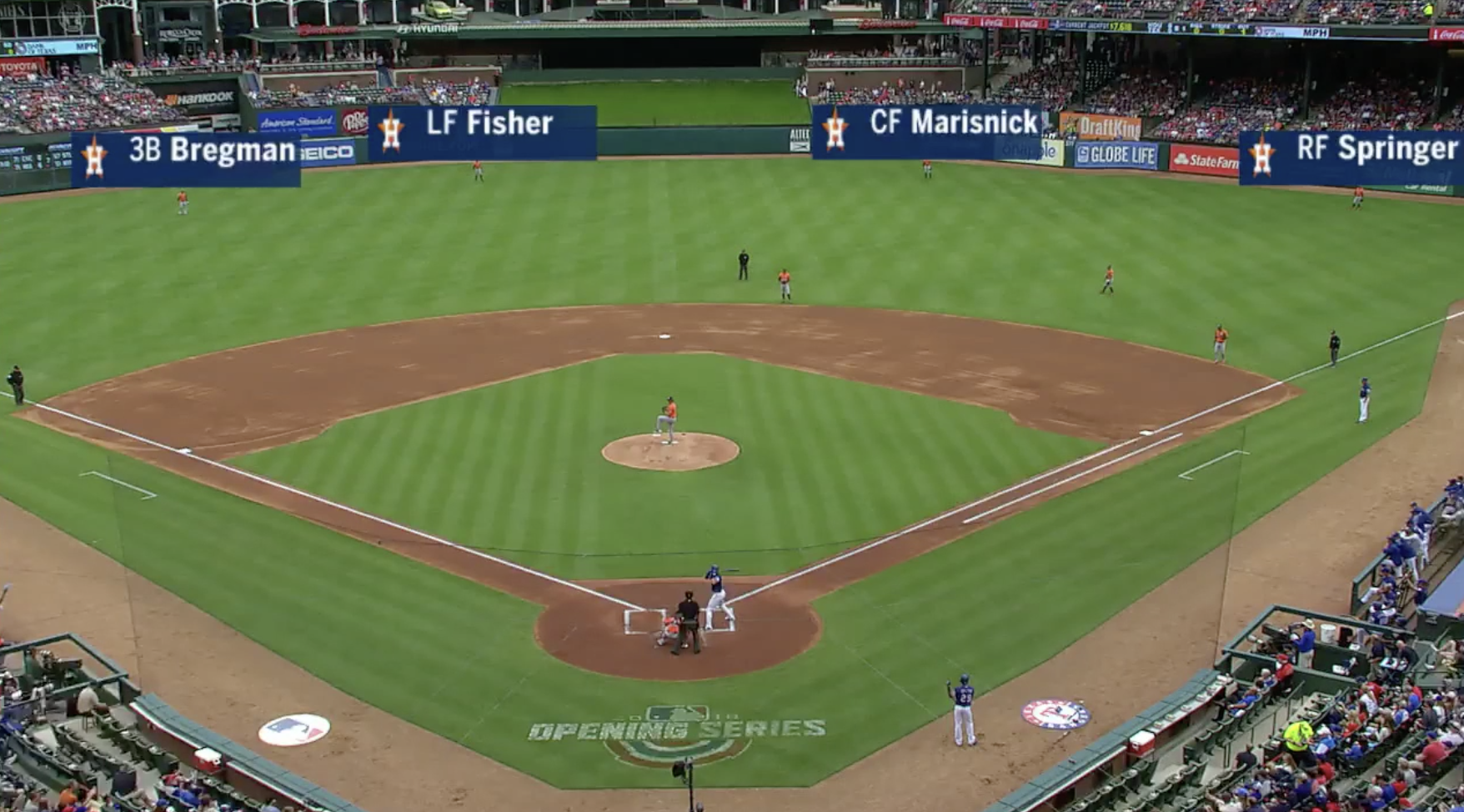
During the opening week, we saw the Astros give us this alignment versus Joey Gallo:

Over the last decade, we’ve seen four-man outfields on a rare occasion. But I’m not sure there has ever been a defensive alignment where only one non-pitcher or non-catcher was standing on the infield dirt. Only Astros first baseman Marwin Gonzalez had his cleats in the Arlington, Texas infield skin. Now that’s extreme.

Read the rest of this entry »


More Than You Wanted to Know About Opening Day Starters

Few pitchers have started more consecutive Opening Day games than Felix Hernandez.
(Photo: Keith Allison)

On the heels of a pair of injury-shortened seasons, it was a rough spring for Felix Hernandez, who was drilled by a line drive in his first Cactus League start. Fortunately, he bounced back in time to build up his pitch count, and when he takes the mound tonight for the Mariners at Safeco Field, he’ll claim a little slice of history.

Hernandez will be making the 11th Opening Day start of his career, putting him into a tie with CC Sabathia for the lead among active pitchers, and the 10th-highest total since 1908, as far as the Baseball-Reference Play Index now reaches. He’ll also be making his 10th consecutive Opening Day start, moving him into a tie for fourth place with Hall of Famers Walter Johnson and Steve Carlton as well as Roy Halladay.

Read the rest of this entry »


Jose Altuve Signs Updated Joey Votto Deal

Unless another major deal comes out in the next few weeks, the Houston Astros have signed Jose Altuve to the biggest contract of the winter. The deal is notable for several reasons.

  1. Under his previous contract, Jose Altuve would not reach free agency for another two years, after the 2019 season.
  2. Jose Altuve’s agent is Scott Boras, and he has long been loathe to give away any free-agent years ahead of free agency.

As Travis Sawchik noted last night, Altuve will reportedly sign for five years and $151 million, and the contract will begin after Altuve’s current contract runs out. Altuve will earn just $12.5 million over the next two seasons in one of the biggest bargain contracts baseball has ever seen. While he wasn’t all that good when the Astros signed him back in 2013, Altuve has been one of the best players in baseball since 2014, with his 24 wins third to only Mike Trout and Josh Donaldson among position players in that span. Altuve just finished off a fantastic MVP season for the World Series champions, and historically, he’s on one of the better runs for a second baseman in history. The table below shows second baseman since 1947 through their age-27 seasons.

Best Second Baseman at 27
Name Team PA HR SB wRC+ WAR
Bobby Grich Orioles 3344 70 77 132 33.6
Roberto Alomar – – – 5064 77 296 118 31.2
Willie Randolph – – – 4178 25 180 110 29.7
Chuck Knoblauch Twins 3857 34 214 116 27.4
Jose Altuve Astros 4311 84 231 124 26.2
Lou Whitaker Tigers 4042 52 76 108 26.2
Joe Morgan Colt .45’s 3920 61 195 123 25.3
Dustin Pedroia Red Sox 3201 75 82 121 24.7
Rod Carew Twins 3641 29 99 123 23.9
Ryne Sandberg – – – 4034 90 210 108 23.7
Edgardo Alfonzo Mets 3887 104 39 113 23.7
Paul Molitor Brewers 3479 60 190 114 21.6

Five of the 11 non-Altuve players on that list are in the Hall of Fame. Grich and Whitaker, meanwhile, represent some of the biggest snubs of the last half-century, while Pedroia remains active still building a case.

When the Twins signed Logan Morrison to a deal for $6.5 million, most agreed it was a bargain. By comparison, the Astros have the reigning MVP locked up for that price in his prime for the next two seasons. That leads to obvious questions regarding the Astros’ motivation here. Why sign a player to an extension before it is necessary? Anyone who remembers the Ryan Howard contract, for example, might look at this extension and wonder if it’s simply a gift from the Houston front office.

This is not a gift, though. It’s a fair deal.

Read the rest of this entry »