Archive for Daily Graphings

Sunday Notes: Revere, Hutchison, Ortiz, Chemistry, more

Ben Revere puts the bat on the baseball. His 4.0 swinging-strike% is fourth lowest among qualified hitters, with only Michael Brantley, Daniel Murphy and Ben Zobrist whiffing less often. His 97.2 Z-Contact% is topped only by Murphy’s 97.7.

Putting balls in play is working out well for the left-handed-hitting former Phillie. Revere is hitting .342/.390/390 since joining the Blue Jays at the trade deadline, and last year he led the National League with 184 hits.

Revere has a low walk rate – 5.5% – but not because he lacks discipline. His Z-Swing% is 58.4, which is 12th lowest among qualified hitters. Speedy and lacking power, he isn’t a hitter you want to issue free passes to.

“I’m not going to get pitched around,” Revere told me last weekend. “Pitchers are like, ‘Don’t let this guy get on with an easy ticket, ’cause he ain’t gonna beat you with the long ball.’ Whether it’s off-speed or fastballs, they’re going to go straight at me.”

Revere went deep yesterday for just the fourth time in over 2,500 big league plate appearances. He was told to hit the ball the other way coming up through the Twins system, and his approach has essentially stayed the same. Read the rest of this entry »


JABO: The Cardinals Have Been Historically Clutch

Thursday night, the Cardinals got thumped by the Reds, 11-0. Bad game. One of those games you just toss out and move on from. You might wonder what this has to do with clutch.

Conveniently, Thursday night, the Cardinals found themselves in basically zero clutch situations. For something a little more representative, consider Wednesday’s game, against the Cubs. Nine outs into the game, the Cardinals trailed 3-1. From there, they yielded no more runs; from there, they scored three more, all in the bottom of the eighth. In that way, the Cardinals won a game in which they were out-hit 11-5. They won a game in which they were out-OPSed .650-.526.

The Cardinals haven’t made a habit of that, exactly, but it gets at the idea. As I write this, the Cardinals have the best record in baseball, by a handful of games. Odds are pretty good they’ll reach or clear 100 wins. It makes sense that they also have the best run differential in the National League. Yet, interestingly, we can also consider OPS differential. By that measure, the Cardinals rank fifth in baseball, between the Pirates and the Yankees. That’s still good, obviously, but there’s something going on in between those numbers and the actual team record. Something that’s made the Cardinals look even stronger.

That something is clutch performance. The Cardinals have been clutch, far more clutch than any other team. It’s admittedly a difficult thing to quantify. And, admittedly, there are multiple definitions of “clutch.” The definition being used here is putting on a particularly good performance in pressure situations. You could think of the Cardinals as having had wonderful timing. It’s lifted their record above what you’d expect.

Read the rest at Just A Bit Outside.


A Look at the Comeback Player of the Year Award

In years past, I’ve looked at players who might win the Comeback Player of the Year Award. I don’t know why, but I just like this award. It sort of gets lost in the shuffle of awards season. It’s usually a feel-good story. I’ve felt like it is interesting to put some statistical context to the award. This year is no different. I never did last year’s post, but I did this in 2011, 2012 and 2013.

The methodology remains the same as it did in previous iterations. From the 2013 post:

Just like last year, the criteria is a player who posted 2.5 WAR or less last year, and has posted at least 1.0 WAR this year. Then I cull the list. The general standard is for a player to have roughly 2.0 more WAR this year than last, but this year I’m making an exception for catchers (roughly 1.5 WAR) and relief pitchers (roughly 1.0 WAR), as WAR may not be as fair to them as it is to others.

From there, we have to decide who is really making a comeback. Sometimes, guys just make the leap, or were never really good to begin with. But first, some honorable mentions.

Read the rest of this entry »


Erasmo Ramirez and Identifying Ideal Strike-Stealing Pitches

Talking to Erasmo Ramirez is refreshing. He always has a smile on his face. Life is fun for him — especially now. He’s having the best season of his career in Tampa Bay. It turns out that changing the use of his slider has been a big part of that success. And certain aspects of his slider may provide a roadmap for other pitchers that should make the same move.

His best pitch is his changeup — “it’s the best one to take me out of troubles,” the pitcher admitted to me — but it’s not good enough to throw every single time. “I try to stay away from it, and show the hitters I’m going to throw every pitch I have in my arsenal,” Ramirez said of his pitching mix.

ErasmoChange
The grip for the change thrown by Erasmo Ramirez, which has the seventh-best swinging strike rate in baseball (min. 400).

The breaking balls haven’t been great. Even as Tony Blengino waxed positively on the pitcher recently, he admitted that “his breaking balls needed reps” coming up. Ramirez this year has been using his curve less (“I’ve been trying to stay away from it, unless I have it rolling.”) but a key change in his slider usage has been huge.

Read the rest of this entry »


Who Is the Real Taijuan Walker?

It’s been a rocky, inconsistent year for the Seattle Mariners, for whom much was expected by many. They are likely to finish more than a couple games below .500, comfortably out of the very attainable second wild-card position. The stunted development of many of their young, homegrown players, including Mike Zunino and the since departed Dustin Ackley, was a major factor. Early on, it looked like Taijuan Walker, who just recently turned 23, was part of the problem. Around Memorial Day, he began to look like part of the solution. Which version of Walker is the one we can expect to see moving forward?

I was a member of the Mariner front office in 2010, and had extensive involvement in the amateur draft. We did not have a first-round selection that year, but did possess a sandwich-round pick, received as compensation for the loss of Adrian Beltre. As one might expect, our draft board was shot full of holes as our turn approached. We thought very highly of Walker; he was in the top 15 of our board. He was joined there by a couple of other righ-handed pitchers, Aaron Sanchez and Asher Wojciechowski, followed by a bunch of blank spaces where other draft magnets had once resided. The Blue Jays had a bunch of compensation picks that year, and selected both of those guys before our turn arrived.

We were thrilled to select Walker. Great athlete, multi-sport star, easy velocity with feel for his curve ball, very few miles on his arm. As an added bonus, he didn’t turn 18 until August of his draft year. When you’re dealing with a projectable high school athlete, in particular, those few months are actually a pretty big deal. The product of Yucaipa HS in Southern California wasn’t a sure thing, with little track record to speak of, even by high school standards, but the raw materials suggesting potential stardom were certainly in place.

He dominated from the get-go in the minors, breaking camp at full-season Low-A Clinton in his first full pro season. Each year, I compile my own ordered minor-league lists of top full-season-league position-player and starting-pitcher prospects based on performance and age relative to league and level. These basically serve as follow lists, with the orders then tweaked based on traditional scouting methods. Walker ranked in the top 20 in each of his four minor-league seasons, peaking at #7 following the 2013 season. This combination of upside and consistency marked him as a likely major-league star.

Read the rest of this entry »


Let’s Try to Make Sense of J.A. Happ

One of my favorite parts of the trade deadline happened right at the deadline itself. As the deadline passed, a Mariners writer or two tweeted out that no trades had been made. Then, a few minutes later, it was announced that J.A. Happ had been traded to the Pirates. It happened suddenly, and it arguably only happened because A.J. Burnett had gotten injured. There were never any Happ rumors to speak of; the MLB Trade Rumors archive doesn’t show anything. Happ was essentially unwanted and mediocre. I forgot who he was traded for, so I looked it up, and I’ve forgotten again. Deadline additions don’t get much less sexy than this.

But sometimes the present doesn’t give a crap about the past. Since getting traded to the Blue Jays, David Price has been worth 1.8 WAR. Makes sense; he’s an ace. Since getting traded to the Pirates, J.A. Happ has been worth 1.4 WAR. Makes less sense. All the other traded starters have done worse. Johnny Cueto’s done worse. Cole Hamels has done worse. Scott Kazmir has done worse. They’ve all done worse. I just came across an article a few minutes ago suggesting that maybe Happ should start the Pirates’ wild-card game. That’s insane, but it still speaks to how shocking this has been. Happ has pitched like a valuable pitcher, after the Pirates got him for basically nothing. Baseball’ll get ya.

So you know what the next section is. The next section is: what? What is this? What do the Pirates have J.A. Happ doing? I’ll do my best to try to explain.

Read the rest of this entry »


What Can We Make of Francisco Lindor?

About a month ago, I asked whether Carlos Correa might’ve already become baseball’s best shortstop. Correa got off to a wonderful beginning, with positive signs all over, while there were indications that Troy Tulowitzki was down a step or two. Nothing now has changed about my evaluation of Correa, as I still think he’s fantastic, but if you just look at the numbers, Correa might not even be baseball’s best shortstop rookie. In basically identical playing time, Correa finds himself a hair behind Francisco Lindor in WAR. In the second half alone, Lindor’s posted a WAR of 3.0, tied with Bryce Harper and fourth overall among position players. The defense, as expected, has been there. Lindor is a gifted defensive shortstop. But he’s also been hitting, after a cold first few weeks. This was less expected.

It’s a reason why the Indians are hanging around the fringes of the wild-card race. Not that they’re likely to get there, but they are mathematically alive, with an improved roster that deserves better than its standing. Lindor is at the middle of the Indians’ little surge, and given his emergence, it’s time we take a look at his abilities. In a short amount of time, the 21-year-old has flashed his whole skillset.

Read the rest of this entry »


JABO: The Transformation of Matt Carpenter

Over the last few years, Matt Carpenter developed into one of the game’s most underrated stars by exceeding at the skill set embodied by the likes of Mark Grace and Joe Mauer over the last few decades; be extremely selective at the plate, rarely strike out, hit a ton of line drives, and create value through elite levels of walks and doubles.

From his rookie season of 2012 through the end of last season, no one in baseball took a higher percentage of pitches than Carpenter, and he ranked 14th overall in contact rate when he did offer at a pitch in the strike zone. Carpenter’s unwillingness to chase pitches out of the zone, and his ability to rarely whiff on swings in the zone, allowed him to post nearly even walk and strikeout rates in an era when pitcher dominance has become the norm. While he wasn’t a big power guy — he hit just 25 home runs during those three seasons — he made up for it by posting one of the highest line drive rates in the game, which allowed him to rank in the top 10 in doubles, so he wasn’t just a slap-hitting singles machine like some other elite contact batters.

This year, though, Matt Carpenter is different.

Read the rest at Just A Bit Outside.


Cody Allen: A Cleveland Closer’s Weird Year

Cody Allen has had, in his own words, “kind of a weird year.” The Cleveland Indians closer has 30 saves and has given up just a pair of home runs in 59 innings. Meanwhile, his ERA (3.51) is nearly a run and a half higher than it was a year ago (2.07) while his FIP (1.96) is more than a full run lower (2.99). His .366 BABIP is exactly .100 points higher than it was in 2014.

Allen is aggressive. His fastball, which he throws 62.4% of the time, is averaging 95 mph. His spiked curveball, which he throws 36.7% of the time, is averaging 85.9 mph. The 26-year-old right-hander – now in his fourth season – has come out of the Cleveland bullpen 60 times in the current campaign.

Allen talked about his statistical season, and his two-pitch power mix, when the Indians visited Boston in August. Read the rest of this entry »


Jays, Mets, Royals Reaping the Rewards of On-Field Success

Television deals get a lot of publicity when it comes to looking at Major League Baseball finances. National television deals that went into effect in 2014 give MLB $1.5 billion per year through 2021, and local television deals have increased over the years providing more money to clubs to provide their product to those not physically witnessing the games. Despite those big figures, all teams still see a large portion of their revenues from doing business the old-fashioned way — putting butts in the seats.

Television revenue, particularly locally, is one way that the large-markets have a big advantage in revenues. Those same teams in New York, Los Angeles and Boston also have some inherent advantages in creating local revenue due to a larger base of potential ticket-buyers, in theory leading to higher prices and greater revenues. Teams in smaller markets likely cannot bridge that gap entirely, but they do have one option in an attempt to bridge that gap, and that is to win baseball games. The Kansas City Royals saw a surge in the standings from the get-go this season following their playoff success last year — and teams like the Pirates have also benefited from winning — but small markets are not alone in their ability to increase revenue through wins: both the Blue Jays and Mets are also seeing increases in attendance, and in turn, revenue.

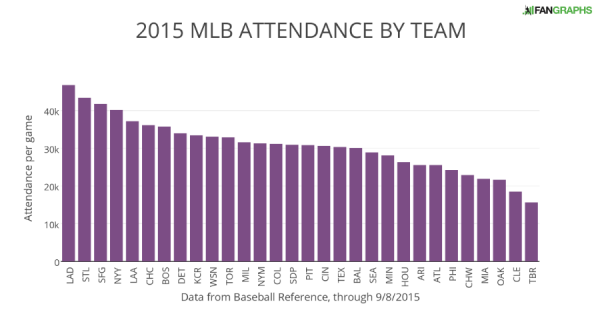
On the season, the Dodgers, with their massive stadium and fanbase, are once again leading the league in attendance, per Baseball Reference.

2015 MLB ATTENDANCE BY TEAM

Read the rest of this entry »