Archive for Daily Graphings

Jays, Mets, Royals Reaping the Rewards of On-Field Success

Television deals get a lot of publicity when it comes to looking at Major League Baseball finances. National television deals that went into effect in 2014 give MLB $1.5 billion per year through 2021, and local television deals have increased over the years providing more money to clubs to provide their product to those not physically witnessing the games. Despite those big figures, all teams still see a large portion of their revenues from doing business the old-fashioned way — putting butts in the seats.

Television revenue, particularly locally, is one way that the large-markets have a big advantage in revenues. Those same teams in New York, Los Angeles and Boston also have some inherent advantages in creating local revenue due to a larger base of potential ticket-buyers, in theory leading to higher prices and greater revenues. Teams in smaller markets likely cannot bridge that gap entirely, but they do have one option in an attempt to bridge that gap, and that is to win baseball games. The Kansas City Royals saw a surge in the standings from the get-go this season following their playoff success last year — and teams like the Pirates have also benefited from winning — but small markets are not alone in their ability to increase revenue through wins: both the Blue Jays and Mets are also seeing increases in attendance, and in turn, revenue.

On the season, the Dodgers, with their massive stadium and fanbase, are once again leading the league in attendance, per Baseball Reference.
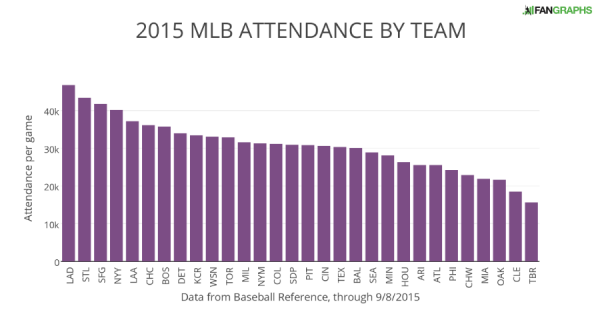
2015 MLB ATTENDANCE BY TEAM

Read the rest of this entry »


Yoenis Cespedes and the MVP Award

Lately there’s been some talk about Yoenis Cespedes as an MVP candidate. Jon Paul Morosi wrote a piece advocating for Cespedes at Fox yesterday, Richard Justice wrote a similar piece for MLB.com, and those are just the ones I saw in between cleaning up randomly placed pockets of cat vomit and carting my kids around town to their various appointments. So there might be more. Articles, not cat vomit. There is definitely more cat vomit.

To check, I did that thing where you start typing a search into Google then stop and let it suggest what you might want. Here’s what my Google suggested when I typed in “Yoenis Cespedes.”

Cespedes Google

So this is now a thing, apparently. Yoenis Cespedes: MVP candidate.

Read the rest of this entry »


Evan Gattis Is Almost Unrecognizable

I’ve written about a few changes like this lately. I wrote about Ryan Goins, whose hot streak coincided with a new unwillingness to swing the bat. I wrote about Joey Votto, whose Bonds-esque second half has come with greater discipline and a preference for very particular strikes. In Goins’ case, the analysis was done in response to improved performance. In Votto’s case, the analysis was done in response to improved performance. There’s nothing quite like that here, no red-hot offensive tear commanding broader attention. Maybe that’s still to come, but I think the observation is interesting enough regardless of everything else.

Evan Gattis is patient now. He’s not Joey Votto-patient. He’s not Matt Carpenter-patient. His patience is relative, but compared to what he’s been, this is a whole different type of hitter. As always, you have to wonder how much of this is actually nothing. Sometimes the numbers we look at aren’t reflective of any deeper truths. But this isn’t based on outcome data. This isn’t based on the usual things that bounce around. This is about swinging. Hitters who like to swing will swing; hitters who like to wait will wait. Gattis has been a swinger. Now Gattis is more of a waiter. This is interesting because of how unexpected it has been.

Read the rest of this entry »


Where Did the Nationals Go Wrong?

The Nationals’ season isn’t quite on life support, but there’s been a bad accident, and the family’s been notified. The situation appears to be dire, and while Tuesday brought its own fresh horrors, that wasn’t the day that slaughtered the dream. It’s the most recent event, the currently most upsetting event, but the Nationals weren’t even supposed to be in this situation in the first place. They’ve had problems for weeks, for months, and now they’re about out of time to save themselves and move on to the tournament. The Mets have simply done too much. The Nationals have simply done too little.

The story would be interesting if it were any division race. What makes this one extra interesting is that it’s this division race. The Nationals were expected to run away with the NL East. The Phillies, as assumed, have been bad. The Braves, as assumed, have been bad. The Marlins had the look of being mediocre. The Mets had the look of a fringe contender. The Nationals had the look of a champion. These are our preseason odds. The Nationals were given an 86% chance to win the division. They were projected to clear the Mets by 13 games. If the Nationals won out, and the Mets lost out, the Nationals would clear the Mets by 18 games. This was supposed to be a relative cakewalk. It’s been more of a…nailwalk? I don’t know. It’s been bad, is the point.

So: why? How has this happened? Obviously, the Mets have quite a bit to do with it, but this post is to focus on the Nationals. Where did this go wrong?

Read the rest of this entry »


The Inning That Ended the Nationals’ Season

I went to a baseball game in Oakland last night. This wouldn’t have any bearing on this article if not for this: I drove to the game, and in that 30-minute drive to the stadium, the Washington Nationals went from clawing their way back into some sort of contention in the NL East by beating the Mets to looking up October beachfront condo rentals. When I got in the car, there was the prospect of an interesting September division race. When I got out of the car, poof — that was all but gone. One inning, three pitchers, six walks, and six runs after the start of the top of the seventh, the score of the game was tied at 7-7, and all it took was a home run off the bat of Kirk Nieuwenhuis in the eighth to finally sink the Nationals.

If you follow either or both of these teams, yesterday’s seventh inning was an encapsulation of how the season has unfolded. The Mets have been one of the best stories in baseball; the Nats have been 2015’s poster child for the biggest gap between performance and preseason expectations. One of the most alluring things about baseball is how large season trends can play out in the microcosm of a single inning, and so the seventh inning saw a shift in win expectancy inline with the arc of the Nationals’ season, from spring training to today:

At one point, with two out and one on in the top of the seventh, the Nationals had a 99.2% expectation of winning the game. And, while late 7-1 leads are blown in games many times during the course of an entire baseball season, when they happen in this sort of context and with this kind of futility, it’s our responsibility to break them down.

Read the rest of this entry »


Dodgers’ $300 Million Payroll Not That Crazy

Back before the 2012 season, Frank McCourt owned the Los Angeles Dodgers. He had purchased the team in 2004, inheriting a club that featured a $105 million payroll in 2003. Nearly ten years later, he sold the team to the deep-pocketed Guggenheim-led group — handing over a club that also featured a $105 million payroll. Major League Baseball revenues had doubled during McCourt’s tenure as team owner — and salaries for players increased at something close to the same rate — but the Dodgers, sitting in one of the biggest media markets in the country, stuck to the status quo after fielding one of the bigger payrolls in baseball at the beginning of the century. The Dodgers have finally caught up with the times (some would say surpassed) in terms of payroll, but while their $300-plus million payroll might seem enormous, the team would still be right in line with the New York Yankees and Boston Red Sox if those two teams had not slowed their spending in recent years.

Prior to the arrival of the Dodgers’ new ownership and $8 billion cable deal, the Yankees were the only team to exceed a $200 million payroll. The Yankees crossed that threshold in 2005, but kept their spending fairly static over the following decade, only getting above $225 million once (in 2013) and falling below that mark last season. Their total outlay on players was often somewhat higher, given the luxury-tax payments the team was forced to make every season. Given the Yankees’ spending over the last decade and the Dodgers’ spending over the last few seasons, it might appear that the luxury tax is not much of a deterrent towards spending, but as Nathaniel Grow detailed back in May, the luxury tax has kept spending down at upper levels.

Read the rest of this entry »


Hitters: Quit Chopping Wood, Don’t Go for Backspin

Around little-league parks, and even on the back fields of certain schools and organizations, you might hear a common refrain from the batting cages. “Chop wood, chop wood,” is how Bryce Harper mimics the coaches he’s heard before. The idea is that a quick, direct path to the baseball — like an ax chop — is the best way to get quickly to the ball and create the backspin that fuels the power.

Turns out, pretty much all of that is wrong.

Read the rest of this entry »


Projecting Javier Baez and Quantifying His Improvements

Taking full advantage of the September roster expansion, the Chicago Cubs called up 22-year-old infielder Javier Baez to help fortify the team’s middle-infield situation. This isn’t Baez’s first taste of the big leagues. In fact, he doesn’t even qualify as a rookie anymore. As you probably recall, he spent the final two months of 2014 season in the majors, where he turned in a historically bad performance as the team’s second baseman.

Just how bad was it? Baez hit a pitcher-esque .169/.227/.324 in 52 games with the Cubs last year. His on-base percentage was the lowest of any hitter who recorded at least 200 plate appearances. Most alarming of all was his 42% strikeout rate, which made him the only player in the game’s history to have a strikeout rate above 40% in more than 200 plate appearances.

After his strikeout woes continued into this year’s spring training, the Cubs had Baez open the year in Triple-A, and kept him there until last week. Baez hit pretty well following his demotion. In 70 games, he hit .324/.385/.527 — which was good enough for a 144 wRC+. That’s markedly better than his 108 wRC+ at the same level last year. Read the rest of this entry »


Mariner Catchers Gun for the Record Books

Let’s get right to the point. It’s not often that I use OPS instead of wOBA or wRC+, but sometimes OPS is just easier, like when you’re relying on the Baseball-Reference Play Index. OPS is the inferior statistic, but the correlation is very strong, so, with that out of the way, here are this year’s worst-hitting catchers, by team:

  • Twins, .591 OPS
  • Marlins, .580
  • Mariners, .466

I’m not one of those people who minds when commenters make note of typos. I actually appreciate it — I hate little mistakes, and I want to have them corrected. Some of you might feel like the above includes a typo, specifically with regard to the “4” in the Mariners number. I assure you, that number is very much accurate. If the 4 were a 5, the Mariners would still be in last. The 4 is a 4. This is only going to get worse.

Read the rest of this entry »


Appreciating Vin Scully Appreciating Clayton Kershaw

It’s a perfect beginning to the end of the day.
— Vin Scully, remarking on the weather prior to last Wednesday’s Dodger game

When I was about eight years old I hid under my blankets past my bedtime. I did this because it was the only way I could listen to Jon Miller call baseball games. I had a little Walkman radio that picked up WTOP out of Washington DC, and if I turned its only knob just barely past the “off” position, I could put it to my ear and be at Memorial Stadium in North Baltimore and my parents wouldn’t be the wiser. Until now, I guess. Sorry, Mom and Dad! I spent many nights with Jon Miller and, in that way, I learned about baseball and fell in love with the game, the team, and the voice in equal measure. Years later, Peter Angelos bought the team and soon after fired Miller and, in doing so, ended my time as an Orioles fan. The point is, announcers matter. They are the adhesive that binds fandom to a team. And there is no better illustration of this fact than Vin Scully.

Scully began calling Dodger games in 1950 while the franchise was still in Brooklyn. That Dodger team contained a pitcher named Rex Barney. Barney would go on to become the PA announcer for the Orioles games that eight-year-old me listened to on the radio under his bedsheets. Ain’t life something? Sadly, Barney died almost two decades ago, his voice the last to grace the loud speakers at old Memorial Stadium and the first at Camden Yards. Through it all, Scully has called Dodger games. I’ve heard Vin Scully referred to as an institution, but Scully is more than an institution. Brookings is an institution, but nobody cares whether it’ll be around next baseball season or not. Scully is beloved in a way an institution is not. He makes baseball better, which, when you think about it, is no easy feat.

Scully was in the booth last Wednesday as Clayton Kershaw threw a complete game against the Giants in Los Angeles. He gave up six hits, one run, one walk, and struck out 15. It wasn’t even Kershaw’s best outing which is what makes it so amazing because for many pitchers it would easily be their best outing. If there’s anything that can enhance a Clayton Kershaw start, it’s Vin Scully. Here are his calls of each of Kershaw’s strikeouts.

Let’s listen together!*

*Note: to hear audio, place mouse on lower left-hand corner of each video and click speaker icon.

*****

Strikeout One: Angel Pagan, 1st Inning, Slider

Clayton ready and the strike one [sic] pitch on the way… check swing… they look… and swing. And Pagan tries to hold up and strikes out.

Perhaps one of the most wonderful things about listening is the certain sounds a person makes around a specific word. Scully has a way of saying the word “two” that is just wonderful. He draws out the “oo” part in a way so delicious to the ear that we don’t want the word to end.

Read the rest of this entry »