Archive for Daily Graphings

Janish Time in Cincinnati?

Between Scott Rolen, Brandon Phillips, and (mostly) Joey Votto, the Reds formed one of the best infields in Major League Baseball this season. Their cumulative performance – 16.4 WAR – ranks higher than all starting infields in the National League.

And that’s without including a shortstop. The Reds weren’t slouches at the position at all in 2010, as their shortstops combined to post 2.5 WAR. The majority of that comes from starter Orlando Cabrera, who posted 1.3 WAR this season. He didn’t do much with the stick (.292 wOBA), but his glove was a solid +3.7 UZR, consistent with a good defensive reputation and a career +45 UZR.

However, Cabrera will turn 36 in November. He suffered injuries toward the end of the season and compiled fewer than 600 plate appearances for the first time since 2005, and was removed from a playoff game due to yet another injury in the Reds’ playoff loss to Philadelphia. Now, the Reds will have to decide whether to keep him around, as Cabrera’s contract includes a $4 million mutual option for the 2011 season.

Cabrera’s poor stick, recent injuries, and moderate price tag may be enough of a reason for the Reds to decline the option and pay the $1 million buyout. If not, Paul Janish should be. Janish has posted 2.0 WAR in his first two significant stints in the Major Leagues. His bat hasn’t been anything stellar, but since his disastrous first stint in 2007 (42 wRC+ in 89 PAs), Janish has shown moderate patience and good contact. He doesn’t have much pop, and some bad luck and a fly ball heavy batted ball profile has led to low BABIPs. It is those two factors which have largely driven his poor batting lines to date.

Between 2009 and 2010, Janish compiled -15 batting runs, and that’s with a BABIP in the .260s. Despite his issues with fly balls, it’s hard to imagine Janish will continue to have such poor results on balls in play. His .260/.338/.385 line in 2010 appears to be pretty representative of Janish’s abilities, although probably with a SLG closer to .360. His minor league numbers are poor, but the two parts of his game that have played the best in the majors – walk rate and contact rate – are the quickest to stabilize. 600 plate appearances still isn’t a huge sample, but for both statistics it is above the reliability thresholds stated here.

His bat probably only plays at shortstop, but that’s not a problem for Janish. According to Baseball America, Janish has “nearly flawless footwork, soft hands and a plus arm.” UZR was insane over Janish in 2009, rating him at +11 in only half a season. That seems outrageous, but DRS and TZL nearly completely agree. He wasn’t quite as impressive in 2010, possibly due to splitting time between SS and 3B in the small sample, but he was still above average. Overall, Janish has a +12 UZR at shortstop that is supported, much like Cabrera, by a strong defensive reputation.

If Janish puts up a .260/.330/.350 line, as I think he will, he’ll need to be about a +5 SS to be an average player. This may be a slightly optimistic prediction, but there’s a very good chance that Janish will be close enough to league average that he would outplay Cabrera over a full season. The Reds should be able to find a Craig Counsell-type player to back up Janish for peanuts. Between Janish and that backup, the Reds should easily be able to replicated the production they got from the shortstop position last season at a fraction of the cost.

TBS Upgrades Postseason Coverage from Chip Caray to Dick Stockton, and Ratings Fall

We don’t often write about broadcasters on this site. The men and women who put the action into words are the ones who provide the first storyline for a game, and at their best they blend observation with insight, allowing the best moments to tell themselves. Of course, they’re usually terrible, and it’s a long, long way down from Vin Scully to Chip Caray. It’s a hard job to try to tell the game as a story that’s equally meaningful to every listener, because the baseball audience is so split between fans who really only understand the game through the lens of back-of-the-card stats like wins and RBI, and fans who hear the word “run producer” like nails against a chalkboard. And playoff baseball frequently brings out the worst commentators, usually multisport announcers who don’t have any familiarity with the teams they’re calling, and so try to mask their ignorance with lame humor or a moral high hand. As John Collins writes at Neon Tommy, “This is the time of year when baseball broadcasts should be at their best, yet the national broadcasters who get dropped in the booth make sure the coverage is at its full-blown worst.”

Back in February, Jon Sciambi, one of the better broadcasters, wrote a great piece for Baseball Prospectus about how broadcasters can bridge the gap, but it’s clear that we’re not there yet. Last fall, TBS took a ton of flack for the miscues of the gaffe-prone Chip Caray (“Line drive base hit… CAUGHT!“), and so they fired him and replaced him this year, first with regular TNT basketball analyst Ernie Johnson, Jr., and then with the aggressively bland Dick Stockton. (Like Caray, Johnson is the son of a longtime Atlanta Braves announcer, and both have called Braves games this year. Newsday’s Neil Best correctly judged Johnson an upgrade over Caray.) Their ratings have dipped nonetheless, as my colleague Maury Brown predicted back in September.

Bill Simmons has written about the terrible state and haphazard selection of announcing teams in basketball and football; he’s been complaining for a decade, but the situation has hardly improved. The problem seems to be that networks few their broadcasting teams and studio analysts as a calling card, a sort of equivalent to “the best political team on television,” when, for the most part, they’re just furniture. The New York Daily News’ Bob Raissman tactfully refers to the TBS studio analysts as “The Valley of the Stupid Gasbags.” Especially during the playoffs, when TBS and Fox are the only show in town, and even mlb.tv is only available to viewers outside the US and Canada, there’s just no choice involved in the matter.

(I ponied up for mlb.tv’s $9.95 supplemental coverage, which allows you to view the play from different angles. But it isn’t an edited television feed, it’s just the raw feeds from the various cameras. So you can’t actually watch the action of the game and see where the ball is hit. It’s kind of cool, but also incredibly disappointing — especially if, hypothetically, you’re at work during a playoff afternoon game and trying to watch it from your computer, like the World Cup or March Madness. Hypothetically.)

TBS didn’t exactly learn the wrong lesson from the Chip Caray debacle: Caray is excitable and loud and frequently yelps before thinking, which lends itself to verbal snafus. He has never been able to enhance the moment. Stockton is boring, but at least not deleteriously so. His old-school tendencies were on full display during the Braves-Giants series, when he failed to make note of Paul Emmel’s blown call on Buster Posey, and repeatedly pronounced the word “error” as “erra,” as though he were a 19th-century Brooklynite. But he has called a decent game. As Matthew Coller wrote at The Biz of Baseball:

TBS’s baseball coverage hasn’t been terrible by any stretch, it’s been exactly what we expected. It’s been regular old vanilla baseball, and minus the yellow jackets (except Craig Sager) we could have seen similar coverage in 1981. That’s how baseball is, I suppose. But, when the YES network and almost every affiliate has super slow-motion cameras, when every team has professional baseball sideline reporters and when MLB Network features more exciting analysts, we are left to wonder: Is this all as MLB on TBS will ever be?

Since Major League Baseball is committed to selling postseason games as a block to a network, we won’t see an end any time soon to the problem of national broadcasters calling local playoff games. Until we at Fangraphs can identify more rigorous metrics to determine who the best and worst broadcasters are, we’ll have to trust our own ears. And plug them whenever Tim McCarver starts to speak.


2010 Disabled List: Position Data

A few days ago, I put out the list of players that spent time on the disabled list in 2010 along with the some team data. Today, I will look at how the DL data breaks down by position.

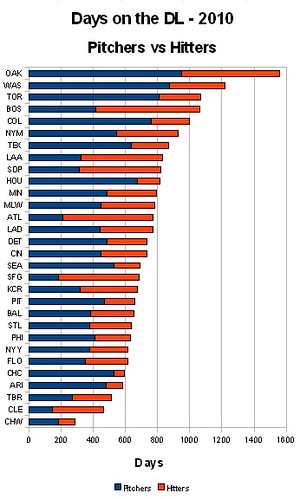
To begin with, here is how each team is broken down by the numbers of days on the DL between when comparing pitchers and hitters:

PitchVsHitDL

The only piece of information that jumped off to me was comparing the days lost by pitchers of the Boston Red Sox and the Arizona Diamondbacks. The Diamondbacks, which lost the 4th lowest number of days, lost more days to pitchers than the Red Sox, which had the 3rd highest total of days lost.

Next, here is a chart comparing the difference in the number of trips to the DL vice the number of days lost for each position:

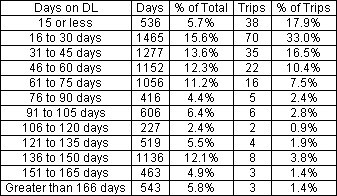
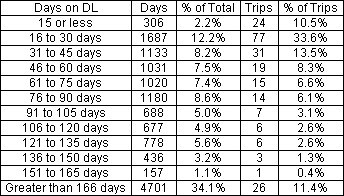
Generally, each position, besides pitchers, loses the same number of days and trips when compared to other position players. When combined, the position players have about the same number of trips to the DL as pitchers. Once on the DL though, the pitchers are more likely to remain on the list for a longer time. This difference can further be seen in the following 2 charts:

Pitchers

pitchersDL

Hitters

hittersDL

The main difference I noticed from the numbers is the high percentage of pitchers than spend >165 days on the DL compared to hitters. Barely any of the hitters on the DL, 1.4%, are out for an entire year, but 11.4% of the pitchers make the longer stay.

For the next installment, I will be breaking down the data by injury type (i.e. strain) or body location (i.e. elbow).


Will Hamilton’s Ribs Hold Him Back?

For more than a month now the Rangers have been without their star center fielder Josh Hamilton. True, he has been back in the lineup every day since October 1, but his presence has been greatly missed. Since his return he is just 4 for 29 with one extra base hit, including 2 for 18 and no XBH in the ALDS against Tampa Bay. It’s natural to wonder, then, whether his ribs are still causing him problems — and further, if those problems will continue to affect him in the ALCS.

Unfortunately, there is no objective way to definitively answer the question posed in the headline. We can look at his swing and we can look at his numbers, but it all leads to educated guesswork. But we might as well go ahead and examine the contributing factors, since Hamilton’s performance will mean a lot to the Rangers’ chances of defeating the Yankees.

The numbers

We have just 32 PA worth of data on Hamilton since he returned from the injury layoff, so there’s not much we can do with it. The sample suggests that his ribs have hindered his performance, but it 1) doesn’t prove that conclusively and 2) offers little predictive information. What, then, can the numbers tell us?

My first thought was to examine Hamilton’s injury history and look for prior rib injuries. On April 22 of last year Hamilton got a day off because of what was termed a ribs contusion. He did pinch hit in that game, and then came back to start in each of the next three games, going 4 for 12 with a homer. He didn’t start the following day, but instead struck out in a pinch hitting appearance. That was the last game he’d play until May 12. The Rangers placed him on the DL with strained ribs.

The two injuries are a bit different. The 2009 injury was a muscle strain, while this year Hamilton suffered two fractured rib bones. Intuitively it seems as though a muscle injury in that area would affect a swing to a greater degree, since much of a player’s power is generated from his core. The fractured ribs certainly cause discomfort, but does that affect the swing to a greater degree? I’m not sure.

In the 67 PA following Hamilton’s return from the DL, he went just 14 for 59 (.237) with six walks (.299 OBP) and nine extra base hits (.542 SLG). So when he made contact the ball went a long way. But he had trouble in general making contact. He struck out 16 times in 59 AB (27%), while his career rate is less than a third of that. he did display a similar tendency in the ALDS, striking out in 1/3 of his AB. Unfortunately, he did not display the same kind of power, as both of his hits were singles.

The scouting

I’ve yet to see a scout, anonymous or otherwise, opine on Hamilton’s swing, so I’m not sure if there is anything noticeably wrong with it. One thing that a few people did note is that the Rays rarely showed Hamilton a fastball in the series. That, compounded with his lack of live action, might have played a part in his ALDS slump. From the Star-Telegram:

Hamilton missed almost all of September because of fractured ribs. While he said he’s not using that as a reason for his struggles, manager Ron Washington believes that might be playing a role.

“Josh hasn’t seen live pitching in a month and he’s up there fighting, and he’s fighting hard,” Washington said. “It’s not an excuse, but he hasn’t seen pitching in a while, and he is facing some pretty good pitching right now.”

The Rays have rarely shown Hamilton a fastball in the series, and when they have, he hasn’t timed it well.

According to the PitchFX data, the Rays threw Hamilton just 17 four-seam fastballs and 13 two-seamers. He saw 24 curveballs, 15 changeups, five sliders, and a sinker as well. Unsurprisingly, he put the four-seamers in play more than any other pitch. But he whiffed badly when challenged with curves and changes.

The match-ups

The only remaining question is of whether this will carry over into the ALCS — which, as stated above, does not have a definitive answer. Hamilton now has 32 PA under his belt since returning, so perhaps he’ll be in a better rhythm when he steps to the plate on Friday. Or maybe the ribs will continue to bother him.

If one thing is for certain, it’s that Hamilton will get no help from Game 1 starter CC Sabathia. He uses his slider heavily against left-handed hitters, and Hamilton will likely see a steady diet of them. He also has a two-seamer with plenty of horizontal movement. It’s in Game 2 that we’ll get a decent gauge of Hamilton’s recovery. He’ll face Phil Hughes, who leans heavily on his four-seamer. By that point we should have a better idea of how Hamilton’s ribs are affecting him.

Josh Hamilton’s condition will play a large part in how the Rangers’ offense fares in the ALCS. The team hit just .253/.286/.437 in its five games against the Rays, and most of that came from Ian Kinsler and Nelson Cruz. They can’t carry the team by themselves. They’ll need their main man, their MVP, to produce against the Yankees. Without Hamilton hitting in the way that he’s capable, the offense could again fall flat.


Rise of The Cutter

You are probably sick to death of the “Year Of The Pitcher” label by now, as it has been trotted out endlessly this year. The lowest scoring division series in history just reaffirmed that we’re going to keep hearing about it, though, and people will continue to speculate as to why the guys on the mound have seemingly grabbed the upper hand in their fight against offense. Looking at the ALCS match-ups, a thought came to me – perhaps the Year Of The Pitcher is due to the Year Of The Cutter.

You can’t watch a baseball game without seeing a guy who recently added a cut fastball to his repertoire. It is undoubtedly the hot pitch in baseball right now, and it will be in full display when the playoffs kick off tomorrow.

What team threw more cutters than any other in baseball this year? The Phillies, at 15.8 percent of their total pitches. In second place was the Tampa Bay Rays, who just lost out to the Texas Rangers – the team that threw the third most cutters in baseball.

Other playoff teams and their respective rank in cutter usage? The Yankees (6th), Reds (8th), Braves (20th), Giants (21st), and Twins (26th). The Giants are the only team among the remaining four that don’t have a starter who uses the pitch, but their caveman-like closer throws it 35 percent of the time.

In fact, nearly half of the starters taking the hill in each LCS will feature the cutter with regularity.

Roy Halladay – 34.2%
Cliff Lee – 19.8%
Andy Pettitte – 20.4%
C.J Wilson – 18.6%
Phil Hughes – 16.4%
Cole Hamels – 14.7%
Joe Blanton – 6.5%

And that’s just the starters. Brian Wilson, as we mentioned, will use it to close out games for San Francisco. Ryan Madson and Chad Durbin both throw the pitch a lot coming out of the Phillies bullpen. The Rangers don’t have any relievers who lean on the pitch, but the Yankees make up for that, giving high leverage innings to Kerry Wood and that Mariano Rivera character, who I’ve heard dabbles with the pitch from time to time.

This is a pretty impressive crop of names, all with one secondary pitch (for everyone but Rivera, anyway) in common. Given the success these guys are enjoying, its no wonder that the cut fastball has become the in vogue pitch of our times. Given that its a relatively new weapon that has risen heavily in usage over the last couple of years, I do wonder if we need to explore its role in the offensive downturn. It’s clearly a weapon that pitchers didn’t use extensively before, and with the best arms in baseball leaning heavily on it, it’s worth exploring whether this one pitch has had a significant impact on the shift in run prevention.


Vladimir Guerrero is Safe at Home

I watched Ron Washington’s Game 5 post game press conference and he stated the following:

We have a very aggressive team, and tonight we took advantage of some things, a ground ball double play Vladimir [Guerrero]. What else do we have to do but come around the bag and keep running? If it’s a double play, the inning is over anyway.

I thought Vlad had slowed down when rounding third base, so I went back and looked at the video to see if Vlad was hustling the entire time to get home or was he waiting to see how the play at first base unfolded.

The video of the play does give a few hints confirming if Vlad was heading home once he left second base as Ron Washington stated or was Vlad looking for some other clue to go home.

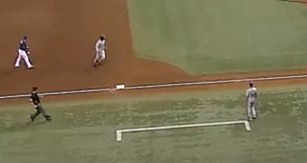
First of all, there was no visual clues that third base coach, Dave Anderson, was sending Vlad home as soon as he left second base (45 seconds into the video).

vladbases1

No arms windmilling- nothing. Anderson simplywalks slowly closer to third base.

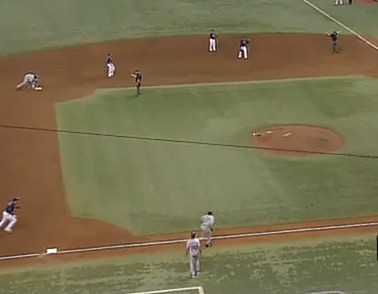
Second, Vlad is not hustling home with 100% effort like Ron Washington mentioned in the press conference. About three steps from third base he begins to slow down to a jog and continues at this pace for few steps after touching third base. During this same time he is watching the play at first base unfold.

vladbases2

Finally, Vlad never actually put his head down and ran home with 100% effort until he saw Kinsler was safe at first base.

I am not sure what event that actually caused him to decide to head home with 100% effort. I first thought he may have been too far off the bag to make it back to third base safely if David Price decided to throw to third base, so Vlad decided to try to score. After watching the video a few times, I think he could have easily made it back to third base.

Maybe it was Texas’s plan to have their runners always round third base on possible double plays with one out and try to score. If this was the case, I think Dave Anderson would have been waving Vlad home once the ball was thrown to first. Instead, both seemed to be watching the the play at first base.

I actually think either Vlad and/or Dave Anderson knew that David Price had a propensity to ignore base runners when covering first base as seen earlier in the game. Once they saw that Ian Kinsler was safe and Price had his back to the play, Vlad headed home to try to score. There is no way from the footage to tell which one made the decision. Anderson was about 6 feet away from Vlad when Vlad decided to head home. He could have easily kept the instructions somewhat quiet in order for David Price not to hear them or Vlad could have made the decision on his own. There is just no way to tell either way for sure.

Ron Washington can claim that Vlad was heading home no matter what due to the Rangers aggressive base running, but I don’t think that is the case on this play. Instead it was a heads up play by some combination of the base runner Vladimir Guerrero and the third base coach Dave Anderson.


Braves Choose Fredi Gonzalez to Replace Cox

As the San Francisco Giants interrupted their celebrations on Monday night to honor the end of Bobby Cox‘s managerial career, the entire baseball world knew it was seeing the end of an era. In 29 seasons – 25 with Atlanta and four with Toronto – Cox won a whopping 2504 of his 4508 Major League games. That figure ranks 4th all-time, behind only Hall of Famers Connie Mack and John McGraw as well as Hall of Fame lock Tony La Russa. Cox also reached a record 16 postseasons, in front of Joe Torre’s 15 and La Russa’s 13. Some would claim that only winning one World Series championship (in 1995) is a black mark for Cox, but I believe that the display of pennants here at Turner Field speaks for itself:

As Cox leaves baseball behind, the Braves will look to continue the run of success achieved under his guidance. They will turn to a former third base coach under Cox and previous Florida Marlins manager Fredi Gonzalez. Gonzalez, 46, has been managing and coaching between the minors and majors since 1990. He earned his first and only prior MLB managerial position in 2007 with Florida, where he remained for three and a half seasons. Gonzalez made it just over 10% of the way to Cox’s win total, compiling a 276-279 record with the Marlins. Gonzalez’s Marlins generally showcased talent but with a limited budget, they couldn’t quite break through in the National League East.

The Marlins fired Gonzalez in June of 2010 in a move that was generally seen as a surprise, even in the Marlins’ clubhouse. Gonzalez had done a decent job with shallow teams. He had also shown an ability to handle a clubhouse, particularly through his careful diffusing of a rift with Hanley Ramirez after the shortstop was benched for lazily pursuing a ball in the outfield in May. Marlins executive Larry Beinfest was extremely vague in his explanation, claiming that the organization “got concerned something was missing.” For whatever reasons, the Marlins decided to move on, replacing Gonzalez with interim manager Edwin Rodriguez.

Gonzalez’s reunion with the Braves was predictable from the start. In the MLB.com article linked above, Braves superstar Chipper Jones declared that everybody in Atlanta “would love to have Fredi back” and that “he knows how things work” around the Braves. Apparently (and unsurprisingly), Jones and the front office were on the same page.

The Braves are coming off a solid season in which they showcased some fantastic young talent, such as Rookie of the Year candidate Jason Heyward and young starter Tommy Hanson. Personally, I think it’s extraordinarily difficult to properly evaluate managers from any point of view, much less from outside an organization, but Gonzalez appears to have a good reputation. With the situation that Cox has left in Atlanta, the playoffs should be a possibility for the near future. Expectations will be high of Gonzalez, as typically happens when a legend is replaced, but the new manager, and more importantly, his talented players, should be up to the task.


Why Having Cliff Lee Start Game 3 Isn’t A Big Deal

When the ALCS kicks off in Arlington on Friday night, Texas won’t have their best player on the field. Because he carried the Rangers past the Rays last night, Cliff Lee won’t start again until Game 3 of the ALCS. Because he’s not comfortable going on three days rest, he’ll only get two starts if the series goes the full seven games. The natural assumption is that this is a big problem for Texas, and gives the Yankees a huge advantage. In reality, it doesn’t matter all that much.

To advance to the World Series, the Rangers have to win four games. Lee will get no more than two starts, so the Rangers need to come out on top in at least two games started by somebody else to win the series. That would be true no matter whether Lee started Games 1+5, 2+6, or 3+7.

Psychologically, I get why 1+5 seems better. He starts two of the first five games, so you’re more likely to get that second start out of your best pitcher. But, it doesn’t change the calculus, really. They still need to win two of the five games he doesn’t start – pitching him earlier in the series just changes the dates of the games they need to win.

Let’s look at this in practical terms.

If the Rangers win three games in the series, then it’s obviously irrelevant – their best three pitchers each took the hill twice.

If the Rangers win two games in the series and lose out in Game 6 with Lee only taking the hill once, it will seem like they were significantly disadvantaged by only throwing him a single time, but the reality is that they wouldn’t have won the series no matter what. If we assume the Game 6 loss in this scenario, having Lee pitch an extra time would have only served to push back the date of the presumed loss to Game 7. Winning to earn Lee another start comes with the same requirement as winning Game 7 after Lee gets you there – a couple of wins from someone else in the rotation.

That is the requirement for the Rangers to win the ALCS, regardless of the order they pitch in. The task is the same, either way.

The other argument I’ve heard is that having Lee go in Game 1 and Game 5 would allow him to pitch in relief in Game 7. While that is true, he can still come out of the bullpen as the Game 3/Game 7 starter – he’d just do it in Game 1 on Friday night instead.

He pitched on Tuesday, and starts again on Monday. Friday is a natural throw day for him between starts, where he’d have had two days off to recover and another two days before his first ALCS start. In fact, it’s the exact same situation they would have faced when using him in relief in Game 7, where he’d be throwing with two days off after his prior start.

Whether its start in Games 1 and 5 and relieve in Game 7 or relieve in Game 1 and start Games 3 and 7, the overall effect is essentially the same. Having their rotation jumbled won’t present a significant disadvantage to winning the series. It just moves their must win games up by a few days.


FanGraphs Audio: Playoff Preview Pod, Vol. 2

Episode Forty-Nine
In which the panel is invective-ridden and error-laden.

Headlines
New York/Philly Rule, Minnesota/Cincinnati Drool
Roy Halladay vs. Tim Lincecum vs. Cliff Lee
Crippling Self-Doubt: Discuss
… and other pathos-inducing contretemps!

Featuring
Dave Cameron, Full-Time Employee
Matt Klaassen, Resident Philosocator
Joe Pawl, Our Man in NYC

Finally, you can subscribe to the podcast via iTunes or other feeder things.

Audio on the flip-flop. (Approximately 35 min play time.)

Read the rest of this entry »

00:35:52

FanGraphs Chat – 10/13/10