Archive for Daily Graphings

J.J. Picollo Addresses the Royals’ New Direction

J.J. Picollo
Jay Biggerstaff-USA TODAY Sports

The Kansas City Royals have made forward-thinking changes in recent months, most notably in the managerial chair and at the highest level of their front office. The latter preceded the former, with J.J. Picollo taking over from Dayton Moore as the team’s top decision-maker in late September. Six weeks later, Picollo hired Matt Quatraro, who had been the bench coach for the Tampa Bay Rays, to replace Mike Matheny as manager.

Another impactful decision was announced this week. In want of a more-analytically-minded pitching coach, Picollo brought on board Brian Sweeney to fill the role that had been held by Cal Eldred. Previously the bullpen coach for the Cleveland Guardians, a team with a well-earned reputation as a pitcher development machine, Sweeney is seemingly a perfect fit for a Kansas City club looking to move away from a reputation of its own. Long seen as an old school organization, the Royals are, by all appearances, becoming more progressive.

Picollo, who now holds the title Executive Vice President and General Manager, talked about the team’s new direction during last month’s GM Meetings.

———

David Laurila: You’ve addressed this previously, but it’s nonetheless the best way for us to start: Given that you worked alongside Dayton Moore for many years, what will differ philosophically with you in charge?

J.J. Picollo: “Culturally and fundamentally, there will be a lot of similarities, because it’s just baseball and how you run an organization. That said, we want to be a little more open-minded to different ways of improving our roster, and utilizing our roster. Player acquisition… a lot has been made about being transactional, but I think that can be overstated. When you’re transactional, you’re just trying to make your team better. If it makes our team better, then we’ll be transactional.

“More than anything, hiring Matt Quatraro, with the way he thinks… he’ll be creative. I think that will be developmentally healthy, especially for our younger players.”

Laurila: How does he think? Actually, let me phrase the question this way: What did he say during the interview process that sold you on hiring him?

Picollo: “A lot, but more than anything, he was able to communicate what his thoughts were. You could just see, in some of the exercises we went through… for instance, how he would put lineups together. Obviously, a lot of that is based on matchups and how you want to use matchups. Also, the idea of using our bench was very clear; it’s something he’s not going to be afraid to do. Another was putting pitchers in situations where they can succeed yet develop at the same time. He was able to explain his processes really well.” Read the rest of this entry »


Alek Manoah’s Steamer Projection Is a Feature, Not a Bug

© Nick Turchiaro-USA TODAY Sports

For the most part, projection systems fall in line with public perceptions of players. Yordan Alvarez is going to be very good next season, but Raimel Tapia won’t be. Shohei Ohtani is the eighth wonder of the world, and so on. But once in a while, they produce a head-scratcher that becomes the subject of debate. This leads to a lot of takes, some of them good but many of them bad. The worst are variations of “Projection X thinks poorly of Player Y, whom I like, and therefore it must be illegitimate.” They’re sometimes funny to read, though they’re mostly annoying because they stem from a fundamental misunderstanding of what projection systems are trying to achieve.

Let’s cut to the chase. The reason I’m writing about this is because Steamer projects Alek Manoah, who placed third in Cy Young voting and served as the Blue Jays’ ace, to put up a 4.09 ERA next season. That seems outlandish, even with the knowledge that projection systems are conservative by design. Manoah isn’t just a one-season wonder. His excellence extends back to his rookie campaign in 2021, and his sophomore effort seemed like a natural progression. The narrative is there: A great starter blossoms into a phenomenal one. Asserting that Manoah will go from an ERA in the low 2.00s to one in the low 4.00s is more or less a rebuke of it.

Of course, Steamer doesn’t think Manoah will land precisely on a 4.09 ERA – more on that later – but considering it’s the expected middle outcome, the shock is understandable. And while I’m not here to endorse it, I do want to point out that it’s not an indication the system is broken, or holds a grudge against your favorite player. You have your reasons, and so does Steamer. Read the rest of this entry »
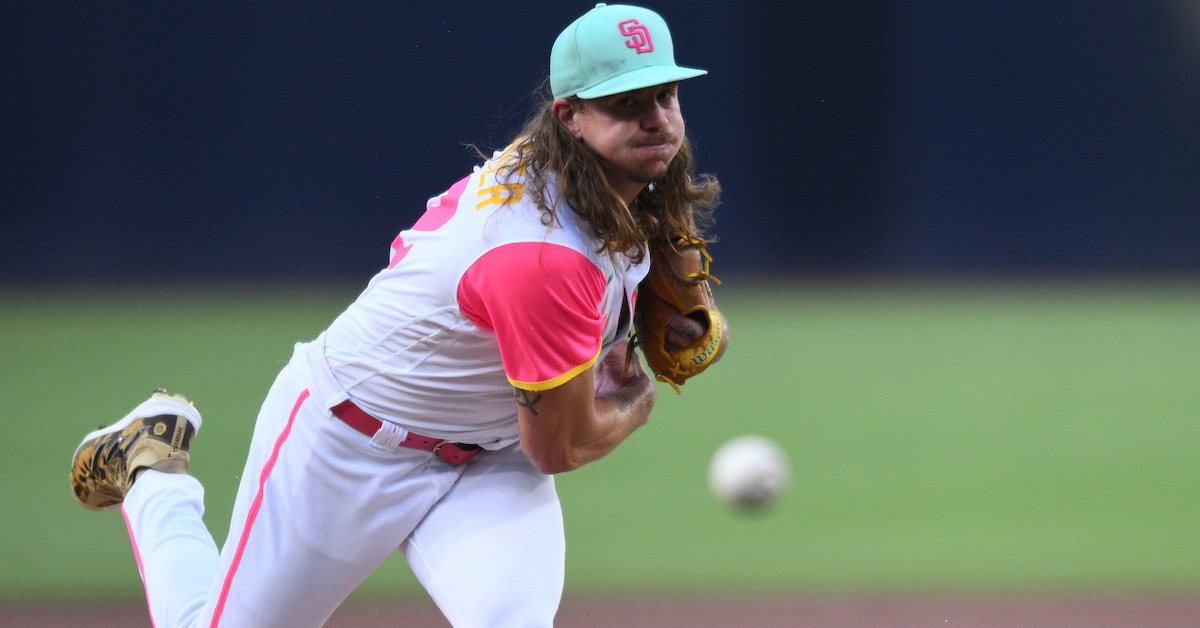

Who Got Lucky in the Outfield?

Mookie Betts
Michael McLoone-USA TODAY Sports

You might want to buckle up. This is an article about small sample sizes, so there’s a statistically significant chance that things are about to get rowdy. It was supposed to be an article about which outfielders are better or worse than you’d expect them to be based on their sprint speed.

Just for fun, here’s the chart I started with. I turned Outs Above Average into a rate stat I’ll call OAA/150. It’s a player’s OAA per 1,350 innings, or 150 games. (I tried several other metrics, dividing by chances instead of innings, and working with UZR and DRS range metrics. This worked best for my purposes.) The sample is 544 outfielder seasons in which the fielder had at least 50 chances on balls with a catch probability below 96% (hereafter known as starred chances). I’ve labeled the two players who stood out the most in either direction in 2022.

Daulton Varsho good, Andrew Vaughn catastrophically bad. No surprise there, but I love charts like this, thick at the bottom and thin toward the top. They show how many paths there are to each outcome. Speed is a big component of OAA; the correlation coefficient of the two is 0.54. But outfielders also need to get good jumps, make plays at the wall, and be able to run down balls in all directions. There are lots of different combinations of skills that can land you in the bottom or middle of the chart. To get to the top, you need to be good at all of them. You also need to be lucky. Read the rest of this entry »


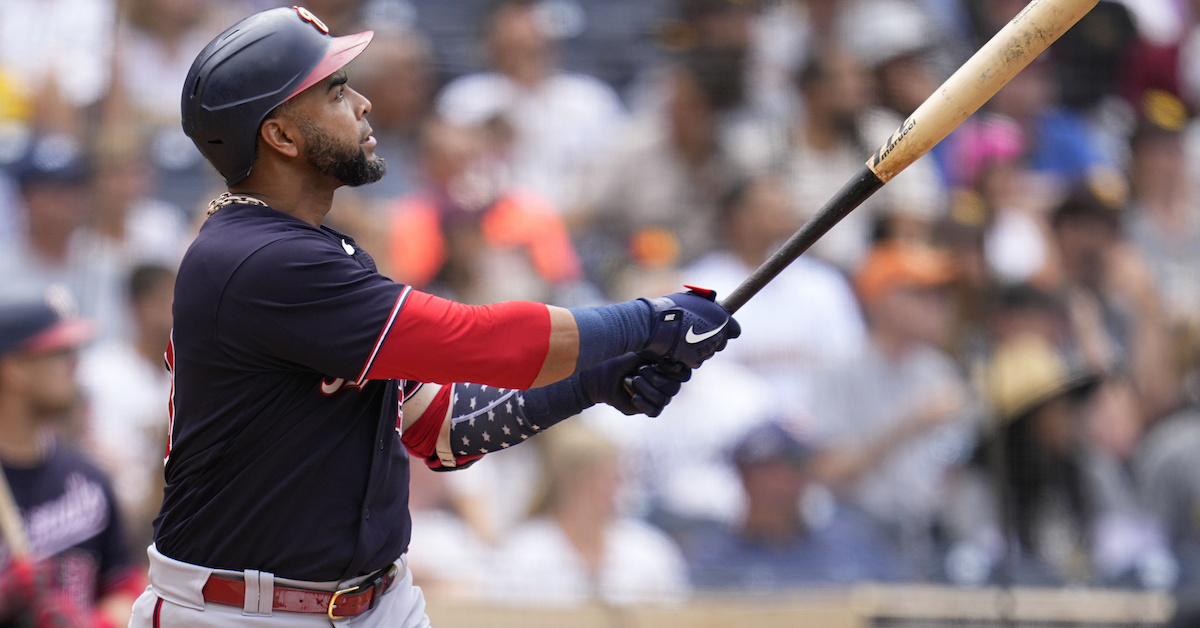
Nelson Cruz Has 13th-Percentile Sprint Speed. Can He Outrun Time?

Nelson Cruz
Ray Acevedo-USA TODAY Sports

The youths are everywhere you turn — loitering at the mall, hanging around in parking lots, playing catcher for the Mets. I’m serious: On September 30, Francisco Álvarez became the first person born after 9/11 to appear in an MLB game. The iPod is older than Álvarez. And it gets worse; there’s a pretty good chance that Andrew Painter, who was born in April 2003, will pitch significant innings for the Phillies next year.

This trend of increasingly younger people being allowed to play professional baseball is troubling to say the least. But it is only a trend, and not a universal dictate. There are a select few graybeards left in the game trying to hold back the tide. If a GM wants to hand a few million dollars to a player who’s too old to spend it all on vape pens and ring lights, there is an option on the free-agent market. A man who’s not only old enough to buy cigarettes, but who was also old enough to buy cigarettes back when they cost $3 a pack. A man so old the Grim Reaper followed him around for a while until he told the Grim Reaper to get off his lawn. An active player who, years after the retirement of Eric Young, Jr., played in the majors alongside Eric Young, Sr.

That’s right: Nelson Cruz. A man who straddles the line between Gen-X and Millennial like the Colossus of Rhodes. At 42 years old, he is the oldest position player on the market. And despite nods at retirement — next spring, he’ll be the GM of the Dominican Republic national team at the World Baseball Classic rather than its DH — Cruz wants to play in the big leagues in 2023. Read the rest of this entry »


Meatballs, With a Chance of Clouting

© Kevin Sousa-USA TODAY Sports

“He made a mistake, and Trout made him pay.” No doubt you’ve heard some version of that sentence countless times. Maybe the announcers called it a hanging slider, or a meatball, or any number of other ways of describing a poor pitch. But what exactly does it mean, and how can you know one when you see one?

I’ve discussed that question with my colleagues frequently, but we’ve never come up with a satisfactory answer because the pitches that get classified as mistakes aren’t always intuitive. Sometimes a pitcher hits the inside edge of the zone, only for a hitter sitting on just such a pitch to unload on it. Sometimes a backup slider ties up the opposing hitter. There’s bias to these observations, too: You’re far more likely to remember a pitch that gets clobbered for a home run than one that merely results in a take or a loud foul.

I still don’t have a definitive answer. I did, however, make an attempt at answering one very specific form of the question. One pitch that really does feel like a mistake, regardless of intent and irrespective of circumstance, is a backup slider over the heart of the plate. Spin a slider wrong, and it morphs into a cement mixer, turning over sideways without movement. Leave one of those middle middle, and the result is a slow and centrally located bat magnet. Read the rest of this entry »


The Dodgers’ Confidence in Shelby Miller Is Undeniable

Shelby Miller
Orlando Ramirez-USA TODAY Sports

Pitch shape is a sticky trait. And I don’t mean sticky in the spider tack way; rather, sticky in that the trait would hold year over year without volatile fluctuation. When evaluating a small sample, teams and analysts must decide what traits are worth betting on and which are just potential blips in a player’s profile. Depending on the team, there are varying levels of confidence in assessing that predicament and turning it into action. In the case of the Dodgers, there is a demonstrated confidence in their assessments that leads them to take on some risk, but they have no issue in turning that risk into a realized success.

The latest instance of that came on Tuesday, with Los Angeles reportedly agreeing to a contract with veteran pitcher Shelby Miller. The deal is a major league contract, assuring that he’ll be a contributor in the Dodgers’ bullpen from day one. That probably came as a big surprise. Miller hasn’t pitched that much in the last five years after struggling with injuries and sub-par performance. But he isn’t the same pitcher he once was, which we saw in his brief 2022 stint with the Giants, where he posted a 26.1% whiff rate on 57 fastballs thrown and showed off a semi-new slider that made an appearance in 2021 but seems to have been refined. Read the rest of this entry »


Michael Wacha on Evolving as a Pitcher (But Keeping His Bread and Butter)

Michael Wacha
Kirby Lee-USA TODAY Sports

Michael Wacha is, in many ways, the same pitcher who broke into the big leagues with the St. Louis Cardinals in 2013. The changeup is still his best weapon, and his fastball velocity has remained in the 93–95-mph range throughout. The 31-year-old right-hander has changed teams a few times, but he’s largely kept the same identity.

There have been tweaks to his repertoire and pitch usage. That’s inevitable over the course of what has been a 10-year career, one that will continue will a team yet to be determined. Following seven years as a Cardinal and subsequent one-year stints with the New York Mets, Tampa Bay Rays, and Boston Red Sox, Wacha is now a free agent. He’s hitting the open market on a high note; in 23 starts comprising 127.1 innings last season, the Texas A&M product went 11–2 with a 3.32 ERA.

Wacha discussed his evolution as a pitcher on the final day of the 2022 regular season.

———

David Laurila: To varying degrees, all pitchers evolve. How many times would you say you’ve changed over the years?

Michael Wacha: “From my rookie year, I’d probably say… a couple of times? But I don’t know. I mean, each year I’m trying to work on something different to help out my repertoire, to bolster it or make it better. So it’s kind of hard to say, but there have been a couple of changes.”

Laurila: Can you give any examples? Read the rest of this entry »


The Nationals Bet on Volatility with Jeimer Candelario

© Jay Biggerstaff-USA TODAY Sports

The Nationals aren’t going to make the playoffs in 2023. They probably won’t even sniff .500; unsurprisingly, the team that traded Juan Soto along with everything that wasn’t nailed down this past season isn’t quite ready to compete for division titles. That doesn’t mean they shouldn’t try to get better, though – when the next generation of Nationals stars reaches the majors, the team would prefer to have some major league pieces already in place, mirroring the vaunted Cubs and Astros rebuilds of the 2010s. To that end, the Nationals made a signing I absolutely love yesterday, snagging Jeimer Candelario on a one-year deal worth $5 million, with $1 million in incentives.

Before the 2022 season, no one would have believed you if you told them Candelario would be a free agent this winter. In 2020 and ’21, he hit a combined .278/.356/.458, good for a 125 wRC+. He backed that up with decent defense at third base; all told, he looked like a comfortably above-average player carried by his bat. Then came 2022, an abject disaster; over 124 injury-interrupted games, he hit .217/.272/.361 and saw pretty much every statistical indicator tick downwards. The Tigers chose to release him rather than go through arbitration, which MLB Trade Rumors estimated at roughly $7 million.

For the 2020 and ’21 versions of Candelario, that would be a bargain. Quite frankly, I still think it would make sense after his poor 2022 season. The Tigers didn’t share my assessment, valuing the combination of money and roster space as more important than retaining his services. I’m not quite sure I understand it – they currently have two open spots on their 40-man roster and no in-house third baseman – but their loss was Washington’s gain. Read the rest of this entry »


South Siders Look for Upside in Mike Clevinger Signing

Mike Clevinger
Orlando Ramirez-USA TODAY Sports

The White Sox dipped into the free-agent pool this week with their first significant move of the offseason, agreeing to terms with righty Mike Clevinger on a reported one-year, $12 million deal. For the soon-to-be-32 Clevinger, it represents an opportunity to reestablish himself as a reliable mid-rotation starter after struggling to do so with San Diego in his return from his second Tommy John surgery in 2022. For the White Sox, it means adding a relative unknown with some upside to a talented and extremely right-handed rotation featuring 2022 AL Cy Young finalist Dylan Cease, a pair of veterans in the possible last years of their contracts in Lance Lynn and Lucas Giolito, and a 26-year-old Michael Kopech, who is trying to stay healthy for a full season himself after an early-career Tommy John surgery of his own.

The move comes as a bit of a surprise this early in the offseason, with much of the starting pitcher market yet to be sorted out. The reported $12 million value of the contract is a chunk of change higher than both our crowdsourcing and Ben Clemens predicted at $8 and $9 million, respectively. There’s a lot of starting pitching out there in November, including a handful of veterans coming off strong years that might be available for a one-year contract at or around $12 million. Corey Kluber contributed a productive season in Tampa this year, as did Michael Wacha in Boston, though he may require a second year of commitment. Andrew Heaney has generated enough buzz early that he might push that budget, but he’s available. Johnny Cueto was the second most valuable pitcher on these very same White Sox, with 2.4 WAR over 158.1 IP, but at age 36 would likely come at a similarly reasonable rate. So why did Chicago instead jump the market for Clevinger? Read the rest of this entry »


Count Got Your Tongue? Consider the Breaking Ball

Charlie Morton
Dale Zanine-USA TODAY Sports

Falling behind in the count puts an enormous amount of pressure on the pitcher. It’s in his best interest to throw a strike and retake control, but knowing this, hitters are more likely to swing. Aiming outside the zone is dicey: It’s great if the hitter bites but disastrous if he doesn’t, and the risk generally outweighs the reward. A pitcher would ideally execute a borderline strike that hitters can’t help but pass up, but that’s easier said than done. Navigating this situation is tricky, and just from a numbers perspective, whoever’s on the mound is pretty much always in trouble. The question isn’t “can the pitcher emerge victorious,” but rather, “Can he escape with minimal harm?”

For decades, pitchers have relied on their fastballs to fight these uphill battles. Part of that is because long ago, some of them actually believed throwing a slider or another secondary pitch wasn’t very manly. You ain’t tough unless you blow a 2–0 heater by your opponent, I guess. But really, it’s because a fastball is the pitch a majority of pitchers are comfortable with, and it’s the one they can most reliably lob in for a strike. If your goal is to equalize the count, why risk using an erratically moving curveball to achieve it?

Unfortunately for those old-timey hurlers, they’re probably rolling in their graves at the apparent cowardice of modern pitchers. Rather than adhere to axioms, pitchers today are challenging notions of what’s “right” or “wrong” in pitching, aided by advancements in pitch- and body-tracking technology. One example of such sacrilege is the continuously increasing rate of breaking balls — sliders, curveballs, and the like — thrown in disadvantageous counts:

It’s true that breaking ball usage is up no matter the count or situation, but I find it particularly interesting that the trend remains strong even when pitchers fall behind. The name of the game is optimization. If teams didn’t think opting for breaking balls when behind in the count granted them an advantage, we wouldn’t see this happening. Granted, just because teams do something doesn’t necessarily means it’s effective, but a league-wide jump of eight percentage points in pitch usage is significant and worthy of investigation. Read the rest of this entry »