Archive for Daily Graphings

Jacob deGrom Might Be Blazing His Way To Cooperstown

Given their blockbuster trade for Francisco Lindor and Carlos Carrasco, their additions of James McCann and Taijuan Walker, and their projected first place NL East finish, the Mets already had plenty of buzz about them this spring. As if they needed more, their best player, Jacob deGrom, has provided some during the Grapefruit League season by reaching triple digits with his fastball velocity. On Tuesday against the Astros, his heater reportedly reached 100 mph 11 times on the stadium scoreboard, topping out at 101 on a pitch to Alex Bregman.

This is nothing new for the 32-year-old righty, who hit 100 in his first outing of the spring on March 6, the same day he was named the team’s Opening Day starter. Statcast wasn’t available for that outing or his March 11 one (both of which also came against the Astros in a spring where travel restrictions limit the pools of exhibition opponents). Here’s a look at deGrom’s upper-level readings from Tuesday:


Read the rest of this entry »


Four Bold(ish) Predictions for the National League

Hot takes are famously a huge part of the sports industrial complex, but here at FanGraphs, we’re not very good at them. I took a crack at some American League bold predictions yesterday, but honestly, they were pretty bland. Picking the relative fortunes of a bunch of good-but-not-great teams? Boring. A top prospect might be Rookie of the Year? Boring.

Today, I’m going a little further. If the last takes were jalapeños with some seeds removed, these are serrano peppers. I said I’d be ecstatic hitting half of my predictions from yesterday; today I’d be pleased with one in the first three (the fourth one is relatively unadventurous). As always, these aren’t my median predictions, merely corner cases that I think are being undervalued. Will they happen? Probably not. But they could, and I don’t think people are giving them enough credence. Onward! Read the rest of this entry »


Stetson Allie Has Come Full Circle, and at Age 30, He Looks Legit

Stetson Allie was undergoing a transformation when he was first featured here at FanGraphs in April 2013. A second-round pick by the Pittsburgh Pirates three years earlier, the burly right-hander was being converting from a pitcher to a position player. Initially, that went well. Allie raked in A-ball, prompting us to feature him again, this time in interview form, in February 2014. As noted in the introduction, he’d morphed into “a corner infielder with plus raw power and a lot of swing-and-miss.”

The pendulum wasn’t done swinging. Much as Allie’s high-octane fastball had been erratic, his ability to make consistent contact was found wanting as he climbed the minor-league ladder. Midway through the 2017 season, Allie — by then in the Los Angeles Dodgers system — was moved back to the mound.

Fast forward to the present day, and Allie is in camp with the Tampa Bay Rays, looking every bit like a viable arm out of a big-league bullpen. In five spring-training appearances, the 6-foot-2, 245-pound flamethrower has tossed five hitless innings, with six punch-outs. The only blemish on his stat line is five free passes. Read the rest of this entry »


Let’s Hear From Three Padres Pitchers

Chris Paddack, Emilio Pagán, and Drew Pomeranz are all a big part of the Padres’ plans this season. The latter two promise to play prominent roles in the San Diego bullpen, while Paddack will be counted on to bounce back and further fortify what looks to be a fearsome starting rotation. Here are snapshots from recent conversations with all three, the first of which was prompted by a question from a member of the San Diego media (apologies for not recalling who posed it), and the others coming via inquiries by yours truly.

———

Chris Paddack took a step backwards in 2020. Coming off a rookie campaign that saw him log a 3.33 ERA over 26 starts, the 6-foot-4 right-hander struggled to the tune of a 4.73 ERA, and an even-uglier 5.02 FIP. He threw plenty of strikes, issuing just 12 walks over 58 innings, but all too often they got whacked. Looking back, Paddack has a pretty good idea of what led to the crooked numbers.

“Being a taller pitcher on the mound, my biggest success is when I’m north to south,” Paddack said earlier this spring. “Last year I was east to west. I was pulling off. My spin direction was outside of one, for y’all that know the baseball term of that. The axis of the baseball… I was getting two-seam run on my four-seam fastball… So, I [looked at] a lot of video from 2019, and well as 2018 in the minor leagues, really breaking down some of my mechanics on my front side. The term I use is ‘staying grounded as long as I can with my legs,’ and letting my upper body pinpoint a strong direction to whoever it is I’m throwing to that day.”

Per StatCast, Paddack’s four-seam spin rate was 2170 rpm last year, versus 2230 in 2019. His vertical ride decreased by 2.1 inches, while his horizontal increased by 2.2 inches. Velocity-wise, he threw two ticks harder, going from 93.9 mph to 94.1 mph. The 25-year-old Austin, Texas native doesn’t profess to be a pitching-analytics nerd, but he’s clearly begun dipping his feet into those waters. Read the rest of this entry »


Mikolas, Kim Injuries Put Cardinals’ Shaky Rotation in Spotlight

It’s a race that currently means nothing because it hasn’t actually begun, but at this writing, the Brewers have inched ahead of the Cardinals in our projected NL Central standings, albeit by a whopping 1.3 wins, 82.1 to 80.9. It’s the kind of thing that happens as we tweak the playing time inputs based upon spring training-related news and updated assumptions, but it’s a reminder that the gap between the two teams — or really, the Central’s top four, including the Cubs (projected for 79.5 wins) and Reds (78.1 wins) — is very small. Any edge could be the difference between snagging a division title or sitting at home in October, particularly given the unlikelihood of the division generating a Wild Card participant.

In that light, the Cardinals’ rotation rates as a moderate concern, at the very least. Last year, the unit entered the season projected as the majors’ 16th best in terms of WAR, but St. Louis soon took significant hits. Just before the pandemic-delayed season got underway, the team lost Miles Mikolas for the year due to a flexor tendon strain that required surgery and Carlos Martinez to a COVID-19 diagnosis after one turn amid a season-halting outbreak, then wound up losing Dakota Hudson to Tommy John surgery late in the year. The Cardinals made the expanded playoffs in spite of their rotation, which tied for 19th in the majors (and placed 11th in the NL) with 3.1 WAR and delivered a 3.86 ERA and 4.55 FIP, with Adam Wainwright as their only starter to deliver more than 0.6 WAR, and that in his age-38 season.

Like the vast majority of teams, the Cardinals appeared as though they would benefit from a dip into the free-agent market for some rotation fortification. Yet they sat on their hands for most of the winter before re-signing Wainwright to a one-year, $8 million deal, and otherwise eschewed any outside help. They kicked the tires on James Paxton, Taijuan Walker, and Jake Odorizzi, but despite saving money elsewhere — particularly by declining Kolten Wong‘s $12.5 million option, cutting Yadier Molina’s salary (from $20 million to $9 million via his new one-year deal), and flat-out stealing Nolan Arenado from the Rockies in exchange for five bodies of varying warmth while getting Colorado to pay the entirety of his $35 million 2021 salary ($20 million of it deferred) — they watched each of those starters sign elsewhere.

And so the Cardinals head into battle with basically the same rotation as before, minus Hudson. The unit is again projected to rank in the middle of the pack, 14th in our Depth Charts at 11.3 WAR. Yet already two starters are dealing with minor injury issues, and it’s tough to ignore all of the various question marks.

Read the rest of this entry »


Four Bold(ish) Predictions for the American League

Most of the time, I don’t like to make predictions. For one thing, they’re hard! The amount of public information out there is borderline overwhelming. Beating the wisdom of the crowd isn’t easy, particularly when the crowd is using fancy models and copious batted ball data to be wise.

The other big problem with making predictions is that they’re usually wrong if they’re bold. That’s the nature of the game — a bold prediction can’t be the majority of the probability mass, or it wouldn’t be bold. How fun can it possibly be to read a list of things that probably won’t happen?

Well, hopefully very fun, because I’m going to make some this week. These aren’t going to be completely wild guesses, of course, because I do have some idea what I’m doing, but I’m not expecting to go 100% on these. If I go two for four, I’ll definitely call that a win. These are merely the synthesis of some observations that I’ve made over the past year or so, sprinkled with a little bit of boldness dust where necessary to make them exciting instead of milquetoast. Read the rest of this entry »


What Did Teams Pay per Win in Free Agency?

How do projected wins translate into salaries in free agency? That’s a fundamental question that front offices have to answer and, in fact, have had to answer ever since free agency opened up baseball’s labor market after the 1976 season. No, no GM back then was using Wins Above Replacement or fancy-pants computers spitting out ZoRPs or Stonker projections. But decisions are always based on some kind of projection, whether that exercise is explicit or not. When Grizzled Greg the GM went after a player for X hundreds of thousands of dollars after the 1976 season, he was still estimating how the player would play in the future and whether that benefit was worth the cost. Heck, I’ve never made a taco-based projection system. Still, when I see a taco, I’m projecting whether or not the DAR (Deliciousness Above Refrigerator) is worth the dollars that will be debited from my bank account.

Naturally, one of the ways we estimate player salaries has been a linear relationship between dollars and wins above replacement. There’s still a debate over whether player salaries should be treated in this way. Many analysts have argued that the price of wins should not be linear because of the efficiency of getting a lot of wins from a single player. After all, there’s a limit on roster size and utilization; you can’t just sign five one-win first basemen and combined them into a horrifying amalgamation whose twisted, fear-inducing form approximates a Freddie Freeman season. And even if you could, I wager that the MLBPA would file some kind of grievance about players being used for twisted medical experimentation. Well, at least players on the 40-man roster.

Matt Swartz is probably the most prominent advocate for the opposite view, that worrying about whether to add a four-win player instead of a pair of two-win players don’t really come up in the real world all that often. I’ve come to side more strongly with the majority in recent years than I used to, simply because I believe — though I can’t prove it conclusively — that good teams are becoming better at not leaving as many obvious holes. For teams like the Rays, Dodgers, and Padres, as well as other teams that prize serious depth, replacement level is probably higher than replacement level. Read the rest of this entry »


Maikel Franco and Orioles Finally Find Each Other

It’s the third week of spring training games, and the Orioles have added a new starting third baseman who’s been available since December: Maikel Franco, seven-year big league veteran with Philadelphia and Kansas City. Baltimore’s roster construction has hardly changed in that time, and I doubt Franco and his career 1.03 WAR/600 needed to be humbled out of demanding a hefty multi-year contract. Both parties have known their situations for months, but are only just now finding each other. This is an odd transaction. Let’s try to unpack it.

It isn’t as though the deal doesn’t make sense. Baltimore’s incumbent at the hot corner is Rio Ruiz, who has gotten a majority of the team’s starts at third base since the O’s claimed him off waivers before the 2019 season and who’s showed some modest fence-clearing ability, hitting 21 homers in 617 plate appearances. But his overall offensive profile is mediocre: His 90 wRC+ in 2020 stands as his career best. At 26, he’s exhausted much of the faith people had in him as a prospect, and his Statcast data doesn’t suggest there’s anything exciting hidden under the surface numbers. Ruiz’s value might top out at less than one WAR, and he entered camp running virtually unopposed for the starting job.

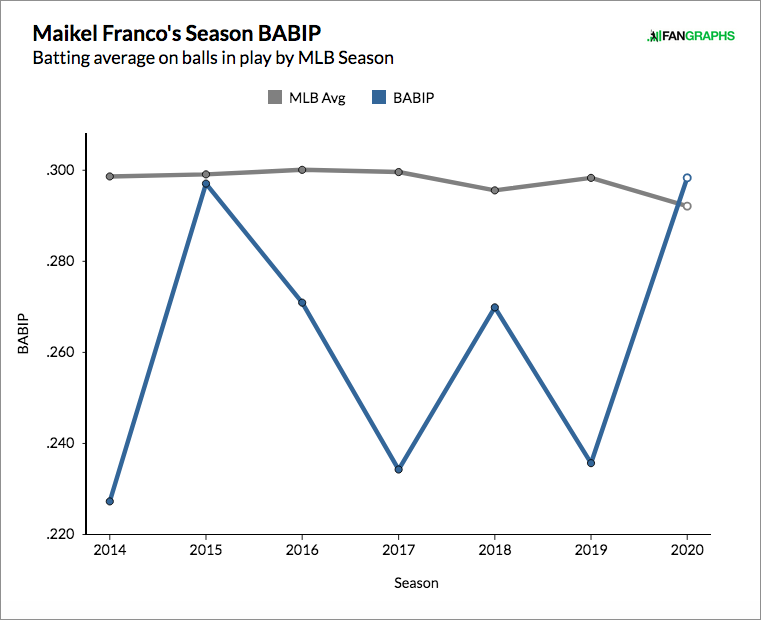
Enter Franco, who signed a change-of-scenery deal with the Royals in 2020 after a disappointing tenure in Philadelphia and turned in his best season in years, hitting .278/.321/.457 with eight homers, a 106 wRC+ and 1.3 WAR. That value placed him ninth among all third basemen, just ahead of peers like Eugenio Suárez and Brian Anderson. The bump in Franco’s production didn’t come from some random explosion in power numbers or a big jump in walk rate, though. He just finally got a normal distribution of balls in play to land for hits.

Read the rest of this entry »


Brendan Rodgers Clobbered a Grounder

Spring training games get silly quickly. By the time the veterans have hit the showers, it’s time for raw prospects and reclamation projects to duke it out. So unless you’re a Carlos Estévez fan or a Padres loyalist, you probably didn’t see this live:

That home run, hit by Joshua Mears, is the hardest-hit ball of spring training so far — or, it was before a Giancarlo Stanton line drive yesterday that I’m totally ignoring for the purposes of this article. At 117.3 mph, it would have been one of the hardest-hit balls in the entire 2020 season. Laser beam home runs are fun to watch, though it’s a good thing a kid made a backhanded catch, or a reclining couple might have caught a baseball with their bodies.

Even if you didn’t see it live, you might have seen MLB Pipeline tweet about it. Failing that, maybe you read about it on MLB.com. Homers, especially smashed ones that show off Statcast, tend to make the rounds. Home runs are big business, and they get reported as such.

What you almost assuredly don’t know is that the previous inning, someone hit the third-hardest-hit ball of the spring (well, fourth now — thanks, Stanton). Feast your eyes on 115.6 mph of pure… well, pure groundball single to shortstop:

Surprisingly enough, MLB.com didn’t write an article about that one. This won’t be on any highlight reels for the year. And yet, that’s the hardest-hit tracked batted ball of Brendan Rodgers’ career. Given that he’ll be playing in the majors this year and Mears will be on a bus in some city you’ve never heard of, the grounder was more meaningful to this major league season. Read the rest of this entry »


Let’s Hear From Four Pirates Pitchers

The Pittsburgh Pirates have a lot of questions to address regarding their pitching staff. With the regular season just two-plus weeks away, final decisions have yet to be made on starter and bullpen roles alike. Candidates abound on both fronts, particularly the latter, with an addition and an injury-induced subtraction further muddying the waters in recent days. Here are snapshots from four conversations — three recent, and one somewhat older — with pitchers who could figure prominently in the team’s plans.

———

Left on the cutting room floor from an interview I did with JT Brubaker at the conclusion of last season was what he said about his two breaking balls. The 27-year-old right-hander considers his slider his best secondary. He’s thrown it since his senior year of high school, and it’s firm. At 86.7 mph (per StatCast), it registered as the 11th-hardest among the 58 pitchers who worked at last 40 innings and had the pitch in their arsenal. Brubaker told me that while it sometimes registers as a cutter, he always considers it a slider.

Eric Longenhagen had written in his 2020 prospect profile that Brubaker’s “relatively new” curveball was his best secondary pitch. I asked the righty what might have prompted that opinion.

“Possibly the analytical side of it,” surmised Brubaker. “It’s something I’d put in the back pocket, then brought back out. I’m always been able to throw a curveball, but I’ve never been fully consistent with it.”

The pitch had actually gone into his back pocket at the bequest of the organization, as they wanted him to focus on his slider. He eventually pulled it back out in need of “something with a little more velocity separation between my changeup and slider, something in the lower lower spectrum to slow the batters down more.” Read the rest of this entry »